
Art & Science of Space Masterclass (AASOS)
A 3-Step System to design Urban Spaces
Three buildings, three places
[ Two Archetypes ]
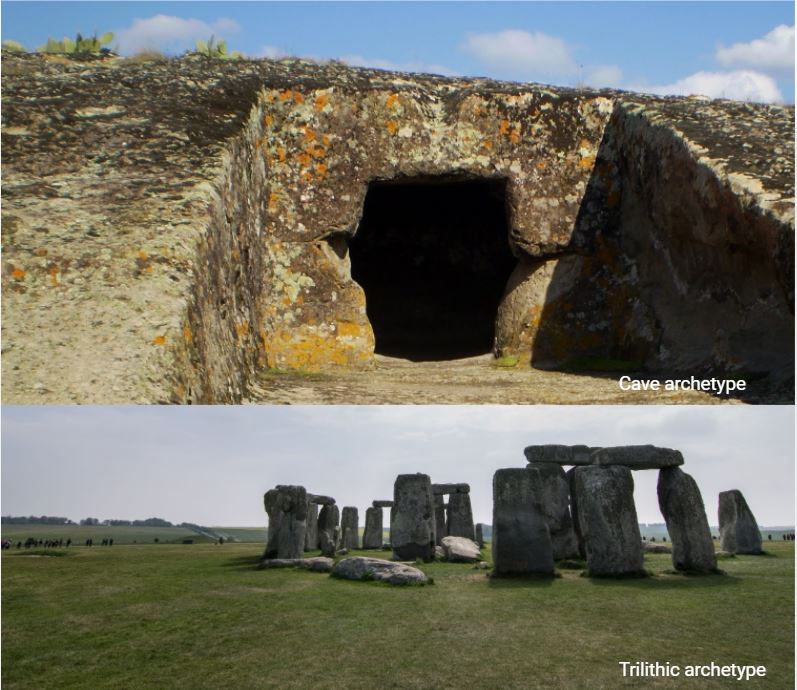
Img 2: Two Archetypes of structures in history: Genna Salixi - Domus de Janas & The Stonehenge (Credits- Cristiano Cani/Antonio Lamielle)
The architecture of buildings and urban spaces can be investigated from a mutual relationship between solid and void; the external space defined by solid objects and the internal space understood as void. The exterior and interior space: Trilithic archetype and Cave archetype The oldest evidence of places built and inhabited by men is an expression of these two archetypes.
Through the Symbol, architecture enters the domain of the unconscious, giving shape to archetypes that reproduce - through forms - the "deep structures" drawn from history and nature.
In the course of time a language of structures developed through these archetypes, which predominantly makes a structure complete in both functionality and aesthetics. There are six principles of this language that can define one or more aspects of any built structure.
[ Linguistic Principles ]
The following linguistic principles breakdown the development of the two archetypes and serve to apply a method for architectural design that relates to history on a structural level.
1. Space as an object- The trilithic archetype
The architecture of archaic and classical Greece conceives space as an object, as a modular module in its basic form: the trilithon. The buildings are separate objects in the space of the acropolis and the agora, in relation to the surrounding natural landscape. The architecture of the modern movement re-proposes, almost exclusively, the archetype of the external space, of architecture made up of objects in the void.
The main features of “space as an object” are:
A. Accurate distinction of the elements of the building, sculptural appearance of the architectonic object: Elements as well as the main structure is clearly visible.
B. Accurate distinction of the buildings between them and diagonal anti-perspective viewpoints: For instance; In a settlement of South Albinia the isolation of individual dwelling buildings do not construct a continuous and compact building image like that of many historical centres in the Mediterranean area. It gives an obvious distinction.
C. The closure of forms into a stereometric figures: Different elements creating a solid form. For eg: Saqqara pyramid and the Geodesic dome.
D. The use of the module as a technique and as a method: A module/structural framework created by a method. For eg. Proportions of the Doric order by Andrea palladio’s theories or the proportions of the modular man by Le-Corbusier.
E. The predominance of the exterior space over the interior and the relationship between the building and the natural landscape.
2. Space as a whole and articulation by elements- The Cave Archetype
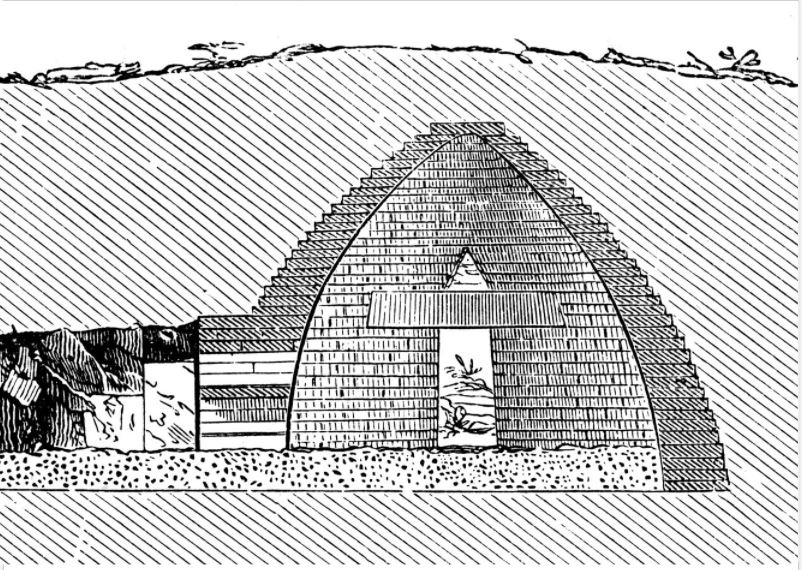
Img 6: Atreus Tomb, Greece- Space as totality (Credits-Wikipedia-Commons)
The lesson of this principle is commonly understood both as architecture of the totality, of the strong and unitary space. With greater emphasis on the interior, and as architecture of articulation, repetition, architecture of autonomous elements; close together, interpenetrating, rotated and, in any case, integrated with each other.
Architecture by elements was revived in the modern era thanks to Louis Khan, and after him this linguistic research spread and continued with the work of Ando, Mayer and Gehry.
The main features of “space a whole and articulation by elements” are:
A. Space as a totality : The archetypal principle of the cave emphasises the interior space as an empty space, clearly separated from the exterior, a space in which the continuity of the constituent elements merge into an organic form.
B. The search for synthesis: The definition of an Element is as a figure in possession of a totality, that leads to surpass the reductive principle which considers the plan as the only generator of the spatial system.
In constituting terms it has defined the supremacy of the Plan-pattern which, with its repeatedly, originated the typology of Multiplan, with evident indifference to internal spatial articulation.
C. The sense of totality of interior spaces: The interior vaulted structures and their material/technology creates sense of continuity and totality of spaces, from vertical element to horizontal one.
D. The sense of totality of the complex articulations built by elements: The sense of architecture for Elements derives from the dispersion of built-objects, fragments closed in themselves, equipped with a specific destination of use, a space that is seperate from the built object but internal to its system, rather than just constructional elements that connects casually.
[ Architecture by Elements ]
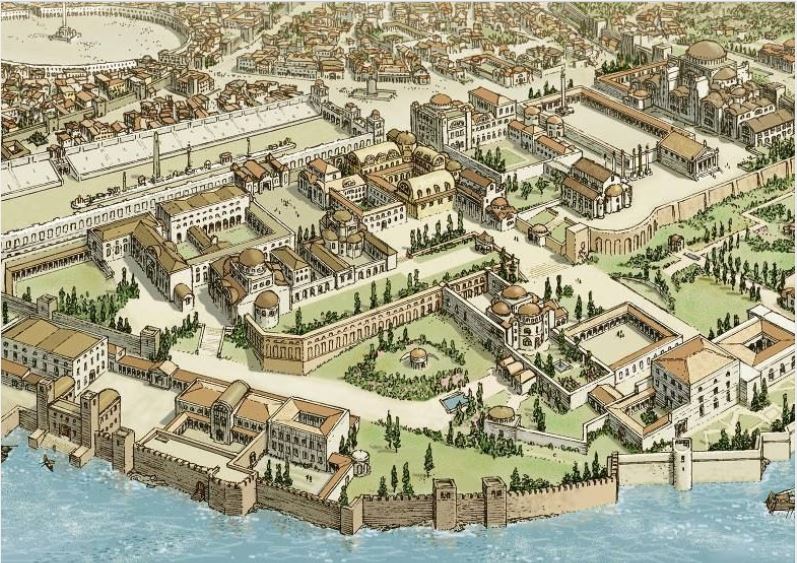
Img 10 :City of constantinople as a formation of elements/objects(Credits-Oliver Frey)
The values in architecture as elements express themselves as linguistic principles and come forwards as specific spatial organized structures: shapes. These shapes become tools to establish an architectural syntax, the most difficult thing to be defined during the architectural configuration process.
Thus presence of more than one language in the same architecture is certainly possible, but it can only develop as a growth of several coexisting languages. The purpose of a competition after this course is to activate not only an emotional relationship with history, but also to investigate in depth the ancient-present relationship. The exercise will help to rediscover values and anchor contemporary research in architecture to a past that must be viewed as alive and vital in today’s context.
[ Brief ]
The challenge for this exercise is to select images of any three buildings and three places, and with no information other than your own observations describe the linguistic principle you recognize in the images and write a short essay on it.
The essay has to be of 100-300 words (three to five paragraphs). The participants need not worry about the proper architectural and historic terminology; one can use ordinary descriptive language. The goal of this assignment is to produce a detailed linguistic analysis based on your careful observations of the features of the linguistic principles. There are no restrictions to historical period, style, placement, type of representation of the photographs, draws, sketch, etc. Although the images need to be ensured that they are copyright free or you own their rights.
In this challenge in form of words, one has to speculate what the similarities and differences between the buildings convey about the relationships of the buildings to their sites and to their eventual inhabitants. Pay attention to the proposed features: find one or more of those features in your selected image/architectural style.
In addition to the essay represent with drawings, diagrams, and any other graphic representation, what you already have expressed in words. Use the images you have selected to highlight the specific linguistic principle.
NOTE: There are endless examples from which you can select your images; often, there are different linguistic principles coexisting in a building or place. In this competition focus on one specific principle only.
Similar Competitions
Discover competitions you might be interested in


A Global Graduation Competition for Architecture, Urban Design & Interior Design


Aesthetic Design Ideas for a Better World · Student Category
