
EHC - Arctic
Extreme Habitat Challenge '20
OVERVIEW

Img 1: Introduction to Extreme Habitat Challenge 2019.
Habitat Challenge
Extreme Habitat Challenge 2019 is pleased to invite architects, designers, engineers, student fraternity, and visualizers from around the globe to take part in its second edition of Arctic Habitat Challenge. The Extreme Habitat Challenge (EHC) is one of the world’s most coveted competitions for habitat design. It recognizes exceptional ideas that redefine habitat design through the implementation of innovative ideas, techniques, construction, visual, programmatic and futuristic organizations through architecture as a tool.
EHC embarks itself on technological and engineering innovations which are about to go big and sets architecture free to innovate more in these uncharted directions. It is a one of its kind platform that promotes the relationship between the habitat + technology + planet. The challenge aims to create habitat environments that defy the adverse conditions through design and make them habitable. In its outlook, EH challenge endorses teams that are multidisciplinary by thought but are aligned to the fact that humans have to grow more, yet responsibly towards the planet.
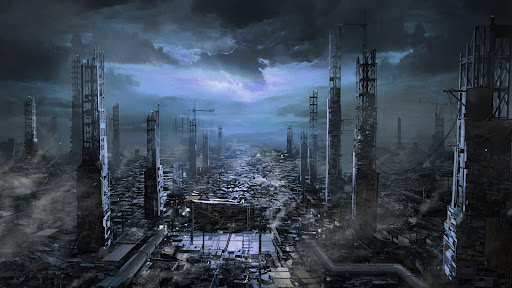
Img 2: Dystopian future of our habitats, which have outgrown its capacity- A concept
Premise
As our cities grow, there are severe impacts visible to the quality of life due to overpopulation - poverty - traffic - pollution, etc. Weather changes are becoming more rampant. Limitless population growth of population ultimately contradicts the motive of moving to the city, where people instead of experiencing a better quality of life face the contrary throughout. With a non-stop growth of the human species, we will eventually see more of these circumstances and vulnerabilities unavoidably in the long run.
Cities cannot be overhauled overnight. But our cities changed, with the advent of the industrial revolution and technological development. Technology is the fastest agent of change today has almost displaced the need of living in a city - including repercussions like social isolation between people of today.
A new layer of evolution has begun, which brings in technology to resolve man-made disasters. Faster transportation techniques and connectivity + collaboration have made it possible to look beyond the boundaries of cities. Through this challenge, we take this opportunity to build a more responsible class of habitats that can be small but can be definitely inspiring for our next change of cities to come.

Img 3: Hyperloop passing through extreme habitat - A concept
Design challenge
The Arctic Bridge is currently used as only a seasonal sea route, which if developed could serve as a major trade route between Canada and Russia. Due to global warming, the rapidly melting glaciers are giving way to new shorter routes across the Arctic. Climate changes at such a scale can herald a new era of cargo shipping around the top of the world. An inevitable future of the planet is paving way for an economically potential idea. The Second Edition of Extreme Habitats Challenge competition chooses two major cities (Vancouver, Canada x Moscow, Russia), connected via the fastest mode of land-bound transit of the future - Hyperloop that embodies the arctic bridge route to open avenues for trade across the arctic ocean.
Design Challenge and Vision: Extreme Habitat Challenge pushes to explore habitat concepts that are responsible, yet brave to grow human civilization in synchronous with nature + technology + habitat + planet.
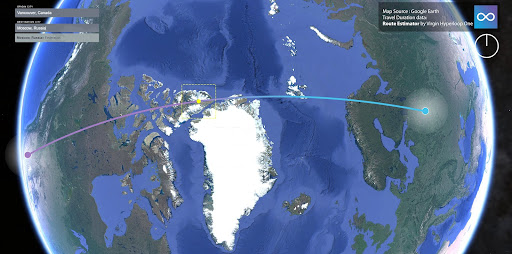
Img 4: Conceptual route of Hyperloop from Vancouver to Moscow
The Route
The route with a distance of over 8200 km, is claimed by Virgin Hyperloop One to be covered in less than 10 hours, with minimal challenge, emissions and time savings. The challenge chooses this route as a test case for Extreme Habitat Challenge 2020, which passes through Ellesmere Island as the selected extreme environment for a potential habitat.
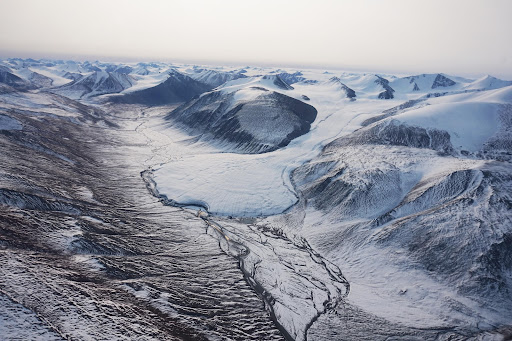
Img 5: A view of Ellesmere Island Glaciers - by Darthmouth Strausslabs
Brief of the competition
The challenge is to design a concept habitat of 1,000 people within an area of 800 m x 800 m, which is able to develop itself to accommodate a population of in future 1,000,000 as desired by the population moving into the place.
The challenge invites ideas that push the boundaries of habitat design using innovative habitat working models, materials, technology, close to zero land costs, a nomadic yet rooted lifestyle. When humans enter extreme habitats they not only respect nature or the forces of nature but they enter with responsibility.
This design challenge exercise can be considered similar to colonizing new earth with the technology of today taking into account the atrocities of extreme cold habitat and conditions required for a feasible living and complete habitat. The challenge urges the first 1,000 people to prototype the habitat that will house all the three elements of human life in it - Live, Work and Play.
This site challenge s peculiarly with a very less human population density is the test bench for designing a new habitat that will inspire how life should be in similar environments while balancing itself harmoniously between forces of human habitat and nature.
Objectives
The objectives for the challenge can be a point of beginning to conceive this design. Participants can assume their own contexts and users for the habitat before initiating their design process.
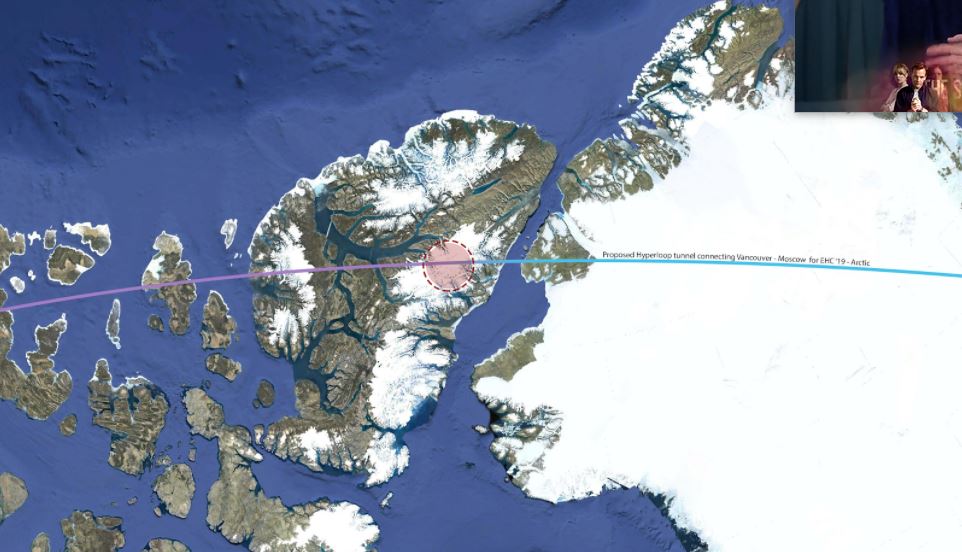
Img 6: Map showing a probable region for Hyperloop Station of the Arctic Route for this challenge
Location - Ellesmere Islands
The Hyperloop Station for this route is expected to be built in Ellesmere Island located at the approximate center between the two cities, which is speculated to house a very sparse population in the future. The region in red depicts a potential habitat zone for this challenge, where this prototype micro-ecosystem can find its place. Participants have to place the site boundary inside the red circle region on a preferred location not exceeding more than 800m X 800m. The challenge programme can be schematically derived from functions like habitat, workplaces, or commercial districts, public and private areas, community farms etc. based on the objectives.
- Location: Ellesmere Island
- Countries in the region: Northern Canada, Greenland
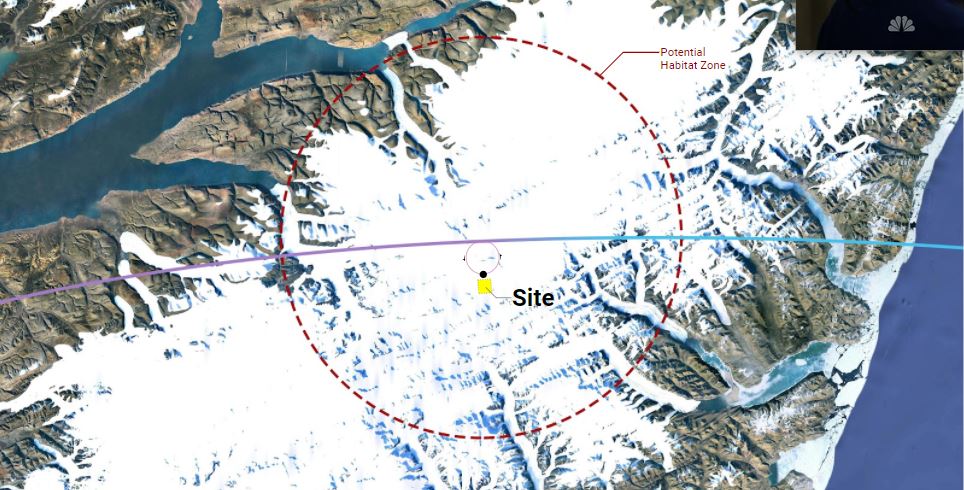
Img 7: Map showing Potential Habitat Zone , with Hyperloop station and site
Potential Habitat Zone
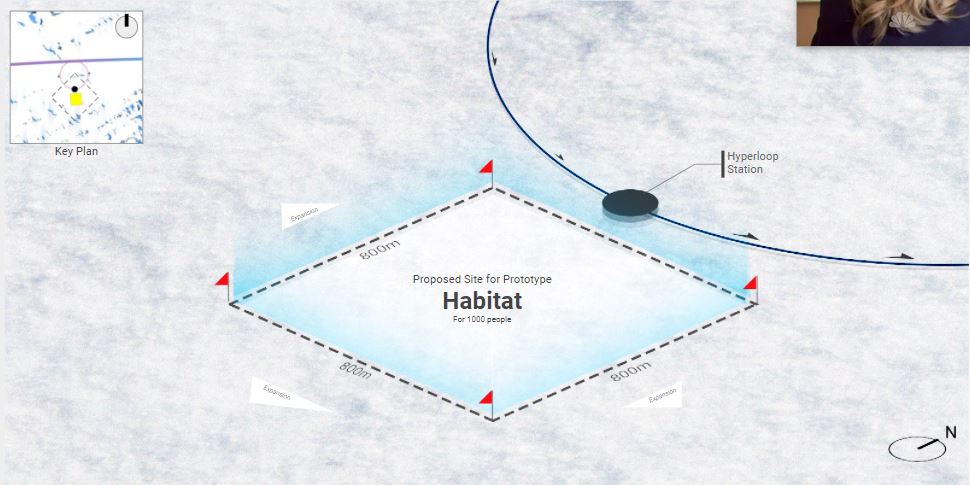
Img 8: Proposed site area for Prototype habitat.
Site
This is an illustrative image of the site boundaries and their placement with respect to the Hyperloop station. The prototype habitat site of 800m X 800m, will hold the primary population of 1000 people after which the development is intended to happen incrementally. The expansion plan vision is limited to a population of about 1,000,000 (figure for quantitative assumptions), to ensure habitat does not grow beyond safe limits and impact the ecosystem unknowingly. This expansion plan can be illustratively explained conceptually in future planning of the habitat.
You can assume data like demography/user group etc. wherever necessary while solving this problem.
Judging Criteria
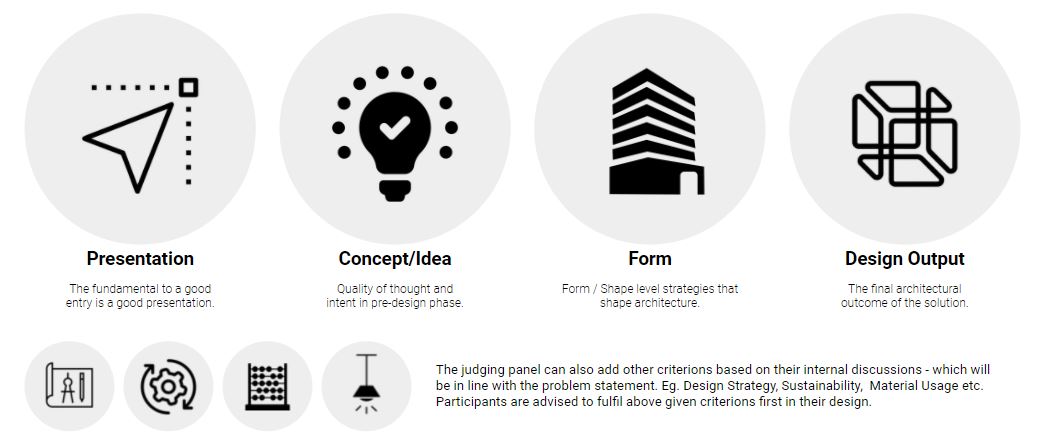
The challenge entries will be judged by an international jury of the competition on the following criteria:
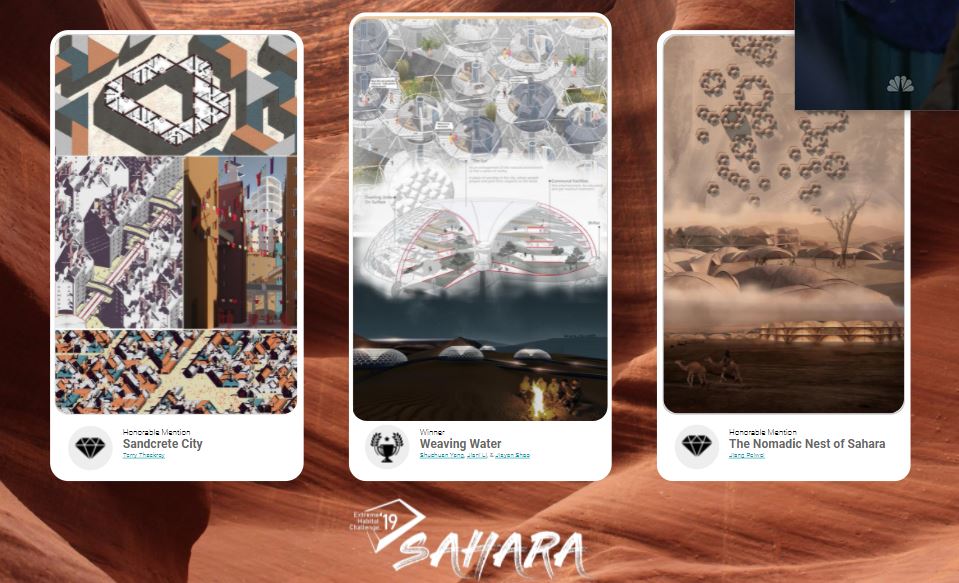
Winning entries of Sahara Edition
These are the best of the previous edition of Extreme Habitat Challenge - Sahara. These entries are one of the most outstanding submissions that brought exceptional merit in terms of their idea, visualization and architectural strategies. Discover the last edition’s brief here and the winning entries.
FAQ for the challenge
Q: Does the design scope includes designing a hyperloop station too? Can we do that of our will?
A: The design problem only includes the habitat design. Even a block massing of the hyperloop station will suffice for indication.
Q: Can we choose the site outside the region across the red circle which depicts the potential habitat zone?
A: No. The site selected has to be inside the red marked region.
Q: What is the population I should design this habitat for?
A: Habitat module should only be for a population for 1000. The next goal should be scalably increase (1,000 > 10,000 > 100,000 > 1,000,000) the same/similar module to a population cap of 1,000,000.
Q: What kind of ideas required for this challenge?
A: This is an open ideas design challenge. Instead of too practical, the challenge invites logical solutions which make use of technological resources of today + tomorrow and innovate freely beyond limiting factors.
Q: Can I make use of speculative technologies (3D printing, Dropship Supply, Robotic construction, etc.) in my proposal?
A: Yes. You can.
Q: How do I gather terrain data of my site selected + geographic/climatic details of Arctic without going there?
A: The terrain data can be easily extracted via google earth pro if required (https://www.google.com/earth/download/gep/agree.html) using the following guide: https://support.google.com/earth/answer/148134?hl=en.
Q: Do I need to learn about the functionality of Hyperloop to participate in this competition?
A: A basic research will definitely help. However the habitat is the primary focus of this competition instead of mediums to reach the habitat.
Q: Can submit a previously made habitat project for this competition?
A: You can. Until the competition conditions are met, you can submit the project.
Q: What are the byelaws for the site?
A: There are no bye laws but they will be framed by climate and your planning for the site. This does not mean that you have to propose regulations, but this will reflect in the future expansion plans (if any) are there.
About Extreme Habitat Challenge
Extreme Habitat Challenge (EHC) serves as a unit block for UNI in the field of resilient habitat design. It intends to break the fusion of traditional design barriers and methodologies by making it a platform for experimentation. EHC aims at creating ecosystems that are benchmarks of how cities could be or should be in future. With a faster transit and a more connected world, the need to stay rooted at one location will go away and futures will be more mobile. However, this power should not be exploited at the cost of the planet.
EH challenge finds its place in its vision of a more sustainable and responsible future. It is a research initiative dedicated to providing opportunities for designers from all domains to explore ideas that go beyond the boundaries of architectural discipline and enrich our built environment; thereby opening up possibilities for the promotion of architectural thought in extreme conditions.
Queries: support@uni.xyz
Discover other competitions: https://uni.xyz/competitions
Facebook: https://www.facebook.com/unixyzglobal/
Instagram: https://www.instagram.com/uni.xyz/
Discover FAQ’s about this competition on our help forum here: http://help.uni.xyz/