
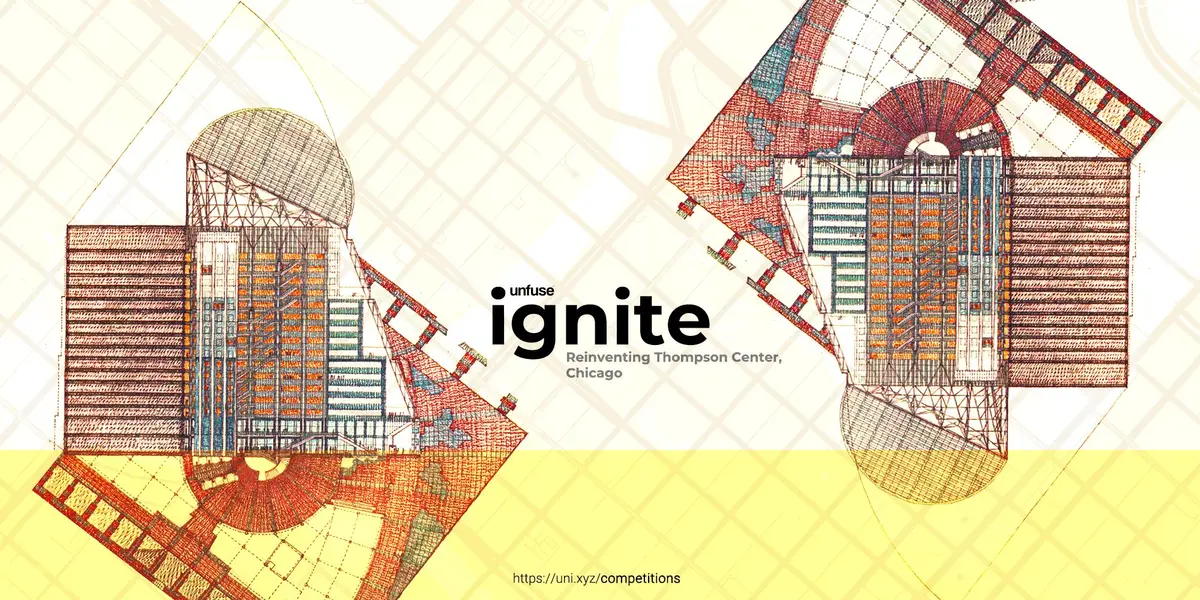
Ignite
Reinventing Thompson Center design challenge
OVERVIEW
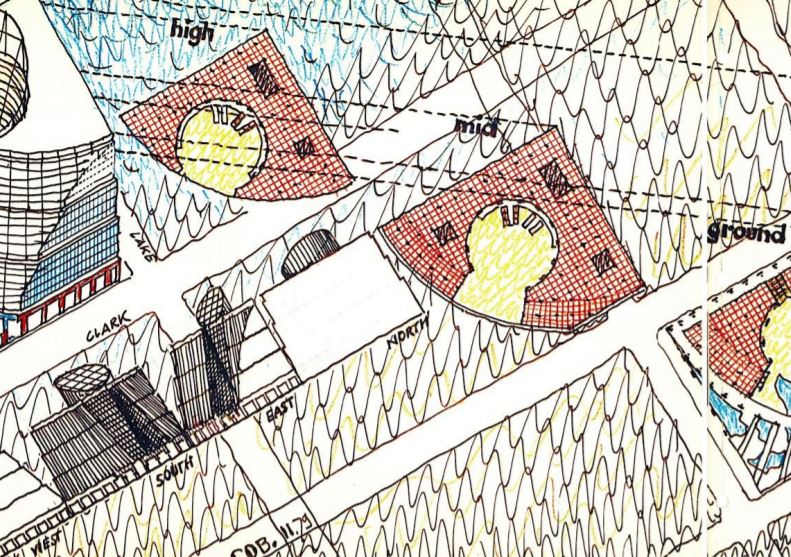
Img 1a: Concept illustration of Thomson Centre by Helmut Jahn
Premise
A beautiful idea or evocative image may stir our imagination more than an object, a building, or even an entire city. Yet, it is materiality that constitutes the great power of architecture, its ability to turn a physical building into a truly transcendental experience.
Let’s think of how to improve buildings that we already have rather than, as often happens, raze them to start new ones from scratch. And when it comes to dealing with recent buildings, yet unprotected by a landmark status, there is a lot of freedom as far as how they could be transformed.
One of the most iconic buildings in Chicago, James R. Thompson Center is a case in point. Illinois state government’s decision to sell it for new development puts this 35-year-old gem of late-20th century architecture in great danger. The only way to save it is to reimagine it.
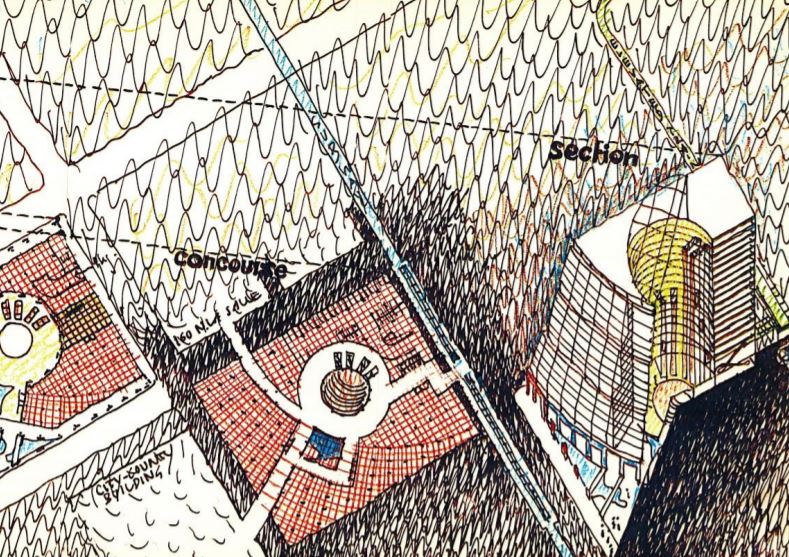
Img 1b: Concept illustration of Thomson Centre by Helmut Jahn
Fabula
Built in 1985, Thompson Center occupies the entire urban block in Chicago’s Loop area defined by W Lake, N LaSalle, W Randolph, and N Clark streets. It was designed by Chicago’s most renowned living architect Helmut Jahn.
Home to offices of the Illinois state government, the building is a unique civic gesture and one of the grandest public spaces in America, Chicago’s Pantheon, if you will. Nicknamed a starship for its futuristic shape, this 17-story steel and color-glass structure is a primary example of both High-Tech and Post-Modernist styles of the highest caliber. It is a symbolic building, a contemporary take on traditional state capitol.
Apart from state offices, the domed building with its remarkable 160-foot-diameter rotunda, energized by moving escalators and glass-enclosed elevators, comprises Chicago Transit Authority train station, basement-level cafeteria, and commerce.
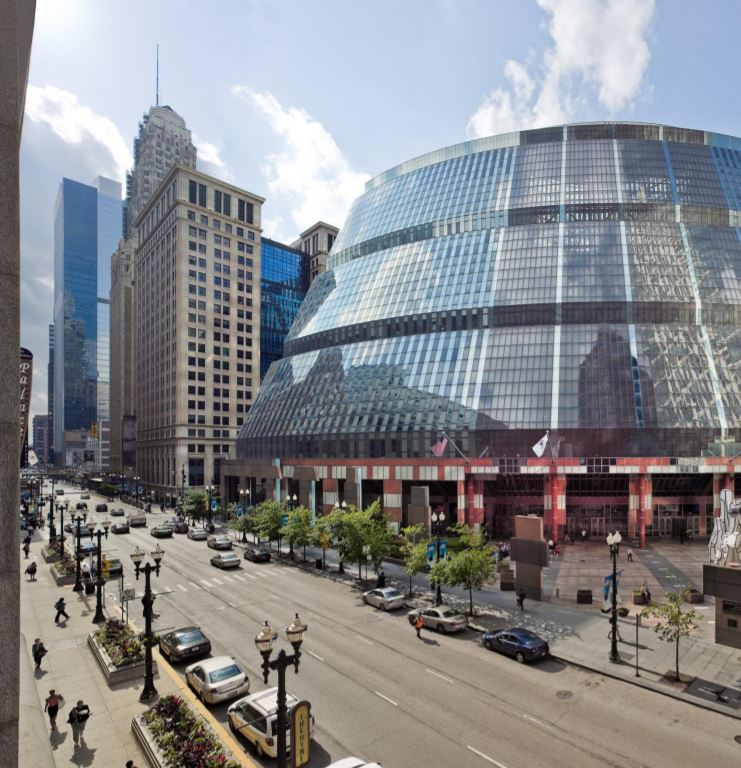
Img 2: View of the Thomson Centre from Street - Rainer Viertlböck
Conflict
It is quite clear that the Center’s original ambition to create a truly grand civic space was a mismatch with its limited function from the outset. Occupied primarily by bureaucrats’ offices the building was not accessible to the public after working hours and on weekends. The government’s vision was never idealistic enough and, as a result, was destined to fail due to the building’s high maintenance cost, exacerbated by years of neglect.
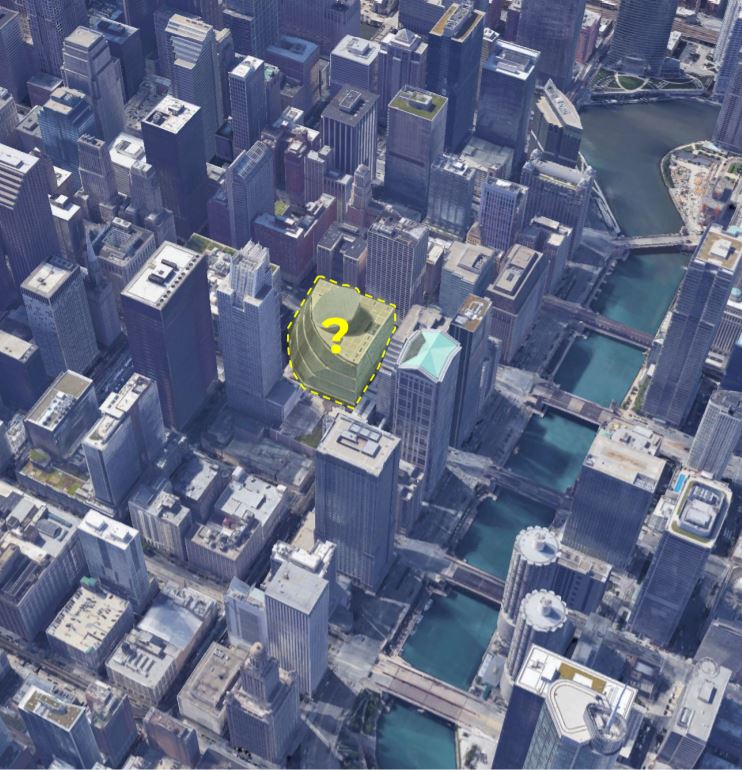
Img 3: Aerial view of Thomson Centre in its urban context - Source: Google Maps
New Future
But imagine a much more resourceful program in the very heart of Chicago, the architectural capital of the world – with the government offices out of the picture, the space could be entirely repurposed through soaring expansion, diversified by introducing such functions as headquarters for major IT companies, workshare spaces for start-ups, event spaces, museums, galleries, hanging public gardens, retail, restaurants, observatory, hotels, condos, and more.

Img 4: Helmut Jahn - Architect of Thomson Centre, Chicago
Endorsement
In 2015 we proposed to repurpose the Thompson Center with the addition of a tall hotel-condo tower to meet the market to come. I propose the doors to come down, so the atrium becomes a public place with upgraded retail and restaurants. The new space no longer belongs to the state of Illinois; it belongs to the people of Chicago.
The original vision of Governor James R. Thompson and the architect to make the building a symbol for the openness and transparency of the state government, an active urban center in the city, and a lively urban and public place has not been upheld by the administrations that followed. The building has not been maintained or repaired, the retail lacks style and attraction.
The best way to save the building is to improve it by making it the most exciting place in the city, with around-the-clock activities. One important aspect of this project would be to enhance the idea of public space. The ground floor would be opened up at the plaza level to make the atrium a true public space. The architectural history is full of examples where adaptive reuse and repurposing has brought new life to similar structures. It is the only way this building will survive and become a landmark for the 21st century.
Helmut Jahn, July 2020
Orginal Architect, Thomson Centre,
Chicago
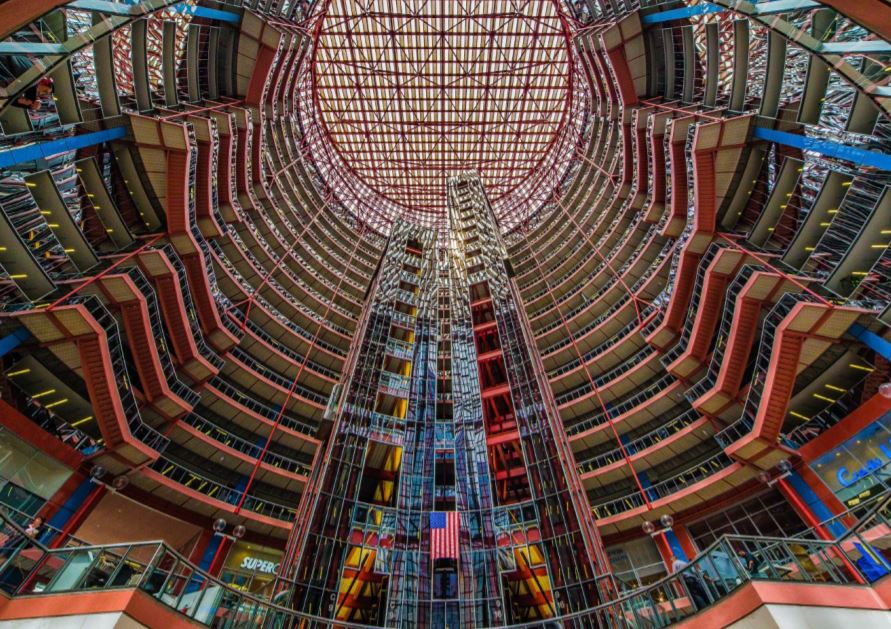
Img 5: Thompson Center Atrium
Brief of the competition
The competition participants are asked to develop a new vision for the Thompson Center, as a creative hub in the center of Chicago.
There is no guidance on how much of the existing Thompson Center should be preserved, but it is encouraged to keep the original rotunda space, as a nucleus for the new Center. Both height and depth limits for this project are suspended. The real constraint here is your own imagination. You are the architect and you have to convince your potential client to implement your speculative scheme, to which this eventual new owner may be aspired by.
The existing glass-and-steel structure comprises 1.2 million sq. ft. of space and in order to make the new complex feasible, proposed schemes should plan for at least 2.5 million sq. ft. of space.
Submissions should include a short statement with a breakup of program outlines, plans, key section, and renderings.
Objectives


Adaptive Reuse: The project should look at reusing what’s already there - In parts or full.
Public Space: The project should sustain the feature of being public oriented at parts of project.
Hanging Gardens: Promote green spaces on multiple levels.
Vertical Living: Create a holistic vertical living for its residents.
You can propose residential, commercial, administrative, leisure all kinds of usages that seem fit to you for this project. The above objectives are some factors you should consider while building your project.
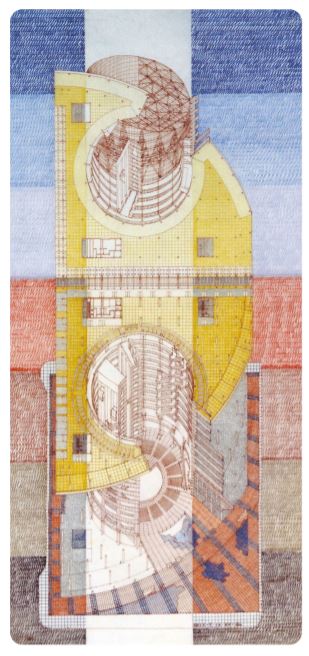
Img 6: Drawings Thompson Center
Drawings by Helmut Jahn for the Thompson Center emphasizing the rotunda atrium and its relation with the plans, elevation and section.
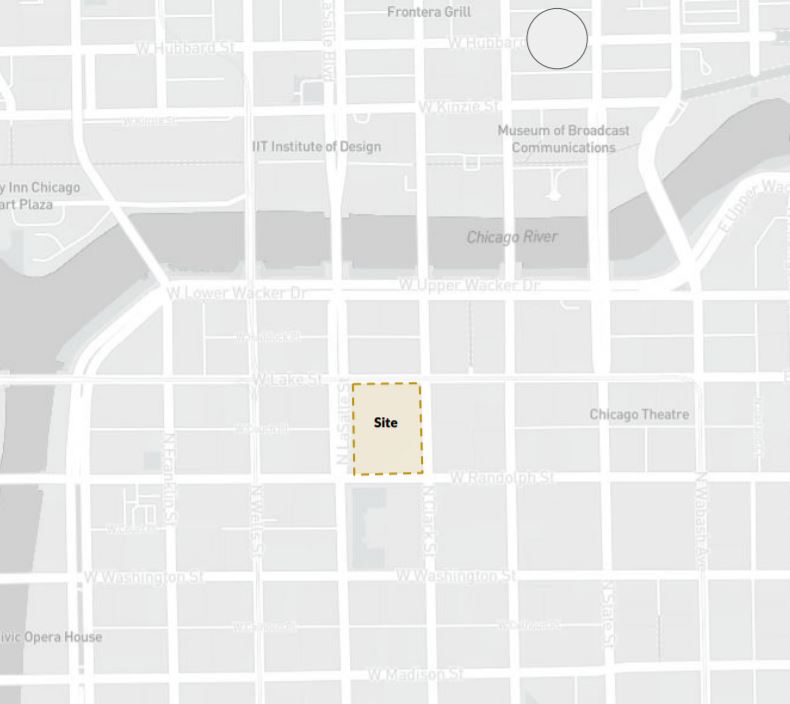
Img 7: Thompson Center Map
Site
Originally the State of Illinois Center; is located at 100 W. Randolph Street in the Loop district of Chicago and houses offices of the Illinois state government. The building serves as a secondary capitol for the State of Illinois in the most populated city and county of the state. The building has to be retained either metaphorically, or physically, or conceptually - the call is up to your rationale.
- Site Area: 11626 sqm.
- Height Restructions: None
- Setbacks: None
- Groundcoverage: Unrestricted
- Site Coordinates
Similar Competitions
Discover competitions you might be interested in


Design challenge to reuse E-waste

Challenge to design locus for the upliftment of human rights
