
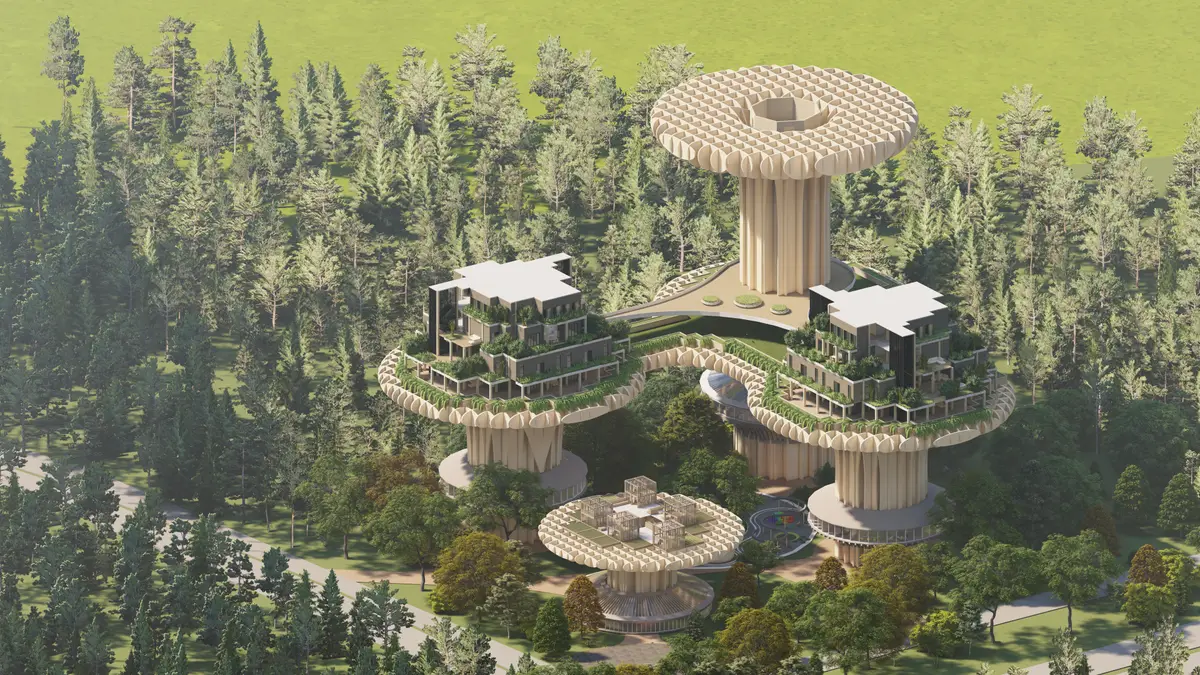
Co-llaboration
Growing Space for Growing Community

Co-llaboration is a future settlement project that responds to global environmental issues in terms of supply and demand for housing against population growth which continues to increase every year. By 2030, Millennials and generation Z will make up the major population globally, 2/3 of the world is going to be occupied by generation Z, they will be the major consumers for housing demand. They are often referred to as “rent generations”, young adults whom because of high house prices, live in rented accommodation.
Therefore Co-llaboration is present in the form of public housing which provides a place to live, equipped with various supporting facilities in the form of a kitchen, sanitary, living room, work room, greenery, hall which is quite complete at affordable prices because the room is sharing. Has a space hierarchy in the form of private, collective and shared space which is divided based on the level of restrictions on people who can access the space. This makes Collaboration a co-living residential area that has complete facilities that meet all the needs of residents in one environment at affordable prices.
Taking the concept of a building form in the form of a biophilic modular with a space repetition design strategy for modules. Making Collaboration a growing building that can continue to grow and multiply according to the needs of a place to live. The applied design strategy provides the building's ability to provide opportunities for residents to interact, express, and be creative by forming flexible spaces and programs within it.
Keyword: generation Z, affordable housing, co- living, biophilic modular
1. INTRODUCTION
Background of The Project
The continuous increase in the population of urban areas has limited the availability of residential land (Pramudito, Praptantya, and Nasir 2019; Sanjaya and Tobing 2019), thereby, causing a hike in the price of residential development and, ultimately, difficulties for the millennial generation to have adequate accommodation. This means the prices of property and land are on the increase and this has also led to low occupancy rates due to the inability to meet the financial requirements to own or rent a house.
By 2030, Millennials and generation Z will make up the major population globally, 2/3 of the world is going to be occupied by millennials and generation Z with both of them in the productive age, they will be the major consumers for housing demand. They are often referred to as “rent generation”, young adults whom because of high house prices, live in rented accommodation.
Excessive land prices in urban areas, scarcity of land, financial scanty, insufficient housing provision, insufficient household income, exorbitant rents, inflated interests in housing loans, and outrageous construction costs are also other causes of housing unaffordability (Ahsan, 2019). What we offer as a response to the community is to provide them with affordable housing. The Un Habitat Organization defines affordable housing as well located, good quality housing but doesn't cost so much that might cost it's occupants other basic living costs or other life enjoyments (UN-Habitat, 2019).
Research Problem
The current and future global environmental issues such as resource scarcity in insufficient housing provision because of excessive land prices, scarcity of land, financial scanty, deficient household income, exorbitant rents, inflated interest on housing loans and outrageous construction costs causes housing unaffordability. Generation Z which will be the main consumers of future dwellings are currently more known as "generation rent" due to affordability issues of housing in urban areas, thus in what ways can architecture help in making houses more affordable while still fulfilling the physical, physiological and environmental needs of the main users.
Aim
The aim of this project is to inquire about new housing design strategies that could comply with generation Z's physical, physiological and environmental needs which include the affordability matter whilst dealing with the rise of population, scarcity of land, and resource scarcity.
2. THEORETICAL ANALYSIS
Characteristic of Gen z
According to Cambridge Dictionary, generation is all living things in a group that start to exist at about the same time, and are related to one that existed at an earlier point in time. The Pew Research Centre (2015), define generation as a group of people with the same range of issues, behavior and characteristics. Generation is usually divided according to factors such as demographics, attitudes, historical events, popular culture, and prevailing consensus among researchers. Each generation is a unique mix of factors (Pew Research Center, 2015).
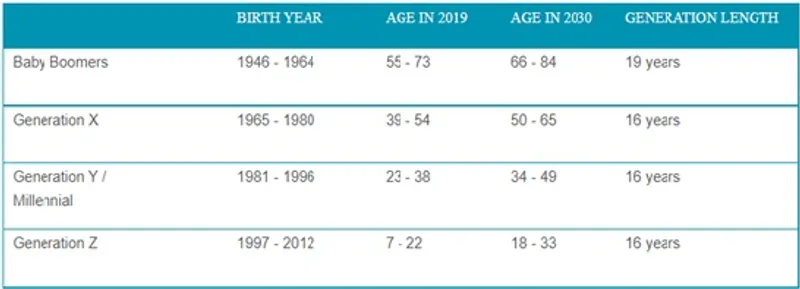
According to the Institute for Emerging Issues (2012), the Generation Z is the most ethnically diverse and technologically sophisticated generation. Generation Z has an informal, individual and straight way of communicating, and social networking is a vital part of their lives. What distinguishes them from other generations is that their existence is more connected to electronics and the digital world since they are born in the digital world. Characteristics defined by APA dictionary as a distinct feature of a person, especially traits that define an individual’s nature of personality in relation to others.

Element Design of Co- living
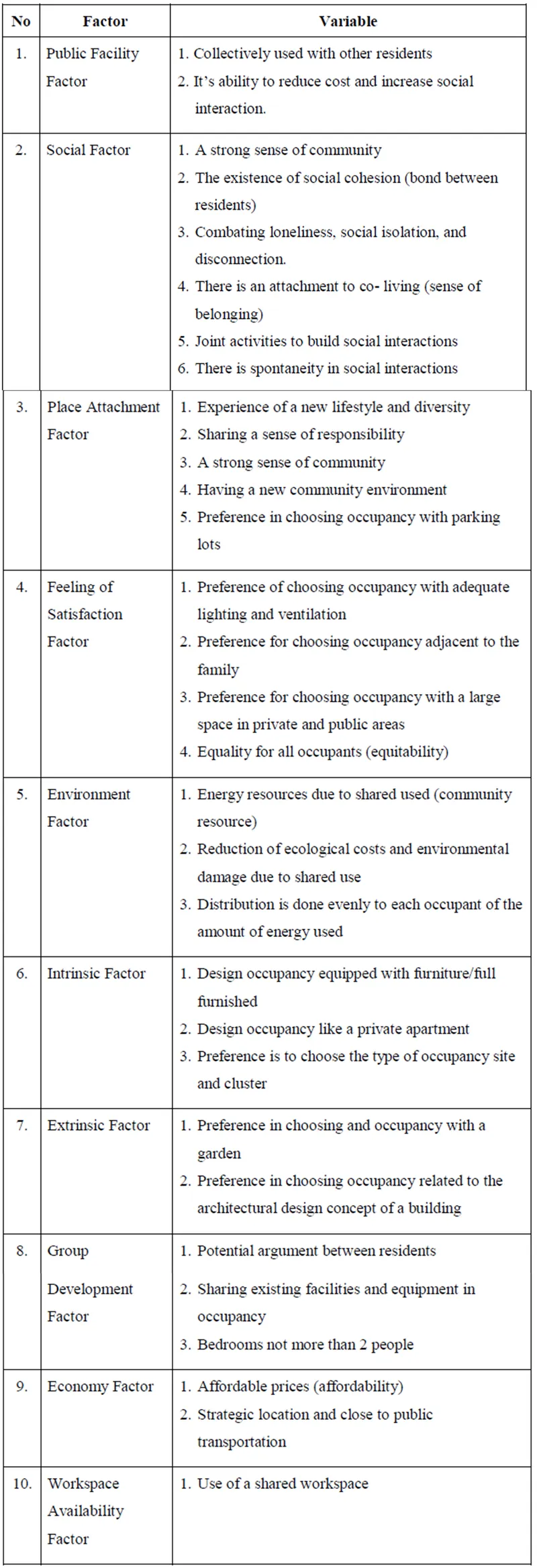
One of the methods considered to be effective in curbing the problem of urbanization, high occupancy prices, and feelings of loneliness is the use of shared living such as coliving space as an alternative residence (SPACE10, Anton, and Irene 2018). The concept was further described by Ataman and Dino (2019) to be a catalyst for social interaction through the introduction of a way to live together through more efficient sharing, use of resources, and space (Ataman and Dino 2019). It also provides opportunities for students and workers to reduce rental costs and daily expenses.
Housing Affordability
The UN Habitat Organization defines affordable housing as well located, good quality housing but doesn’t cost so much that might cost it’s occupants other basic living costs or other life enjoyments (UN-Habitat, 2019). Housing can be classified as affordable when it’s cost doesn’t consume more than 30% of a household’s gross income (Miller, 2002). Based on the definitions defined by experts above, we could conclude affordable housing as housings which price doesn’t go over 30% of citizen’s yearly gross income yet still able to give the quality the people need.
● Causes of House Unaffordability
The demand for housing in urban areas and inflation in building materials’ prices caused an increase in housing prices as well (Ghaus & Pasha, 1990). Excessive land prices in urban areas, scarcity of land, financial scanty, insufficient housing provision, deficient household income, exorbitant rents, inflated interests on housing loans, and outrageous construction costs are also other causes of housing unaffordability (Ahsan, 2019). Based on the causes found above there are several that could be alleviate through architecture, amongst the causes there are inflation building materials costs, outrageous construction cost, excessive land prices and scarcity of land.
● Effects of House Unaffordability
In terms of the city, the lack of affordable housing will cause an increase in homelessness and slums, pushing people to live in suburbs while working in the city centre which needs longer time to commute and transportation (Steffen, 2014). Environmental degradation due to urbanization, over population, increase in energy use, intensification of agriculture and increase in transportation, in which all of these will cause pollution, and resource such as air, water, soil, and natural resources depleted due to overusing (Choudary, Chauhan, & Kushwah, 2015), health issues such as respiratory disease, nervous system, psychological distress, cardiovascular disease, cancer, allergies, etc. due to inadequate poor living conditions (Braveman, Dekker, Egerter, Sadegh-Nobari, & Pollack, 2011), and degrading national-level economic growth.
● Affordable Housing through Architecture
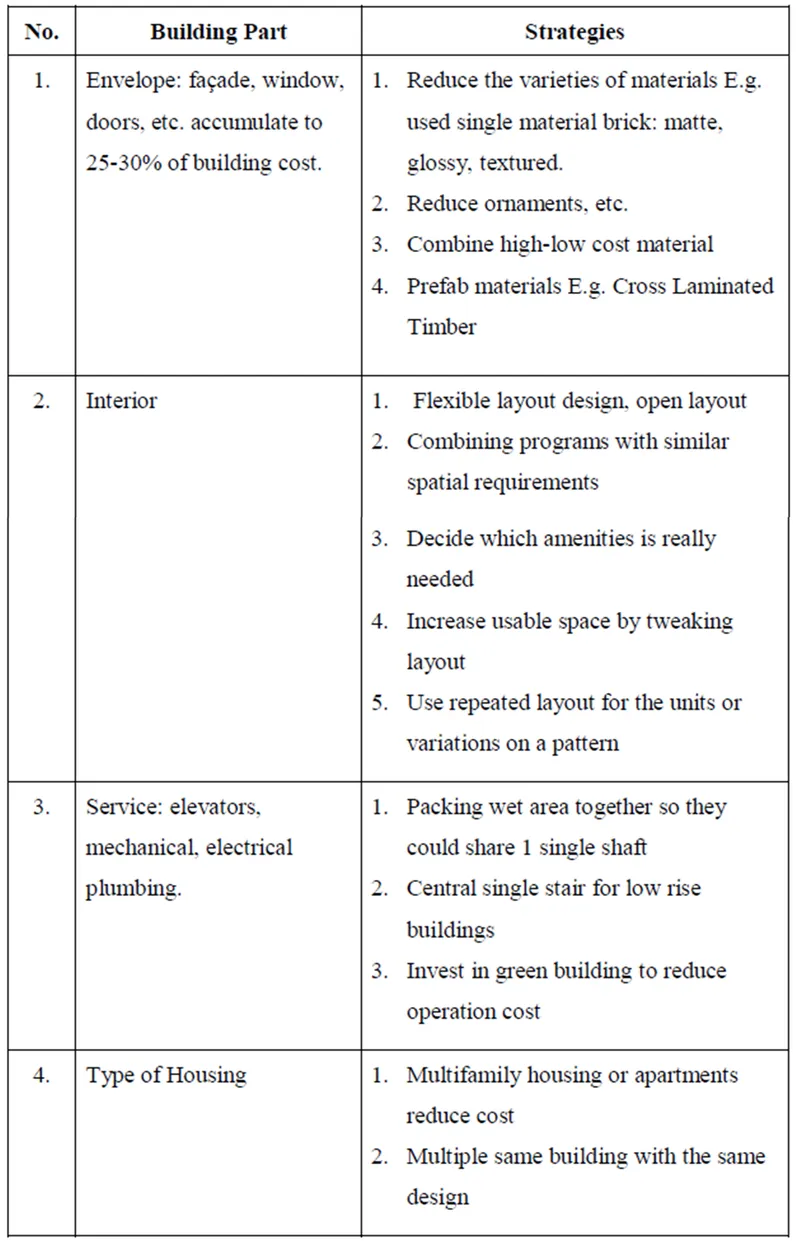
According to Hoyt (2020) architecture could support affordable housing through saving cost in the building construction. In order to save the cost, the building is divided into three parts: building’s envelope, interiors, and services.
3. METHOD
The method we use in searching for concepts, spatial formations and program arrangements is the phenomenology method. The basic purpose of phenomenology is to reduce individual experiences with phenomena to a description of universal essence (a grasp of the very nature of the thing) (Manen, 1990, 177). The inquirer then collects data from persons who have experienced the phenomenon, and develops a composite description of the essence of the experience for all the individuals. These descriptions consist of what they experienced and how they experienced it (Moustakas, 1994).
This phenomenology analysis will be carried out on generation z which will dominate the population in the next 10-20 years. An analysis of how daily activities, needs, desires, social relationships, and lifestyles shape the characteristics of Gen Z. What phenomena occur in their daily lives and how does this affect their lifestyle, mindset and need for space.
4. DESIGN CONCEPT
Home is defined as the experience of a dwelling, an emotional bond to a dwelling place where both physiological and psychological needs of an individual are fulfilled (Després, 1991). Through various research conducted by Somerville, concludes that home is the center of family life; a place of retreat, safety and relaxation; freedom and independence; self-expressions and social status; a play of privacy, continuity, and permanence; a financial asset; a support for work and leisure activities (Somerville, 1997). We can conclude from the sources above that a home could be defined as a physical structure that provides physiological (human physical body) and psychological (human mind and behavior) needs.
Means to describe a conservative house with a new, creative and imaginative perspective make the image of a house more fun, flexible and enjoyable. In it there are several design strategy plans that are carried out to obtain the formation of mass and space in accordance with what will be applied to this Co- llaboration project. Here are some points of the design strategy:
Massing Concept
1. Biophilic Modular Architecture
The concept of biophilic design emerges as a solution in an environment where urbanization drives people away from nature, and the built environment becomes increasingly critical to people's productivity, emotional, physical, and mental health; and leads to the pursuit of nature (Miray Gur, 2022). According to the characteristics of generation Z that prioritizes fit and health, provides living space that has greenery, adequate lighting and ventilation so that residents can spend time in nature that boosts mental health, creativity and productivity.
Biophilic modular architecture was chosen because the sustainability of the building emerged as an essential issue for society's well being. The concept of sustainability has started to take place in research in the current period. At present, where urbanization continues rapidly, the idea of sustainability has become a necessity. The element of making durable housing was to invest in green building so that it would reduce the operating costs in the future.
2. Growing Structure
This is our response to the community's need for a place to live which continues to increase but on the one hand the availability of land is decreasing. The Biophilic Modular Architecture Mass that is applied to the massing concept above is the beginning of a growing building. The concept of structure to be applied in this project is a growing structure. Imagining a living space is a part of a cell that forms a tree and continues to grow until a collection of these trees will form a forest which in urban life takes on the role of a community.
3. Used of Local Material
The concept of mass Collaboration uses local materials because it will increase the sustainability of the building. This will be very wise and good for reducing project development costs because local materials are easy to find, but also help the environment around the project.
Programming Concept
1. Mixed- Use Building
The Collaboration aims to be a future home for people who will be dominated by generation Z, where the need for housing continues to increase, and limited land causes housing prices to become more expensive. The co-living residential concept is applied in this project, where housing as the main basic need will be equipped with various supporting facilities and can be used jointly by all residents at a relatively low price because it is shared.
Collaboration in this project is defined as a collection of spaces, activities, age, gender, work, interests, desires, work, and needs that will be interconnected, interact and help each other. Hoping to help residents interact socially with the existing layout. It aims to accommodate residents to their need for community and connection in life, whether for learning, growing or making money.
Generation z has a characteristic where the boundaries for work and entertainment overlap with each other, and they can't stand doing the same thing for a long period of time. Make making money a top priority with the largest percentage in their lives. Making us focus on the goal of providing a place to facilitate the above characteristics, in the form of a workspace with a shared room concept that is flexible, increases creativity, productivity and provides space and opportunities for generation Z to interact.
2. Module
The module concept is applied to building structures with the consideration that by forming multiple same spaces with the same design, and repeated layouts for living units or variations on a pattern, it would reduce the production cost by using pre-fabrication material. This concept is applied to every form of space, which differs only in the grouping of spaces, the pattern of spaces and the functions of each module. This gives freedom in how to shape the space in it for both designers and residents.
3. Space Integration
Freedom to shape space due to the application of a module structure that can be combined, repeated, and insert some new function, there is a flexible spatial placement concept that results in creative and effective spatial formations. The module is in the form of a cube and stacking together to form a tree, this allows in each level there are several different forms of spatial arrangement, this is because Generation Z really likes to explore something new, unique and adventuring.
4. Back to Nature
Generation Z, which will dominate the population for the next 20 years, receives a legacy in the form of nature that has been damaged. Therefore, sustainable buildings are one of the priority elements in design, resources and nature are getting worse and become the basis for why every building takes a role in repairing natural damage caused by humans. or disaster. Having priorities and concerns about fit and health, makes many Generation Z like being in the middle of greenery, apart from being relaxing, it also increases the productivity of the residents.
REFERENCES
Singh, Dr. Amarendra Paratap, and Jianguanglung Dangmei. 2016. Understanding the generation z: The future workforce. Amaekantak: South- Asian Journal of Multidisciplinary Studies. Page 1-2.
Ozdamar, Esen Gokce, and Oksan Tandogan. 2022. Emerging Approach in Design and New Connections with Nature. United States of America: IGI Global.
Wardono, Prabu, and Isrina Indah. 2021. Co-living space: The shared living behavior of the millennial generation in Indonesia. Bandung: Department of Design, Faculty of Art and Design ITB.
Ahsan, M. (2019). Making Unaffordable to Affordable: Looking into Affordable Housing Issues and Its Remedies. Sciendo.
Després, C. (1991). The meaning of home: Literature review and directions for future research and theoretical development. Journal of Architectural and Planning Research.
Earth. (2021, August 5). 11 Biggest Environmental Problems Of 2021. Retrieved from Earth.org: https://earth.org/the-biggest-environmental-problems-of-our-lifetime/
Ghaus, A., & Pasha, H. A. (1990). Magnitude of the Housing Shortage in Pakistan. JSTOR, 137-153 (17 pages).
Henilane, I. (2016). Housing Concept and Analysis of Housing Classification. Baltic Journal of Real Estate Economics and Construction Management, 168-179.
Miller, N. A. (2002). The Face of Affordable Housing Part I. Minneapolis: University of Minessota.
Nielsen. (2015). Global Generational Lifestyles. US: The Nielsen Company.
Parker, K., & Igielnik, R. (2020, May 14). Retrieved from Pew Research Center: https://www.pewresearch.org/social-trends/2020/05/14/on-the-cusp-of-adulthood-and-facing-an-uncertain-future-what-we-know-about-gen-z-so-far-2/
Shaw, D. (2017). Affordable Housing Supply: April 2016 to March 2017 England. England: Department for Communities and Local Government.
Wilson, E. O. (1984). Biophilia. Harvard University Press.
World Green Building Council. (n.d.). What is Green Building? Retrieved from World Green Building Council: https://www.worldgbc.org/about-green-building

Popular Articles
Popular articles from the community


Play: Fragments of Their World
Familiar architecture becomes modular playground design, creating safe spaces where displaced children can learn, connect, imagine and play.

Co-life: Sustainable Architecture for Age-Friendly Community Living
Co-life reimagines sustainable architecture for seniors through courtyards, rammed earth, shared gardens, and spaces designed for belonging.

The Musturak Paradise: Senior Living Architecture for a Connected Future in Temara, Morocco
The Musturak Paradise reimagines senior living architecture in Temara via private homes, social spaces, culture, community, and shared care.

The Ocean Hive: Sustainable Architecture for a Self-Sufficient Civilization at Sea
The Ocean Hive imagines sustainable architecture at sea, where modular habitats, algae, wave power and ocean waste sustain a growing colony.

Similar Reads
You might also enjoy these articles

The Rhythm of Seasons
A Farmers' Market Connecting Nature and the City

More Than a Building-Designing a Living System
More Than a Building-Designing a Living System
Base Beyond
DESERT COMPOUND ARID: TOURISM OF ABSENCE AND ABUNDANCE

Explore Co-Living Competitions
Discover active competitions in this discipline


Challenge to reimagine the Iron Throne

Photograph architecture without architects

Illustrate the lost glory of Angkor Wat - Render Challenge

Design challenge to reuse E-waste
Comments (0)
Please login or sign up to add comments
No comments yet. Be the first to comment!