
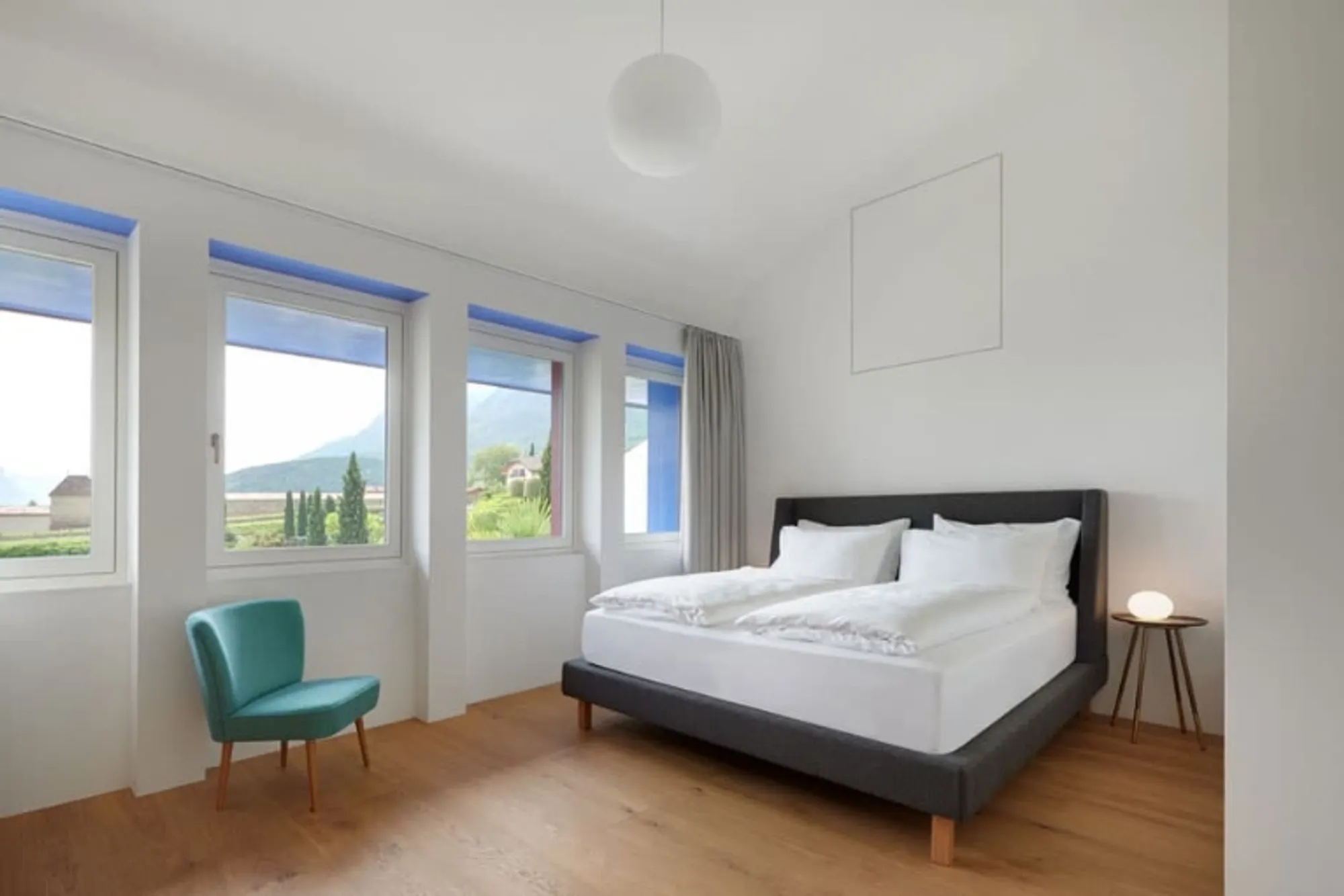
Step inside the breathtaking Villa Baronessa and discover a world of mesmerizing architecture, vivid colours and an enchanting atmosphere!
What makes Villa Baronessa a must-see for architecture enthusiasts and art lovers alike?


Nestled on the edge of the charming South Tyrolean wine village of Kaltern, two extraordinary houses exude an irresistible aura amidst a lush Mediterranean garden. The Villa Baronessa and Villa Baronessina stand tall like sculptures, basking in the serene surroundings of nature. These remarkable structures flawlessly blend diverse concepts, juxtaposing history and modernity, Alpine and Mediterranean influences, and even South Tyrolean and Japanese cultures, all while maintaining a distinct architectural identity.
The Baronessa ensemble is an architectural oxymoron, beautifully highlighting its unique essence through the perfect fusion of opposing elements. The result of a collaborative effort between Kaltern architect Walter Angonese and artist Manfred Alois Mayr from Vinschgau, the properties have been meticulously designed to reflect the essence and history of the land while keeping in sync with the present. The duo has skillfully created a harmonious balance between elegant architecture and a laid-back holiday vibe, making it a place that appeals to the senses and soothes the soul.

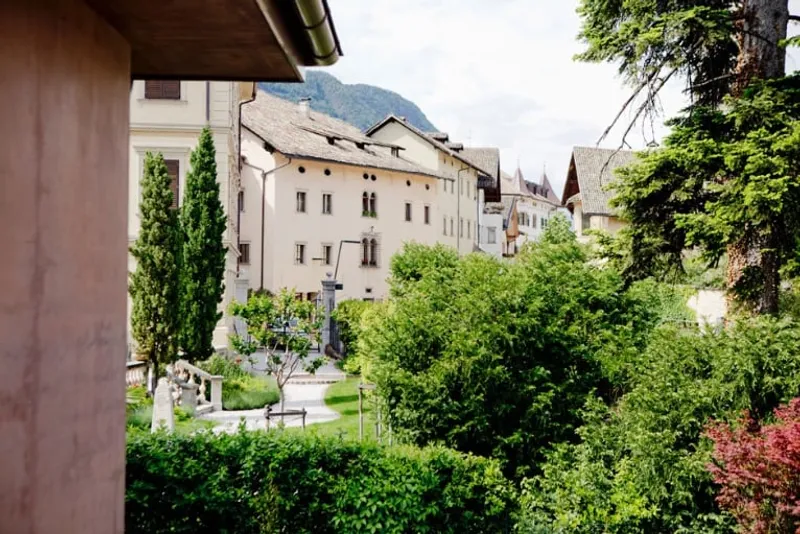
As you exit the Brenner Motorway at Tramin, the road takes you on a picturesque journey uphill amidst apple orchards and vineyards. On your right, Lake Kaltern gleams with tranquil beauty. Soon, you arrive at the charming town of Kaltern, adorned with houses in the Überetscher architectural style, featuring elements like bay windows, sandstone arcades, and closed courtyards, reflecting the influence of Tuscan princess Claudia de' Medici.
Kaltern seems to possess two distinct personalities - the German and Italian cultures blend harmoniously with contemporary architecture and local traditions. Its location amidst the rugged mountain scenery of the Dolomites and the Mediterranean wine landscape creates a unique symbiosis and atmosphere. The air carries a mild and gentle quality, just as Goethe described in his "Italian Journey". You'll spot palm trees, passion flowers, cypresses, and lemon trees in every garden and facade, adding a southern flair to the surroundings. The peaks of the Dolomites and the Mendelpass rise magnificently, reaching over 2,000 metres into the sky.
Claudia and Reinhart Volgger have turned a historic garden house into a stunning villa, blending modern architecture with traditional elements. The Villa Baronessa, located in the private park of the Baronesses Weihrauch di Pauli estate, offers breathtaking views of the surrounding landscape. The couple seized the opportunity to purchase the property in 2012 and enlisted architect Walter Angonese to extend the original building and create a harmonious ensemble with a new, pavilion-like structure. The two houses are connected underground but maintain their independence and privacy. This unique and picturesque retreat is the result of a perfect fusion of history, architecture, and nature.
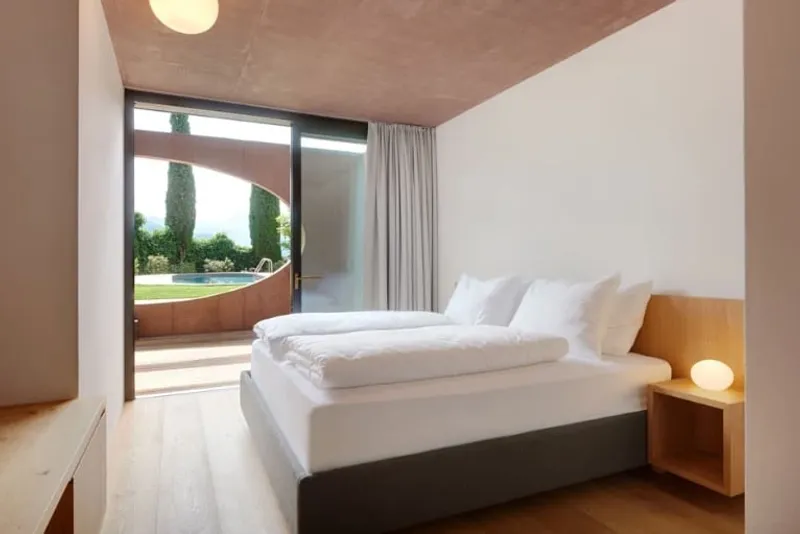
Enter into a world of surprises and sensory delights as you explore the stunning Villa Baronessa and its "little sister" house. With every step, you'll encounter unexpected perspectives and evocative textures that create a tension between contemplation and communication. The vibrant colors and spacious rooms are in constant dialogue with the surrounding landscape, framing a breathtaking show staged by nature itself.
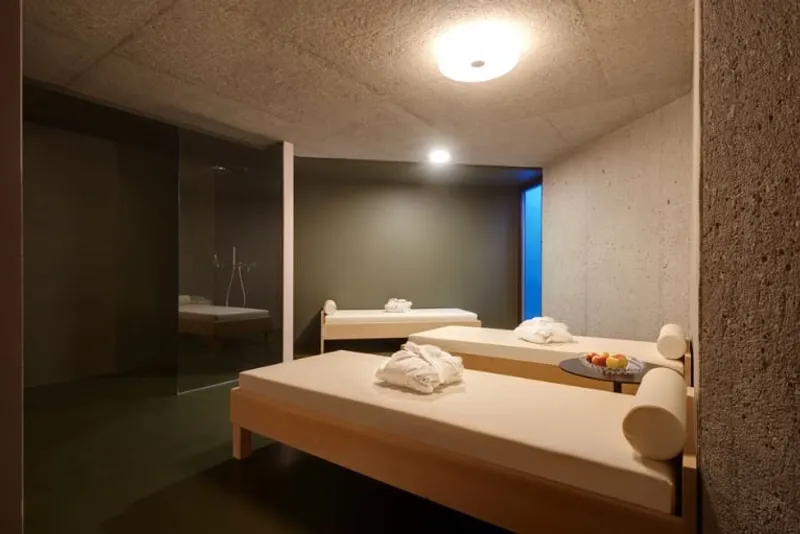
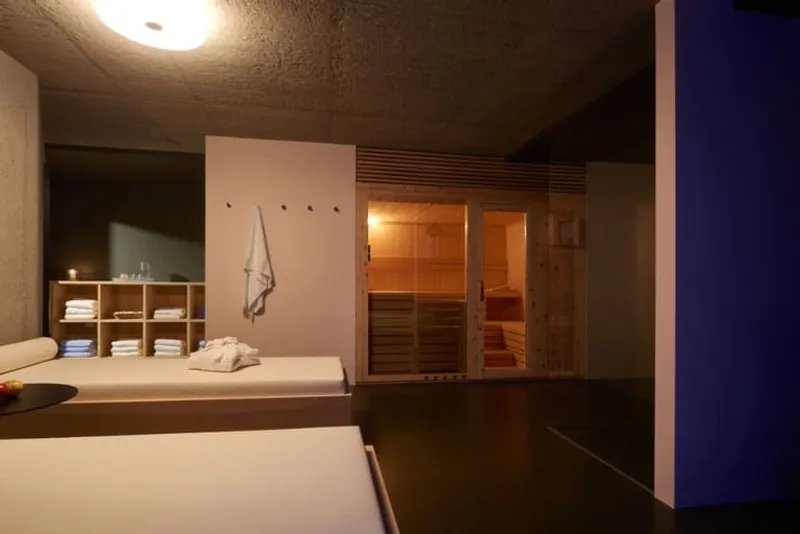
The patio acts as a bridge between the two houses, seamlessly integrating the Mediterranean style into the architecture. And don't miss out on the impressive energy of the basement, where the wine cellar, sauna, underground parking, and even the staircase become sacred spaces that awaken your senses.
Experience the symbiotic interplay of architecture, color, and texture that elevates Villa Baronessa into a truly mesmerizing home.


The construction of the idea
Renowned architect Walter Angonese has made a name for himself with his innovative wine architecture, as seen in his projects for the Josef Hofstätter and Manincor wineries. He also specializes in restoring important historical buildings, such as Castle Tyrol and the Kufstein fortress. Angonese's unique approach involves building on existing structures, incorporating elements of the context and place. This is exemplified in his recent work on the Villa Baronessa/Baronessina ensemble, where he seamlessly blends the old and new. Despite being known for his "building on" philosophy, Angonese believes that creating something new is equally important. He despises the current trend of simplistic "Klimahaus" boxes and prefers to incorporate unique elements and themes in his designs. Angonese's work is not only limited to architecture, he is also a regular professor at the Accademia di Architettura of the Università della Svizzera Italiana in Mendrisio.
What conditioned us in the sense of “building on” the existing? Scale, appropriateness, the completion of the local structure, the paths within the house. The landscape. When it came to the teahouse also the framing of the landscape.
How do you approach the historical substance of a building? And how does architecture remain authentic when historic buildings are redeveloped in the present?
We always approach historic buildings with respect. I myself have developed a method that might be best described as “monument conservation without monument conservationists”. The existing building always has a value that needs to be understood and interpreted. But not neurotically so – with respect and reverence, rather than unhelpful mental blocks. I have a similar strategy with all existing buildings; from time to time the monument protection services get in the way, from which I expect an equal dispute and no power battles. I’m happy to respond to such disputes, but not when they come “from on high”.
We feel that we succeeded in preserving Walter Pinzer’s authentic style, and that we even took it a little bit further by applying the colours of Manfred Alois Mayr. The original yellow was not quite philologically accurate: Pinzer employed a yellowish colouring at the Weihrauch di Pauli residence, which the investigations in the course of the restoration of the residence revealed to be quite arbitrary. Today the building has regained its original character. Yellow would have been a mistake, and beige in the context of the new library would have been incoherent, since the new library replaced a run-down barn building in yellow tones. And yes, we also extended the building. In this case, the most appropriate strategy was to simply extend the hipped roof and add the extension underneath; it would have been wrong, in this case, to connect a completely new structure.
The Baronessa Ensemble was a joint project with artist Manfred Alois Mayr. Colour became an architectural task; architecture an unfolding space for strongly resonating colours. How does this interdisciplinary creative process succeed, in which architecture and art merge symbiotically without losing their independence?
We have a great deal of mutual trust and have been working together for a long time. Often we start out on a common path and then our two disciplines divide, but sometimes Manfred only needs to make very selective contributions. The pergola was one of those – we had planned a pergola so that the outside area of the kitchen could be used too. For the rest the house, Manfred was simply given a colour outline. And the result is what you see today. Ultimately, I believe it is our mutual trust.
Manfred Alois Mayr first “senses” a place. What comes first with Walter Angonese: the head or the gut?
My gut feeling. My project methodology is “the construction of the idea”, which I also teach in the context of my university courses. From intuition to cultural and tectonic reflection, from declining architectural tools and approaches to the idea. Which you should never abandon. At the beginning, however, I always operate more intuitively than rationally. But, where are the boundaries for someone who doesn’t like boundaries?
You dubbed the Villa Baronessina the “teahouse”.
The Japanese teahouse is a personal association. Whether the Baronessina is perceived as such by others is not important to me. A teahouse is both introverted and extroverted, plays with gardens and spatial perceptions (for example Katsura, Roynai etc.). But a teahouse is not a residential building. In this respect it remains a personal association and object of my intuition.
What role does the landscape play for the Baronessa Ensemble?
The interior living landscape and the landscape in the sense of the views and the spatial perception of the immediate landscape are always important themes for us. This is one of the reasons why we have created a Mediterranean garden for our friend and landscape designer Roland Dellagiacoma. He knew how to create a landscape as well as a climatic buffer between the sealed surface of the parking level and the expanse of the landscape. With a lot of variety, but inspired by the South. We are just at the cusp of the South, as Goethe recognised.
Alchemist of colour
The artist Manfred Alois Mayr enters into resonance with the essence of a place. Like an alchemist, he transforms the identity of a place into colour. His chromatic concepts – in the Manincor winery, at the University of Bolzano, in the Museum Vorarlberg, to name but a few – have a powerful effect on the viewer. The history, stories and the cultural context of the place of his interventions guide M.A. Mayr in his choice of pigments and techniques, and the emphasis is not on the artistic act itself but on the identity of a place that can be experienced through colour.
Mr. Mayr, colour is anything but a design or decorative element for you. Colour is instead an experiential medium in the tension between art and everyday life in your projects. How do you use colour?
Colour has become a central theme for me in general. In architecture, colour is not decorative for me, but rather a physical presence – an effect on the occupant of a room. I don’t want to place the observer in front of but “within” colour. In that I include everything concerning the history of a colour and its “materiality”: the extraction of various pigments and their origin, their relationship to a particular place or tradition. The attraction of a place lies not only in its individual smells and noises, but also in its different colours.
I quite like to compare it to music, where, despite playing the identical note, different instruments can be distinguished from each other. A “C” on the trombone sounds different to a “C” on the flute or violin. So the timbre of a piano is different from that of a string or wind instrument. Then there is also the colour rhythm and the speed of a colour – here too the comparison to the tempo and pauses in music is pretty clear. “Adagio” (slow and calm) or “vivace ma non troppo” (lively but not too much) or “moderato” (moderate).
The “volume” of a colour is also important. Matt ultramarine blue behaves differently both spatially and in terms of its aura than high-gloss ultramarine. Light and shadow, as well as a reflecting or light-absorbent surfaces, are essential factors for the efficiency of a colour.
You describe yourself as a “senser” of places. How did you “sense” and perceive the property of Villa Baronessa at the beginning of the project? What fascinated you?
The first thing that impressed me was the location and the combination of the two structures – i.e. the interplay of the old and new structures. They interlink the past with the present.
As always, when entering a building site, my first impressions arise in the form of questions: What is the architectural language? How do I respond to it? What is the function of the building? Where does it require emphasis or refinement? Where is the whole “orchestra” required, where is it a solo piece? Where are there pauses?
I walk through the building site several times like a water-diviner and wait to see where the architecture creates the impulse in me to make a colour intervention.
Finding the balance between the place, the space, the wall (including the physical properties of the wall) and the complete structure always requires a very specific colour tone. The great challenge for Villa Baronessa was to pinpoint and refine that colour tone until it really started to resonate.
How does the “message” of a place manifest itself to you?
Every place or non-place has a soul for me and every constructive engagement with it requires its own unique approach or treatment. Engaging with and absorbing the foreign environment is a way to find me in that place – in the opposite way friction, inspiration and ideas take me out of myself. The task I set myself each time is to create a “place within a place”.
What are the colours/pigments you have used in Villa Baronessa and Villa Baronessina?
The two main colours that give Villa Baronessa its personal character are lime white, ultramarine blue and oxide red. They partially extend from the outside to the inside and thus – to compare them to natural colours – enhance the pale lilac blue and dull lemon yellow of the interiors. In Villa Baronessina, on the other hand, gold dominates the sleeping area on the upper floor. The light falling from above lends the tent-shaped and unusual room a special warmth and atmosphere.
The primary challenge at Villa Baronessa was to accentuate the architecture to the utmost degree through colour – I was able to achieve this by combining the above-mentioned colours with “non-colours”, i.e. the inherent colours of the materials used, such that the colour is sensed but not “seen”. In the villa’s interior, for example, it appears as natural as a window to let in the light.
The essence of Villa Baronessa and Villa Baronessina is revealed through mood, colour oscillation and sensory experience. How do the two houses affect you today? Can you put the essence of Villa Baronessa and Villa Baronessina into words?
I don’t want to express the essence of Villa Baronessa and Baronessina. Because colour and architecture can do what language cannot do, and language can do what colour or architecture cannot do. For me it is a matter of really “living and breathing” a space: immersing yourself in the rooms in order to feel their essence and mood, to experience them and let them have an effect on you. Architecture and colour are a way of life – the mood between the occupant and the space is the culture …
Credits: Juergen Eheim, Vicky Klieber (image 3)



Popular Articles
Popular articles from the community


Lunar Spiral: Space Architecture Shaped by the Mathematics of the Universe
Lunar Spiral reimagines space architecture through Fibonacci geometry, lunar regolith, levitating habitats, and self-sustaining Moon living.

The Musturak Paradise: Senior Living Architecture for a Connected Future in Temara, Morocco
The Musturak Paradise reimagines senior living architecture in Temara via private homes, social spaces, culture, community, and shared care.

Co-Life: Senior Housing Design That Reconnects Older Adults With the City
Co-Life reimagines senior housing design through healing gardens, shared streets, workshops, and a sustainable community across generations.

Conexión: Biophilic Design Reimagines High-Rise Living in Hong Kong
Conexión reimagines high-rise living in Hong Kong through biophilic design, green facades, shared spaces, daylight, water and nature within.

Similar Reads
You might also enjoy these articles
116 Rokeby Building, Collingwood
Sustainable Collingwood office building featuring double-skin façade, natural ventilation, rooftop amenities, and carbon-neutral design focused on wellbeing and longevity.
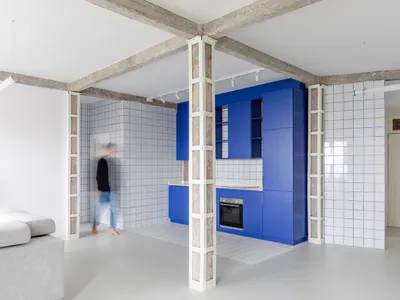
Contemporary Apartment Renovation in Spain: RV House by BIAN Opens Up to the Sea
A minimalist 1930s apartment in Santander is transformed into a flexible, sea-facing home through contemporary Spanish renovation.
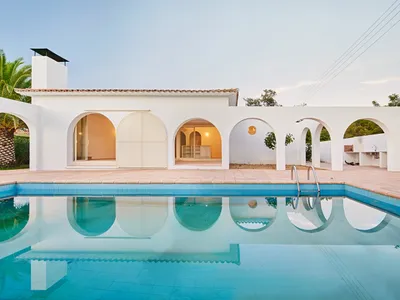
3 Marías House: A Contemporary Mediterranean Courtyard Retreat by Bajet Giramé + Burckhardt
Mediterranean courtyard home blending traditional architecture with modern design, terracotta flooring, flexible interiors, sustainable climate strategies, and garden integration.
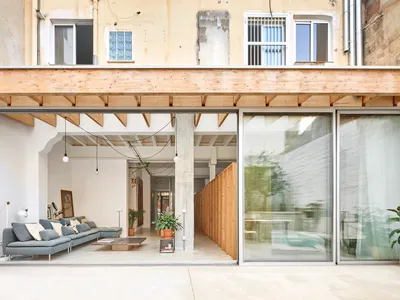
NZ10 Apartment by auba studio: Adaptive Reuse in Palma de Mallorca
Adaptive reuse apartment transforms bakery into light-filled home with patios, privacy layers, and wood interiors enhancing urban living experience.

Explore Villa Competitions
Discover active competitions in this discipline




Challenge to reimagine the Iron Throne


Photograph architecture without architects


Illustrate the lost glory of Angkor Wat - Render Challenge


Design challenge to reuse E-waste
Comments (0)
Please login or sign up to add comments
No comments yet. Be the first to comment!