
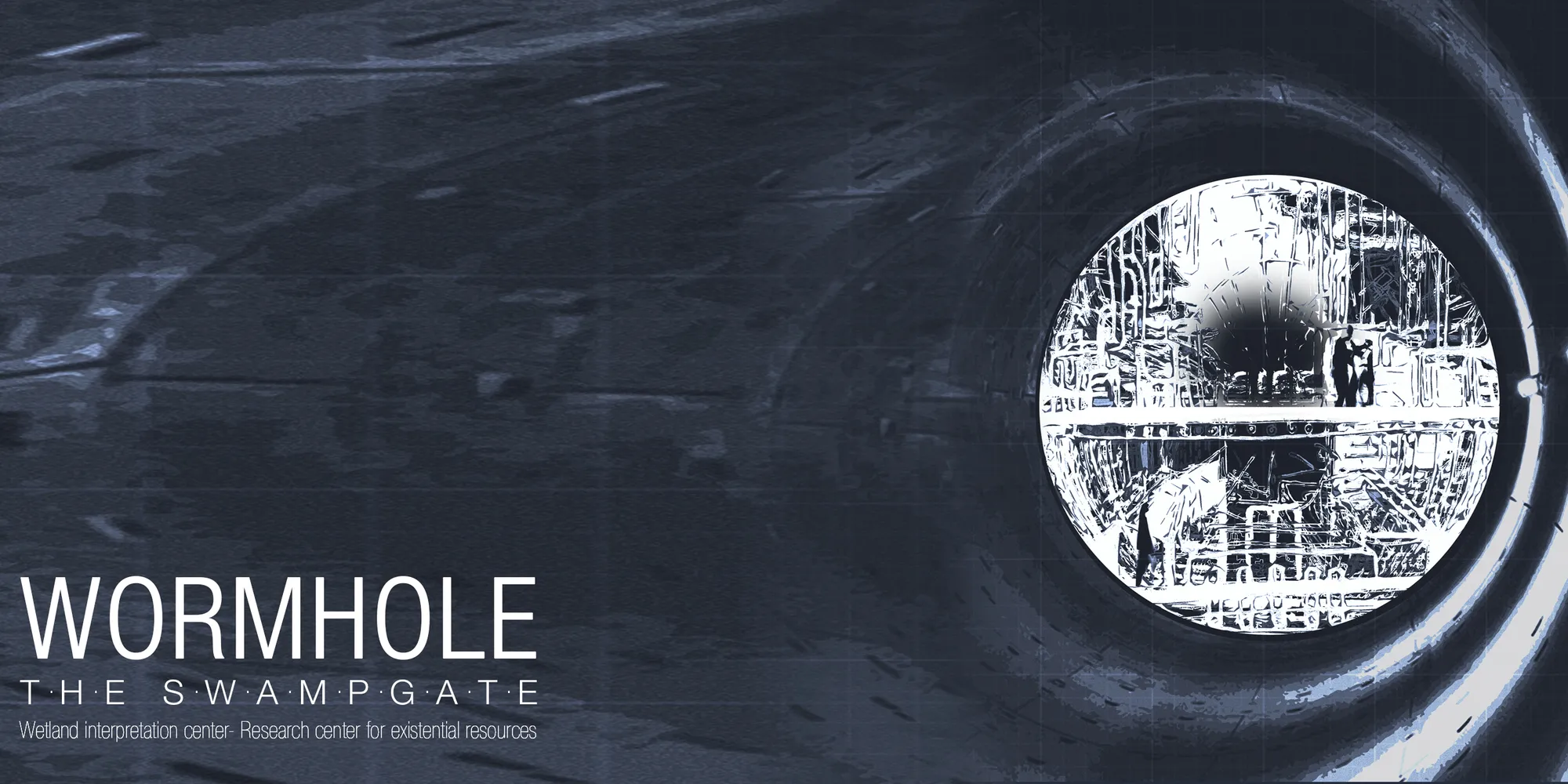
WORMHOLE -The Swampgate
Research center for existential resources
Imagine yourself in the middle of nowhere, empty space, nothing is around you. You are at the beginning of time and space as we know it. Slowly the world emerges, life is created and the only thing you care about is your own survival. Instinctively, you search for food and water resources as do all other species around you, a food chain system is developed, and you got yourself on top of it. Thousands of years later, you find yourself in present time, in total control of resources this world possesses. But suddenly the realization hits you-humans made dramatic changes to the way Earth’s system functions, and you and I are the ones to blame, because it’s the consequences of our actions, terrible resource managing and the never-ending wish for more that got us to the present point in time. Humans have directly altered Earth’s land by deforestation, the degradation of land, loss of biodiversity and pollution. We have the biggest impact on land and freshwater ecosystems, mainly because they were exploited in search for water and food (growing plants, keeping animals). We are faced with fatal predictions and catastrophic images of the future ahead of us. So now we’re presented with a single choice.
We either find solutions for problems we have created and face them head on, or we continue with the same poor decision-making that has landed us in this position in the first place.
This project's primal idea is putting a visitor of the Wetland Interpretation Center- “Wormhole” in this position and giving them the opportunity to pick their own path through different trajectories. The Center allows you to explore the possibilities of solutions the wetlands can provide us with-water resourcing, purification and storage. The essential role of wetlands in the development of human civilization and regulation of vital freshwater resources is often undervalued, this projects makes it undeniably clear - wetlands provide a key solution for the problems we’re currently facing as a civilization. The object itself is hidden and buried in the rampart (the wetland outwall), the only man-made structure found on the location, which role is to prevent flooding of the surrounding land by layers of soil and dirt. Most of existing land structures and terrain are preserved in their original form, allowing the ecosystem to function properly and naturally.
After the entrance, you are introduced with two routes of exploring the Center, each representing an objectification of a possible course of action.
Option number one is observed while walking through a linear path of level 0- the ground level. You walk along wide window-like openings in the object that resemble metaphorical cuts of Earth. They allow you to peacefully observe the nature and wetland landscape surrounding the Center. This view represents the solution, and it is the path that is going to lead us to the better, healthier, and more stable future. This is a place for reflection, the space that gives us the opportunity to silently observe and contemplate. On one side-north- there’s a view of the surrounding landscape, which at night glows using light installations, while on the other side –south-you can see the wetland intersected by paths, walkways and places of permaculture development.
On the other hand, if you choose to go downstairs to an underground level -1 you’ll find yourself in the bunker- the place of anticipation of death and destruction. Shelters are described as “the architecture of failure”(1) , and this one’s purpose beside the obvious (which is to protect you in case of catastrophe) is to provoke its visitors to perceive the extent of impact their decisions make. “Who even wants to look or even think about architecture for the end of the world?”, well now you are walking through it, and you feel its pessimism.
The Wormhole Center doesn’t only point you to the problem, and it’s possible solution, it’s allowing you to witness the system with which we’re fighting the problem of freshwater and food resourcing. The network of pipes conducts water to pools and water collectors and applies the wetland's filtering mechanisms on it. In the laboratories, the science team constantly checks water’s quality and performs experiments that you as a visitor can watch and learn through in the educational spaces of the center. The Seed Vault ensures long-term storage of duplicates of seeds conserved in genebanks around the world, and The Wormhole center has one. This provides security of the world's food supply against the loss of seeds in genebanks due to mismanagement, accident, equipment failures, funding cuts, war, sabotage, disease and natural disasters. There is also an immersive experience of you walking either below plants on level 0 or wandering around the parts of UK’s 2010 pavilion at Expo, known as the Seed Cathedral. The installation showcases the seed collection of Kew Gardens’ Millennium Seedbank educating the public about UK’s long-lasting tradition of protecting the green concept (the UK pioneered the world’s first ever public park and the world’s first major botanical institution, the Royal Botanic Gardens at Kew)
The goal of the project is to showcase the surrounding landscape in its full glory, as well as to create unforgettable and educational experiences. The wetland lies hidden behind the rampart where visitors can explore the unique surroundings by hopping on a moving walkway and off of it on wooden pathways leading you through the terrain, where you can observe wetland’s ecosystems and permaculture islands. Permaculture is an approach to land management and settlement design that adopts arrangements observed in flourishing natural ecosystems. Different routes end with different viewpoints, so the visitor never knows what they’ll stumble upon next.
Beside the labs, water collectors and outside infrastructure, you are able to see Wetland themed exhibitions, enjoy the Center’s Café (which uses the collected water and cultivated plants to make Britain’s signature tea) and attend lectures about the importance of preserving Wetlands and the benefits they bring to humankind.
Without food, human beings can stay alive for 7 days, without water for 3 days and without air one cannot survive for more than a few minutes. No matter where they are, people need safe air to breathe, clean water to drink and nutritious food to eat- to survive. These resources are vital for human health, but are often taken for granted. Our fight for better management of existential resources continues, and this Center is its starting point. Wetlands are beacons of hope that this fight which humanity is facing will be won some day and that we’ll be able to call a world with clean air, fresh water and food for all our reality.
(1) Ross, Richard. 2004. “Waiting for the End of the World”. Interview with Sarah Vowel, page 17. New Yersey, Princeton Architectural Press.


Popular Articles
Popular articles from the community


The Earth Pod: 3D Printed Homes for Resilient Refugee Communities
The Earth Pod reimagines refugee housing through 3D printed homes made from clay, combining resilience, self-sufficiency, and rapid shelter.

Hill & Cross Opera: Sculptural Opera House Architecture Shaped by Tallinn’s Landscape and Identity
Hill & Cross Opera reimagines opera house architecture in Tallinn through its sculptural hill, civic plaza, glass wave and a luminous cross.

The Ocean Hive: Sustainable Architecture for a Self-Sufficient Civilization at Sea
The Ocean Hive imagines sustainable architecture at sea, where modular habitats, algae, wave power and ocean waste sustain a growing colony.

Co-life: Sustainable Architecture for Age-Friendly Community Living
Co-life reimagines sustainable architecture for seniors through courtyards, rammed earth, shared gardens, and spaces designed for belonging.

Similar Reads
You might also enjoy these articles

Day and Night Park: A Time-Based Urban Newsstand in Beijing
A temporary urban newsstand in Beijing blending travel, light, and reading through poetic colors, compact form, and community-focused design.

Modernist Patio Renovation in El Masnou, Barcelona by Oliver Segura Arquitectura + Cebrià Arquitectura
Modernist patio renovation blending tradition and innovation with a movable pool, leveled floors, and Catalan materials in El Masnou.

Alto Residencial Coop: Cooperative Housing Development in Santiago de Compostela by Carbajo Barrios Arquitectos
A linear cooperative housing complex blending white volumes and perforated metal façades, enhancing community living, natural light, privacy, and urban integration.

Vil Genis School by BPA ARCHITECTURE – Massy, France
Vil Genis School in Massy, France, features sustainable design, south-facing classrooms, community integration, accessible spaces, and modern educational architecture.

Explore Educational Building Competitions
Discover active competitions in this discipline



Challenge to design public laboratory


Challenge to reimagine the Iron Throne


Photograph architecture without architects


Illustrate the lost glory of Angkor Wat - Render Challenge
Comments (0)
Please login or sign up to add comments
No comments yet. Be the first to comment!