
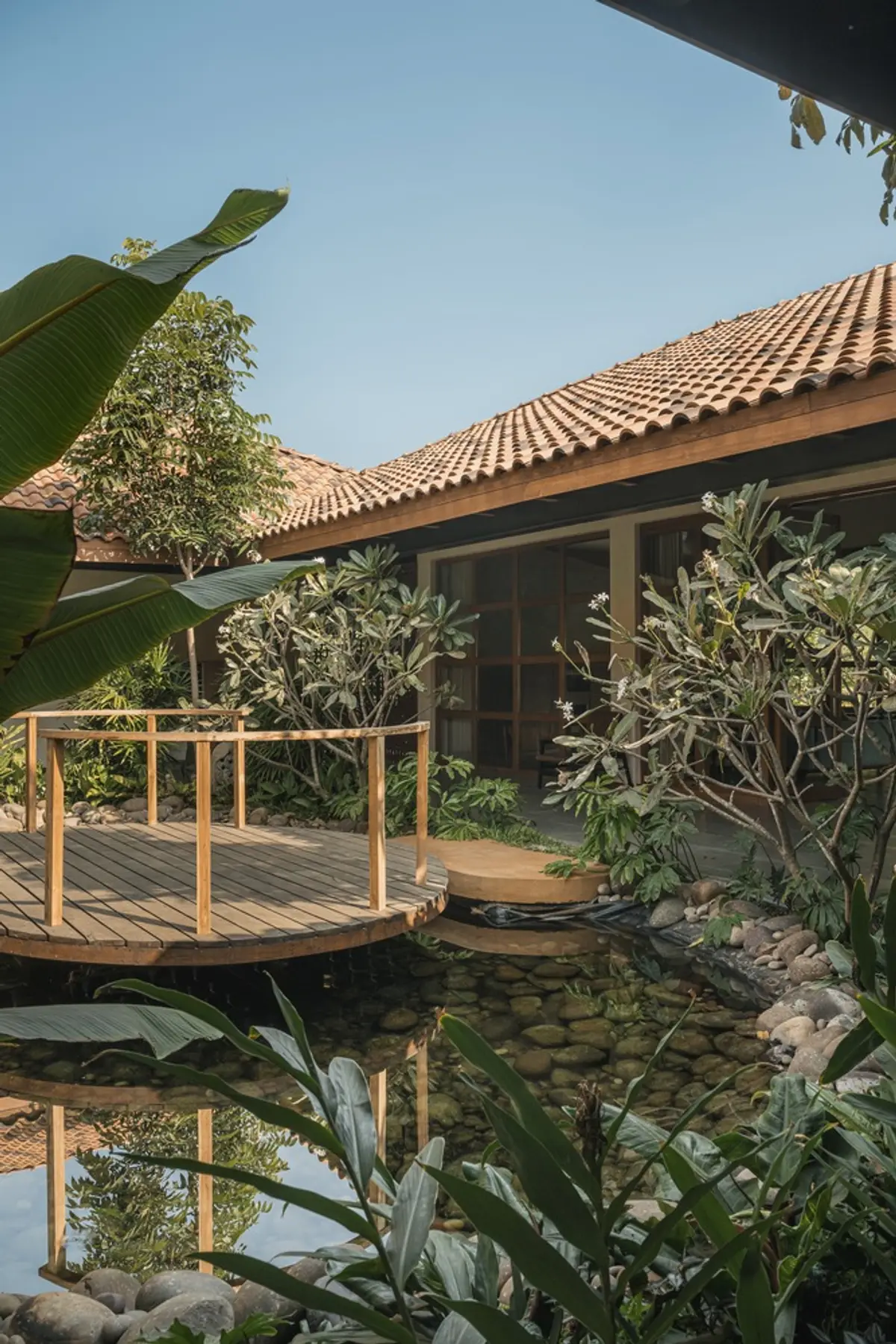
23 Degrees Design Builds an All-Timber Courtyard House Rooted in Telangana's Manduva Tradition
A six-bedroom family retreat in Mansanpally village near Hyderabad trades metal for wood and rethinks the traditional courtyard plan.


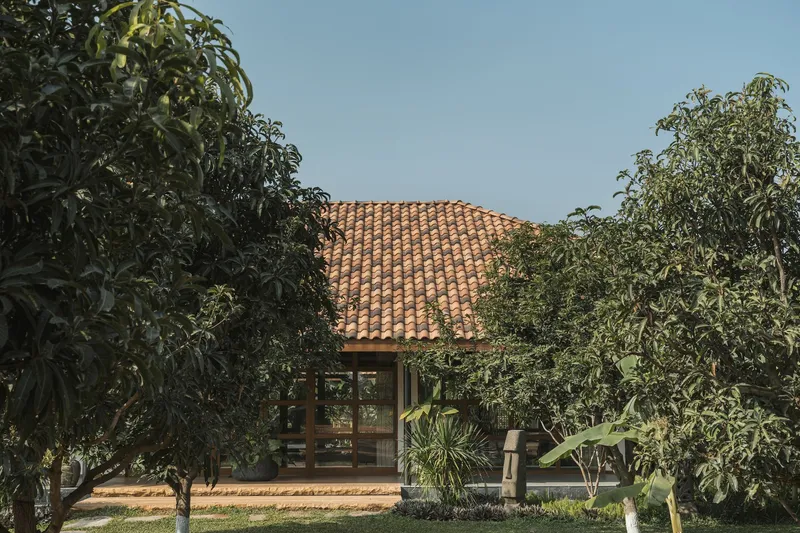
Forty kilometers outside Hyderabad, buried at the end of a narrow path through a mango orchard, sits a house that could easily be mistaken for a small village. Four detached timber pavilions ring a central courtyard, their clay tile roofs pitched at easy angles beneath a canopy of frangipani and banana trees. The project, designed by 23 Degrees Design, began as a single-bedroom farmhouse and grew into a 14,000 square meter family compound for the client and their extended relatives. Its reference point is the traditional Manduva house, a courtyard typology native to the Telangana region, but the result is something distinctly contemporary: open, airy, and built almost entirely without metal structural members.
What makes this project worth studying is not the courtyard itself, which is common enough in South Asian residential design, but the structural commitment. The entire roof system is timber: trusses, beams, purlins. No steel moment frames, no hidden reinforced concrete cores propping up a decorative wood skin. The architects fragmented the roof into four smaller sections unified under a single organizational logic, and then detached the blocks from each other to let wind pass through from every direction. It is a house designed around absence: the gaps between buildings, the voids in the roof plane, the open thresholds between inside and out.
Four Pavilions Around a Green Core
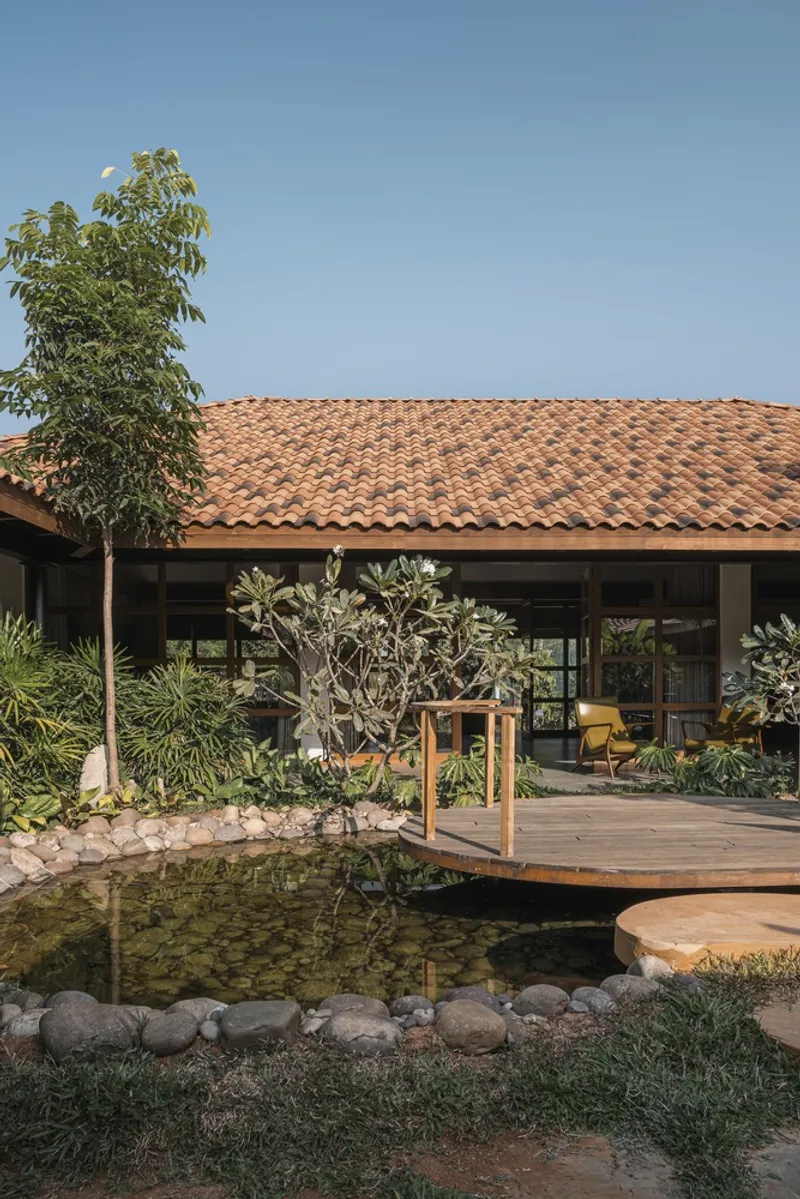
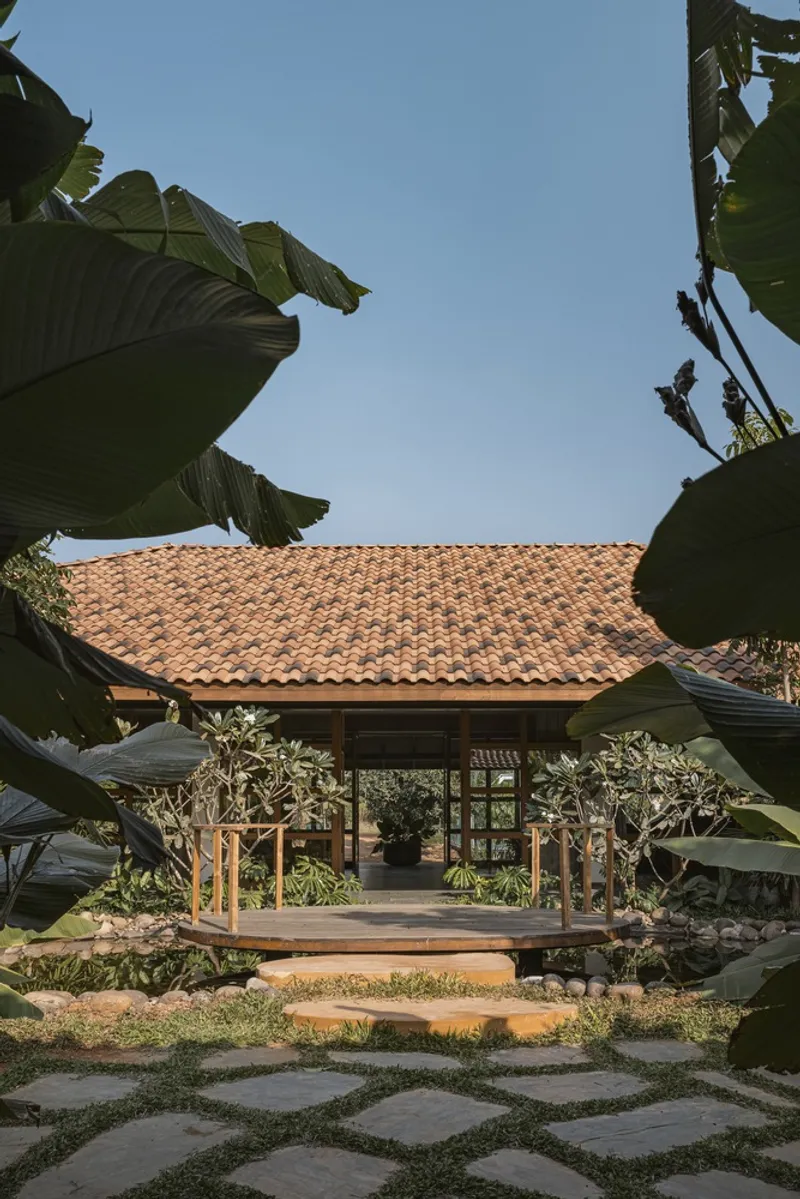
The compound reads as a cluster rather than a single building. Each pavilion sits slightly apart from its neighbor, and the central courtyard functions less like a room and more like a village square. There is a planted pond, a suspended timber deck, and enough open ground for communal gatherings. The water element is not decorative. It serves as a climatic regulator, cooling air before it enters the surrounding rooms.
The approach sequence matters. You arrive through the mango orchard, cross a waterbody at the entrance, and pass through a semi-open veranda before the courtyard reveals itself. The architects clearly understood that the power of the Manduva courtyard lies in the arrival, the slow transition from enclosed path to open sky. By keeping the approach narrow and the courtyard wide, they amplify the spatial release at the center.
Timber Structure, No Steel
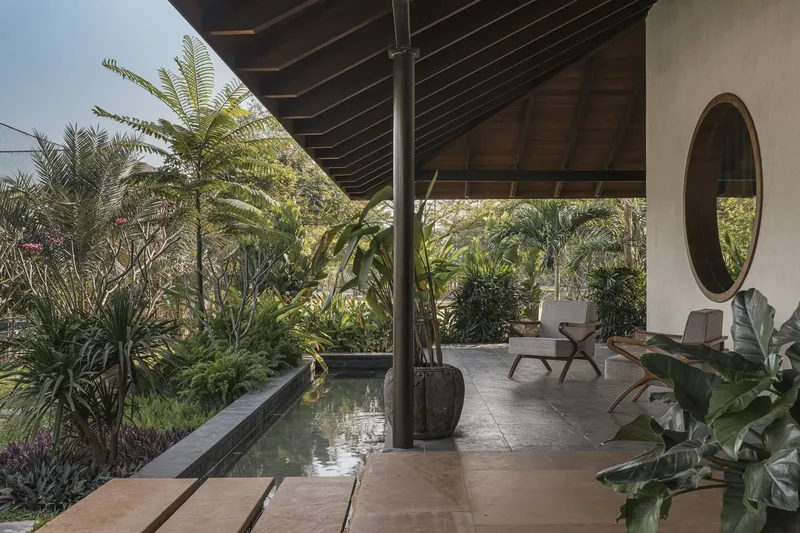
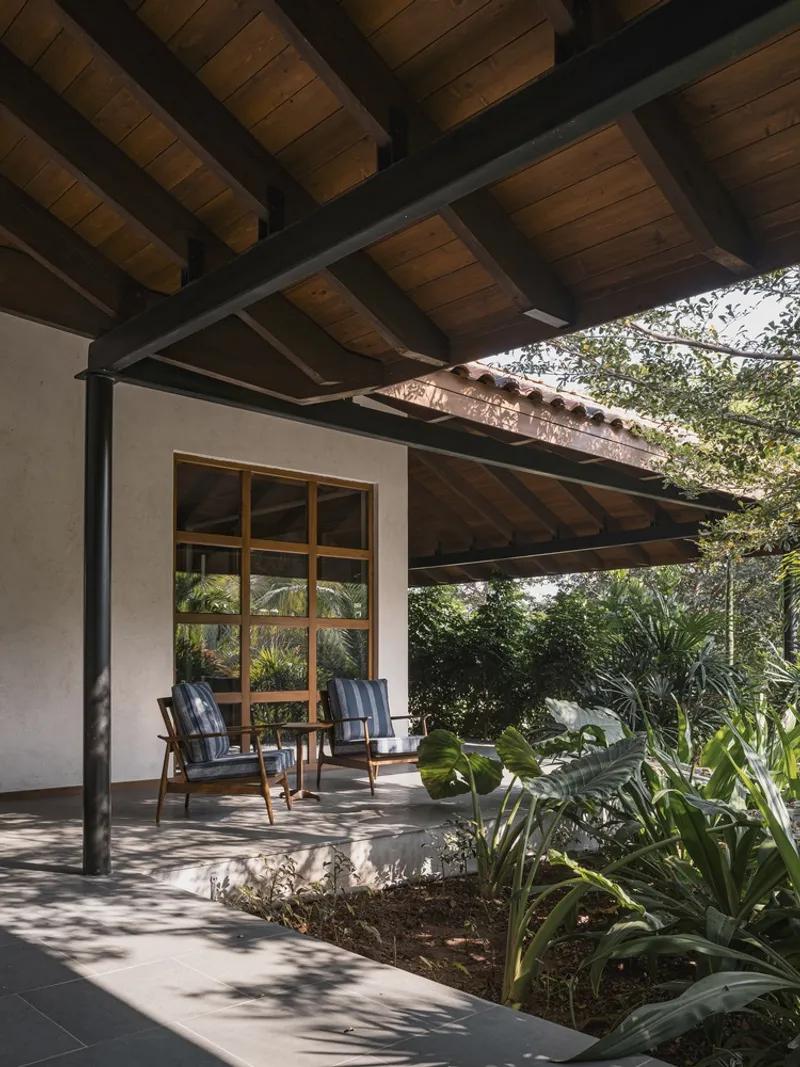
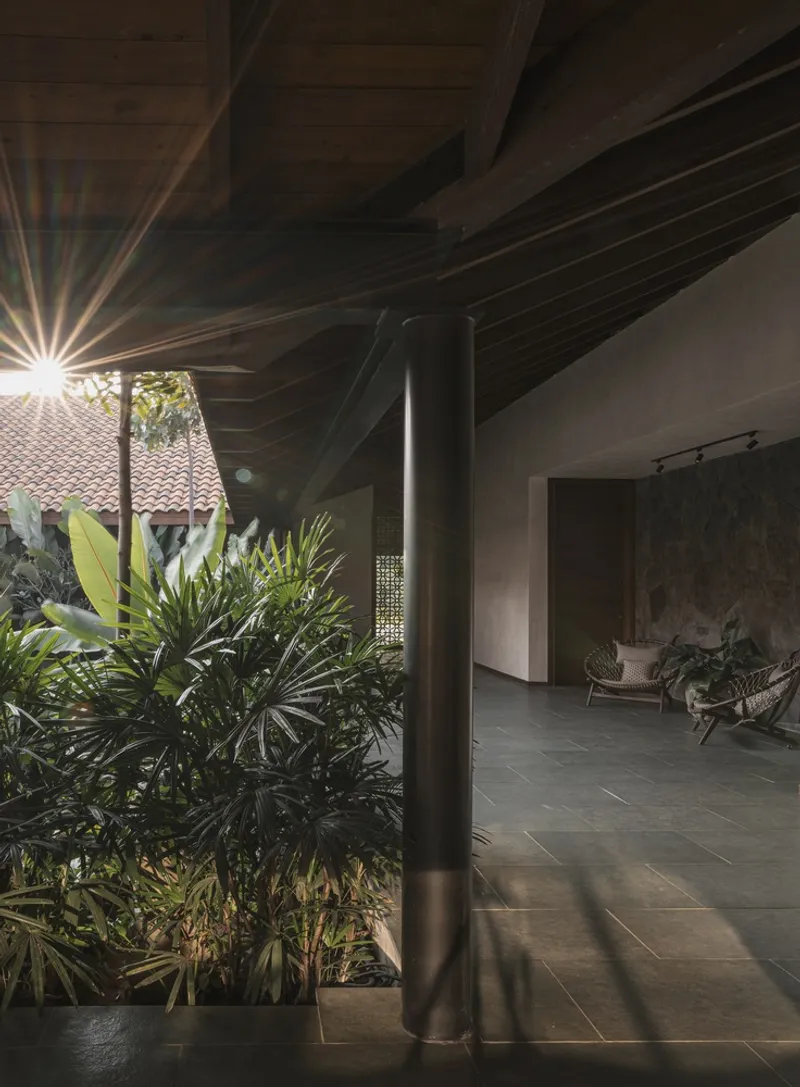
The roof is the defining gesture. Exposed timber trusses span each pavilion, their triangulated geometry visible from every interior space. Spanish terrace tiles sit atop the timber framing, giving the roofline a warm, earthy color that blends with the surrounding vegetation. The decision to avoid metal structural members entirely is unusual for a house of this scale and speaks to a genuine engagement with pre-industrial building methods rather than a surface-level nod to tradition.
Steel columns do appear at the verandas and covered walkways, serving as slender supports for the extended roof overhangs. But the primary structure, the bones of each pavilion, is wood. The distinction is worth noting: the architects did not eliminate steel from the project, they eliminated it from the structural system that defines the building's spatial character. The trusses are the architecture. Everything else is subordinate.
Thresholds and In-Between Spaces
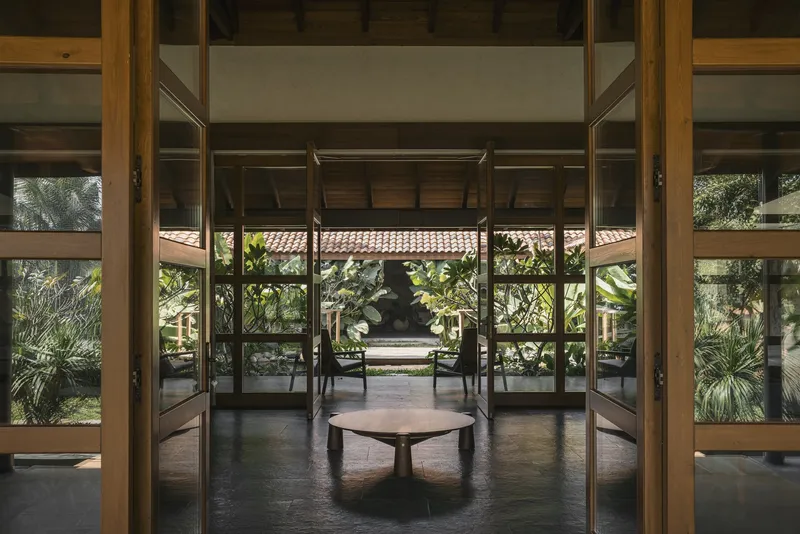
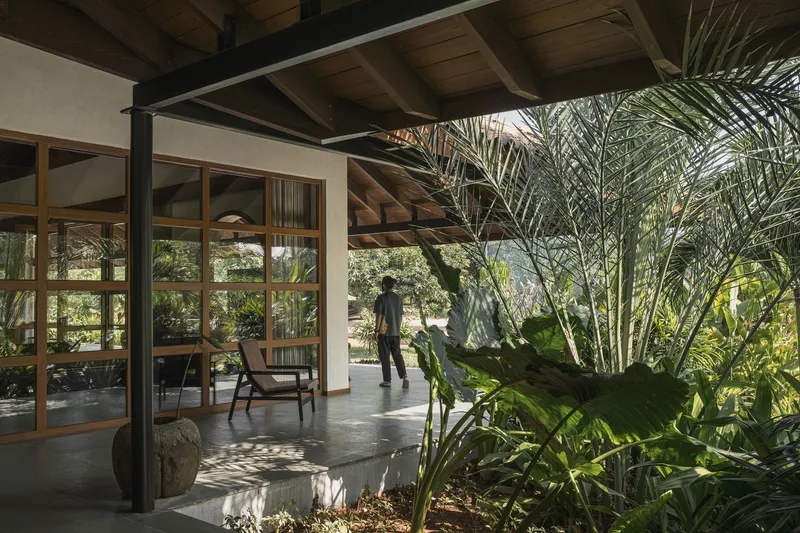
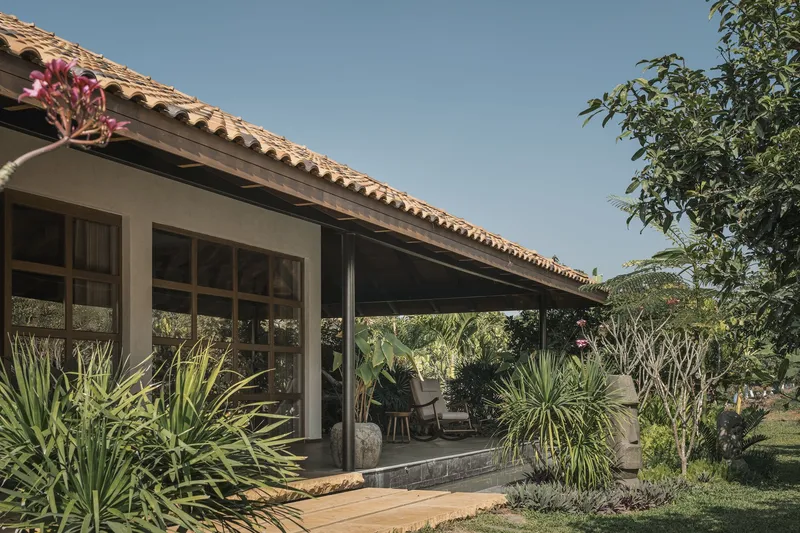
The most compelling spaces in this house are neither fully inside nor fully outside. Covered terraces, shaded walkways, and semi-open verandas account for as much square footage as the enclosed rooms. Timber ceilings extend well beyond the glass line, creating deep overhangs that shelter outdoor seating areas and planted beds. The effect is a gradual gradient from courtyard to corridor to room, with no hard boundary between landscape and architecture.
Each of the six bedrooms opens onto a rear veranda with its own private green space. The bedroom doors are recessed and positioned to the side, preventing direct visual connection to the central courtyard. It is a smart move for a multi-generational household: privacy is maintained through geometry, not walls. You can move from your bedroom to the communal courtyard in a few steps, but nobody can see into your room from the center of the house.
Material Palette: Stone, Wood, White
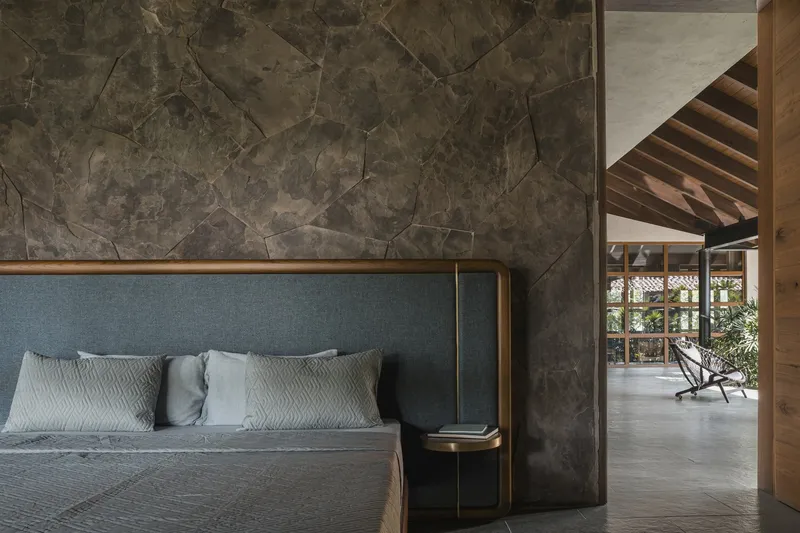
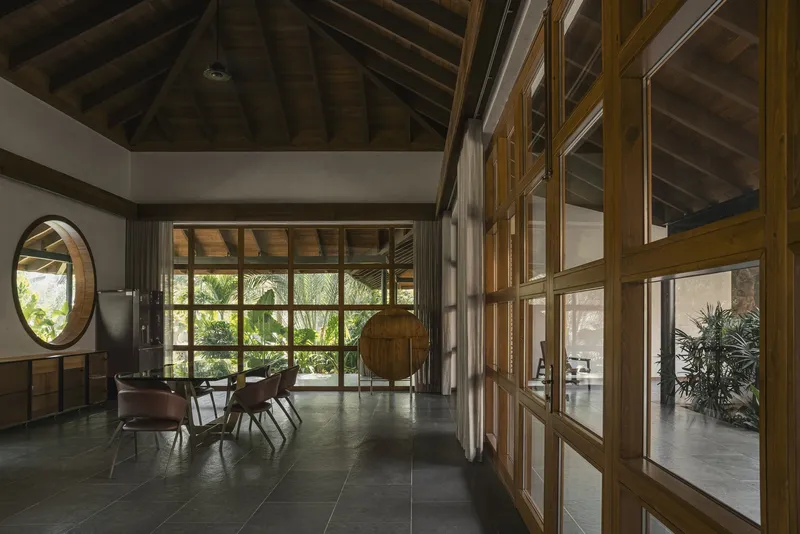
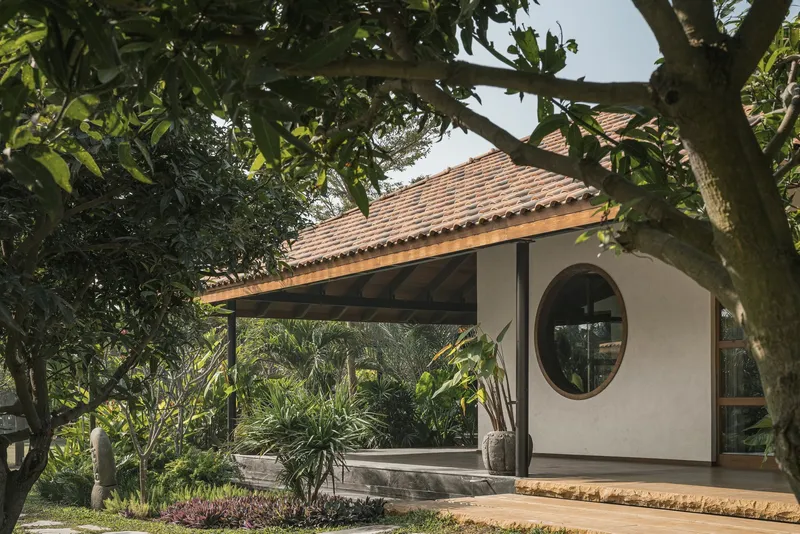
The interior material strategy is restrained to the point of severity. Kota stone with a leather finish unifies the flooring across semi-open and enclosed spaces, providing a consistent tactile ground plane. Civil walls receive a white micro-topping finish that reads almost like plaster, keeping the backdrop neutral so the timber roof structure can dominate visually. Brown sandstone appears as feature walls at strategic locations, adding warmth without competing with the wood.
The circular windows that punctuate several walls are a quiet formal move that distinguishes this project from a purely traditional vocabulary. They frame specific views, admit controlled light, and introduce a geometric counterpoint to the linear timber framing. Combined with the gridded glass doors and timber-framed partitions, they give the interiors a layered quality: you are always looking through multiple planes toward the landscape beyond.
Living with the Landscape
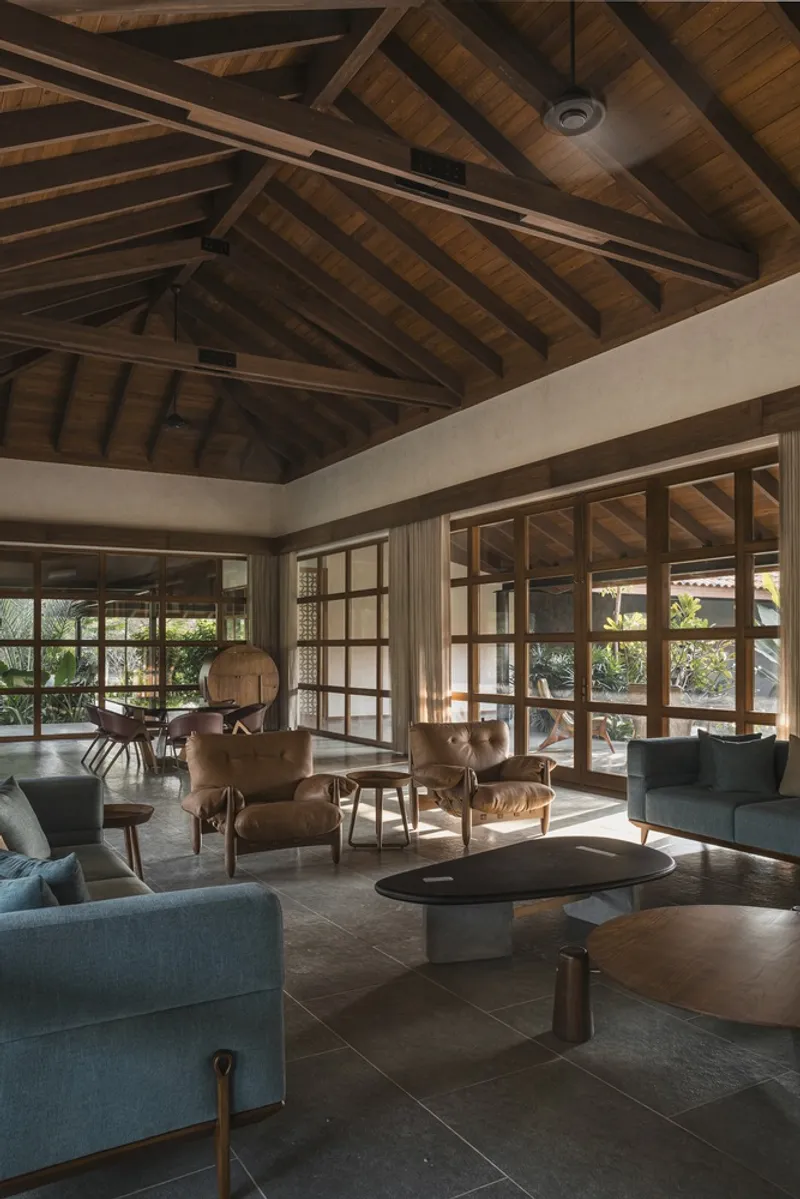
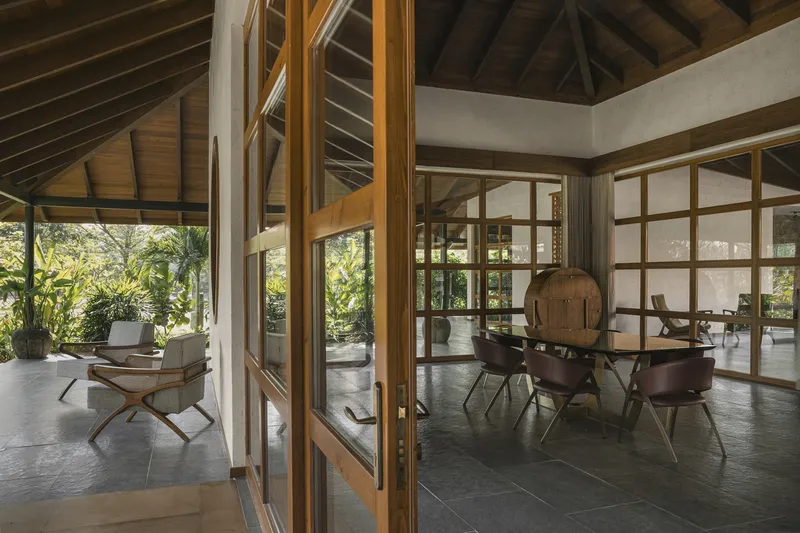
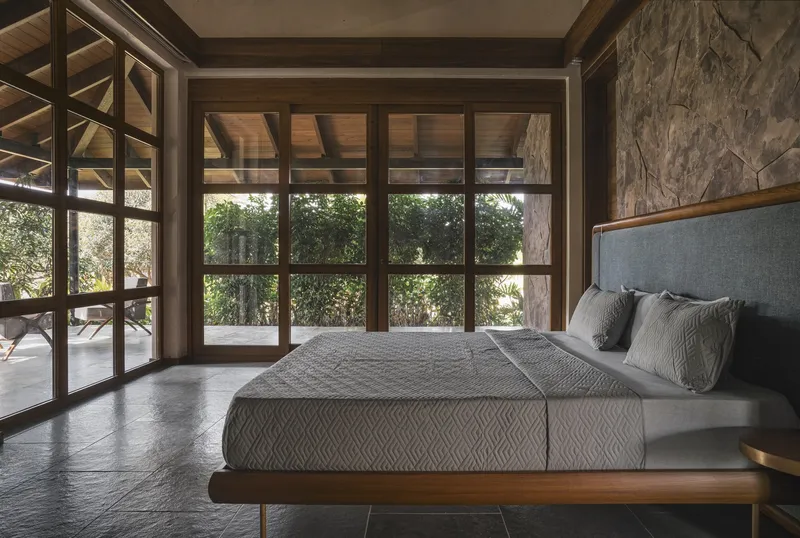
The gridded glass doors that define the living spaces are the project's primary interface between interior comfort and exterior environment. They fold open completely, collapsing the distinction between living room and garden. The exposed timber trusses continue overhead regardless of whether you are inside or outside, providing spatial continuity across the threshold. Furniture is colorful and deliberately casual, reinforcing the idea that this is a retreat, not a formal residence.
The landscape strategy reinforces the courtyard logic. Succulents, palms, banana plants, and mature trees are arranged informally around and between the pavilions, softening the geometry without obscuring it. The koi pond beneath the timber deck pavilion brings life and movement to the compound's center. The architects clearly intended for the vegetation to grow into and around the architecture over time, blurring the boundary between what was designed and what simply grew.
The Living Room as Anchor
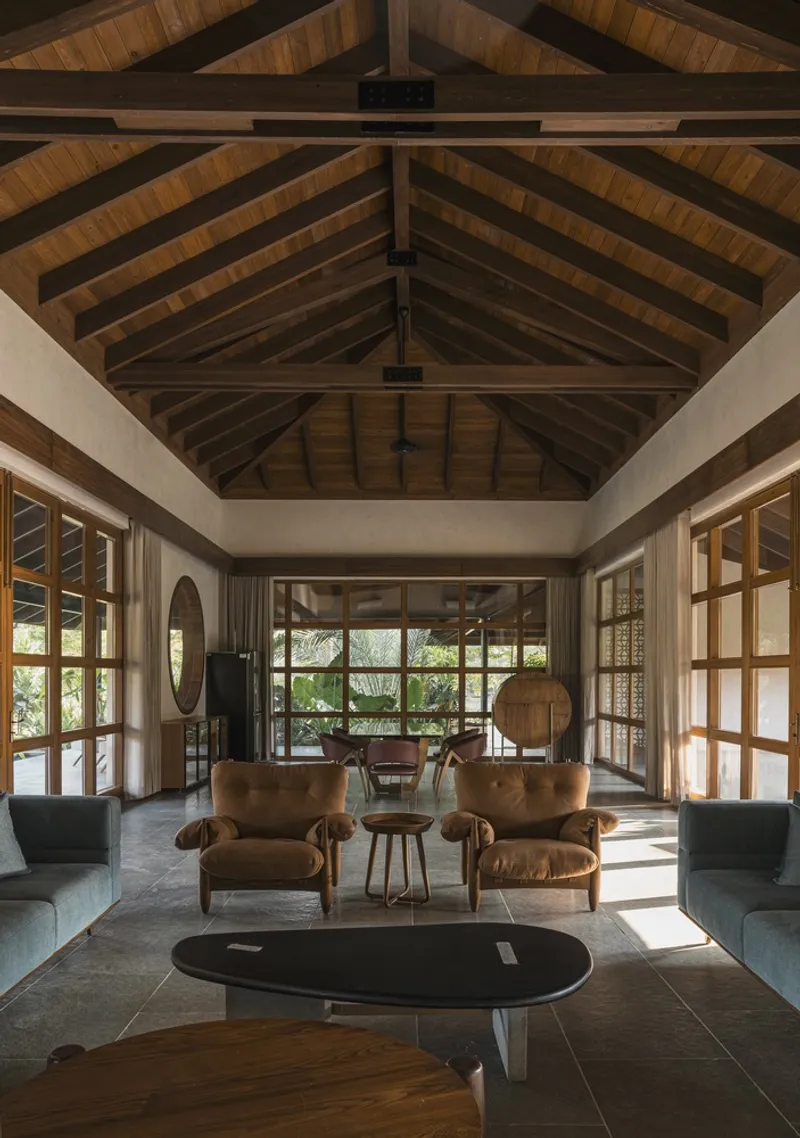
The main living room sits beneath the most dramatic timber truss, a high vaulted ceiling that gives the space a generosity well beyond its footprint. An arched mirror above a pair of leather armchairs subtly echoes the roof geometry, and timber screen partitions modulate the boundary between living area and covered terrace. The room is both the most enclosed space in the house and the most connected, with sightlines extending through gridded glazing to the garden on multiple sides.
Plans and Drawings
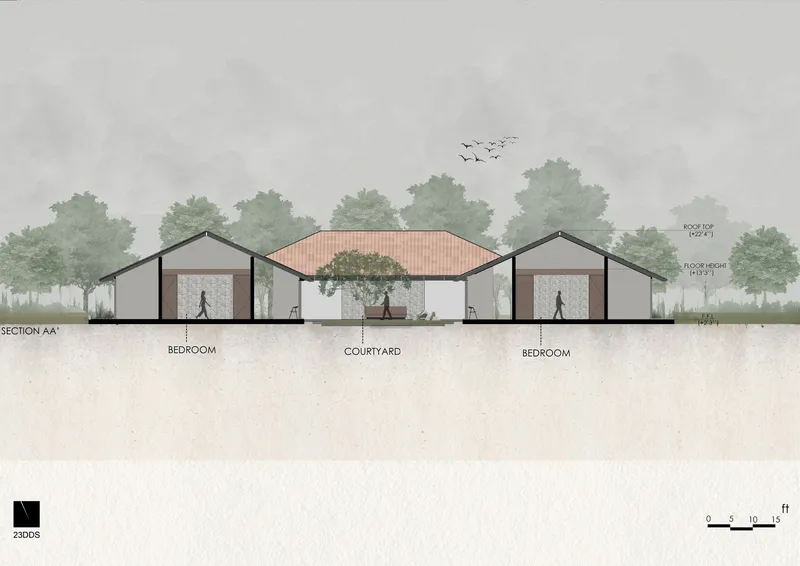
The section drawing reveals the project's fundamental logic: three gabled volumes arranged around a central courtyard with a tree at its heart. The pitched roofs step down gently, and the space between them is as important as the space beneath them. Birds fly overhead in the drawing, a romantic touch that nonetheless communicates something true about the project's openness to the sky.
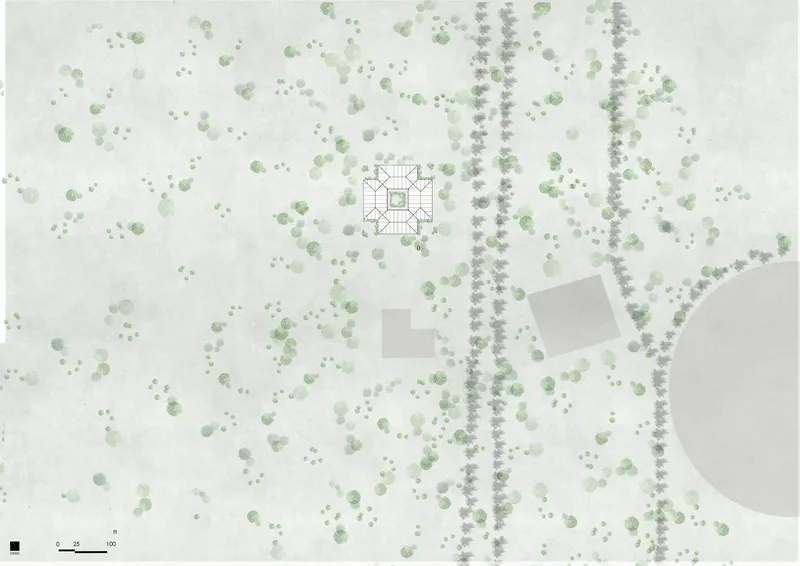
The site plan shows how deliberately the compound is embedded in its landscape. The building footprint occupies a relatively modest portion of the overall site, surrounded by scattered mature trees and framed by linear tree-lined pathways. The approach sequence from the mango orchard is clearly legible: a single path leads through dense planting to the entrance, compressing the experience before the courtyard opens up.
Why This Project Matters
The Courtyard House succeeds because it takes a regional typology seriously enough to reinvent it. The Manduva house is not treated as a nostalgic image to be reproduced in render-friendly materials. Instead, 23 Degrees Design extracted its organizational principle, the courtyard as social and climatic engine, and rebuilt it with a structural system and spatial openness that respond to how a contemporary multi-generational family actually lives. The decision to build the primary structure entirely in timber is not a gimmick; it produces a fundamentally different acoustic, thermal, and visual experience from what a steel or concrete frame would yield.
More broadly, this project demonstrates that vernacular architecture is not a style to be quoted but a set of strategies to be deployed. The detached pavilion plan allows cross-ventilation without mechanical systems. The deep overhangs eliminate solar gain on interior walls. The courtyard creates a microclimate that is measurably cooler than the surrounding fields. These are not aesthetic choices; they are performance decisions that happen to produce beautiful spaces. In a climate where air conditioning has become the default response to heat, a house that works this hard to avoid it deserves attention.
Courtyard House by 23 Degrees Design, Mansanpally village, Hyderabad, India. 14,000 sq. m. Photographs by The Fishy Project.
About the Studio
Share Your Own Work on uni.xyz
If projects like this are the kind of work you want to make, uni.xyz is a place to publish your own, find collaborators, and enter design competitions.


Popular Articles
Popular articles from the community


Cube Design Draws an Ecological Corridor Between Two Shenzhen Hills with the Nankai Building
Beside Shenzhen's container docks, the Nankai Building pairs stacked balconies with a climbing green screen to connect two hillsides across its height.

David Ortega Stacks a Two-Story Mexico City Penthouse Around a Steel Stair and a Pergola-Shaded Roof Terrace
In Colonia Roma, a 300 m² penthouse uses oak joinery, a planted steel stair and a slatted roof pergola to make a new-build apartment feel like a house.


Manzana Morphosis: Stretching Barcelona's Grid into a Living Landscape for 2050
A radical reworking of the Eixample manzana turns density into a tool for generous public space, vertical ecology, and environmental performance.

Opera on the Sea: Driftwood Logic Shapes a Timber Opera House on Estonia's Coast
Trevor Orgill's opera house translates the entangled drift of floating timber into a civic building where wood, water, and music converge.

Similar Reads
You might also enjoy these articles

Bamboo Housing Challenge 2026: Design Affordable, Sustainable Homes Using Bamboo
An international design competition by Bamboo U and IBUKU inviting architects and designers to reimagine affordable housing using bamboo — with the winning design built full-scale in Bali.

Computational Design & Education: Beegraphy Design Awards Introduces 7th Category (Featuring Jiyun's Innovative Approach)
Dive into Beegraphy’s 7th Design Awards category, where computational design meets education to create immersive, interactive learning tools, inspired by Jiyun’s work.

From Parametric Lighting to Urban Furniture: Join the 2nd Workshop in Beegraphy’s Computational Design Series
Dive into Cutting-Edge Design Techniques and Practical Applications with Industry Experts

Last Call: Unleash Your Architectural Genius in SHAK's Kindergarten Design Competition
Urgent call for architects to join SHAK's kindergarten design competition before the looming deadline

Explore Vernacular Architecture Competitions
Discover active competitions in this discipline

Challenge to reimagine the Iron Throne

Photograph architecture without architects

Illustrate the lost glory of Angkor Wat - Render Challenge

Design challenge to reuse E-waste
Comments (0)
Please login or sign up to add comments
No comments yet. Be the first to comment!