

AR Arquitectos Sinks a Black Concrete House into a Steep Hillside in La Calera, Córdoba
In La Calera, outside Córdoba, a 550 m² family home pairs black-stained concrete with timber slats and is entered from below, through its sunken floor.


La Calera sits just outside Córdoba, a hilly, semi-rural town where houses climb slopes that are steep enough to make every section drawing an argument with gravity. For a family client, Córdoba studio AR Arquitectos has built the Black House: 550 m² over two storeys, finished in 2022, with exterior walls of black-stained concrete and a long upper volume wrapped in timber slats.
Black concrete gets the headline, but we think the section matters more. The lower floor is partly buried in the hill, so you arrive by walking down steps to a front door that sits below the street. Cars take a ramp down to a garage laid out like a breezeway, which keeps views open through the house. The studio says its aim was to break with conventional premises and make concrete the main material, used in every sense. What holds our interest is how that heavy palette is put to work on a difficult slope, and how much the timber softens it.
A Dark Bar on a Corner Plot
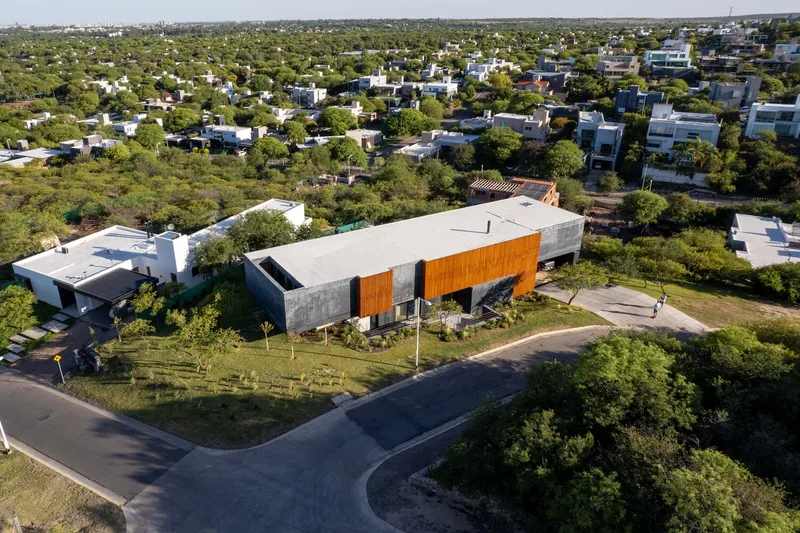
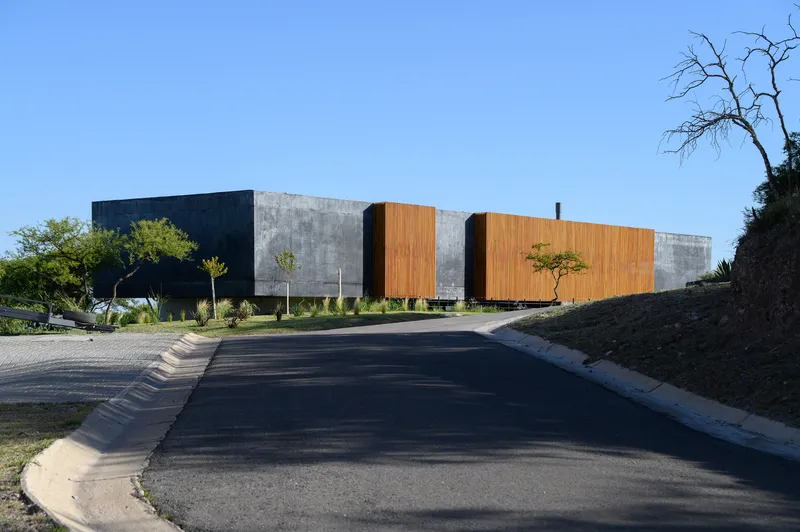
The aerial view explains the neighbourhood: white houses, mature trees, and one flat-roofed dark mass on a corner. The house does not try to blend in. It sets itself apart with tone rather than form, and the form itself stays disciplined, a set of parallel, overlapping volumes and nothing more.
From the street, the long block reads as charcoal concrete topped by a band of timber slats. The horizontality is deliberate. On a sloping site, a long flat volume works like a datum, a level line the terrain falls away beneath, and it makes the drop visible instead of hiding it.
Arriving by Going Down
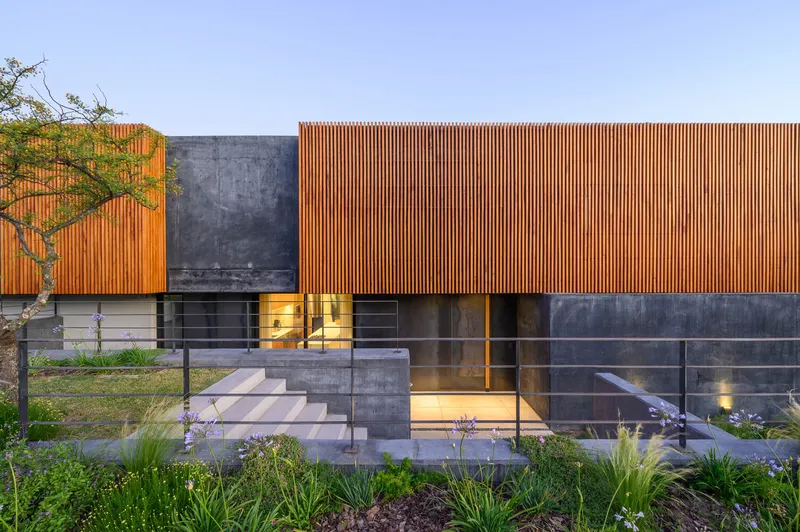
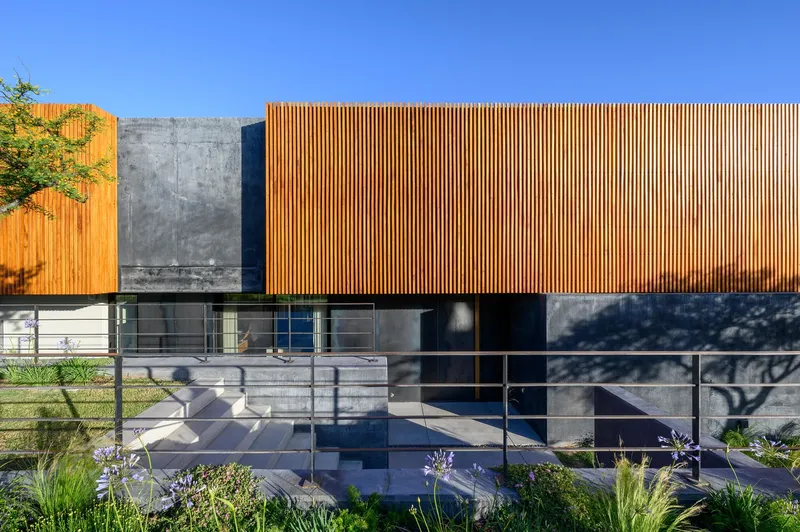
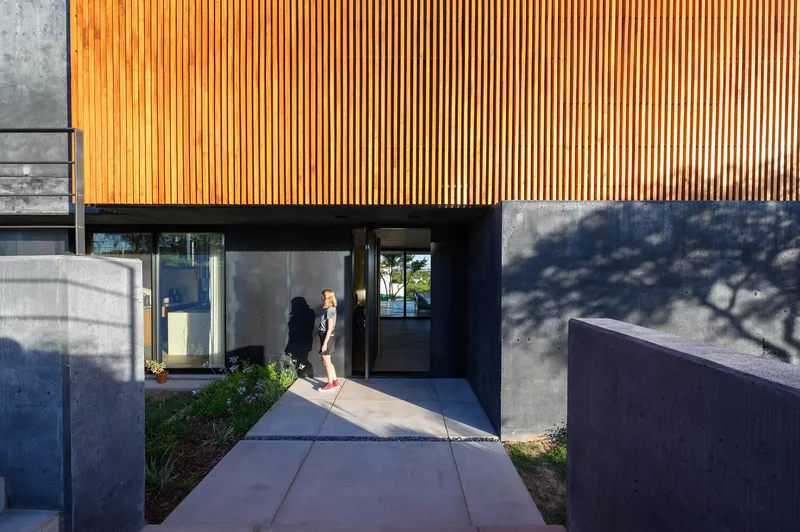
Most hillside houses make you climb toward the view. This one asks you to descend. Concrete steps with slim steel railings lead down to the entrance, and the timber volume cantilevers overhead like a canopy. The move compresses you briefly before the interior opens up, a well-worn sequence that pays off here because the lower floor gives onto mountain views.
Tree shadows on the dark wall do some of the work that ornament once did. Black-stained concrete is unforgiving in flat light but comes alive in raking sun, and the photographs make clear that the architects knew this. Entry is through the centre of the house, so the first thing you meet inside is the open plan rather than a corridor.
Timber as a Second Skin
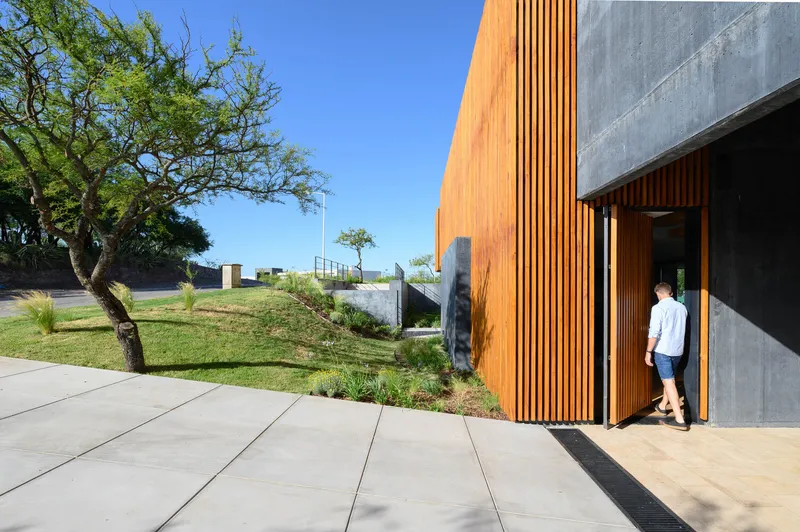
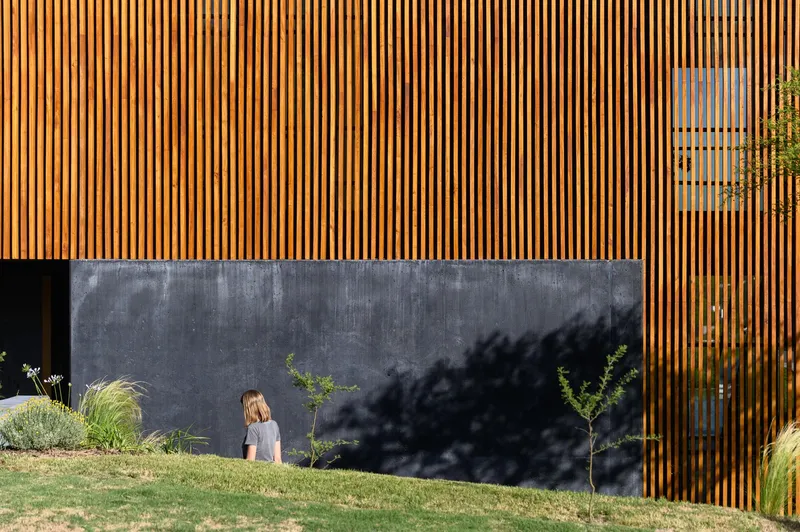
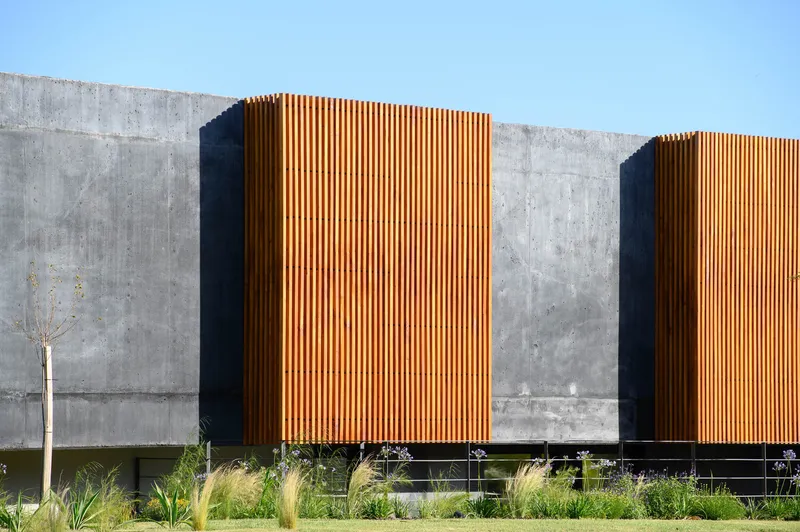
The vertical slats, described as kiri wood, are the counterweight to all that concrete. They filter light and give the facade a finer grain, and in one case they swing open: a pivoting slat door lets you pass straight through what looks like a solid screen. That kind of detail rewards a second look.
Where slat panels meet board-marked concrete above a bed of grasses and agapanthus, the material story is easy to read. The concrete carries the imprint of its timber formwork, and real timber sits right next to it. Whether or not that echo was intended, it ties the two materials together better than a simple light-against-dark contrast would.
Working with the Slope
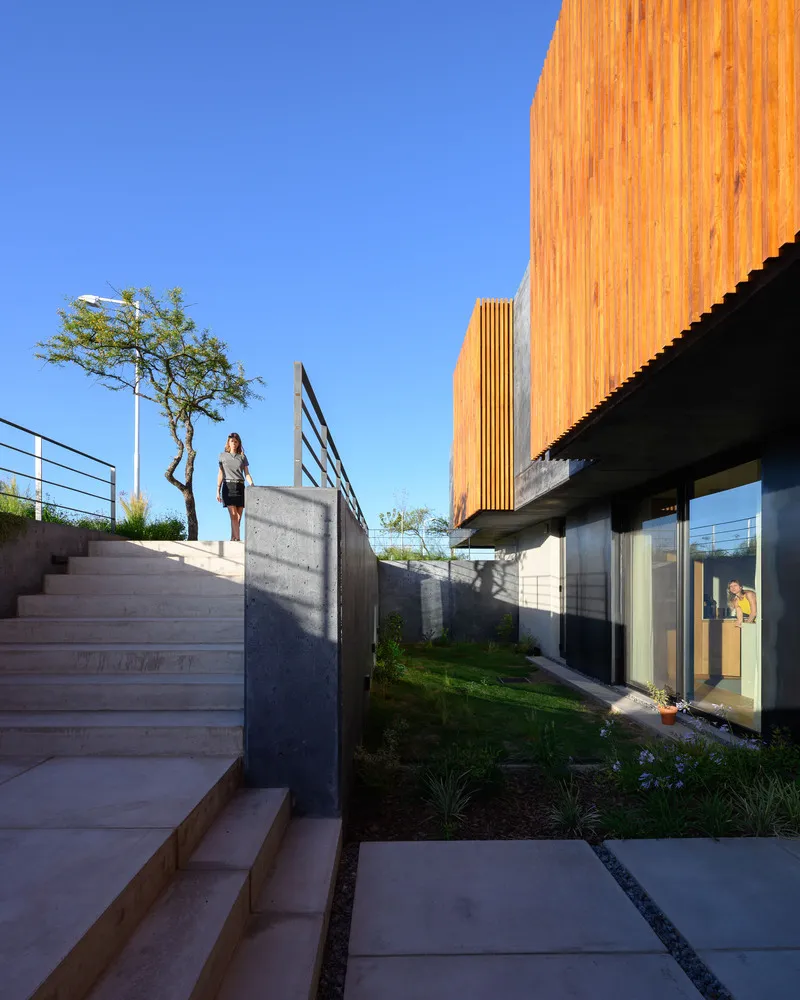
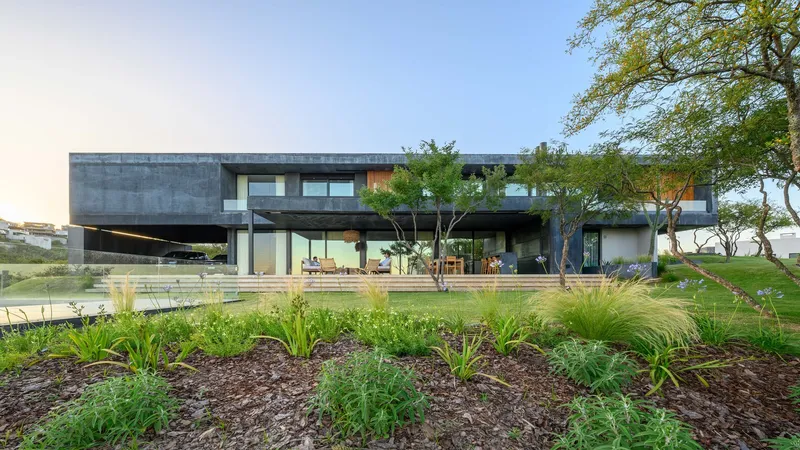
A concrete stair and retaining wall run alongside the timber-clad volume. Here the structure and the landscape are the same thing: the walls that hold back the hill also shape the outdoor routes. Partly sinking the lower floor is a practical response to the topography, and it gives the social spaces a sense of being anchored.
At dusk, from the garden side, the arrangement inverts. The dark upper volume hovers over a glazed terrace, and the lower level glows through tall sliding glass walls. The heavy block on top of a transparent base is the house's clearest gesture, and it lands best seen from below, across the planting.
One Open Room Below
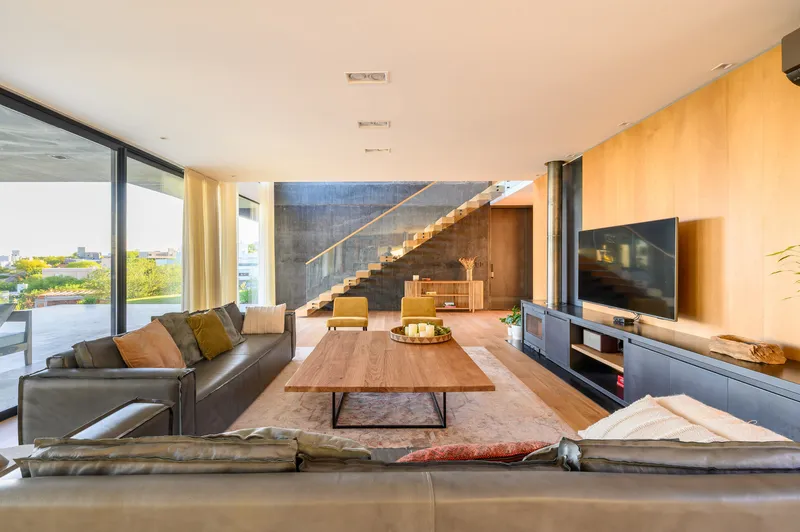
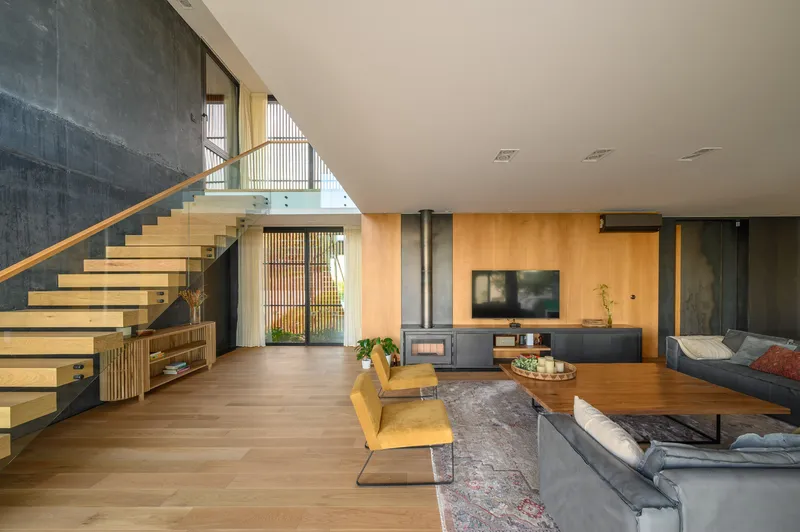
The communal areas form a single open-plan level. Inside, the floating timber staircase against a concrete wall is the centrepiece: oak treads with no visible stringer, set in a double-height space, with a glass balustrade that keeps the stair from cluttering the room. It is a familiar device, but it is executed with restraint.
The palette stays tight: leather, oak, concrete, a fireplace flue, a timber wall panel. Yellow chairs supply the one loud note. Low evening sun crossing the concrete shows why the architects pushed glazing to the full height of the common areas. With the light coming in sideways, the walls change through the day.
Private Rooms in Timber
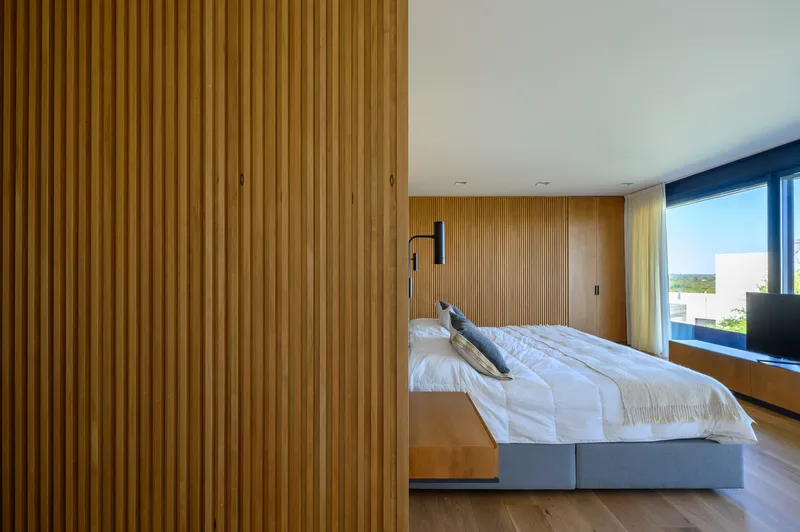
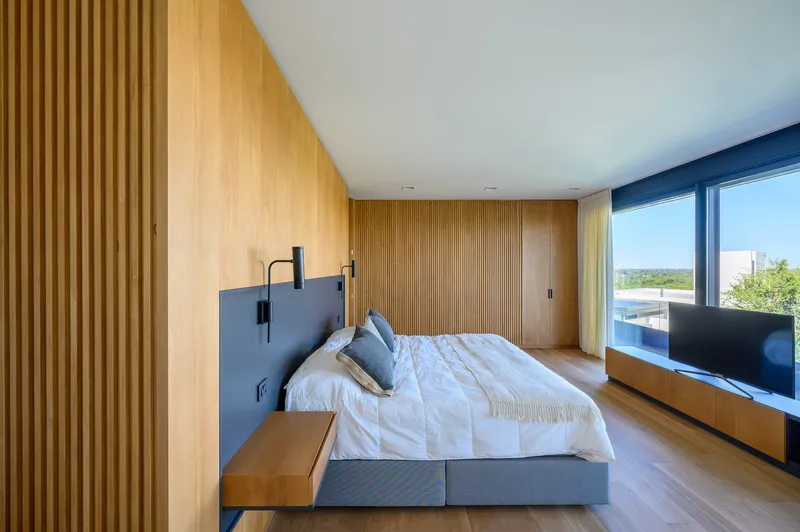
Upstairs, timber takes over. Slatted partitions and wood wall panels line the bedrooms, a floating nightstand keeps the floor clear, and corner windows frame treetops instead of the street. After the weight of the ground floor, these rooms feel lighter and quieter, and that shift in material marks the boundary between public and private clearly.
The slatted partition in one bedroom borrows the facade's language for an interior screen. That continuity between inside and outside is consistent throughout the house, and it keeps the project from reading as a concrete shell with an unrelated interior inserted into it.
Why This Project Matters
Black concrete houses risk becoming a style exercise, all mood and no reason. The Black House avoids that because its strongest decisions come from the site: the sunken lower floor, the downward entry, the ramped breezeway garage, and the retaining walls that double as landscape. The colour comes second. The section does the real work.
For you as a designer, the lesson is about pairing. Concrete alone would have been severe on a residential street, and timber alone would have been ordinary. Together, with the slats doing the work of a screen, a door, and an interior partition, they give a 550 m² family home both mass and grain. Anyone building on a steep plot can learn from it.
Black House by AR Arquitectos, La Calera, Córdoba, Argentina. Area: 550 m². Year: 2022. Photography by Gonzalo Viramonte.
About the Studio
Share Your Own Work on uni.xyz
If projects like this are the kind of work you want to make, uni.xyz is a place to publish your own, find collaborators, and enter design competitions.


Popular Articles
Popular articles from the community


David Macias Steps a Doorless Stone and Plaster House Down a Tropical Colombian Hillside
In the humid hills of Colombia, Threshold House replaces the front door with an open void and terraces its 850 m² down the slope instead of fighting it.

David Ortega Stacks a Two-Story Mexico City Penthouse Around a Steel Stair and a Pergola-Shaded Roof Terrace
In Colonia Roma, a 300 m² penthouse uses oak joinery, a planted steel stair and a slatted roof pergola to make a new-build apartment feel like a house.

Juan García Correa, John González and Claudia Rueda Sink a Circular Amphitheater into a Manizales Engineering Building
On the La Nubia campus in Manizales, Colombia, the S1 Building folds labs and offices into a hillside of ramped lawns that double as a campus route.

longwave studio Reorganizes a 112 m² Tainan Apartment Around the Daily Routines of a Family and Two Cats
In Tainan, Taiwan, birch plywood, rust-red furniture and a freestanding plaster wall link arrival, storage, work and family life in one apartment.

Similar Reads
You might also enjoy these articles

Bamboo Housing Challenge 2026: Design Affordable, Sustainable Homes Using Bamboo
An international design competition by Bamboo U and IBUKU inviting architects and designers to reimagine affordable housing using bamboo — with the winning design built full-scale in Bali.

Computational Design & Education: Beegraphy Design Awards Introduces 7th Category (Featuring Jiyun's Innovative Approach)
Dive into Beegraphy’s 7th Design Awards category, where computational design meets education to create immersive, interactive learning tools, inspired by Jiyun’s work.

From Parametric Lighting to Urban Furniture: Join the 2nd Workshop in Beegraphy’s Computational Design Series
Dive into Cutting-Edge Design Techniques and Practical Applications with Industry Experts

Last Call: Unleash Your Architectural Genius in SHAK's Kindergarten Design Competition
Urgent call for architects to join SHAK's kindergarten design competition before the looming deadline

Explore Architecture Competitions
Discover active competitions in this discipline

Challenge to reimagine the Iron Throne

Photograph architecture without architects

Illustrate the lost glory of Angkor Wat - Render Challenge

Design challenge to reuse E-waste
Comments (0)
Please login or sign up to add comments
No comments yet. Be the first to comment!