
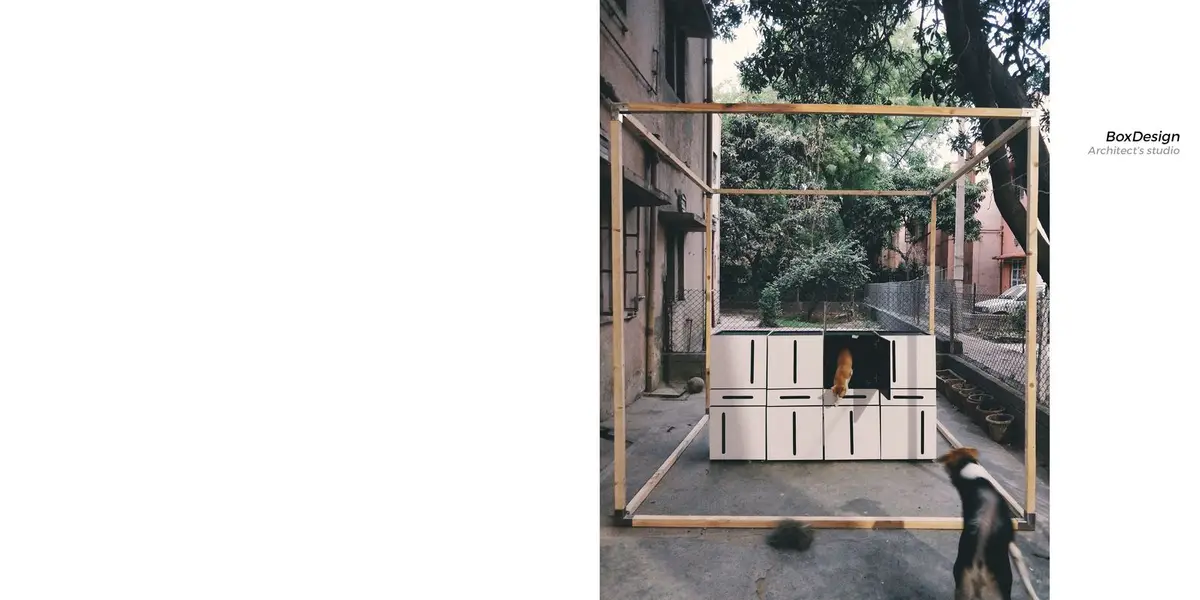
BoX: A Pine Frame and Stackable Cupboards That Rethink Furniture for Small Rooms
Vivek Namdev's modular system pairs a Canadian pine frame with repeatable cupboard modules, keeping windows clear and small rooms open to light.


Most furniture for small apartments fails in the same way: it fills the room it was meant to serve. BoX starts from the opposite premise. Rather than offering a fixed object, it offers a framework, a timber cage that holds stackable cupboards, drawers and work surfaces. That framework can be replicated, resized and rearranged as the room, the programme or the occupant changes. The furniture behaves less like a product and more like a small piece of architecture: a contained volume with its own structural logic, sitting lightly inside a larger one.
The project was developed by Vivek Namdev and published on uni.xyz as a study in how compact interiors can be reshaped through flexible geometry, minimal material use and adaptable construction. Its intended settings are broad: residential studios, workspaces, compact apartments and hybrid living environments. These are the spaces where a single bulky wardrobe or desk can decide how the entire room gets used. Namdev's answer is a boxed system that can evolve into several furniture typologies while keeping the interior open and legible.
Starting at the Windowsill, Not the Wall

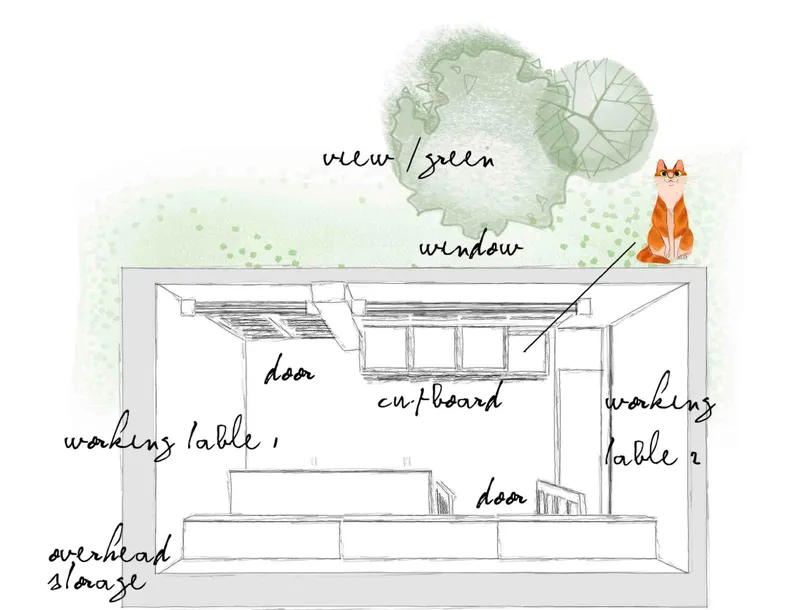
The watercolour concept sketch is disarmingly domestic: a standing figure, a cat and a window, with a run of cream cupboards tucked beneath the sill. It is a telling first move. By placing the unit under the window rather than against a blank wall, Namdev keeps the storage below eye level. Daylight reaches deep into the room and the view outward stays unbroken. In a small space, light and outlook are the scarcest resources, and the furniture is designed to protect both rather than compete with them.
The sketched plan confirms that this is a spatial decision, not a decorative one. Windows, cupboards, doors and work tables are mapped together within a single rectangular room, with trees and a seated cat drawn just outside. The unit sits at the threshold between interior and exterior, and its top edge becomes a ledge for working, pausing or watching. The furniture gives the room a place to inhabit the window, turning a constraint into the room's most occupied edge.
Nine Frames of Stacking and Shuffling
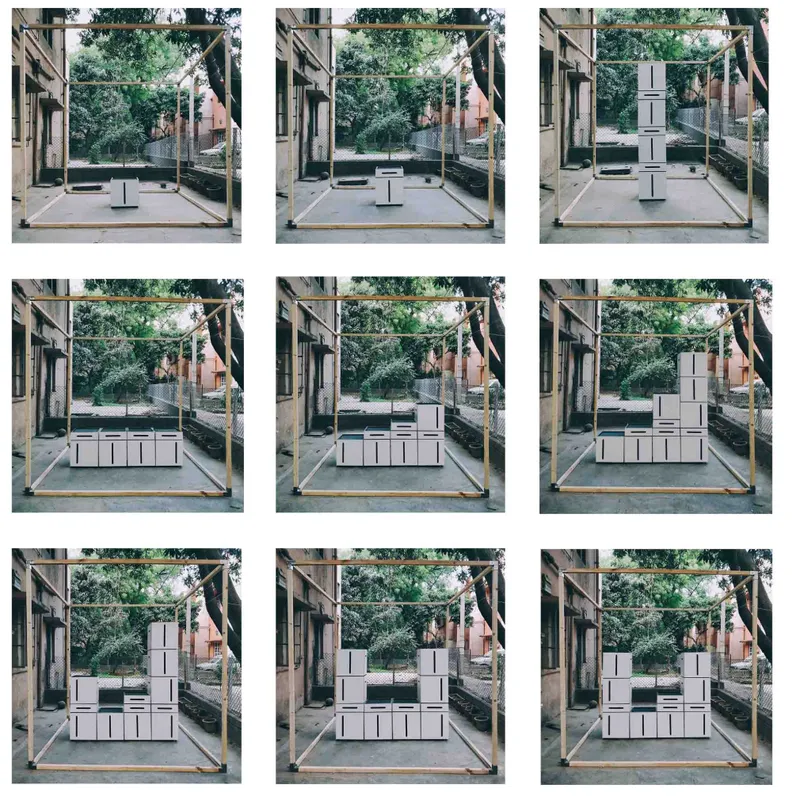
The strongest argument for BoX is this nine-frame photo sequence. White cupboard modules are stacked, removed and rearranged inside a timber frame set up in a courtyard. Claims of modularity are easy to make in renders; showing physical modules being moved by hand is more persuasive. Each frame reads as a different configuration of the same kit, and the sequence makes the system's core rule clear. The frame stays constant while its contents remain negotiable.
This is where the project's dimensional discipline pays off. The cupboards, drawers and storage units follow a consistent module, so the system can expand or contract without being redesigned from scratch. A storage wall, a workspace unit or a hybrid piece are not separate products. They are different arrangements of one vocabulary.
The Frame as a Room Within a Room
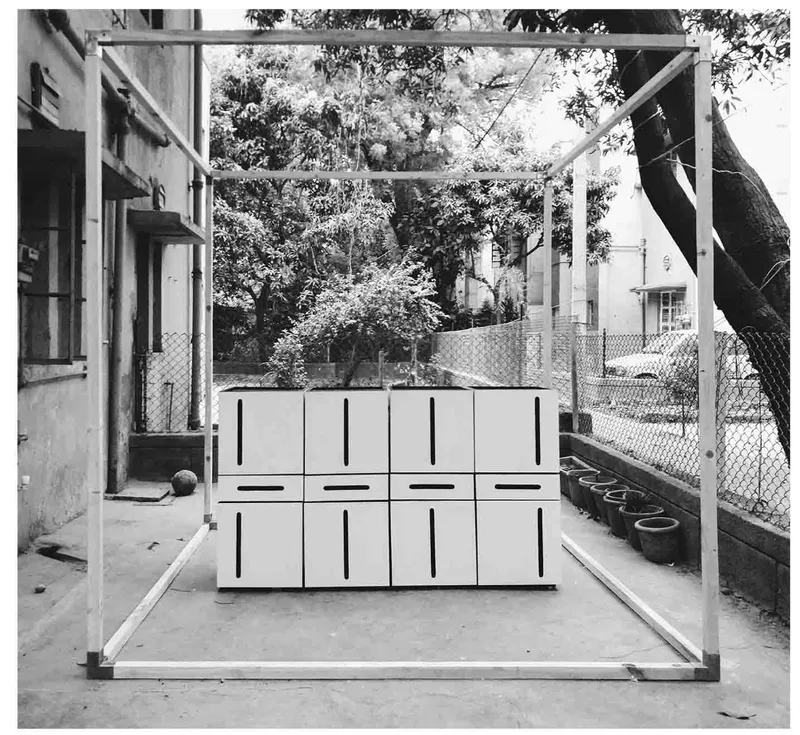
Photographed in black and white against a leafy tree and a chain-link fence, the assembled unit reads almost as a pavilion. Eight cupboard modules sit inside a wooden cube frame, and the open timber members define a volume without fully enclosing it. The structure is built from horizontal and vertical Canadian pine framing members joined with stainless steel corner brackets. The choice of brackets over bespoke joinery is pragmatic: it favours precision, durability and easy assembly, and it allows the same components to be reproduced across different sizes.
The pine gives the frame warmth, but its real contribution is conceptual. It acts as a spatial container, lending the furniture a sense of architectural enclosure while staying porous to light and view. Placing the prototype outdoors, among real trees and an ordinary fence, tests that idea well. The frame holds its own as an object in space, which is precisely what it needs to do in a crowded interior.
Black Laminate, Pine and the Discipline of the Junction
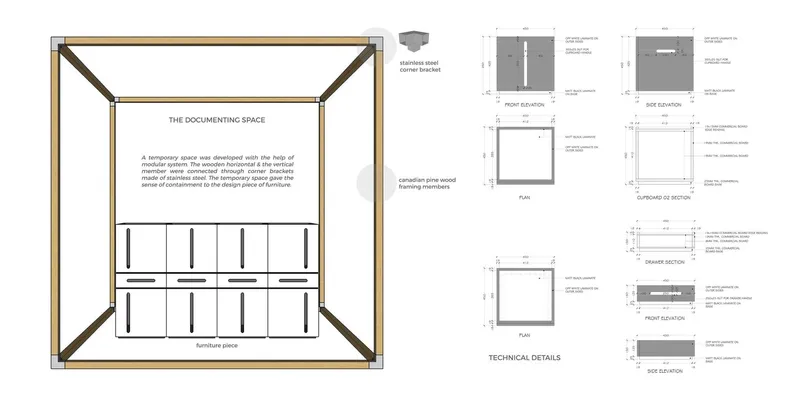
The axonometric pulls the system apart into frame and cupboard modules. Elevations, plans and sections of the cabinet details sit alongside it, and here the project shifts from concept to buildable proposal. The cabinet units are specified in commercial boards with matte black laminate finishes, set against the pine frame. That two-tone palette is deliberately restrained. It limits visual noise in rooms where every additional colour or texture shrinks the perceived space.
The technical drawings show attention to the things that make furniture usable at human scale: proportions, board thicknesses, clearances, handle placements and edge finishes. These junctions are where modular systems usually reveal their weaknesses, with gaps between units and awkward reaches to handles. Resolving them on paper suggests a designer thinking about the person opening the drawer, not only the diagram of the grid.
Why This Project Matters
BoX treats furniture as infrastructure for changing lives. As urban homes shrink and rooms are asked to serve as bedroom, office and living space at once, single-purpose pieces become liabilities. A frame that stays put while its modules are rearranged offers a more honest response to how people actually live. It answers to shifting routines, moves between flats and the slow accumulation of belongings.
What elevates the project beyond a catalogue idea is its spatial intelligence. Namdev begins with the window, the light and the view, then designs a system that serves them, and he backs the concept with a physical prototype and resolved details. The result is a reminder that in small spaces, the best furniture often does the least visual work. It organises the room quietly and leaves the openness for the people living in it.
View the Full Project
About the Designers
Designer: Vivek Namdev
Enter a Design Competition on uni.xyz
uni.xyz runs architecture and design competitions year-round that reward proposals with spatial conviction and real site intelligence.
Project credits: BoX by Vivek Namdev.


Popular Articles
Popular articles from the community


longwave studio Reorganizes a 112 m² Tainan Apartment Around the Daily Routines of a Family and Two Cats
In Tainan, Taiwan, birch plywood, rust-red furniture and a freestanding plaster wall link arrival, storage, work and family life in one apartment.

David Ortega Stacks a Two-Story Mexico City Penthouse Around a Steel Stair and a Pergola-Shaded Roof Terrace
In Colonia Roma, a 300 m² penthouse uses oak joinery, a planted steel stair and a slatted roof pergola to make a new-build apartment feel like a house.

U.GA Architects Wraps an Oval Rooftop Pool in Curved Board-Formed Concrete on Busan's Jeollidan-gil
In Busan's Jeonpo-dong, a 454 m² mixed-use block stacks a neighborhood facility, guest rooms and an oval rooftop pool inside spiraling concrete walls.

Architekt Andreas Gruber Scatters 23 Dark Timber Chalets Across a South Tyrolean Forest Edge
In Molini di Tures, Amonti Chalets breaks a resort into a hamlet of gabled timber houses, with parking, storage and services pushed into the slope.

Similar Reads
You might also enjoy these articles


Maya Harvest: A Cacao Resort Village Rooted in Mayan Tradition and Local Craft
Situated within a Tabasco cacao plantation, this shortlisted resort proposal merges vernacular materials with hands-on cultural immersion.
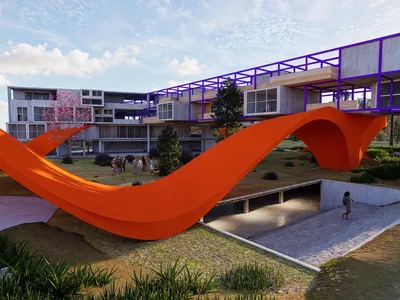
Harmonia: A River-Shaped Community That Grows Over Decades in Boa Vista
Curved pathways and modular grid structures along the Branco River create a phased settlement designed to evolve from 2030 to 2050.

The Architecture of Bathing: A Mughal Hammam Reimagined Across the Yamuna
Charlotte May's honorable mention entry for The Black Taj reinterprets Agra's bathing rituals through red sandstone, water, and framed views of the Taj Mah
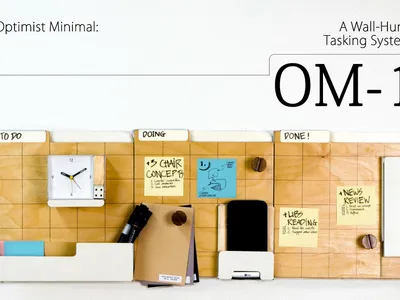
Om-1: A Wall-Hung System That Moves Your Workspace Off the Desk
Modular plywood boards, magnetic pegs, and utility elements migrate clutter from the horizontal surface to the vertical plane.

Explore Modular Furniture Competitions
Discover active competitions in this discipline

Design challenge to equip cities with modern furniture

Competition to design a workstation for architects

Packaging challenge - Design meets sustainability
Comments (0)
Please login or sign up to add comments
No comments yet. Be the first to comment!