

Community-Centered Cultural Architecture: James Baldwin Media Library and Refugee House by associer
Associer transforms a 1970s school in Paris into a sustainable media library and refugee integration center through community-focused architecture.


In the vibrant and densely populated 19th arrondissement of Paris, the architectural studio associer has reimagined the former 1970s Jean Quarré upper secondary hospitality school into a landmark project of community-centered cultural architecture. This transformation has yielded the James Baldwin Media Library and Refugee House, a unique cultural and social hub that combines a neighborhood media library with an inclusive refuge dedicated to supporting refugees’ integration into Parisian society.


Revitalizing a Brutalist Legacy for Social Impact
The original 1970s concrete school structure posed both challenges and opportunities. Rather than demolishing it, associer embarked on a sensitive refurbishment strategy that preserved and enhanced the raw beauty of the exposed reinforced concrete posts, beams, floors, and façade panels. Asbestos was carefully removed, and selective deconstruction allowed parts of the concrete elements to be reused on-site, maintaining material continuity and honoring the Brutalist heritage while adapting it to contemporary social functions.


The retention of the building’s structural integrity has resulted in spacious interiors with softened surfaces and textured materials that provide a tactile warmth and thermal inertia ideal for the Parisian climate. The reactivation of this overlooked architectural asset now frames a welcoming environment for education, culture, and humanitarian engagement.


Bioclimatic Design Enhancing Comfort and Sustainability
The renovation follows bioclimatic principles, optimizing natural light and ventilation to improve user comfort and reduce energy consumption. The existing concrete structure has been refined to allow increased daylight penetration, bathing interiors in a soft natural glow. Hygienic natural ventilation is facilitated through the introduction of double-height air wells and interior patios, promoting fresh airflow and passive temperature regulation throughout the year.


This environmental sensitivity extends to the outdoor spaces, where 70% of the site’s waterproof surfaces have been replaced with permeable ground cover, such as recycled concrete slabs and stabilized sand. These measures combat the urban heat island effect while fostering biodiversity through new green areas—including a central patio, a shaded garden, a shared garden, and a tranquil terrace.


The Link: A Wooden and Poured Earth Connector
A defining feature of this project is the creation of a vertical “link” volume that physically and symbolically connects the media library and the Refugee House. This new structure embraces ecological responsibility through the use of bio-sourced and geo-sourced materials, notably prefabricated poured earth walls that regulate humidity and thermal inertia naturally.


Encased in a wooden mantilla, this structure acts as a sun filter and environmental shield, balancing protection with openness. The tall post-and-beam wooden frame creates warm, inviting interiors where community members and refugees can share meals, practice French, and build social bonds in acoustically comfortable spaces designed for inclusion.


Hospitality and Integration in Architecture
The Refugee House is more than a shelter; it is a place of encounter, learning, and empowerment. The architectural language fosters hospitality through spacious communal areas, terraces facing south for relaxation, and gardens that serve as peaceful urban oases. This approach turns architecture into a social catalyst, reinforcing the importance of space in welcoming displaced populations and supporting their cultural integration.


A Model for Future Social Architecture
The James Baldwin Media Library and Refugee House exemplifies how community-centered cultural architecture can address urgent social needs while revitalizing existing urban fabric. The project’s blend of Brutalist heritage, ecological innovation, and human-centric programming creates a compelling model for adaptive reuse and socially responsible design in metropolitan contexts.


Through the thoughtful renovation and extension by associer, the building now stands as a beacon of cultural resilience, social justice, and environmental stewardship—demonstrating how architecture can actively foster community cohesion and human dignity.


All Photographs are works of Pierre-Yves Brunaud


Popular Articles
Popular articles from the community


The Amber Palace Opera: A Geological Fiction Surfaces on Tallinn's Baltic Waterfront
Pierre Brillard reimagines a Baltic legend as a public landscape, opera house, and waterfront promenade rooted in Tallinn's coastal identity.
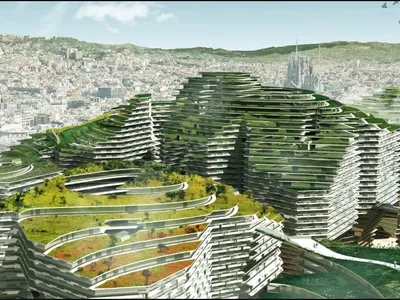
Manzana Morphosis: Stretching Barcelona's Grid into a Living Landscape for 2050
A radical reworking of the Eixample manzana turns density into a tool for generous public space, vertical ecology, and environmental performance.

Aquadapt: An Underwater Habitat That Rewrites Its Rooms by the Hour
Curved modules ring the seabed while one shell shifts from breakfast room to cinema, farm and football pitch as residents' needs change.


graciastudio Turns a Viewless Tijuana Lot Inward Around a Courtyard of Concrete, Timber and Trees
In Tijuana, Jorge Gracia's GA2 House stacks a timber-clad private floor over exposed concrete and replaces a missing view with a planted interior patio.

Similar Reads
You might also enjoy these articles

Cube Design Draws an Ecological Corridor Between Two Shenzhen Hills with the Nankai Building
Beside Shenzhen's container docks, the Nankai Building pairs stacked balconies with a climbing green screen to connect two hillsides across its height.

Praksis A and Studio Sted Bend a Red Timber Cabin Across the Granite of Norway's Southern Coast
On the southern Norwegian coast, a 105 m² cabin follows the rock on slender posts, pairing red cladding outside with pine, brick and plywood within.

David Ortega Stacks a Two-Story Mexico City Penthouse Around a Steel Stair and a Pergola-Shaded Roof Terrace
In Colonia Roma, a 300 m² penthouse uses oak joinery, a planted steel stair and a slatted roof pergola to make a new-build apartment feel like a house.

PARALELA and LB2 Thread a Public Walkway Through the Base of a Las Condes Residential Tower
In Las Condes, Santiago, the Hamlet Building gives its fenceless ground floor to a 70-metre wooded passage linking two streets and the metro.

Explore Architecture Competitions
Discover active competitions in this discipline

Challenge to reimagine the Iron Throne

Photograph architecture without architects

Illustrate the lost glory of Angkor Wat - Render Challenge

Design challenge to reuse E-waste
Comments (0)
Please login or sign up to add comments
No comments yet. Be the first to comment!