

Crumple: Foldable Architecture
This project investigates the housing crisis in Dadaab camp in Kenya. The manifesto in which the geometry reidentify the process of foldable tensile structure. Manifold creates a three-dimensional space that allow refugees to designate their own spaces based on their own needs.
This project redefine a housing solution within a catastrophic conflict. The danger, over capacity and lack of proper infrastructure form a complex intersection between humanitarian crisis and housing. It also explores ideas of ephemerality and permanence surrounding these camps and their relation to those architectural elements deemed essential vs non-essential. Different families' situations and their daily struggle in finding safety and security becomes the main problem, potentially paving the way for the transformation of these camps into dignified spaces.
All refugees are provided with amenities and packs of food when entering the camp. Settlements for refugees are mostly made up of temporary structures such as reinforced tents and trailer boxes. The surface of the desert is covered by plastic sheets inside the tents, to create a minimum level of interior space. Many families managed to renovate their settlements by using relatively permanent materials and to improve their living conditions by building private bathrooms and even gardens. However, this level of autonomous construction is usually limited by the lack of water sewage systems and the heavily overloaded electrical grid.
In times of emergency, elements pertaining to aesthetics, comfort and humanity are often left out, as they are seen as nonessential. Likewise, elements deemed essential are often poorly planned or do not consider the growth of a site, rendering them inconvenient, ineffective or even unsafe. Throughout Dadaab lifetime, it has become increasingly like an informal city and a home to its residents. Interventions by residents take place in many forms either independently, illegally or through the help of aid organizations. Although the camp has seen many issues since its inception, it has also become a space in which residents are able to intervene and adapt to the space, which has become a long -term home. As the building of refugee camps typically builds upon the models of other refugee camps, as opposed to those of other cities or of the environment of the camp itself, a hyper-homogenization may occur.
Interventions by refugees also occur on a macro scale, as the physical structure of Dadaab is constantly changing as refugees frequently pick up and move their tents and caravans. While the original process was for the international agencies to set up a tent on an issued plot in the camp, the family would immediately seek help from able residents to move it to their chosen location near family or friends in an attempt to partially recreate their old community. As a result of this frequent intervention, agencies changed their protocol to distribution of tents and not assemblage on the plot and later expanded to include distribution of caravans. This eventual distribution of caravans, and the needs of the residents for their homes to be mobile, prompted some residents to devise carting capabilities by welding together axles from camp fence posts. This innovation also became a part of the camp’s lifecycle as mobility was needed to move the caravans to their initial plot and were again moved in cases where families moved and sold to another family, who wished to have their caravan in a different spot.
Residents have also set up shops based on their previous profession and have connected with local communities, yet all of these shops are illegal, taking the camp’s power and electricity. While there are physical manifestations of refugee flourishing, there are also more ephemeral and social manifestations.
The word “camp” itself is misleading and it could convey a sense of temporarily mixed with a false hope. Some people may think it's a temporary situation until the many generation have stayed within the area of this camp. While innovations and interventions of mobility are certainly connected to the thriving of life in the camps, they have also had some negative side effects because of the constant changes taking place there. For instance, the movement of ambulances and other essential vehicles on
their originally prescribed route has become difficult, because the vehicles will often find that their path is now blocked by homes. It seems that when the camp administration and supporting aid foundations work together with the residents, both in case such as the farming initiative and permitting new arrivals to move their structures to other plots, and in more informal ways such as allowing residents off-site and turning a blind eye as they steal electricity, set up illegal businesses, the camp becomes a site of urban flourishing. It becomes a real town in the making, an authentic place where the hands of its inhabitants are seen everywhere, as opposed to yet another non-place as many refugee camps tend to become in their restriction and homogeneity, as seen with Dadaab.
Dadaab offers a unique challenging site and offers an insight into potential pathways of growth for future refugee camps and even for the camp itself in becoming a recognized permanent city. Although originally its centralized layout was disadvantageous, it has enabled organic growth and thriving of residents after taking matters into their own hands. Crumple offers a low-cost architecture that can be customized to fit the family needs. The idea of having tent structure that connects and forms families’ spaces as desired. This intervention harmonize the urban platform and unify a language that create a social equity within the frame.

Popular Articles
Popular articles from the community


Opera on the Sea: Driftwood Logic Shapes a Timber Opera House on Estonia's Coast
Trevor Orgill's opera house translates the entangled drift of floating timber into a civic building where wood, water, and music converge.

Opera by the Sea Estonia: Three Shells Dissolving Architecture into Tallinn's Coastline
A winning opera house proposal replaces monumental form with interconnected shells that blur the boundary between building, park and Baltic Sea.

Tsunami Convergenics: Turning Catastrophic Ocean Forces into Underwater Housing Infrastructure
A speculative underwater settlement off the coast of Onagawa, Japan, treats tsunamis and typhoons as energy sources rather than threats.

Singing Woman: Contemporary Architecture Inspired by Estonia’s Voice and the Sea
Singing Woman turns Estonia’s song culture into flowing opera house architecture, blending public life, landscape, sea, and national memory.

Similar Reads
You might also enjoy these articles
The Rhythm of Seasons
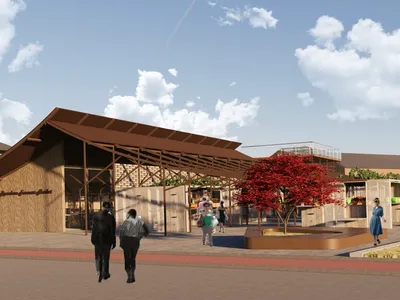
A Farmers' Market Connecting Nature and the City

More Than a Building-Designing a Living System
More Than a Building-Designing a Living System
Base Beyond
DESERT COMPOUND ARID: TOURISM OF ABSENCE AND ABUNDANCE

Explore Dystopian Architecture Competitions
Discover active competitions in this discipline


Challenge to reimagine the Iron Throne

Photograph architecture without architects

Illustrate the lost glory of Angkor Wat - Render Challenge

Design challenge to reuse E-waste
Comments (0)
Please login or sign up to add comments
No comments yet. Be the first to comment!