ECHO
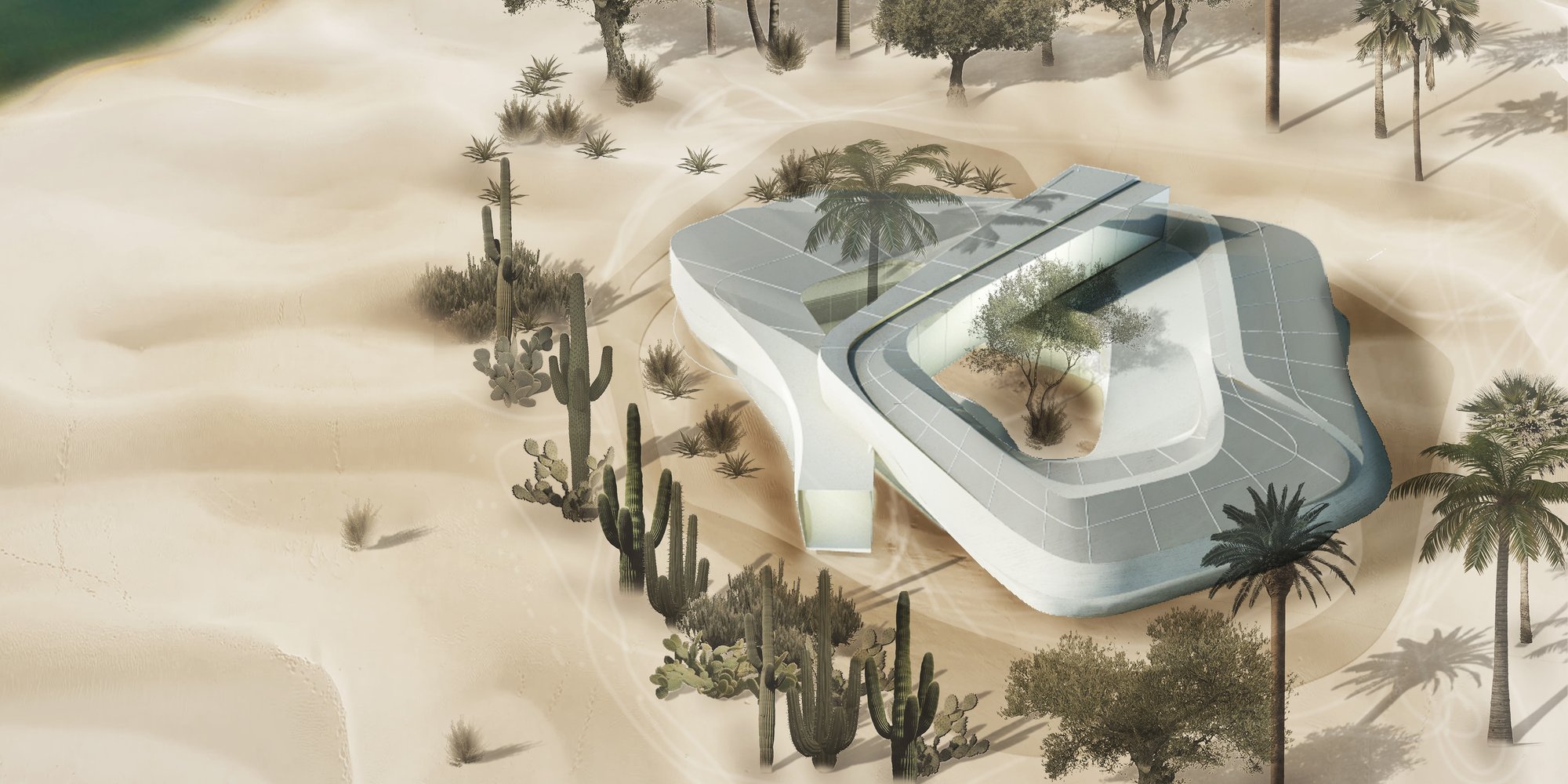
Marrakesh Cultural Center, Morocco

The main objective of this project is to reflect and advocate the potential future of Marrakesh while celebrating Moroccan culture. Through the use of materials, technology, and landscaping, the project primarily explores and attempts to address the following:
- Breaking the depletion of the oasis and its habitat.
- Combating desertification.
- Ways the culture center can impact and contribute to the surrounding areas.
- Evolving labor skills in Marrakech.
- Highlighting Moroccan culture and the desert oasis experience.
- Improving livelihood opportunities (and its expansion)
01 - CONCEPT IDEA
Sound is a significant part of a desert experience. Sand and the desert terrain allow sound to travel farther away - one hears the sound of wind rustling, trees, and animals. The Word 'ECHO' sums up the intent of the project: to reflect the desert experience, reflect/echo the Moroccan culture and its future, and strive to be eco-oriented.
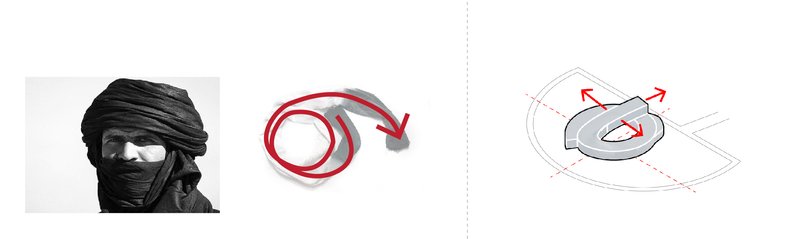
The headscarf/turban is part of the Moroccan and desert identity. It's worn by firmly wrapping the fabric around one's head. Its loops protect the user from wind-borne sand, heat, and sunburn. The shape and use of the loop inspired the formation of the culture center.
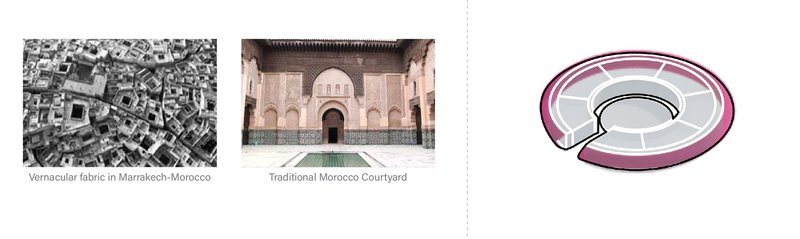
Architecturally, as the weather is hot and arid, traditional buildings are built with little to no windows on the exterior. The courtyard becomes an essential element as it allows light to enter. It becomes a central part of the house, with rooms surrounding it. Similarly, the center uses the loop to echo the Sahara identity creating a small open but shaded courtyard protected from wind-borne sand.
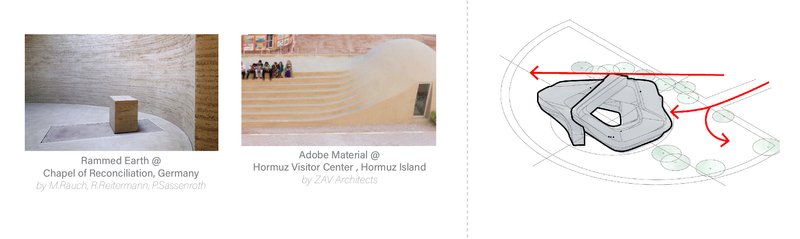
The use of adobe and rammed earth is not only traditional and economical; the process of turning mud to adobe allows the potential for 3d printing technology to experiment and evolve adobe production. Raw materials of adobe are available locally, are strong, well insulating, and malleable. The project explored how 3d printing technology can produce organically formed adobe (explained further in chapter 05-Materials & Methods).
02 - DESIGN METHODS, PROCESSES, AND ITERATIONS
The primary method of design investigation is research.
The design process for 'ECHO':
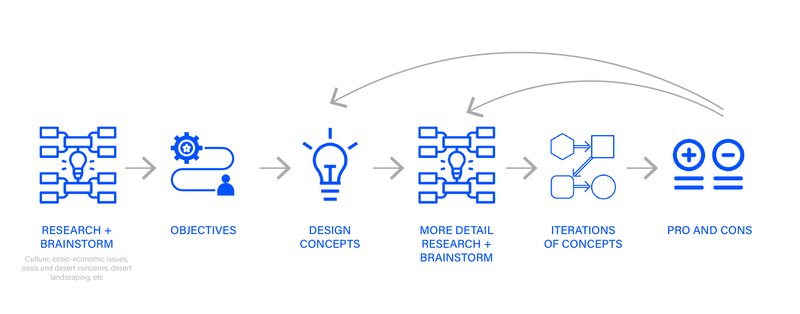
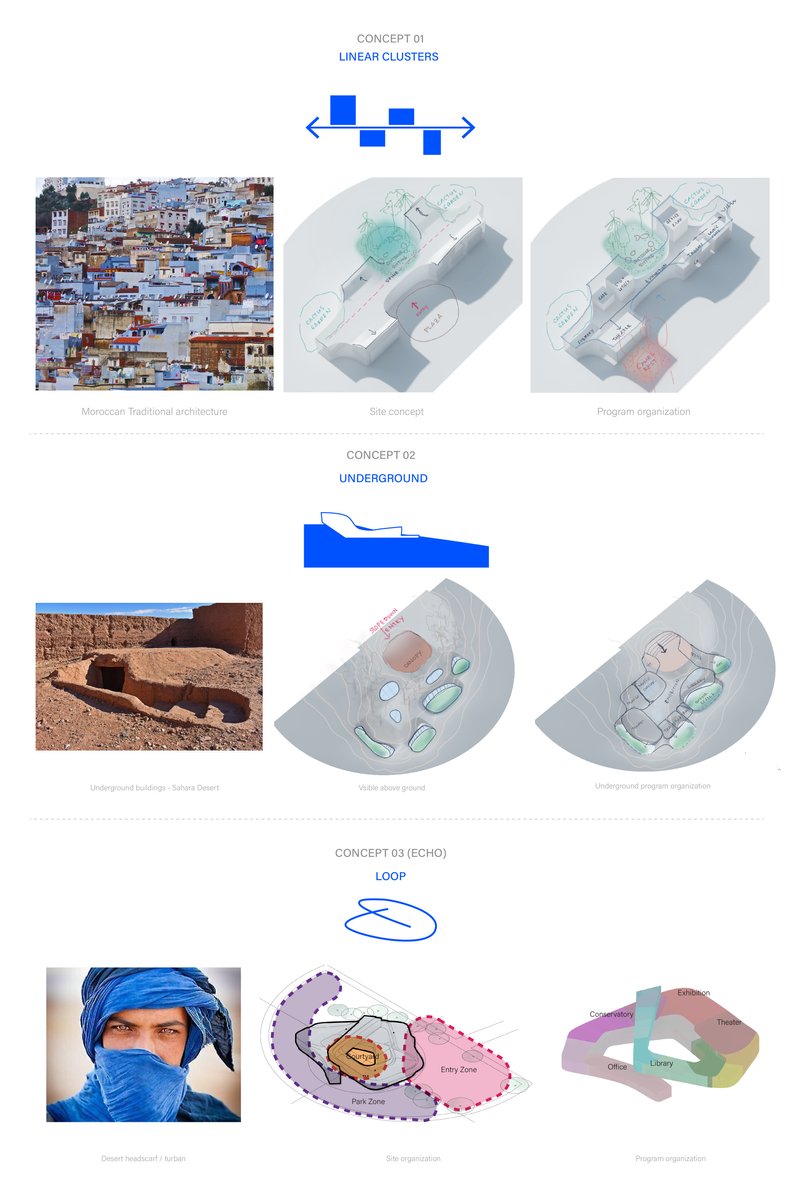
There are three design concepts that were tested;
- Linear clusters - Inspired by traditional Moroccan townscape, this option organize and stack programs along an axis.
- Underground - Inspired by traditional earth buildings in the Moroccan Sahara Desert, this option explores the potential for the culture center to be underground.
- Loop - Inspired by the headscarf/turban and traditional courtyard. This project moves forward with the loop option.
03 - THOUGHTS ON CELEBRATING CULTURE AND A SYMBOL OF THE FUTURE.
'ECHO' attempts to symbolize the Marrakesh of the future in the following ways:
- Trying a new way of using traditional materials. Using adobe's raw materials for 3d printing adobe structure commemorates Moroccan culture and its future potential.
- The project advocate to improve labor skills with the use of technology in construction. For example, training construction workers to work with the latest construction technology like robotic building printers will benefit the construction job market in Morocco. In addition, collectively, this creates more opportunities for Morocco to lead in the construction industry.
- Combating desertification by seeding, soil modification, and crops enhancement.
In addition, the images in the project (both in the interior renderings and 'day in a life of' collages) suggest the use of the center is to celebrate local Moroccan culture. I've included artworks by local artists like Ghizlane Sahli or photographs/videos by the late Leila Alaoui whose work reflects and questions society today.
04 - ORGANIZATION
The site is divided into three zones;
- The entry - that consists of the plaza, drop-off, and parking.
- The courtyard - that is protected and shaded by the loop/building. Here, there is a small area for outdoor dining, a small open space for group gatherings/practice, and the start of a walking trail.
- The park - has a trail that loops around the site. The park is divided into sub-zones; a shaded zone with tall trees that can be used for a picnic area, a cactus zone overlooking the water with a photo spot, and a camel rest area zone that has tall trees, water source & food for the camels.
Architecturally, the intent and thought process for organizing and condensing the programs is as follow:
When we enter the cultural center, we will immediately see the exhibition which is integrated with the lobby. When there is an event/showing, the theater entrance is by the lobby, allowing break-out events to be part of the exhibition space. Beyond the lobby, we can see the courtyard and a hint of the other areas of the culture center.
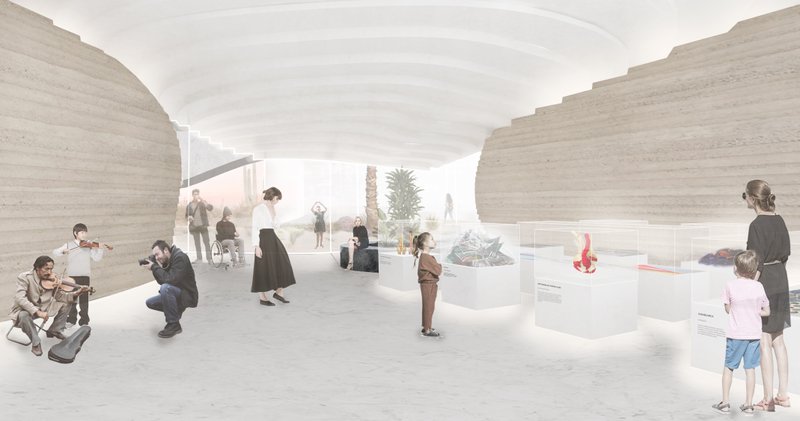
From the lobby, moving forward towards the courtyard, we will see/locate all the other rooms arranged around the yard. Walking to our left are all the tourist/visitor-oriented programs, like the cafe, restrooms, the library, and the observatory. Walking to our right are all the 'frequent visitor' or admin programs, like the music conservatory, training rooms, storage rooms, admin offices, and conference rooms. The curves and loops of the corridor allow the user to enjoy and interact with nature. The openness of the architecture brings indoor programs closer to the outdoor. The built area of the cultural center totaled 993 sqm. (Breakdown of the square footage is diagramed on board 03).
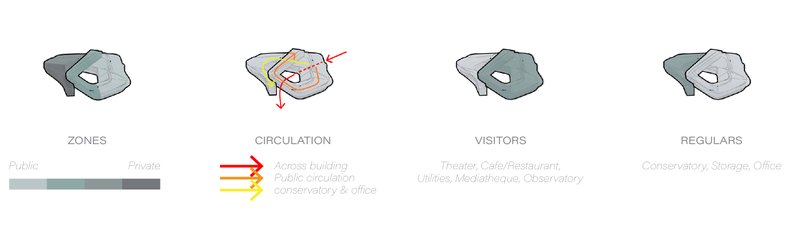
The thought process behind 'A Day in a life' diagram :
Typical users for this space will be tourists, visitors to the music conservatory, and those who work there.
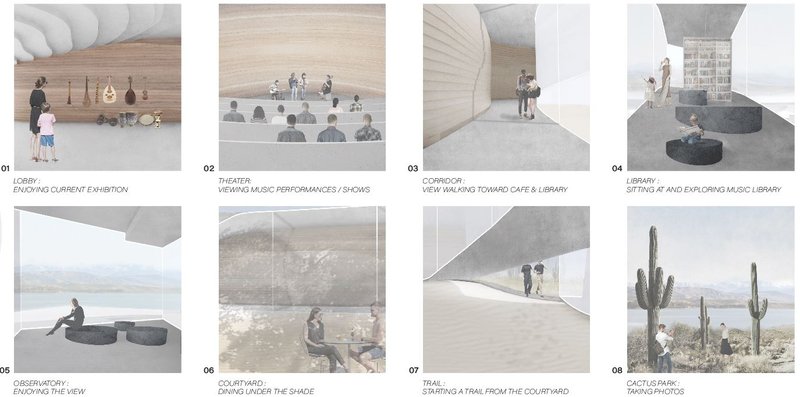
When a tourist visits:
We will first see the current exhibition as we enter. We will be able to sit on an ongoing performance or shows. We will then walk around the corridor towards the cafe and the library. At the library, we will be able to enjoy the view of the desert and the oasis. We could also be enjoying our food and beverages outdoor under the shade in the courtyard. We then could start the trail, walk around the park, and take photos at the cactus garden.
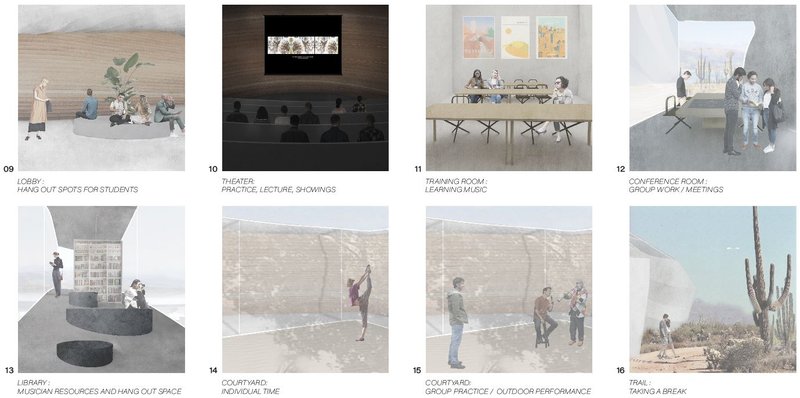
When someone visits the center for music/training:
Before training starts, we could sit around the lobby and socialize with friends. We could be at the theater attending lectures, viewing documentaries, or practices. Besides the training rooms, we could also use the conference room for group work or a meeting. The library is an excellent place for us to get resources and unwind our minds by looking at the desert views. The courtyard is another place we could get some alone time or group practice outdoor. Walking through the park is an excellent way for us to unwind after a long training day.
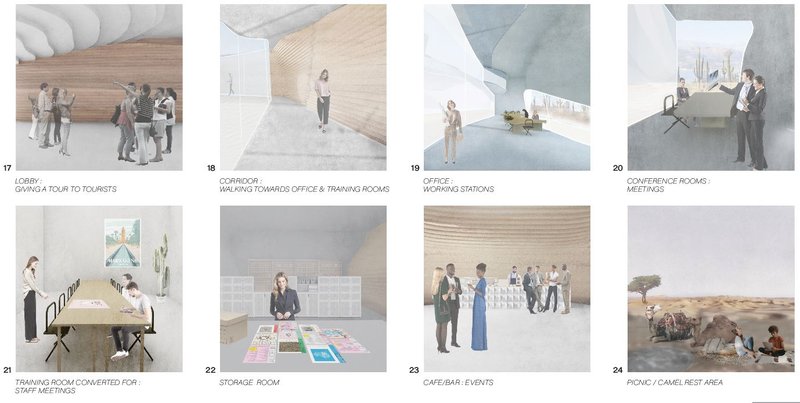
For someone who works there:
The lobby is where we start to give our tour of the cultural center. The office workstations and conference rooms are where we mostly work at. Sometimes, we could use the training room for new staff training or meetings. The storage room can also be used as a workroom for cataloging and curating upcoming exhibitions. When we are hosting an event, we could use the theater, the lobby, and the cafe/bar for food & beverages. Besides eating at the cafe or the courtyard, we like to sit outside in the shade having a picnic.
05 - MATERIALS & METHODS
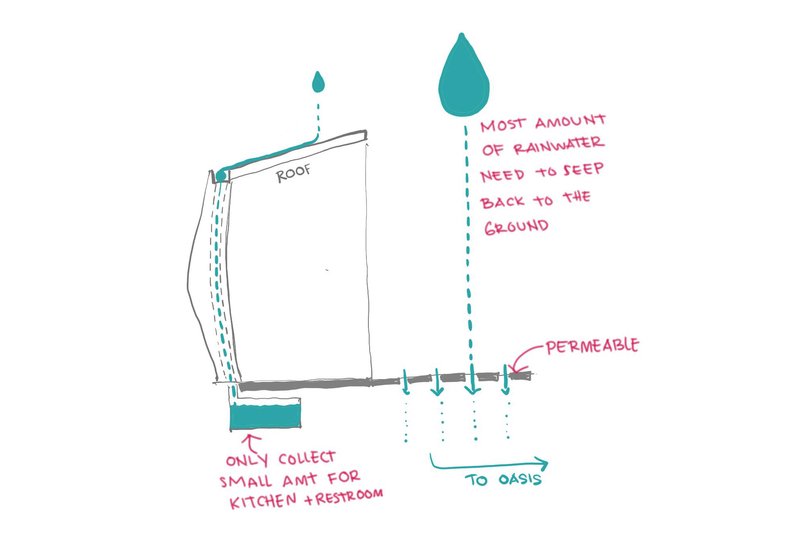
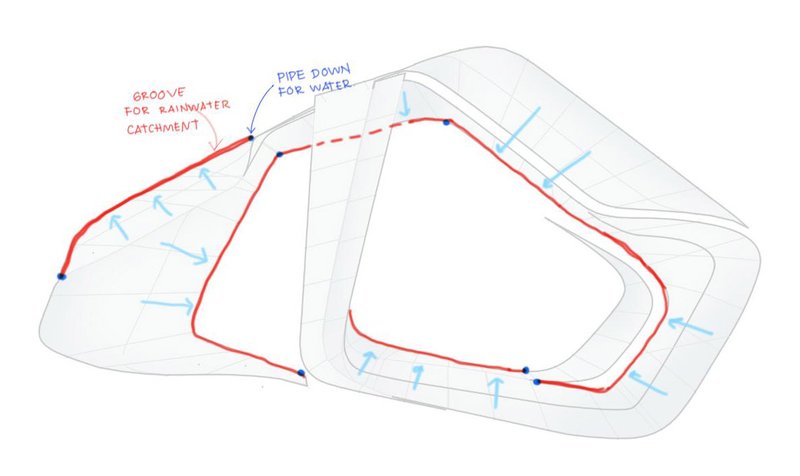
The exterior skin of the building is made of 3d printed adobe for better insulation from the weather. The outer skin facing towards the courtyard is made from double tempered glass to provide light and views. The shape of the loop and the trees allow the yard to be primarily shaded. Rammed earth and local stones make the interior walls and floors. The solar panels on the roof are installed with a groove joint that allows rainwater that falls on the roof to be collected and reused. The intent is only to collect a small amount of rainwater for the center to use, so that rainwater can seep into the soil, which will help the oasis from drying out. The plaza, the trails, and the parking lot are made of blocks of adobe that are permeable, allowing water to seep in and smaller grass to grow.
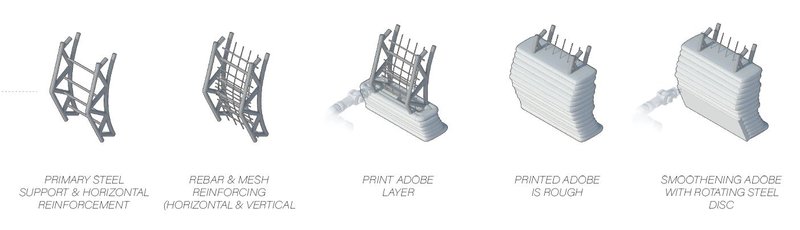
3d printing Adobe
3d printing technology has been experimenting with different kinds of raw materials and aggregate. Adobe is an indeed dried mud brick that is mixed like a paste, poured into a mold, and left to dry in the sun. The input for the 3d printing can be a mix of mud, water, and binding aggregate. This method is more sustainable, saves cost, is more efficient, avoids unsafe labor, and can more accurately build organically formed buildings. The use of 3d printing significantly reduces the amount of waste that came from adobe's formwork.
There is a common fear that introducing 3d printing construction can hurt the construction workforce. However, 3d printing construction could be seen as an opportunity for growth and improve employment opportunities. Suppose we advocate educating and training the construction workforce in Morocco to work with building technology (not only 3d printing robotics). Int could open up a massive opportunity for an evolved, better-skilled construction workforce. Collectively, this could put Morocco ahead in the future of building construction.
06 - ENVIRONMENTAL OBJECTIVES
How is a specific objective attempted to be made?
An Oasis is often depleted of its natural resources. 'ECHO' attempts to combat desertification through controlled water collection & salination, seeding, careful selection of plants, soil modification, and renewable & recyclable energy.
The importance of letting rainwater seeps into the ground.
An oasis gets its water from an underground aquifer or above ground like rainwater or rivers. Water that seeps into the environment and the nearby aquifer helps to keep the oasis from drying out. A well moist aquifer also helps the surrounding plants from dying, providing animals shelter and shade. Therefore, we should control the collection of water.
Seeding and the selection of plants
Tall trees like palm trees, shrubs, and floras help protect the oasis from the sun, shifting sands, and other harmful elements. Seeding around the area provides covers for the soil. Even dry branches and logs could help shade sand/soil around the oasis from overheating and evaporating its moisture.
The project selects native resilient plants (tall trees, shrubs, and cacti) that protect the oasis from the sun, wind-borne sand, insects, and diseases. Existing trees that are currently on the site will remain.
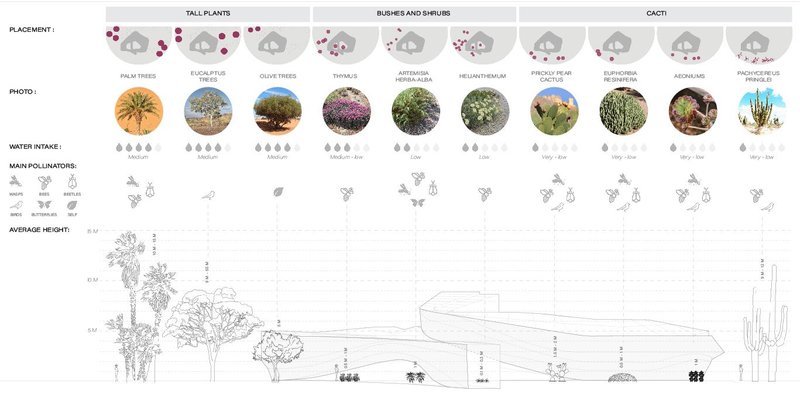
The above matrix laid out the primary plants that are incorporated in the project. It considers their benefits for the oasis, water intake and water retention, form (in relation to the building), and primary pollinators. The intent is to create small biodiversity of floras and faunas that are good and enriching.
Soil modification
Researcher Kristian Morten Olesen has developed a 'Liquid Nanoclay' technique that transforms poor sandy soils into moist, high-yielding soil. Treating the poor soil with a clay coating alters the soil property to bind with water, allowing the soil to absorb more rainwater for its aquifers and helps fight desertification.
Solar Panels
The project incorporates about 730 sqm of solar panels. Assuming a typical one sqm solar panel generates 250 - 400 watts per hour, the center will harvest approximately 1,460,000 - 2,336,000 watts per day, which is more than enough electricity for the center. The majority of the energy is shared with the surrounding area.
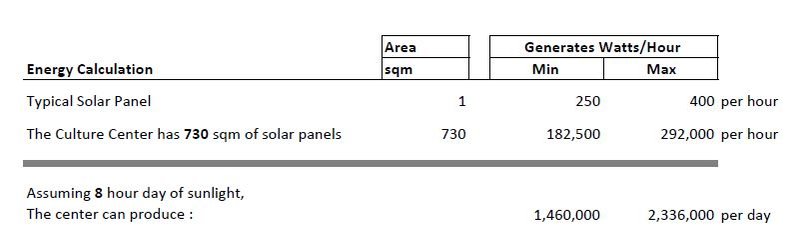
Reference 01 - How much energy do solar panels produce
07 - EXPANSION PLAN + TRANSFORMATION OVERTIME
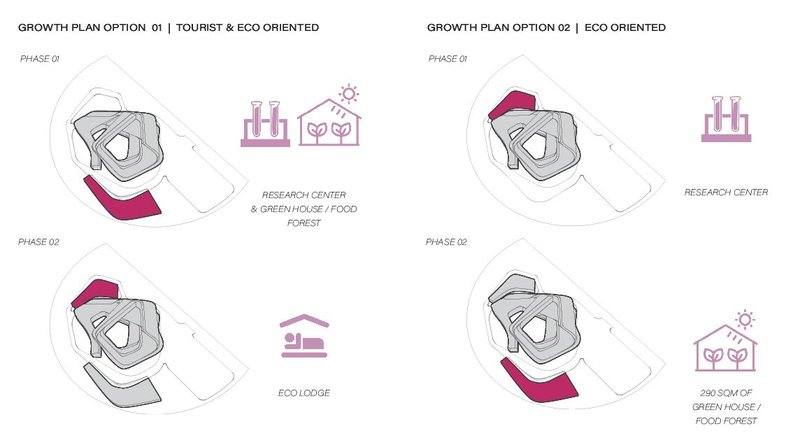
The expansion focuses on increasing livelihood opportunities as well as tourism through incorporating the following:
- Research Laboratory- An in-house research and production center
- The lab will expand the soil modification initiative. The modified soil will be distributed across the region for crops and other agricultural needs.
- The lab will consistently observe the health of the oasis, its surrounding landscape, and its habitat.
- To meet the community's changing needs, the lab will continuously test for new ways to ensure access to sustainable food, energy, and environmental resources in the Saharan desert.
- The Food Forest / Greenhouse
- The greenhouse grows crops and desert plants that need a controlled environment to start.
- The greenhouse allows for seed propagation and young seedlings to grow, especially during unpermitted weather. The seeds can then be transplanted across the region (and passed on to other farmers) when the weather permits and the crops/ plants are at a better stage.
- Visitor's Lodge
- A small lodge for visitors to experience the oasis /desert at night.
Notes on FAQs Answered above:
● What was the concept behind the project?
(addressed in Board 01 and Journal Chapter 01)
● What was the intent behind the organization of elements across various levels (Architectural, Site, Urban)?
(addressed in Board 02 -site, 03-architecture, 05-landscape and Journal Chapter 04, 06)
● How many iterations were tried to arrive at the final outcome?
(addressed in Journal Chapter 02)
● Which methods of design investigation?
(addressed in Journal Chapter 02)
● How was the programme condensed into final?
(addressed in Board 03, and Journal Chapter 04)
● What/How were the materials chosen?
(addressed in Board 01, 04, and Journal Chapter 05)
● How was a specific objective attempted to be met?
(addressed in Board 05,07, and Journal Chapter 06, 07)
● What is the expansion plan of the project? and How will the project transform with the passing time? etc
(addressed in Board 07, and Journal Chapter 07)
References (1)