
Exordium: A 50-Acre Hospital Campus Where Architecture Becomes Medicine
Dharsini Kalaiselvan's thesis project reimagines the women's and children's hospital as a landscape of domes, courtyards, and therapeutic gardens along Ama


What if the building itself were part of the prescription? Exordium takes that question seriously, proposing a 50-acre women's and children's hospital campus in Amaravati where biomorphic domes, ramped courtyards, hydrotherapy rooms, and open-air theatres sit alongside operating suites and specialist clinics. The design refuses to treat architecture as a neutral container for medical equipment. Instead, every circulation route, every planted courtyard, every acoustic decision is calibrated to reduce stress and accelerate recovery.
Designed by Dharsini Kalaiselvan as an undergraduate thesis and shortlisted in UNIATA '19, Exordium is sited in the fertile Guntur district along the banks of the Krishna River, near Krishnayapalem village and Karakatta Road. The project forms the first phase of a larger medical campus vision, with the Women's and Children's Hospital block as its centerpiece. Kalaiselvan's ambition is clear: to build a precedent for healthcare environments where spatial design and human emotion are treated as inseparable.
Zoning a Campus Around Segregation and Connection
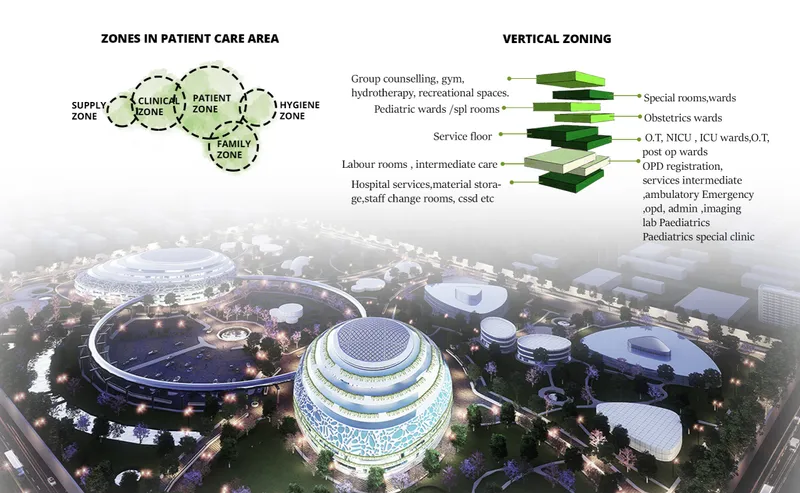
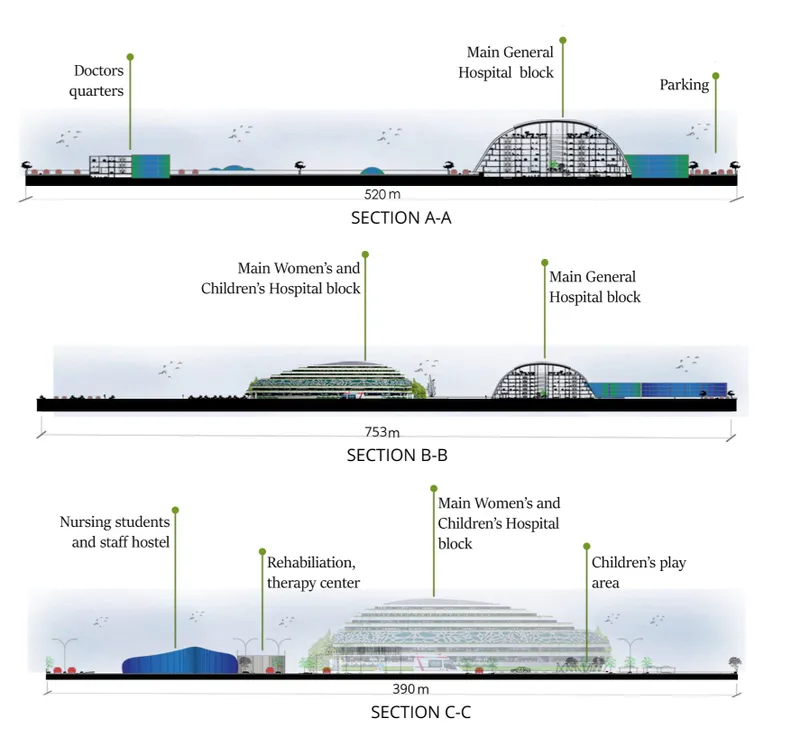
The masterplan diagram reveals how Kalaiselvan organizes a sprawling programme into segregated yet interconnected zones: infectious disease care, rehabilitation and therapy, general and specialist medical services, and residential quarters for doctors, nurses, and students. A balanced circulation system threads through these zones, integrating vehicle access, pedestrian walkways, and green corridors designed to reduce stress at every transition point. The sectional drawings expose the vertical logic, showing how hospital blocks, staff quarters, and parking relate to each other across the terrain. Sculpted parking areas use fluid forms and organic landscaping so that even infrastructure reads as part of the natural environment rather than as an interruption of it.
What stands out in these drawings is the deliberate avoidance of the corridor-as-spine model that dominates hospital design. Here, movement is distributed across green corridors and courtyards, making wayfinding intuitive rather than reliant on signage alone. Tactile installations, cultural references, and landscape rhythms reinforce orientation, so that patients and visitors build a mental map through sensory experience, not fluorescent-lit hallways.
A Children's Play Area That Doesn't Feel Like a Hospital
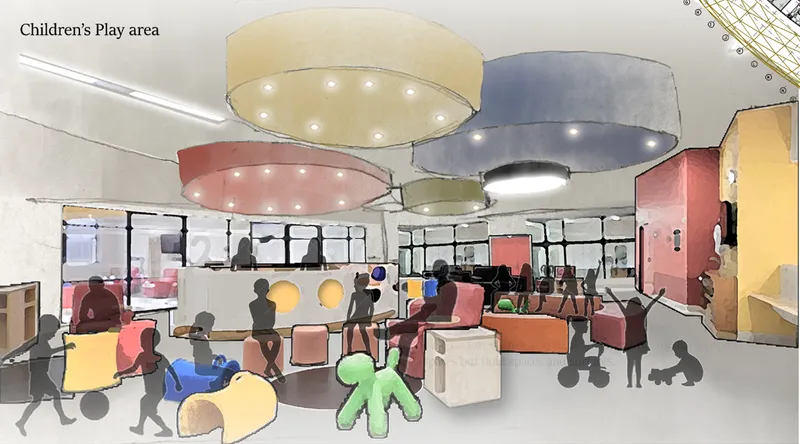
The rendered interior of the children's play area shows a ceiling punctuated by coloured circular elements that cast diffused, playful light across the space below. Figures are seated throughout, suggesting a room designed for lingering rather than passing through. The colour palette is warm but restrained, avoiding the saccharine approach common to paediatric design in favour of something genuinely calming. Play areas for children and safe outdoor environments are distributed across the campus, promoting recreation and social interaction as integral to the treatment process.
Kalaiselvan's thesis rests on the belief that mental and emotional wellness is inseparable from physical treatment. Spaces like this one make that argument concrete. A child undergoing treatment encounters a room that acknowledges their need for joy and stimulation, not just their diagnosis. It is a small but powerful architectural statement about who the hospital is really for.
Tropical Atrium: Bringing the River Landscape Indoors
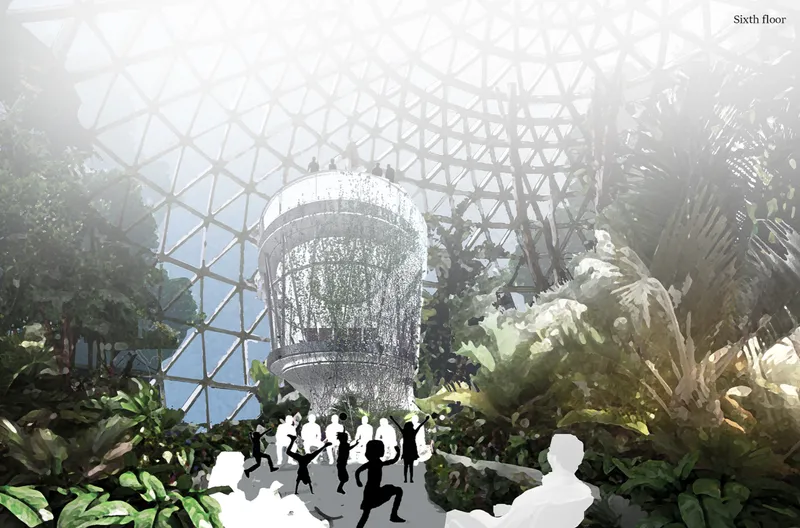
The atrium space is the project's most dramatic interior moment. A triangulated glass roof floods the volume with daylight, while dense tropical plantings rise from ground level into a mist that softens the boundary between inside and outside. A hanging chandelier provides a focal point, but the real protagonist is the vegetation, which transforms the atrium into a therapeutic garden embedded within the hospital's core. The use of natural elements such as courtyards, water bodies, and gardens is central to Kalaiselvan's strategy: nature is not decoration here, it is infrastructure.
On the sixth floor, the design extends this logic further with specialized areas for holistic health, including ramped courtyards and double-height spaces that encourage group therapy and individual reflection. Yoga halls, hydrotherapy rooms, group counselling zones, and gymnasiums occupy this upper level, making it a dedicated zone where patients transition from acute care to recovery through active, body-centred engagement.
Domed Forms and the Scale of Compassion
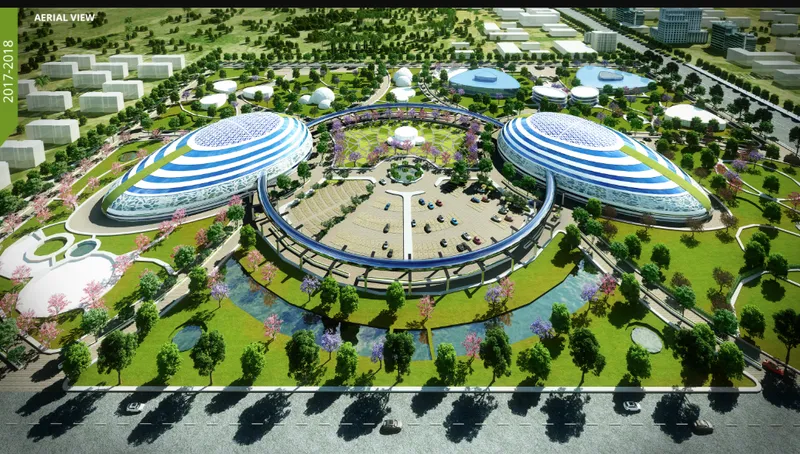
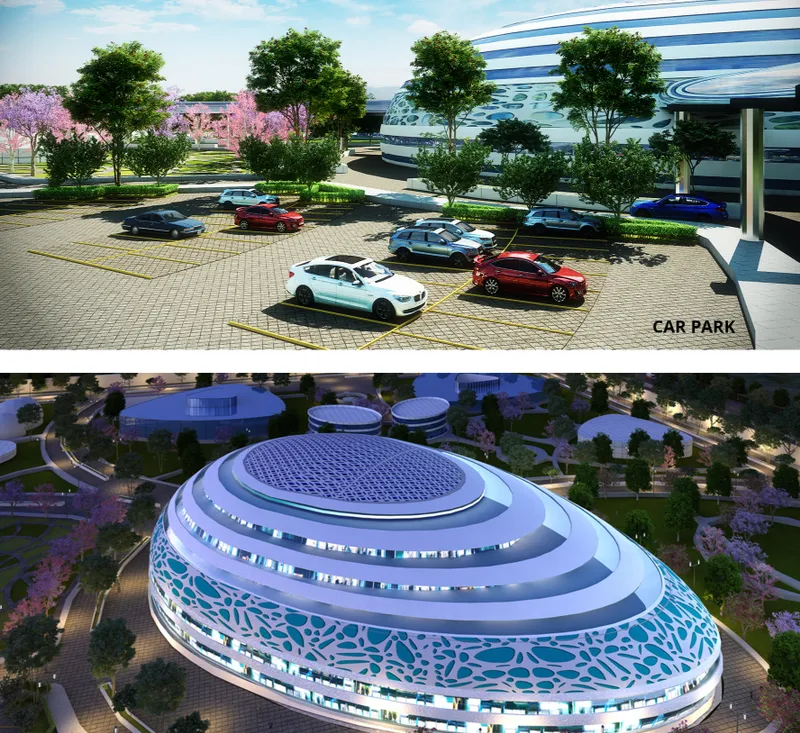
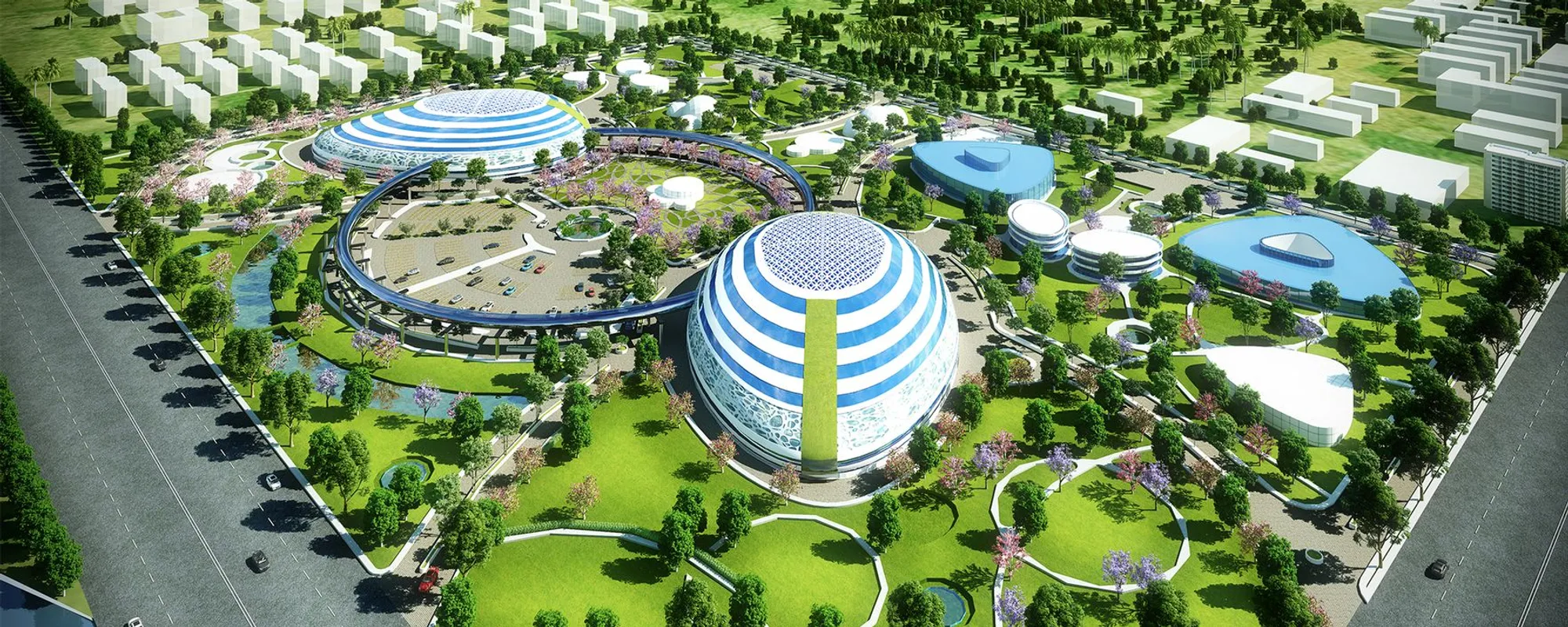
The aerial rendering shows the campus from above: two large blue-striped domes flanking a circular courtyard, surrounded by mature trees and pathways that radiate outward. The dome form is not arbitrary. Its gentle, flowing profile enhances daylight penetration, ventilation, and acoustic comfort within the hospital block. At ground level, the parking area view confirms how the campus manages its edges: vehicles sit beneath tree canopy, and the oval dome with its patterned blue facade is framed by spring bloom, making the approach to the hospital feel more like entering a park than an institution.
Kalaiselvan's use of biomorphic forms extends to architectural storytelling. The campus choreographs experiences as visitors move from arrival through gardens, past water features, and into the dome's interior. Female-centric amenities and renewable energy sources are woven into the programme, reinforcing the project's dual commitment to inclusivity and sustainability. The dome does not just shelter medical functions; it signals a fundamentally different relationship between patient and building.
Why This Project Matters
Healthcare architecture in India too often defaults to institutional efficiency at the expense of human dignity. Exordium pushes back against that default with a rigorously structured 50-acre masterplan that treats landscape, daylight, acoustics, and emotional resonance as legitimate design parameters alongside infection control and clinical adjacency. Kalaiselvan's proposal is ambitious in scope, yet disciplined in its organizational logic, delivering clearly segregated zones without sacrificing the sense of a unified, walkable campus.
As a thesis project, Exordium reveals a designer thinking at urban scale about problems usually confined to floor-plan optimization. The integration of open-air theatres, yoga halls, ramped courtyards, and hydrotherapy rooms within a hospital programme challenges the conventional boundaries of what medical infrastructure can include. If the project's shortlisting in UNIATA '19 signals anything, it is that the profession is ready to take healing architecture seriously, not as a soft addendum to technical design, but as its foundation.
View the Full Project
About the Designers
Designer: Dharsini Kalaiselvan
Enter a Design Competition on uni.xyz
uni.xyz runs architecture and design competitions year-round that reward proposals with spatial conviction and real site intelligence.
Project credits: Exordium: by Dharsini Kalaiselvan UNIATA '19 (uni.xyz).




Popular Articles
Popular articles from the community


Hill & Cross Opera: Sculptural Opera House Architecture Shaped by Tallinn’s Landscape and Identity
Hill & Cross Opera reimagines opera house architecture in Tallinn through its sculptural hill, civic plaza, glass wave and a luminous cross.

Co-Life: Senior Housing Design That Reconnects Older Adults With the City
Co-Life reimagines senior housing design through healing gardens, shared streets, workshops, and a sustainable community across generations.

Riyadh For All: Intergenerational Urban Design for Active Aging in Rabat
Riyadh For All reimagines urban design in Rabat with intergenerational co-living, adaptive courtyards, and Moroccan cultural exchange today.

Play: Fragments of Their World
Familiar architecture becomes modular playground design, creating safe spaces where displaced children can learn, connect, imagine and play.


Similar Reads
You might also enjoy these articles

Bao Huynh Watercolor Atelier: A Serene Art Retreat in Hội An
Bao Huynh Watercolor Atelier in Hội An blends multifunctional art spaces, sustainable design, local materials, and family-friendly living in a serene environment.

Atelier Macri Concept Store Interior Design by CASE-REAL
Atelier Macri store features a "ko" counter, walnut wood details, cork displays, blending retail, gallery, and seamless customer experiences.

Manuel Vargas Izquierdo Stadium and High-Performance Sports Center: Architectural Excellence in Jalpa de Méndez
The Manuel Vargas Izquierdo Stadium blends sustainable design, inclusive sports facilities, and cultural-inspired architecture, revitalizing Jalpa de Méndez’s public spaces.

KAKR Buluh Awar Hall: Revitalizing Community and Ecology Through Bamboo Architecture
Community built bamboo hall revitalizes Buluh Awar village, empowering youth, restoring ecology, celebrating vernacular craftsmanship through sustainable architecture and culture.


Explore Urban Design Competitions
Discover active competitions in this discipline



Challenge to design locus for the upliftment of human rights


Design challenge to reuse E-waste
Comments (0)
Please login or sign up to add comments
No comments yet. Be the first to comment!