

A Piece of Moon: A 40-Meter Spherical Landmark Celebrating Lunar Exploration
A continuous spherical structure and helical tower stage immersive VR exhibitions marking the 50th anniversary of the moon landing.


A spacecraft has touched down at the water's edge. That is the deliberate illusion produced by A Piece of Moon, a 40-meter continuous spherical structure whose alien silhouette rewrites the skyline it occupies. The project stages a collision between cosmic mythology and public architecture, using laser projection, VR technology, and suspended exhibition artifacts to immerse visitors in the technical and philosophical legacy of space exploration.
Designed by Chiming Wong and Kuai Yu, the project was recognized as an Editor's Choice entry for Moontrip 2019, a competition calling for architectural proposals that commemorate the 50th anniversary of the historic moon landing. The result is a landmark that reads simultaneously as exhibition venue, monument, and spatial spectacle.
A Cloverleaf Dome and Spiral Tower on the Waterfront
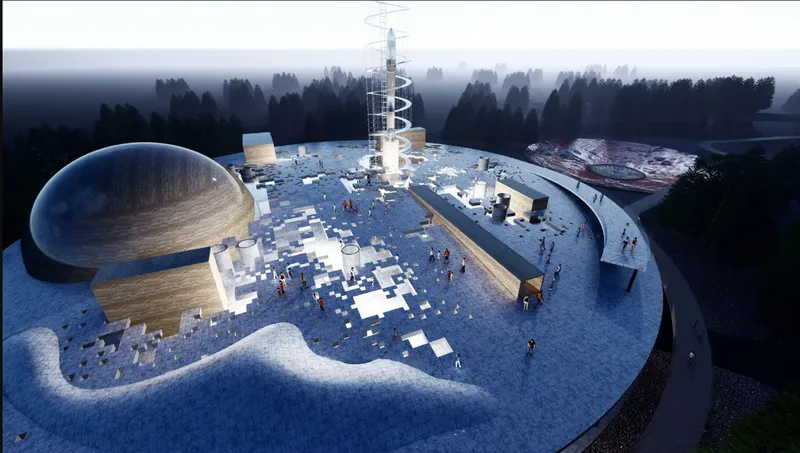
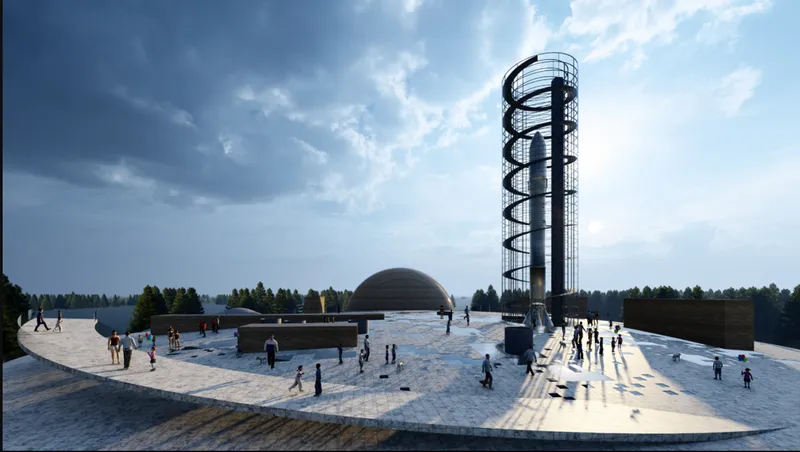
From above, the building resolves into a cloverleaf roof that hugs a domed volume, its curving surfaces flowing outward into a broad plaza. Beside it, a helical observation tower spirals upward, its slender form offering a vertical counterpoint to the dome's earthbound mass. The aerial view reveals visitors scattered across the open landscape, reinforcing the structure's civic ambition: this is not a hermetic gallery but a public ground plane shaped by the geometry of a celestial body.
The wide perspective under dramatic clouds makes the scale legible. The dome and tower together compose a silhouette that feels both monumental and estranged, as if a fragment of the lunar surface had been transplanted wholesale to a terrestrial waterfront. The continuous spherical envelope avoids sharp breaks, lending the entire complex the quality of a single geological event rather than a conventional building.
Looking Down into the Spiral: A Suspended Rocket at the Core
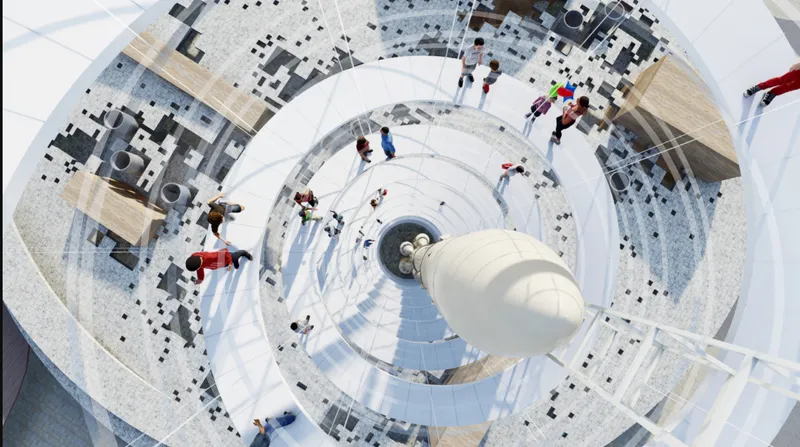
A top-down view into the helical tower reveals concentric rings of paving radiating outward from a central void. Suspended within that void is a rocket, hanging vertically as if frozen mid-launch. Visitors circulate the rings below, their small figures registering the tower's true diameter. The image confirms the design's core spatial move: the spiral is not decorative but organizational, pulling the eye and the body downward toward the exhibition's most symbolic artifact.
Interior Galleries Where Astronauts Float Overhead
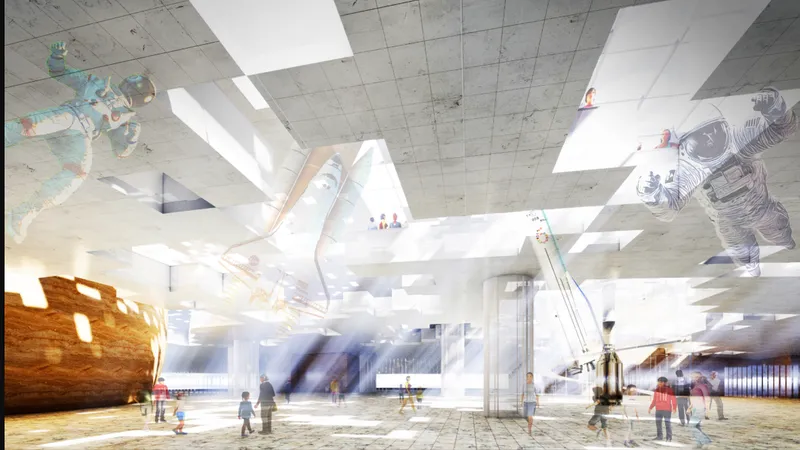
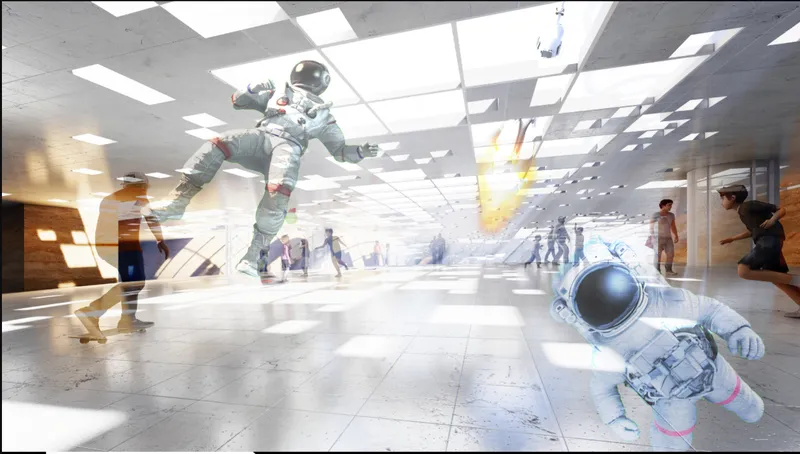
Inside the domed volume, the exhibition program unfolds beneath a concrete ceiling punctuated by skylights. Hanging rocket components and astronaut figures are suspended at various heights, creating a layered interior atmosphere that mimics the weightlessness of space. Visitors below appear blurred in motion, reinforcing the immersive character of the experience. VR technology and interactive installations take visitors through the technical history of rocket construction and the broader mysteries of the universe.
The second interior view shifts emphasis to a gridded skylight ceiling, flooding the exhibition hall with diffuse natural light. Suspended astronaut figures and a spherical rocket element occupy the middle ground between floor and ceiling, establishing a vertical territory of display that conventional wall-mounted exhibitions cannot achieve. The spatial strategy is clear: the visitor does not merely observe artifacts in a case but walks beneath them, looking up as one might look at the night sky.
Why This Project Matters
Commemorative architecture often defaults to static monumentality: a slab, a wall, a plaque. Wong and Yu reject that impulse entirely. Their proposal treats the anniversary of the moon landing as an occasion for spatial immersion rather than reverent distance. The 40-meter dome, the spiral tower, the suspended rockets and floating astronauts all work together to place the visitor inside the narrative of lunar exploration, not outside it.
The project also demonstrates how emerging technologies like VR and laser projection can be integrated into architectural form without reducing the building to a container for gadgets. The continuous spherical geometry, the cloverleaf plan, and the helical circulation are all legible as architecture first. Technology amplifies the spatial experience; it does not replace it. That balance is what makes A Piece of Moon a convincing proposition for how we might build public memory in the twenty-first century.
View the Full Project
About the Designers
Designers: Chiming Wong, Kuai Yu
Enter a Design Competition on uni.xyz
uni.xyz runs architecture and design competitions year-round that reward proposals with spatial conviction and real site intelligence.
Project credits: A piece of moon by Chiming Wong, Kuai Yu Moontrip 2019 (uni.xyz).


Popular Articles
Popular articles from the community


Architekt Andreas Gruber Scatters 23 Dark Timber Chalets Across a South Tyrolean Forest Edge
In Molini di Tures, Amonti Chalets breaks a resort into a hamlet of gabled timber houses, with parking, storage and services pushed into the slope.

U.GA Architects Wraps an Oval Rooftop Pool in Curved Board-Formed Concrete on Busan's Jeollidan-gil
In Busan's Jeonpo-dong, a 454 m² mixed-use block stacks a neighborhood facility, guest rooms and an oval rooftop pool inside spiraling concrete walls.

Cube Design Draws an Ecological Corridor Between Two Shenzhen Hills with the Nankai Building
Beside Shenzhen's container docks, the Nankai Building pairs stacked balconies with a climbing green screen to connect two hillsides across its height.

longwave studio Reorganizes a 112 m² Tainan Apartment Around the Daily Routines of a Family and Two Cats
In Tainan, Taiwan, birch plywood, rust-red furniture and a freestanding plaster wall link arrival, storage, work and family life in one apartment.

Similar Reads
You might also enjoy these articles

Gil Mello Arquitetura Tilts a Single Roof Toward the Waterfalls on a Plateau Above Aiuruoca, Brazil
In Aiuruoca, Minas Gerais, a 200 m² house of local labor and reclaimed poles pairs a low valley veranda with a tall mountain one.
U.GA Architects Wraps an Oval Rooftop Pool in Curved Board-Formed Concrete on Busan's Jeollidan-gil
In Busan's Jeonpo-dong, a 454 m² mixed-use block stacks a neighborhood facility, guest rooms and an oval rooftop pool inside spiraling concrete walls.

Felipe Hess Arquitetos Turns a Blind Stone Wall to the Street and Opens a Brazilian House onto a Courtyard and Canal
A canal-front house in Brazil hides behind painted stone and planting, then opens to an olive-tree courtyard, a reed-ceilinged porch and a curving pool.

David Macias Steps a Doorless Stone and Plaster House Down a Tropical Colombian Hillside
In the humid hills of Colombia, Threshold House replaces the front door with an open void and terraces its 850 m² down the slope instead of fighting it.

Explore Futuristic Design Competitions
Discover active competitions in this discipline

Challenge to imagine architecture inspired by fiction

Challenge to reimagine the Iron Throne

Photograph architecture without architects

VR headsets Storefront design competition
Comments (0)
Please login or sign up to add comments
No comments yet. Be the first to comment!