
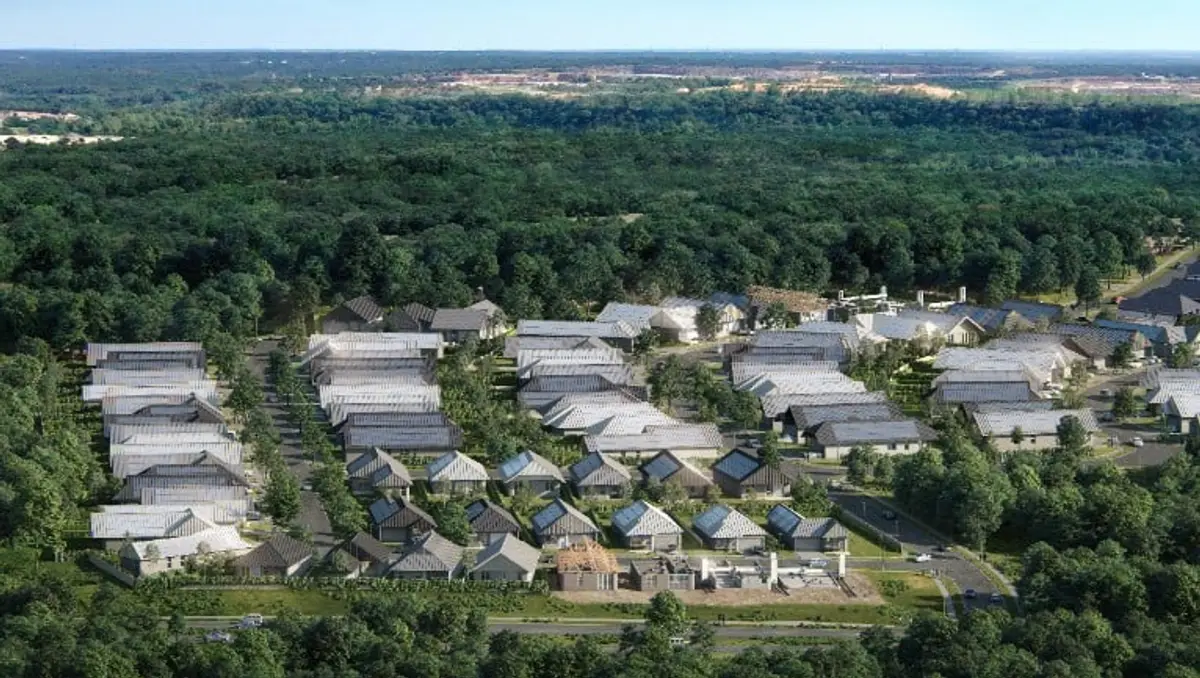
ICON, Lennar, and BIG team up for record-breaking 3D-printed home community
The innovative project will revolutionize construction and offer affordable, sustainable housing


Lennar, one of the United States' leading homebuilders, and ICON, a company pioneering large-scale 3D printing, have recently announced a commitment to building the largest community of 3D-printed homes. The 100-home community, which will be codesigned by the renowned architecture firm BIG - Bjarke Ingels Group, will be built using ICON's innovative robotics, software and advanced materials. The project is scheduled to break ground in 2022 and is expected to provide affordable, technology-driven homes that meet rising demand.
According to Eric Feder, President of LENX, "Labor and material shortages are two of the biggest factors pushing the dream of home ownership out of reach for many American families. Lennar has always expanded the boundaries of technological innovation to keep quality homes affordable and 3D printing is an immensely encouraging approach. We are excited to collaborate with ICON to develop solutions to emerging challenges in the coming years."
ICON's 3D printing technology produces resilient, energy-efficient homes faster than conventional construction methods with less waste and more design freedom. Designed and engineered from the ground up for volume 3D printing of homes with precision and speed, ICON's Vulcan construction system can deliver homes and structures up to 3,000 square feet that are built to the International Building Code (IBC) structural code standard and expected to last as long or longer than standard Concrete Masonry Unit (CMU) built homes.

ICON's proprietary wall system and advanced materials are stronger and longer-lasting than traditional building materials and provide safer, more resilient homes that are designed to withstand extreme weather, greatly reduce the impact of natural disasters, and be printed at high speeds and at scale. Jason Ballard, the ICON co-founder and CEO, stated that "Construction-scale 3D printing not only delivers higher-quality homes faster and more affordably, but fleets of printers can change the way that entire communities are built for the better. The United States faces a deficit of approximately 5 million new homes, so there is a profound need to swiftly increase supply without compromising quality, beauty, or sustainability. That is exactly the strength of our technology."
By partnering with ICON and Lennar, the 3D-printed architecture and the photovoltaic roofs are innovations that are significant steps towards reducing waste in the construction process, as well as towards making homes more resilient, sustainable, and energy self-sufficient. Martin Voelkle, Partner at BIG-Bjarke Ingels Group, said, "Additive manufacturing has the potential to revolutionize the built environment as it gets adopted by the industry at scale. By partnering with ICON and Lennar, we are able to see this new technology roll out to the widest possible audience."

In conclusion, this project has the potential to revolutionize the home-building industry, reduce waste, and increase the supply of quality homes. The commitment of Lennar and ICON to build the largest community of 3D-printed homes to date using ICON's innovative robotics, software, and advanced materials is a significant step towards meeting the rising demand for affordable homes in the United States. With the codesign of BIG - Bjarke Ingels Group, this project is expected to deliver higher-quality homes faster, more affordably, and with more design freedom. The partnership between Lennar, ICON, and BIG is expected to have a significant impact on the future of community-scale development and the adoption of 3D printing technology in the homebuilding industry.
References (1)


Popular Articles
Popular articles from the community

Tsunami Convergenics: Turning Catastrophic Ocean Forces into Underwater Housing Infrastructure
A speculative underwater settlement off the coast of Onagawa, Japan, treats tsunamis and typhoons as energy sources rather than threats.

Manzana Morphosis: Stretching Barcelona's Grid into a Living Landscape for 2050
A radical reworking of the Eixample manzana turns density into a tool for generous public space, vertical ecology, and environmental performance.

Cloaked Colonization: A Mobile Underwater Habitat That Moves Like a Fish
Micah Abaya's shortlisted EHC Pacific entry reimagines ocean settlement as a dispersed network of self-sustaining architectural organisms.

Opera on the Sea: Driftwood Logic Shapes a Timber Opera House on Estonia's Coast
Trevor Orgill's opera house translates the entangled drift of floating timber into a civic building where wood, water, and music converge.

Similar Reads
You might also enjoy these articles
116 Rokeby Building, Collingwood
Sustainable Collingwood office building featuring double-skin façade, natural ventilation, rooftop amenities, and carbon-neutral design focused on wellbeing and longevity.
Contemporary Apartment Renovation in Spain: RV House by BIAN Opens Up to the Sea
A minimalist 1930s apartment in Santander is transformed into a flexible, sea-facing home through contemporary Spanish renovation.
3 Marías House: A Contemporary Mediterranean Courtyard Retreat by Bajet Giramé + Burckhardt
Mediterranean courtyard home blending traditional architecture with modern design, terracotta flooring, flexible interiors, sustainable climate strategies, and garden integration.
NZ10 Apartment by auba studio: Adaptive Reuse in Palma de Mallorca
Adaptive reuse apartment transforms bakery into light-filled home with patios, privacy layers, and wood interiors enhancing urban living experience.

Explore Concrete 3D Printer Competitions
Discover active competitions in this discipline


Challenge to reimagine the Iron Throne

Photograph architecture without architects

Illustrate the lost glory of Angkor Wat - Render Challenge

Design challenge to reuse E-waste
Comments (0)
Please login or sign up to add comments
No comments yet. Be the first to comment!