

Rede Arquitetos Turns Circulation into Civic Space at the Educar II SESC School in Fortaleza
In Fortaleza, Brazil, Educar II SESC-CE trades a signature form for mesh screens, yellow thresholds and courtyard walkways built for equatorial heat.


Schools in Brazilian cities are rarely just schools. They act as civic anchors, polling stations, weekend meeting points and, for many families, the most generous public building within walking distance. Educar II SESC-CE in Fortaleza, designed by Rede Arquitetos, appears to accept that role. The campus opens itself around paved courtyards and open-air corridors, so the boundary between institution and street feels porous.
What we find most compelling is how little the project relies on a single image. There is no sculptural hero form here. The architecture builds up through repeated, legible parts: perforated and mesh screens, white steel stairs, horizontal louvres, truss-supported roofs, and saturated yellow surfaces that double as signage. The decisive move sits in section. Walkways ring an open courtyard, and that turns the daily act of moving between rooms into the building's main social experience.
Street Presence and the Yellow Threshold


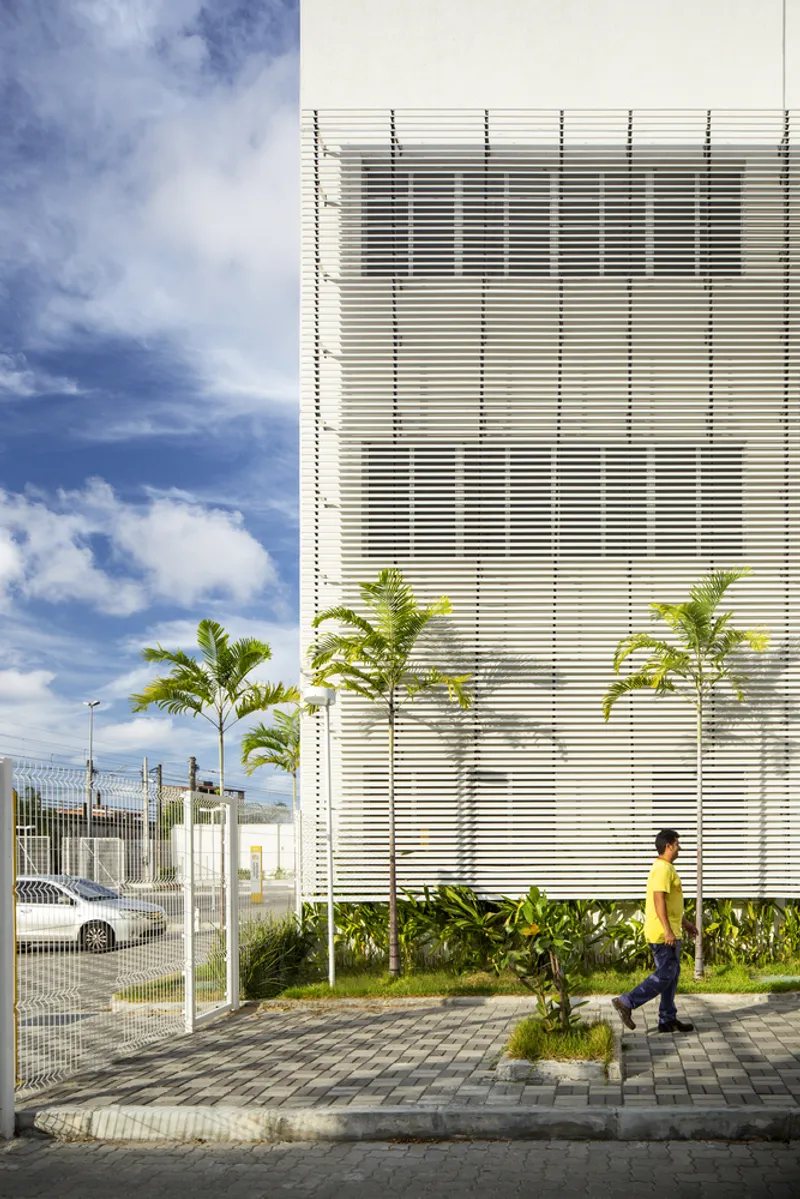
From the corner, the school reads as a clean white block with a yellow underside, wrapped in a perforated skin and fronted by palms. The yellow carries real weight. It shows up in soffits, recesses and long plaza-facing walls, and it flags the places where public ground becomes school ground. You learn where to enter before you read a sign.
The entrance atrium makes the urban relationship explicit. It opens toward a parking lot and a rail line, with a yellow soffit below and a glazed roof above. The school does not turn its back on the infrastructure around it. It frames it. That candor about context is rarer in institutional work than it should be.
Screens Tuned to Orientation

The open stair tower is the facade's most legible event. White steel flights and mesh guards stack upward in full view, and vertical movement becomes part of the elevation instead of something tucked inside a core. Young palms and street lamps at its base set it at a civic scale, closer to a public stair than a fire egress.
Elsewhere, horizontal white louvres take over, and palm shadows play across them on the sidewalk side. The shift from mesh to louvre does not read as stylistic variety. It reads as a response to orientation and exposure, with each face screened according to the sun it receives. In a city this close to the equator, that kind of facade-by-facade thinking does more than any single material choice.
The Courtyard as Civic Engine

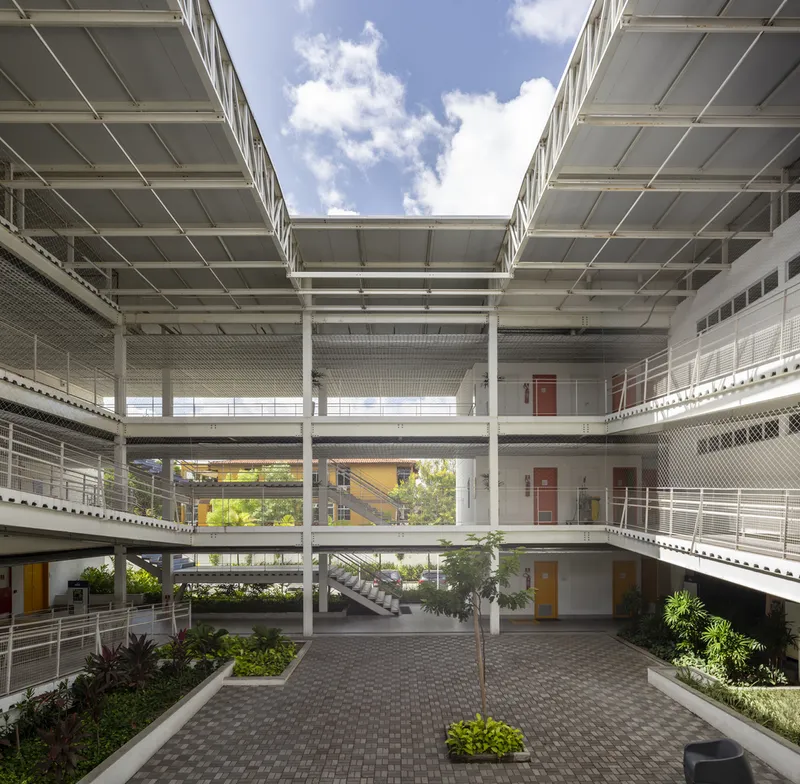
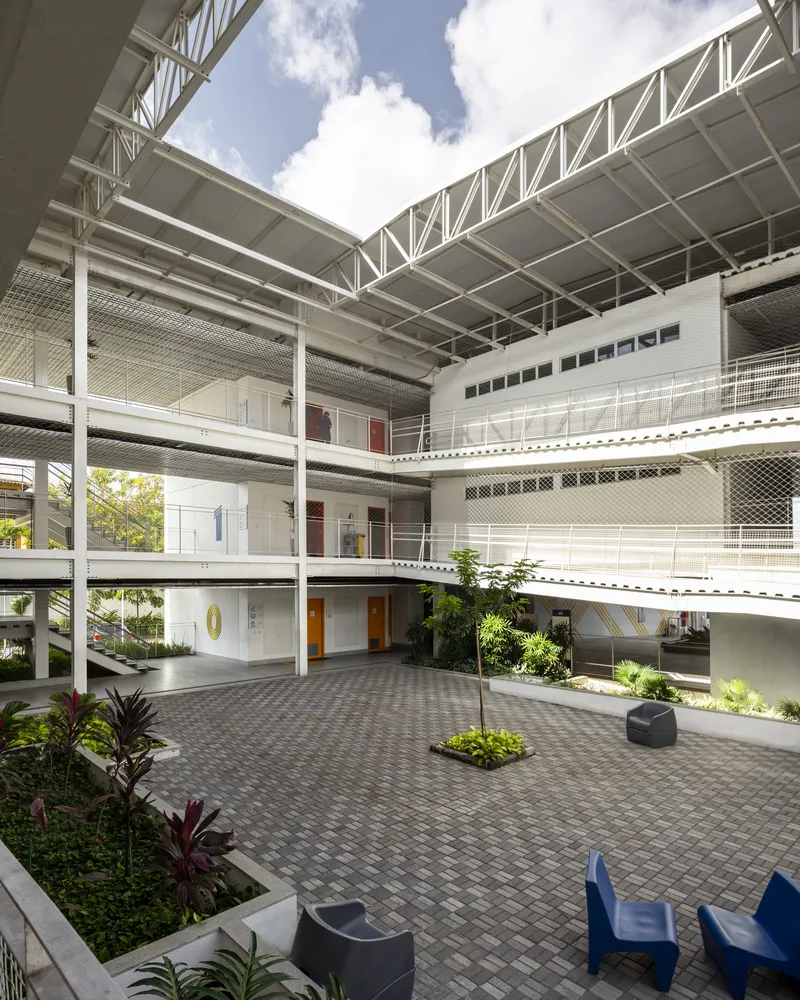
The courtyard is the heart of the project. Paving, planted beds, a young tree and loose blue chairs create a ground plane that feels closer to a small plaza than a school yard. Tiered walkways with mesh railings and ramps wrap the void, so every corridor works as a balcony and every trip between classes carries a view down to whoever is gathered below.
Overhead, white steel-truss roofs cover parts of the space without sealing it. Shade arrives in pieces and the sky stays visible. In Fortaleza's heat, an open, shaded volume ringed by breezy corridors is a sensible passive strategy. The design relies on air movement and shadow far more than enclosure, and the section does the environmental work that would otherwise fall to equipment.
Graphics That Do the Wayfinding


Large letterforms (a striped A, a concentric-line C, a plain D) are painted at architectural scale onto walls along the walkways. They work as both identity and navigation. A child does not need to read a room number to know which block they belong to; the wall tells them.
Sunlight filtering through the mesh-railed walkways overhead stripes these surfaces again, so the graphics shift through the day. Long planters along the covered walkways keep the palette from tipping into the purely institutional. The approach is cheap, durable and effective, which is exactly what public school design should aim for.
Rooms for the Body: Sports Hall and Dance Studio

The sports hall is the campus's most dramatic interior. Red steel arches span a blue court, and the curved roof lifts the ceiling well above what a flat slab could offer. Light enters through the side walls rather than glaring down from above, which matters in a room built for fast movement and tracking a ball.
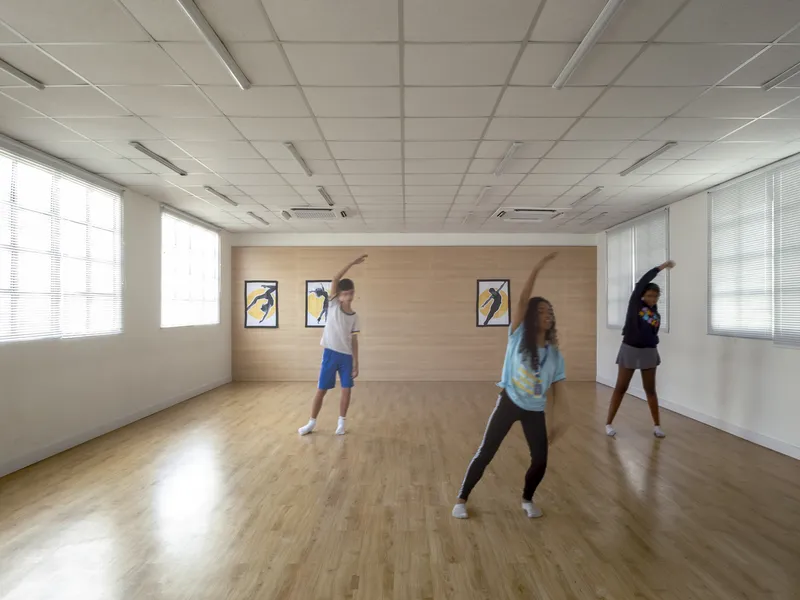
The dance studio moves in the opposite direction: warm wood floor, a timber-clad end wall, bright windows. It is quieter and more intimate, a reminder that the project tunes each program room to its use rather than applying one material language everywhere. Together, these two rooms suggest a school that treats physical and artistic education as core, not as extras.
Why This Project Matters
Educar II SESC-CE shows that a public school can be generous without being monumental. Its strength comes from many modest, well-placed decisions: screens matched to orientation, color used as signage, stairs and walkways put on display, and a courtyard that lets the school feel like part of the neighborhood. None of these moves is exotic. The skill is in how consistently they are combined.
For architects working in hot climates and on tight public budgets, the lesson is that section and circulation can carry both environmental and social ambitions at once. Rede Arquitetos makes corridors into balconies and a courtyard into a civic room, and in doing so makes a strong case that the in-between spaces of a school deserve as much design attention as its classrooms.
Educar II SESC-CE by Rede Arquitetos, Fortaleza, Ceará, Brazil.
About the Studio
Share Your Own Work on uni.xyz
If projects like this are the kind of work you want to make, uni.xyz is a place to publish your own, find collaborators, and enter design competitions.


Popular Articles
Popular articles from the community


Aquadapt: An Underwater Habitat That Rewrites Its Rooms by the Hour
Curved modules ring the seabed while one shell shifts from breakfast room to cinema, farm and football pitch as residents' needs change.


graciastudio Turns a Viewless Tijuana Lot Inward Around a Courtyard of Concrete, Timber and Trees
In Tijuana, Jorge Gracia's GA2 House stacks a timber-clad private floor over exposed concrete and replaces a missing view with a planted interior patio.

David Ortega Stacks a Two-Story Mexico City Penthouse Around a Steel Stair and a Pergola-Shaded Roof Terrace
In Colonia Roma, a 300 m² penthouse uses oak joinery, a planted steel stair and a slatted roof pergola to make a new-build apartment feel like a house.

FCC Arquitectura Expands a Portuguese Granite House with a Board-Marked Concrete Wing
In Portugal, JV House pairs a cleaned-up whitewashed and granite dwelling with a timber-shuttered concrete extension, courtyards and a garden pool.

Similar Reads
You might also enjoy these articles

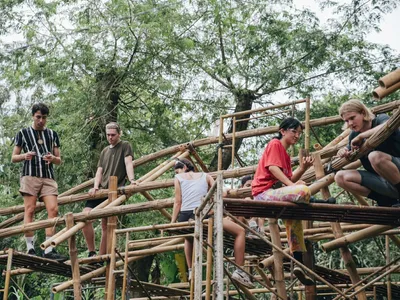
Bamboo Housing Challenge 2026: Design Affordable, Sustainable Homes Using Bamboo
An international design competition by Bamboo U and IBUKU inviting architects and designers to reimagine affordable housing using bamboo — with the winning design built full-scale in Bali.

Computational Design & Education: Beegraphy Design Awards Introduces 7th Category (Featuring Jiyun's Innovative Approach)
Dive into Beegraphy’s 7th Design Awards category, where computational design meets education to create immersive, interactive learning tools, inspired by Jiyun’s work.

From Parametric Lighting to Urban Furniture: Join the 2nd Workshop in Beegraphy’s Computational Design Series
Dive into Cutting-Edge Design Techniques and Practical Applications with Industry Experts

Last Call: Unleash Your Architectural Genius in SHAK's Kindergarten Design Competition
Urgent call for architects to join SHAK's kindergarten design competition before the looming deadline

Explore Architecture Competitions
Discover active competitions in this discipline

Challenge to design public laboratory

Challenge to reimagine the Iron Throne

Photograph architecture without architects

Illustrate the lost glory of Angkor Wat - Render Challenge
Comments (0)
Please login or sign up to add comments
No comments yet. Be the first to comment!