
UNA Barbara e Valentim Build a Curved Rammed Earth House at the Foot of São Paulo's Serra do Japi
A 550 m² residence in the São Paulo countryside uses colonial-era earth construction and passive climate strategies to settle quietly into its radial plot.


Rammed earth is one of those materials that architects either treat as a nostalgic gesture or ignore altogether. UNA Barbara e Valentim, led by Fernanda Barbara and Fabio Valentim, take a third path with Japi House: they use it as the primary structural and spatial device for a 550 m² residence in São Paulo's countryside, wrapping the perimeter of a radial plot in a continuous curving wall of compacted soil. The technique arrived in Brazil with the Portuguese during the colonial period, and here it is reinterpreted without sentimentality, paired with board-formed concrete and timber louvers to make a house that performs as well as it signifies.
What makes the project genuinely interesting is the refusal to separate sustainability from architecture. The rammed earth wall is not a decorative skin; it is the load-bearing perimeter, the privacy screen, and the thermal mass all at once. Concrete handles the roof slab and internal walls, a planted roof adds insulation and rainwater management, and folding timber shades modulate solar gain. Every material decision does double duty. The result is a house that looks effortless from the pool deck but is, in section, a diagram of passive climate strategy.
A Wall That Becomes a Building
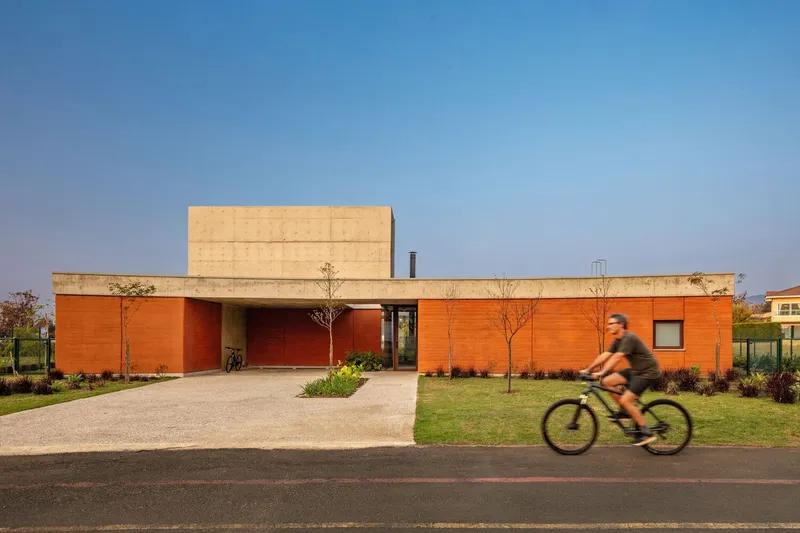
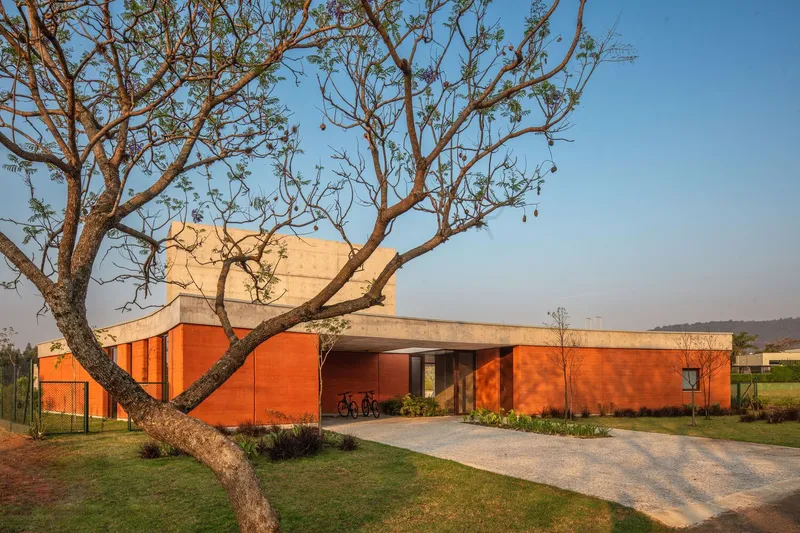
The defining move is the curved rammed earth wall that traces the irregular boundary of the radial plot. From the street, the house reads as a long, low terracotta mass topped by a thin concrete brow. The warm, stratified texture of the compacted soil gives the facade a geological quality, as though the building rose from the ground rather than being placed on it. A leafless tree against the orange surface at late afternoon light confirms that the architects were thinking about color temperature as much as structural performance.
The curve does practical work too. It shields the interior from the street and neighboring properties without requiring fences or secondary enclosures. Privacy is embedded in the plan, not bolted on. Where the wall turns a corner, the concrete roof cantilevers past it, creating deep overhangs that protect the earth from rain and shade the glazing below.
Concrete as Counterpoint
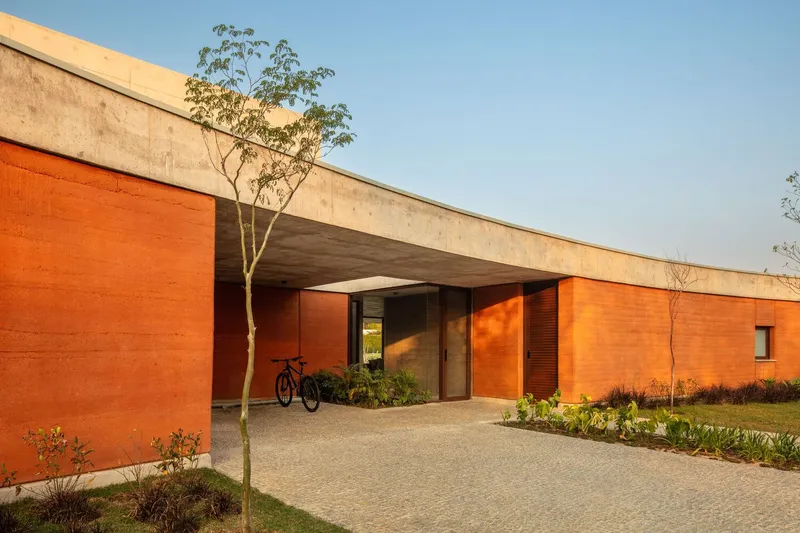
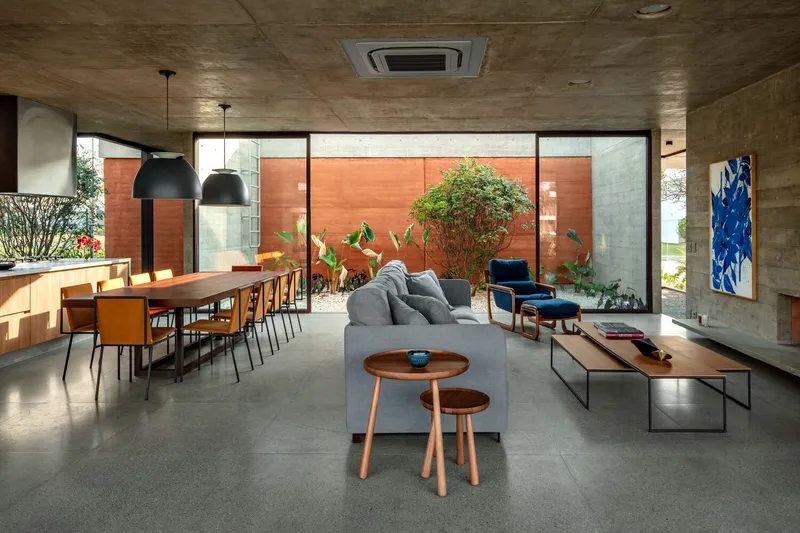
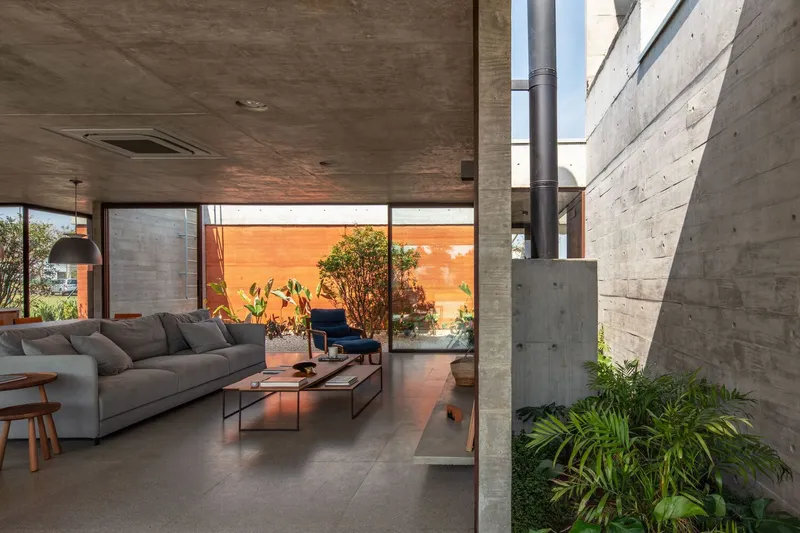
If rammed earth provides the warm, textured envelope, exposed board-formed concrete supplies the structural skeleton and the interior character. The entry portal frames a glazed door within a deep concrete soffit, announcing the material duality before you step inside. Inside the open-plan living and dining area, the concrete ceiling carries the imprint of its timber formwork, an honest record of how it was made that rhymes with the layered striations of the earth walls.
The internal concrete walls open generously onto planted courtyards, turning what could be a heavy material into a frame for greenery and light. One corner of the living room dissolves into a glazed courtyard packed with vegetation, a move that brings cross-ventilation deep into the plan and softens the monolithic quality of the concrete. The two materials, earth and concrete, never compete. They divide responsibilities cleanly: earth wraps, concrete spans.
Living Between Inside and Outside
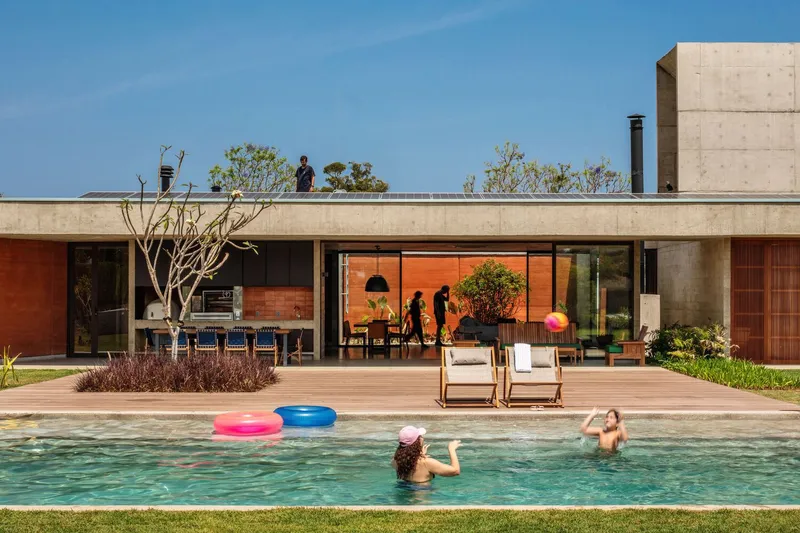
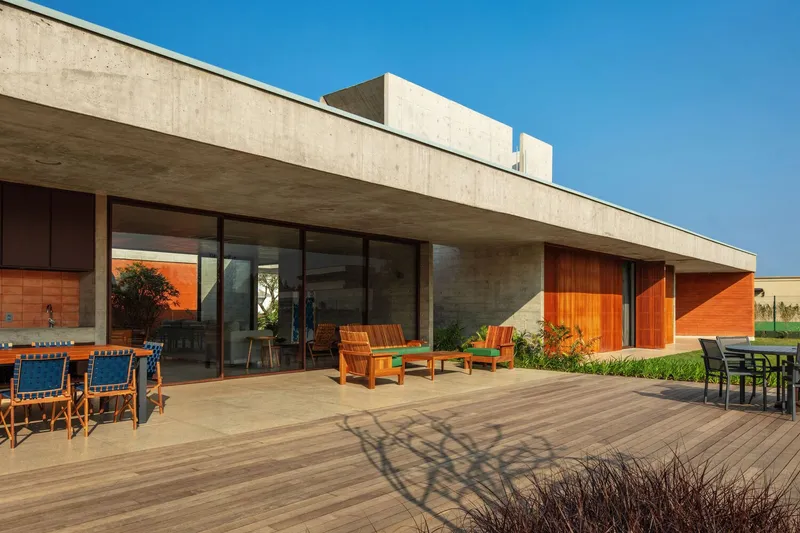
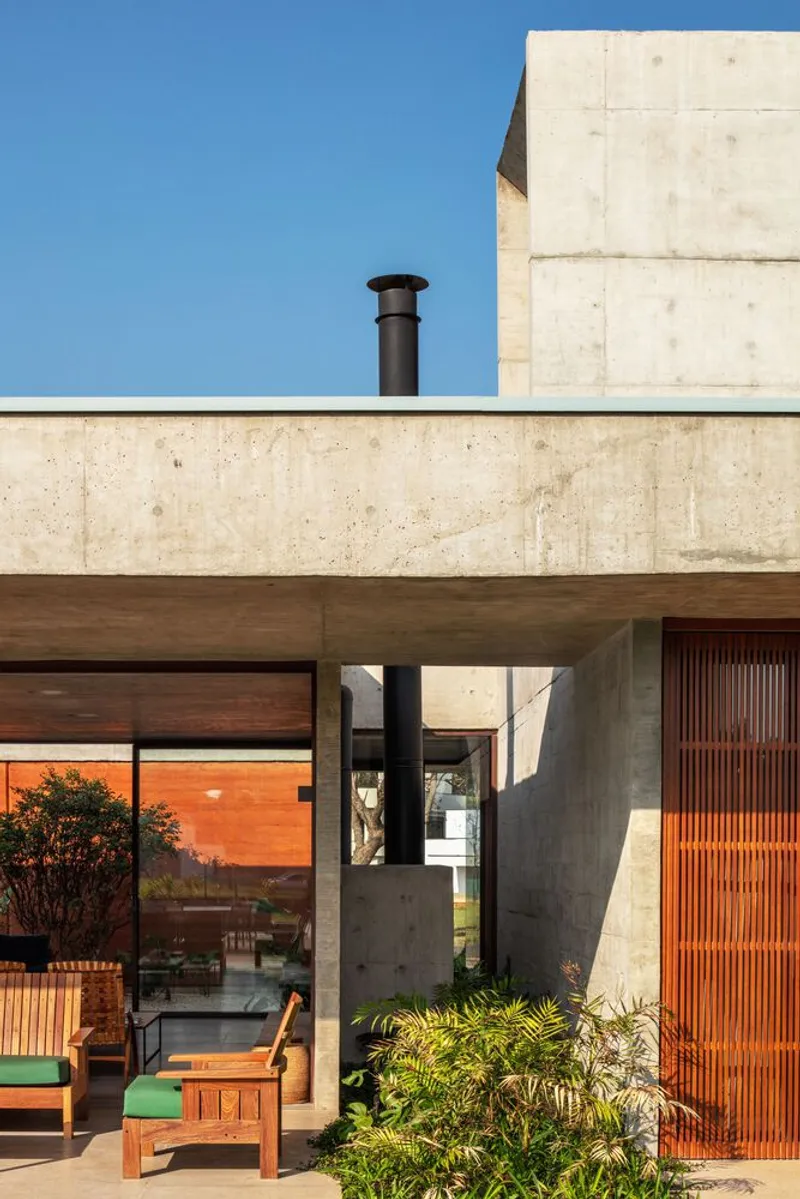
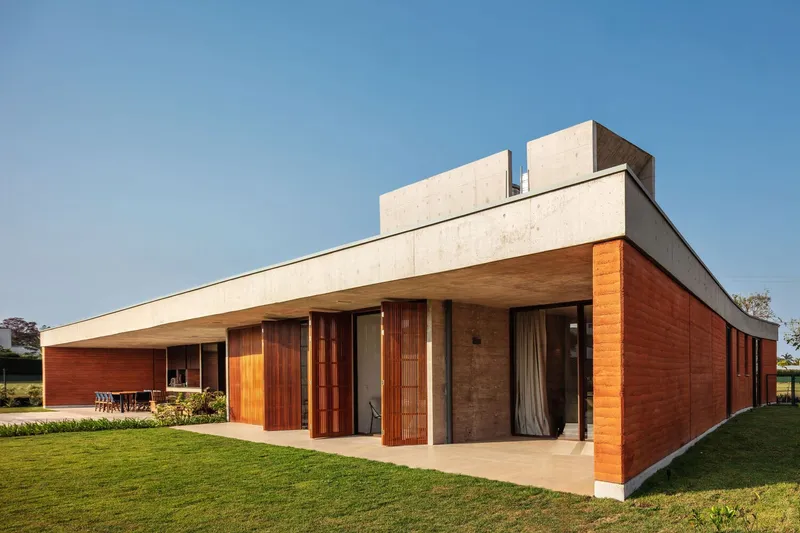
The poolside elevation is where Japi House shows its full hand. Floor-to-ceiling glass walls slide open to merge the living room with a timber deck, a lawn, and finally the pool. Families swim while the kitchen is a few barefoot steps away. The cantilevered concrete roof extends well beyond the glass line, creating a covered patio zone that is neither inside nor outside but something more useful than either.
Timber slatted screens and planted beds line the covered patios, filtering light and air without closing off views. The deep concrete beams overhead are left exposed, their rhythm giving order to the transitional spaces. These in-between zones are not leftover circulation; they are the primary living spaces for much of the year, which is exactly the right response to São Paulo's subtropical climate.
The Tower and the Horizon
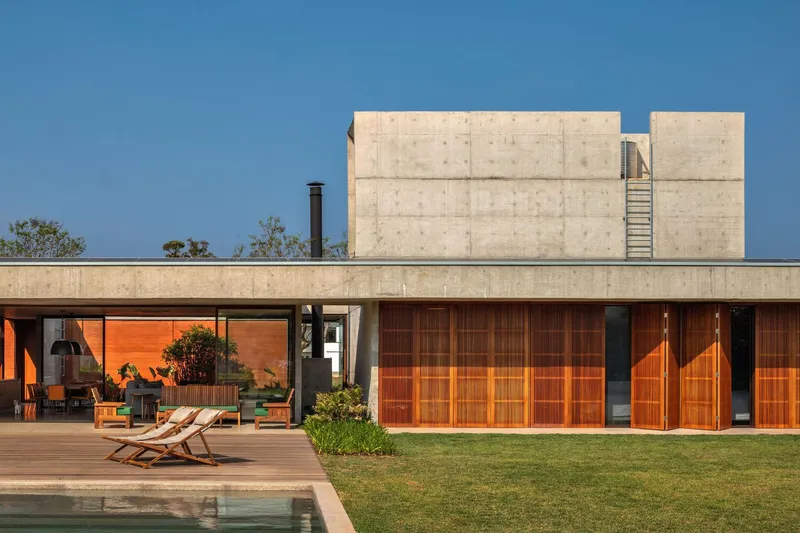
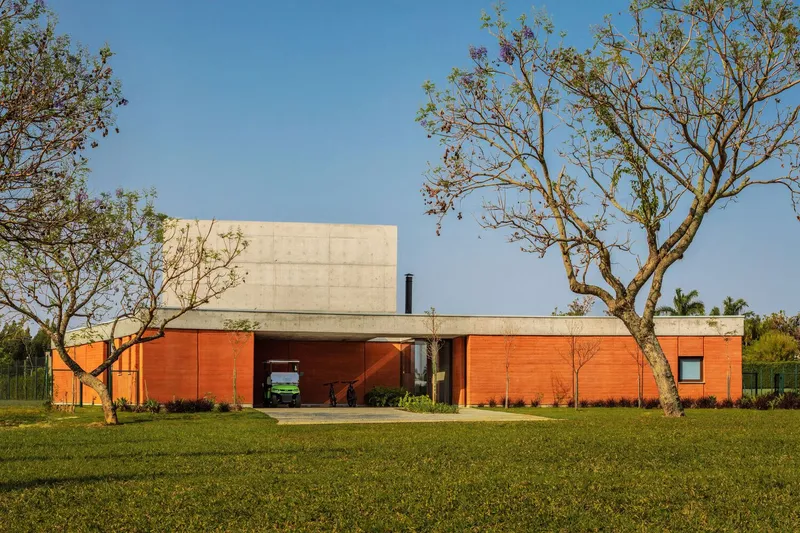
Against the resolute horizontality of the house, a single concrete tower rises to hold water tanks and mechanical equipment. It is a frankly pragmatic element that the architects allow to become sculptural, a vertical punctuation mark against the long, low datum of timber shutters and rammed earth. Seen from across the lawn in afternoon sunlight, the tower anchors the composition the way a chimney anchors a farmhouse: not as ornament, but as an honest expression of what the building needs.
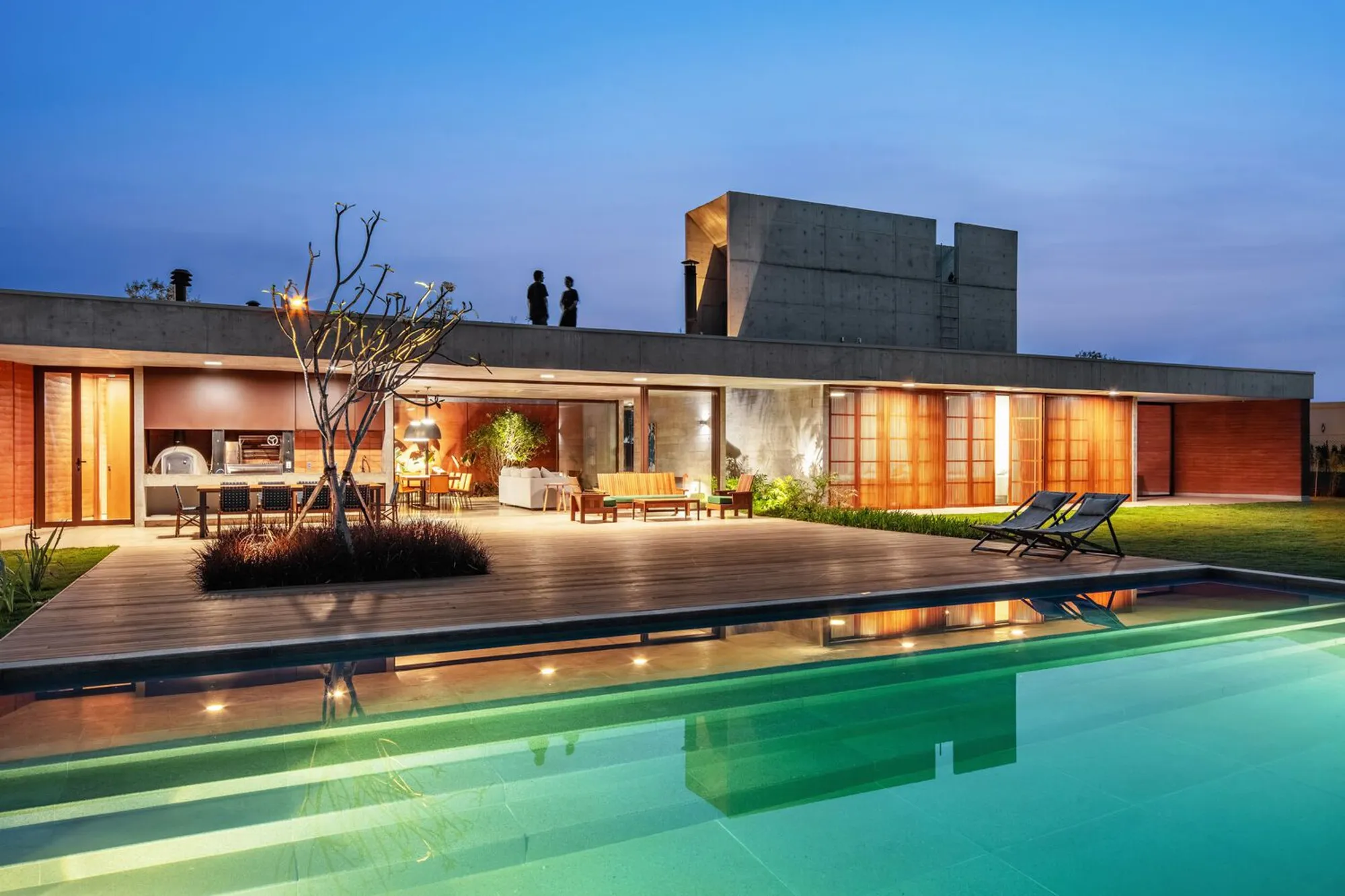
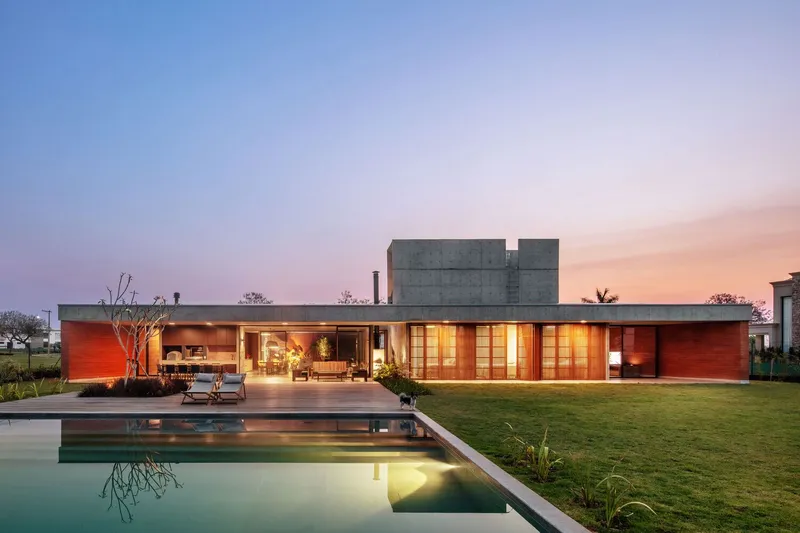
The elongated wood-clad facade at dusk, glowing from within through its glazed openings, reveals how the house stretches across the site. The horizontal proportion is deliberate. It keeps the building below the tree canopy and distributes program along the curve of the plot rather than stacking it. The tower's contrast makes the rest of the house feel even more grounded.
Timber Screens and Controlled Light
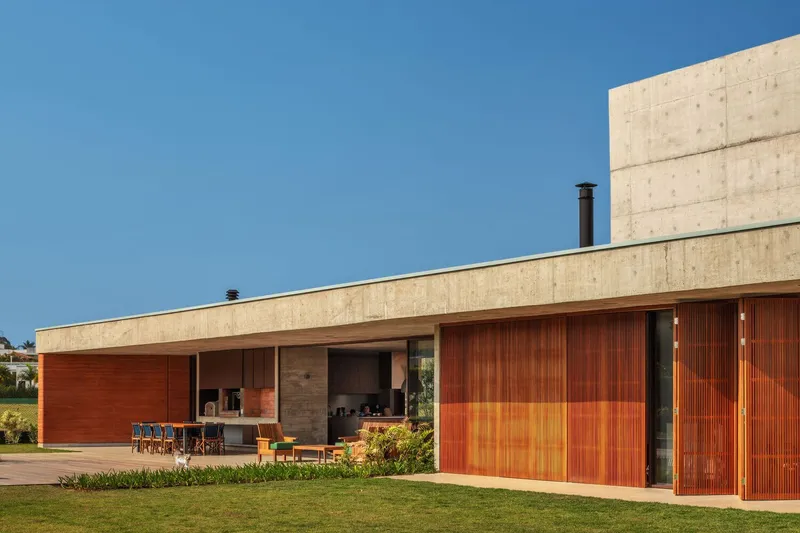
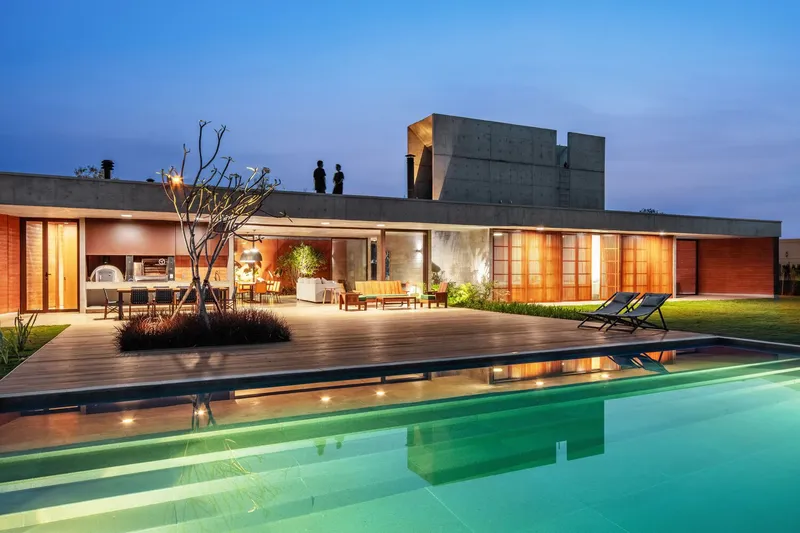
Folding timber louvers run the length of several facades, functioning as operable sunscreens that residents can adjust throughout the day. At dusk, the rear elevation becomes a lantern: warm interior light leaks through the slats and across the concrete soffit of the outdoor kitchen, turning a practical shading device into the house's most photogenic feature. The louvers also reinforce the horizontal lines, their repetitive rhythm calming the composition.
The twilight view from the pool captures the full effect. The illuminated interior is visible through floor-to-ceiling glass, the timber deck mediates between water and architecture, and the deep roof plane floats above it all. It is a house that invites occupation rather than admiration, which is a harder thing to design.
Plans and Drawings
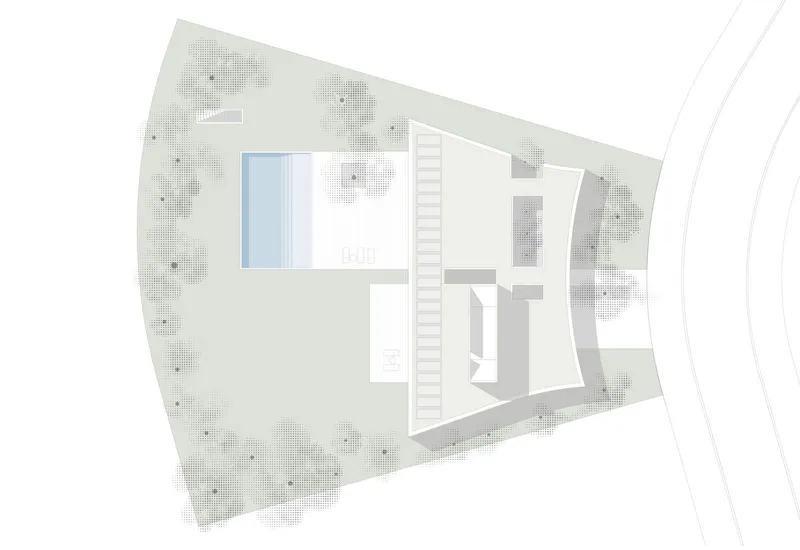
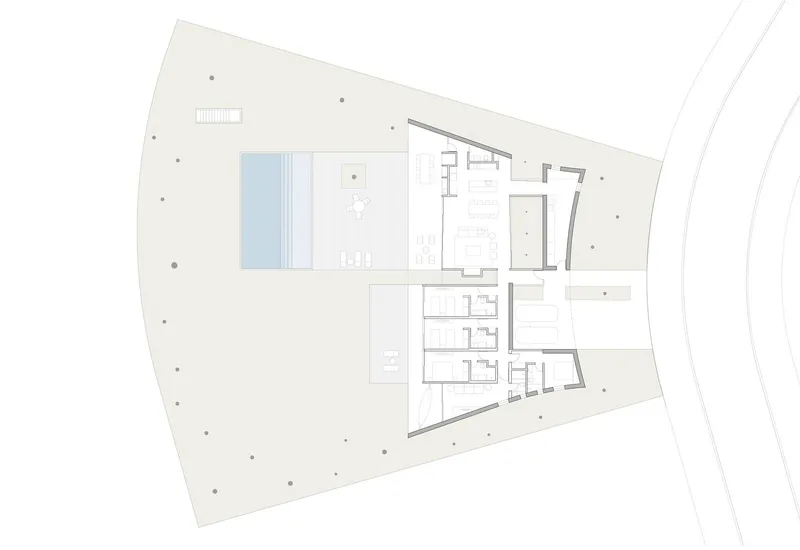
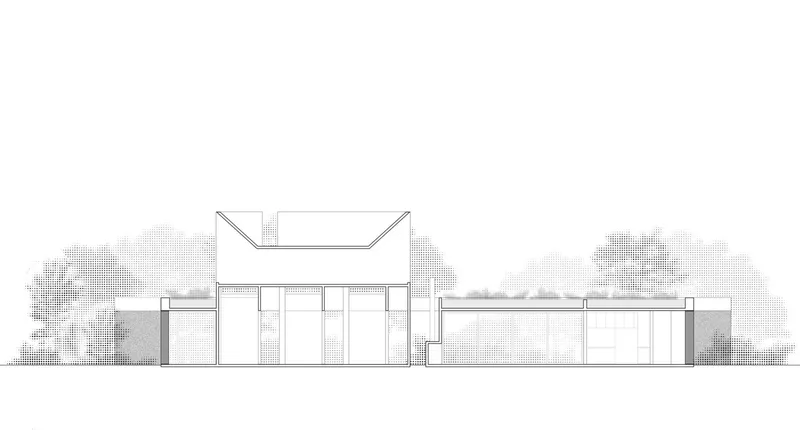
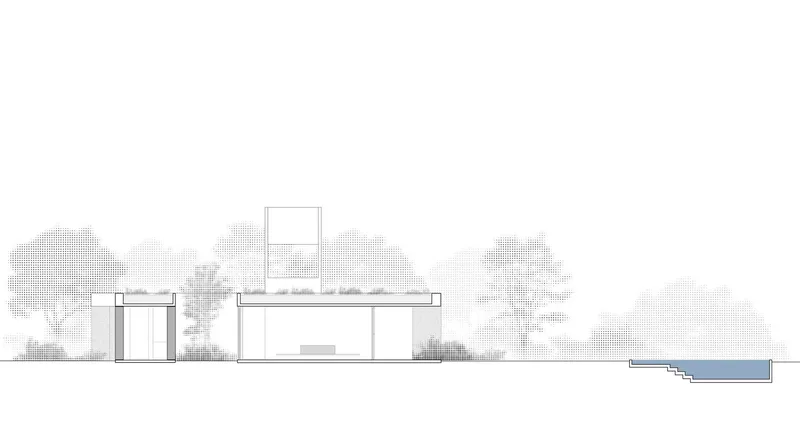
The site plan confirms what the photographs suggest: the building footprint is roughly L-shaped, wrapping around a pool and courtyard to define outdoor rooms on an irregular lot scattered with trees. The floor plan reveals a binuclear organization, with social and private zones separated by a central access point. Rooms open toward the garden and pool on one side while the rammed earth wall closes the house to the street on the other.
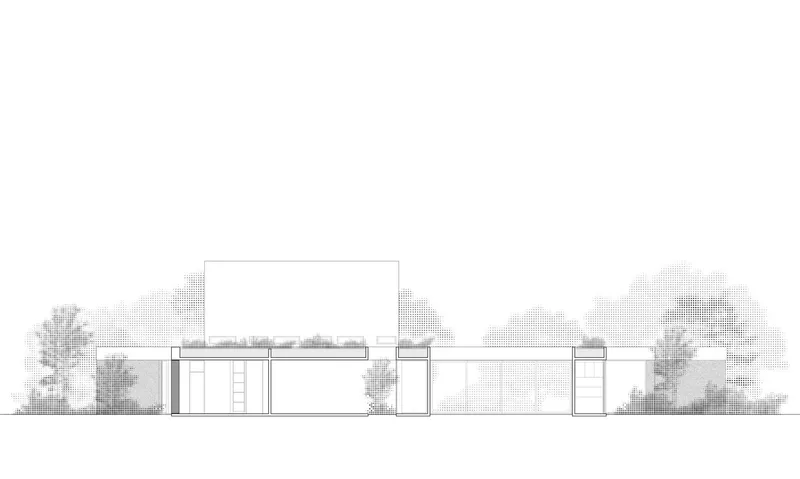
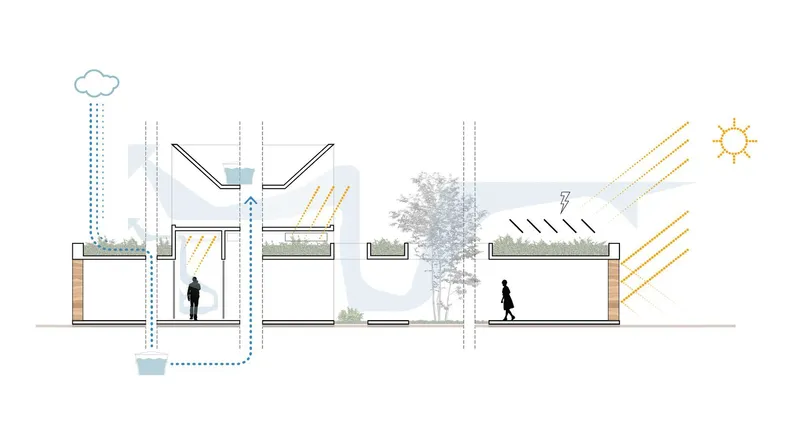
The section drawing is the most revealing document in the set. It illustrates the full stack of passive strategies: planted roofs for thermal inertia, rainwater collection channels, solar gain diagrams, and the deep overhangs that keep direct sun off the glass. An elevation shows the planted roof in profile, its greenery merging the roofline with the surrounding landscape. These are not afterthoughts layered onto a form; they are the form.
Why This Project Matters
Japi House matters because it treats sustainability as a design discipline rather than a checklist. Rammed earth, green roofs, passive ventilation, and operable timber screens are all centuries-old ideas, but the architects integrate them into a spatial sequence that feels genuinely contemporary. The curved wall is not a formal indulgence; it follows the plot geometry and provides thermal mass. The concrete tower is not a sculptural whim; it holds the water tanks. Every gesture earns its place twice, once structurally and once experientially.
For architects working in tropical and subtropical climates, this project offers a clear lesson: the most effective environmental strategies are often the ones embedded in the plan and section from the start, not the ones specified by engineers after the design is locked. UNA Barbara e Valentim demonstrate that rammed earth can carry a modern house, literally, and that the oldest construction technique in the Americas still has something to teach the newest generation of designers.
Japi House by UNA Barbara e Valentim (Fernanda Barbara and Fabio Valentim). Located in the Serra do Japi foothills, São Paulo countryside, Brazil. 550 m².
About the Studio
Share Your Own Work on uni.xyz
If projects like this are the kind of work you want to make, uni.xyz is a place to publish your own, find collaborators, and enter design competitions.



Popular Articles
Popular articles from the community


The Musturak Paradise: Senior Living Architecture for a Connected Future in Temara, Morocco
The Musturak Paradise reimagines senior living architecture in Temara via private homes, social spaces, culture, community, and shared care.

Conexión: Biophilic Design Reimagines High-Rise Living in Hong Kong
Conexión reimagines high-rise living in Hong Kong through biophilic design, green facades, shared spaces, daylight, water and nature within.

AL-JANNAH: Sustainable Architecture and Permaculture for Afghan Widows
AL-JANNAH uses sustainable architecture and permaculture to create resilient oasis of housing, learning, work and renewal for Afghan widows.

Co-Life: Senior Housing Design That Reconnects Older Adults With the City
Co-Life reimagines senior housing design through healing gardens, shared streets, workshops, and a sustainable community across generations.


Similar Reads
You might also enjoy these articles

FAMM Arquitectura Organizes Ten Villas Around Courtyards and Jungle in Nosara, Costa Rica
El Molino pairs two elongated volumes with deep overhangs and timber louvers to build a compact coastal community five minutes from the beach.
Oscar Niemeyer's Ibirapuera Park Pavilions Define São Paulo's Cultural Identity in Concrete and Curve
A constellation of modernist volumes set within São Paulo's most important urban park, conceived for the city's 400th anniversary in 1954.
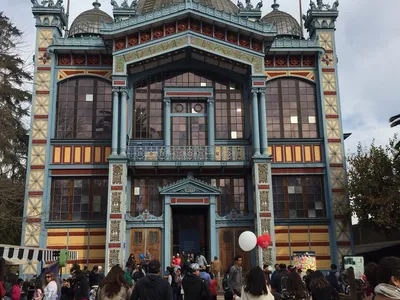
How Henri Picq's 1889 Paris Pavilion Traveled 11,000 Kilometers to Become Santiago's Artequín Museum
A prefabricated iron and glass pavilion built for the Paris Universal Exposition found a second life as a children's art museum in Chile.
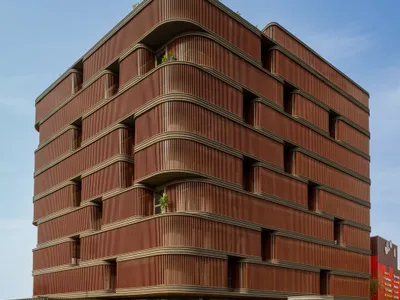
Sanjay Puri Architects Wraps a Jaipur Office Tower in Capsule-Shaped Green Buffers
A nine-level climate-responsive workplace near Jaipur Airport uses stacked planter terraces and aluminium screens to fight 40°C heat.


Explore Rammed Earth Competitions
Discover active competitions in this discipline



Challenge to reimagine the Iron Throne


Photograph architecture without architects


Illustrate the lost glory of Angkor Wat - Render Challenge


Design challenge to reuse E-waste
Comments (0)
Please login or sign up to add comments
No comments yet. Be the first to comment!