

Nature Sprawl: A Saharan Habitat That Separates People and Ecosystems by Height
A shortlisted EHC-Sahara entry that lifts homes and water tanks on columns, leaving the ground to salt-tolerant plant grids that hold the sand.


Most desert settlements claim the ground first and fight the landscape afterwards. Nature Sprawl does the opposite. It gives the sand surface back to vegetation and raises human life above it on columns. The project's central bet is vertical. By assigning separate heights to human activity and natural habitat, it argues that a city in the Sahara can grow without displacing the fragile ecology it depends on. The 'sprawl' in the title is deliberately provocative. Here, sprawl describes nature spreading outward, and the settlement follows it.
Designed by 希 青木, A T and 佳慧 陳, the proposal was shortlisted in the Extreme Habitat Challenge 2019: Sahara. The brief asked for habitation in one of the planet's harshest environments. The team answered with a system rather than a single building: a set of functional cross-sections that can be repeated, adjusted and extended across the desert as needs change.
Two Datums: A Ground for Plants and an Upper Level for People
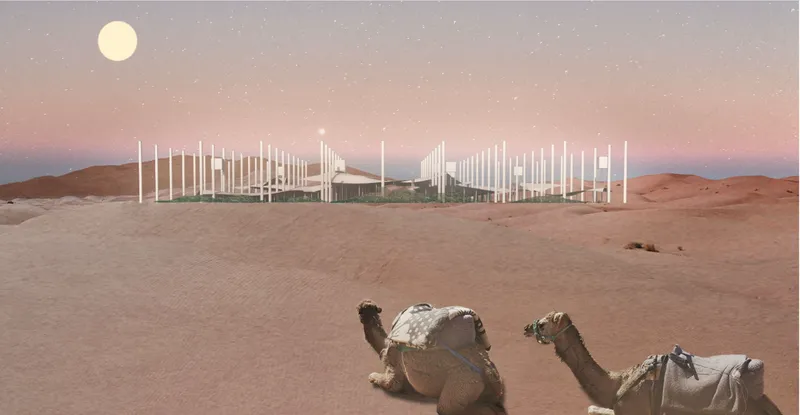
The opening image sets out the project's organising logic. The designers avoid a massive, imposing structure. They divide the habitat into cross-sections, each tuned to a specific purpose, and set human functions and natural habitats at different heights. This is a sectional idea before it is a planning idea. Disturbance to the ecosystem stays low because the two programmes rarely compete for the same square metre of ground.
The split also does climatic work. Elevated structures reduce the inhabitants' exposure to heat, and the shadows they cast create cooler conditions below, where plants can grow. The architecture performs as a canopy. Shade, often treated as a by-product in desert design, becomes the medium that joins the human level to the ecological one.
Plant Grids and Columns: Building With the Desert's Geology


Construction starts with landscape, not buildings. Grids of salt-tolerant, desert-resistant plants are laid out first to stabilise the sand and guard against erosion. Only after that are columns placed, and their positions follow the geological characteristics of the terrain. These columns carry both the homes and the water tanks. The sequence matters because it makes ground stabilisation the precondition for habitation instead of an afterthought.
Pairing water storage with the elevated structure is one of the proposal's sharpest moves. Water held in raised tanks supports the effort against desertification, and it sits within the same structural system that shelters the plants below. Respect for the desert's geology here has a practical purpose: in a landscape of moving sand, secure foundations depend on reading the ground correctly.
Modular Growth From a Village of 1,000 to a City of 1,000,000

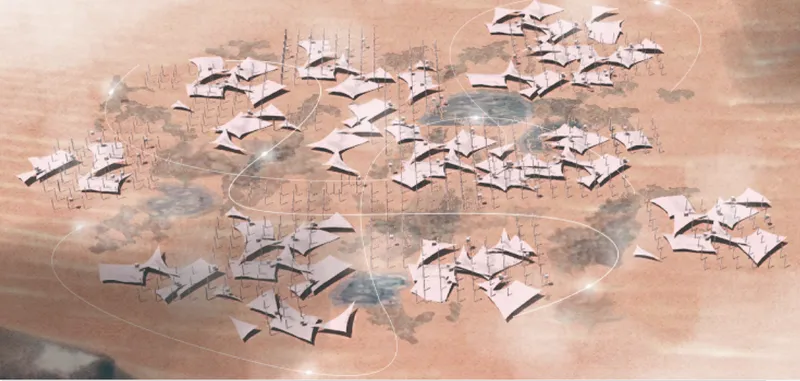
The final drawings take the system to the scale of a city. Nature Sprawl is built on modular expansion, in which functions grow independently so the infrastructure can absorb new needs without overwhelming its surroundings. Water and vegetation zones are tuned to specific functions. That lets the model scale from a small community to an urban centre, and the designers project a population range of 1,000 to 1,000,000 inhabitants.
The team also defines who this city is for: people drawn from different cities to live and work alongside nature. Public and private spaces are set out as distinct realms, each designed around the natural habitats beside it. The resulting picture is of a settlement whose density is measured against its ecology, where each new module of housing has a matching extension of planted, stabilised ground.
Why This Project Matters
Speculative desert projects often get carried away by the spectacle of the extreme. Nature Sprawl stays disciplined. Its strongest idea is sectional and simple: lift people up, keep the ground for plants, and let the overlap between the two produce shade, stability and water. That gives the proposal a logic that holds up whether the module is built once or ten thousand times.
The project also reframes what growth can mean in fragile terrain. Expansion is usually where sustainable intentions break down. Here, every increment of human settlement is tied to an increment of ecological repair, so the plant grid advances as the city does. As a shortlisted response to the EHC-Sahara brief, it makes a persuasive case that the most useful thing architecture can do in the desert is help the ground hold together.
View the Full Project
About the Designers
Enter a Design Competition on uni.xyz
uni.xyz runs architecture and design competitions year-round that reward proposals with spatial conviction and real site intelligence.
Project credits: Nature Sprawl by 希 青木, A T, 佳慧 陳 EHC-Sahara (uni.xyz).


Popular Articles
Popular articles from the community


Opera on the Sea: Driftwood Logic Shapes a Timber Opera House on Estonia's Coast
Trevor Orgill's opera house translates the entangled drift of floating timber into a civic building where wood, water, and music converge.

Aquadapt: An Underwater Habitat That Rewrites Its Rooms by the Hour
Curved modules ring the seabed while one shell shifts from breakfast room to cinema, farm and football pitch as residents' needs change.


ETEH Reworks the Shared Spaces of São Domingos School in Brazil Around Timber, Color and Hanging Plants
At São Domingos School in Brazil, 436 m² of hall, refectory and library are recast with timber joinery, a yellow and blue code and trailing greenery.

The Amber Palace Opera: A Geological Fiction Surfaces on Tallinn's Baltic Waterfront
Pierre Brillard reimagines a Baltic legend as a public landscape, opera house, and waterfront promenade rooted in Tallinn's coastal identity.

Similar Reads
You might also enjoy these articles

Cube Design Draws an Ecological Corridor Between Two Shenzhen Hills with the Nankai Building
Beside Shenzhen's container docks, the Nankai Building pairs stacked balconies with a climbing green screen to connect two hillsides across its height.

Praksis A and Studio Sted Bend a Red Timber Cabin Across the Granite of Norway's Southern Coast
On the southern Norwegian coast, a 105 m² cabin follows the rock on slender posts, pairing red cladding outside with pine, brick and plywood within.

David Ortega Stacks a Two-Story Mexico City Penthouse Around a Steel Stair and a Pergola-Shaded Roof Terrace
In Colonia Roma, a 300 m² penthouse uses oak joinery, a planted steel stair and a slatted roof pergola to make a new-build apartment feel like a house.

PARALELA and LB2 Thread a Public Walkway Through the Base of a Las Condes Residential Tower
In Las Condes, Santiago, the Hamlet Building gives its fenceless ground floor to a 70-metre wooded passage linking two streets and the metro.

Comments (0)
Please login or sign up to add comments
No comments yet. Be the first to comment!