

Nendo's Stunning Tokyo 2020 Olympic Cauldron Shines as a Hydrogen-Powered Sun
Japanese Design Studio Nendo creates an innovative and eco-friendly centrepiece for the Summer Games

The Tokyo 2020 Olympic Cauldron was designed by Oki Sato of Nendo, based on the concept "All gather under the Sun, all are equal, and all receive energy" by Mansai Nomura, who was the Chief Executive Creative Director of the planning team for the Opening and Closing Ceremonies at the Tokyo 2020 Olympics and Paralympics. The design process was a laborious journey, with a total of 85 drafts made to achieve the desired resemblance to the Sun. The final design features a spherical form, consisting of upper and lower hemispheres, each with five panels representing the Olympic rings.
During the Opening Ceremony of the Olympic Games, the cauldron "bloomed" to welcome the final torchbearer. This was a symbolic representation of not only the Sun but also the energy and vitality that can be obtained from it, such as plants sprouting, flowers blooming, and hands opening wide towards the sky. The flames are fueled by hydrogen energy, which is being touted as the next-generation energy source. The hydrogen used was produced at a facility in Fukushima Prefecture, which is undergoing recovery from the Great East Japan Earthquake that occurred in 2011. The electricity required for the electrolysis of water in the hydrogen production process is provided by solar power generation.
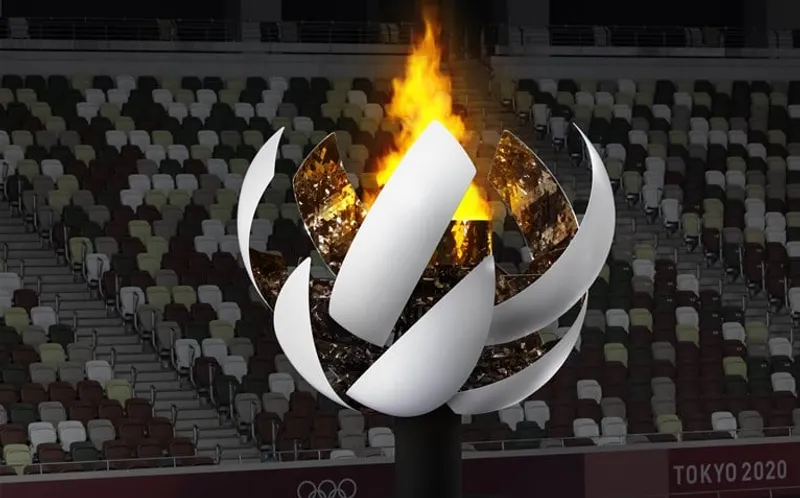
The design of the Olympic Cauldron presented some unique challenges. Since hydrogen burns with a colourless and transparent flame and is invisible, it was necessary to color the flame using sodium carbonate. The amount and direction of the aqueous solution sprayed from the vicinity of the burner were repeatedly examined along with the amount of hydrogen and the angle of the valve to adjust the movement and shape of the flame to shimmer like firewood being stoked. This attempt to "design flames" was unprecedented.
The cauldron weighs 2.7t and has a diameter of approximately 3.5m after transformation. The exterior panel, which weighs approximately 40 kg per sheet, was made by cutting out a 10 mm thick aluminium plate and moulding it with a special hot press machine capable of applying a pressure of 3500 tons, which only a few exist in Japan. The work was performed at an ultra-low speed while consistently scanning the shape using a laser to accommodate weight reduction. The last phase consisted of adjustments, polishing, and application of heat-resistant paint, all of which were finished by the hands of craftsmen.

The internal drive unit was required to be as compact as possible, yet highly waterproof, fireproof, and heat-resistant. By covering the machines with polygonal mirror panels as much as possible, it was intended to create a diffused reflection of the lighting from the ceremonies and the flame light. Tests for heat resistance and wind resistance were repeated, and the apparatus was tuned to prevent any vibration or error even under varying conditions. As a result, a smooth movement with fine accuracy in panels passing each other was realized, operating at less than 3 mm distance at the area of the narrowest passing width.
The Olympic Cauldron thus created through this journey crystallizes the essence of Japanese manufacturing. The design process was rigorous, with numerous attempts made to achieve the desired effect. The final product is a testament to the skill and craftsmanship of the artisans who worked on it. The use of hydrogen energy, produced in an area still recovering from a devastating earthquake, underscores the resilience and determination of the Japanese people. The Tokyo 2020 Olympic Cauldron is a remarkable achievement and a fitting symbol for the games.
***
All images and text courtesy of nendo
Cover photo ©Takumi Ota




Popular Articles
Popular articles from the community


The Musturak Paradise: Senior Living Architecture for a Connected Future in Temara, Morocco
The Musturak Paradise reimagines senior living architecture in Temara via private homes, social spaces, culture, community, and shared care.
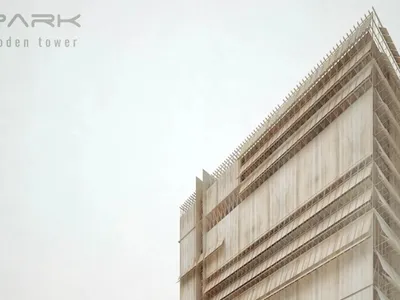
EW PARK: Sustainable Architecture Reimagines the Future of Urban Parking
EW PARK reimagines city parking as a modular wooden tower combining automation, solar energy, electric mobility, and adaptable urban design.

Co-life: Sustainable Architecture for Age-Friendly Community Living
Co-life reimagines sustainable architecture for seniors through courtyards, rammed earth, shared gardens, and spaces designed for belonging.

The Earth Pod: 3D Printed Homes for Resilient Refugee Communities
The Earth Pod reimagines refugee housing through 3D printed homes made from clay, combining resilience, self-sufficiency, and rapid shelter.

Similar Reads
You might also enjoy these articles
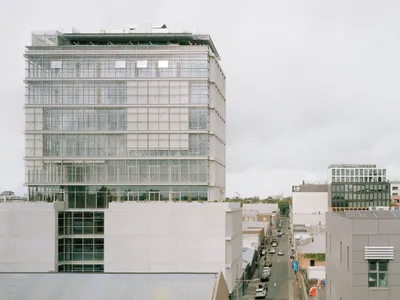
116 Rokeby Building, Collingwood
Sustainable Collingwood office building featuring double-skin façade, natural ventilation, rooftop amenities, and carbon-neutral design focused on wellbeing and longevity.
Contemporary Apartment Renovation in Spain: RV House by BIAN Opens Up to the Sea
A minimalist 1930s apartment in Santander is transformed into a flexible, sea-facing home through contemporary Spanish renovation.
3 Marías House: A Contemporary Mediterranean Courtyard Retreat by Bajet Giramé + Burckhardt
Mediterranean courtyard home blending traditional architecture with modern design, terracotta flooring, flexible interiors, sustainable climate strategies, and garden integration.
NZ10 Apartment by auba studio: Adaptive Reuse in Palma de Mallorca
Adaptive reuse apartment transforms bakery into light-filled home with patios, privacy layers, and wood interiors enhancing urban living experience.


Explore Architecture Competitions
Discover active competitions in this discipline




Challenge to reimagine the Iron Throne


Photograph architecture without architects


Illustrate the lost glory of Angkor Wat - Render Challenge


Design challenge to reuse E-waste
Comments (0)
Please login or sign up to add comments
No comments yet. Be the first to comment!