
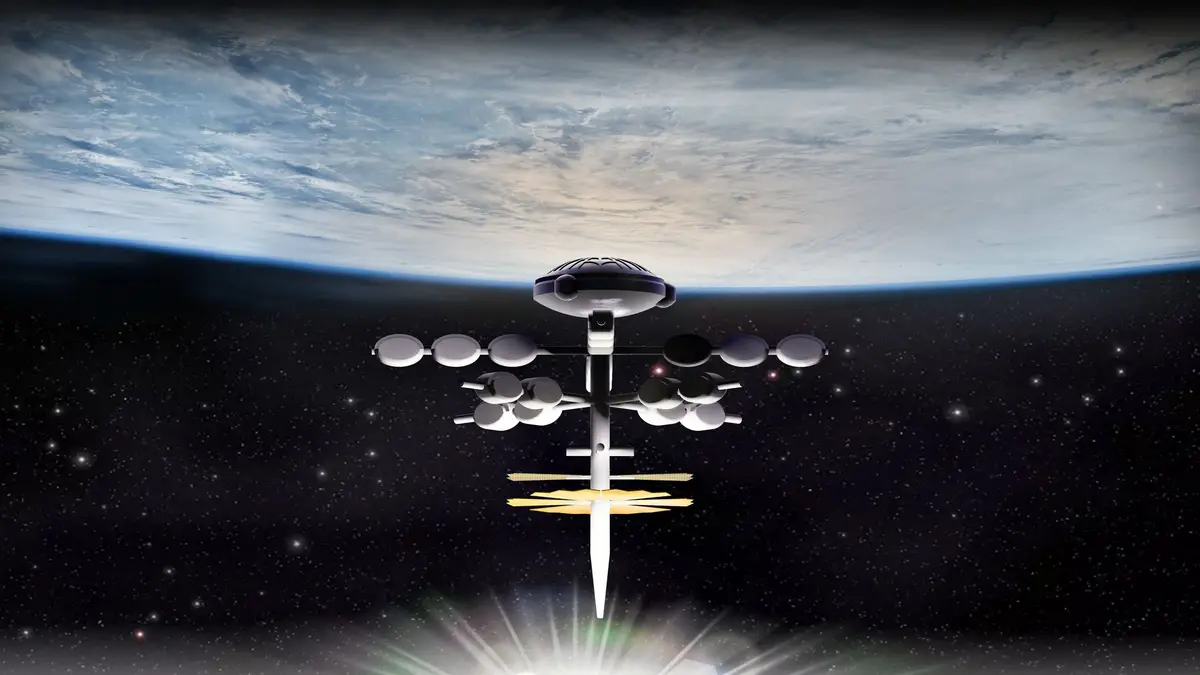
Orbital Habitat Architecture: Innovating Life Beyond Earth with Project DRAGONFLY
Explore the pioneering design and sustainable vision of Project DRAGONFLY, the future of self-sustaining orbital habitat architecture.


Orbital Habitat Architecture
Orbital Habitat Architecture marks a significant leap forward in our journey to becoming an interplanetary species. With visionary projects like Project DRAGONFLY by Jessica Obregon winner entry of Spacestop, humanity is taking bold steps to establish self-sustaining habitats not just on distant worlds but in the very fabric of space itself. This prototype 2023 exemplifies how far we've ventured beyond the realm of science fiction, into a reality where space-based economies flourish and multi-planetary living is within reach.

A Glimpse into Current and Future Orbital Habitats
The International Space Station: A Multinational Effort
The International Space Station (ISS) has been the cornerstone of outer space research since 1998. As a multinational effort, it integrates technology and resources from NASA, Roscosmos, JAXA, ESA, and CSA, establishing a precedent for international cooperation in space.

Blue Origin's Orbital Reef and Orbital Assembly's Voyager
Following the ISS's success, Blue Origin's Orbital Reef is poised to become the first commercially owned space station, designed as a mixed-use habitat for an array of businesses and private users. Similarly, Orbital Assembly's Voyager project is revolutionizing space tourism by offering luxury hospitality with the unique feature of artificial gravity, enhancing guest comfort.

Unveiling Project DRAGONFLY: The Prototype for Future Orbital Habitats
Addressing the Challenges of Space Architecture
Project DRAGONFLY responds to a myriad of design challenges unique to space, from the perils of orbital debris to the psychological impacts of isolation in a confined environment. Its design incorporates prefabricated components and pressurized systems, tailored to withstand the rigors of space.
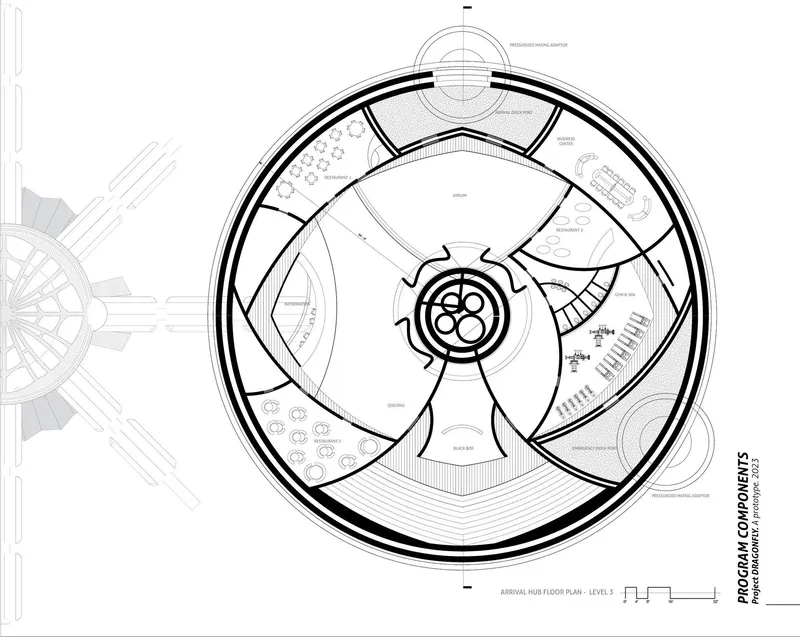
Human-Centric Design: The Core of Project DRAGONFLY
Acknowledging the human factor in design, Project DRAGONFLY offers spacious rooms, panoramic earth-facing windows, and areas for community and solitude. The integration of greenery transcends mere aesthetics, playing a role in mental well-being and sustainable living.

Project DRAGONFLY's Integrated Approach to Spatial Design
The Vision of Project DRAGONFLY's Integrated Wings
The project's initial concept featured separate wings for a hotel, control center, and gas station. However, an integrated approach has been adopted to foster community and adapt to future needs, setting a new standard in Orbital Habitat Architecture.
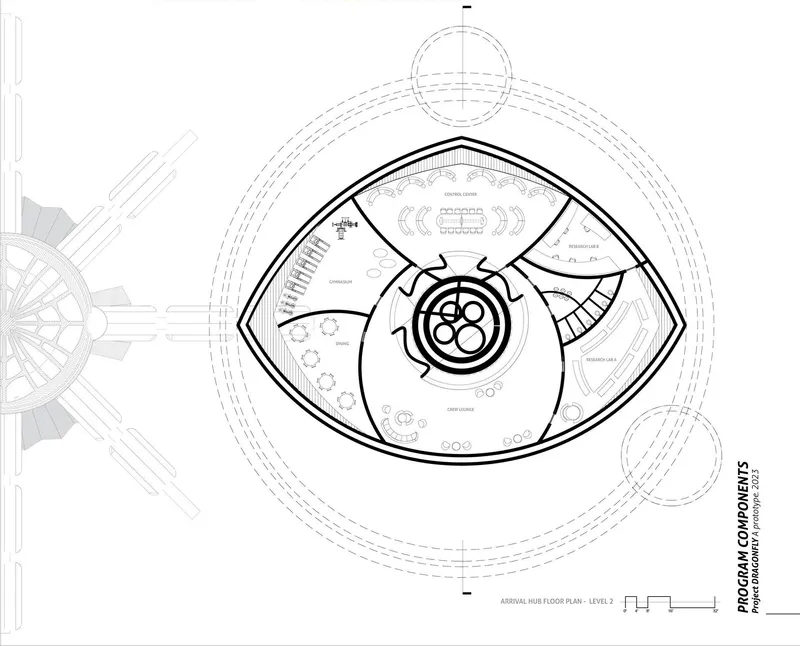
The Arrival Hub: Gateway to a New World
At the heart of Project DRAGONFLY lies the Arrival Hub, a zero-gravity atrium offering amenities from dining to recreation. It serves as a nucleus for orientation and community engagement in a weightless environment.
Envisioning a Live-Work Space Ecosystem in Orbit
Research and Relaxation in Space
Moving beyond utilitarian designs, Project DRAGONFLY emphasizes work-life balance by providing scientists and guests with amenities that encourage relaxation and community building, reshaping the concept of Orbital Habitat Architecture.

The Living Quarters: Simulated Gravity for Enhanced Comfort
The propeller modules, housing living quarters and hotel suites, feature simulated gravity to comfort inhabitants, representing a milestone in the architectural design of orbital habitats.

Technical Aspects and Sustainable Expansion of Project DRAGONFLY
Fuelling the Future: The Fuel Module and Solar Arrays
Project DRAGONFLY's design includes a fuel module for refueling missions and a solar array that reflects a commitment to sustainable growth and scalability within the realm of Orbital Habitat Architecture.
Project DRAGONFLY is not just a blueprint for the future of space habitation but a beacon of human innovation. As we embrace the challenges and potentials of Orbital Habitat Architecture, we edge closer to a reality where life thrives beyond the blue skies of Earth.


Popular Articles
Popular articles from the community


ETEH Reworks the Shared Spaces of São Domingos School in Brazil Around Timber, Color and Hanging Plants
At São Domingos School in Brazil, 436 m² of hall, refectory and library are recast with timber joinery, a yellow and blue code and trailing greenery.


Singing Woman: An Opera House That Performs Before the Curtain Rises
Ovidiu Cristian Pavel's conceptual opera house translates Estonia's choral identity into a sculpted waterfront landmark facing the Baltic Sea.

The Amber Palace Opera: A Geological Fiction Surfaces on Tallinn's Baltic Waterfront
Pierre Brillard reimagines a Baltic legend as a public landscape, opera house, and waterfront promenade rooted in Tallinn's coastal identity.

Juan García Correa, John González and Claudia Rueda Sink a Circular Amphitheater into a Manizales Engineering Building
On the La Nubia campus in Manizales, Colombia, the S1 Building folds labs and offices into a hillside of ramped lawns that double as a campus route.

Similar Reads
You might also enjoy these articles

Vereda Arquitetos Renovates a 40-Square-Meter Apartment Inside Niemeyer's Copan Building
A compact unit in São Paulo's most iconic residential tower gets a material overhaul that pairs exposed concrete with bold blue Formica.

Shakur's House: Exposed Brick as an Interior Organiser in a 168 m² Mashhad Residence
Brick moves indoors in this Mashhad residence, where masonry walls, glass partitions and teal planes sequence a compact home without closing it off.

Day and Night Park: A Time-Based Urban Newsstand in Beijing
A temporary urban newsstand in Beijing blending travel, light, and reading through poetic colors, compact form, and community-focused design.

Modernist Patio Renovation in El Masnou, Barcelona by Oliver Segura Arquitectura + Cebrià Arquitectura
Modernist patio renovation blending tradition and innovation with a movable pool, leveled floors, and Catalan materials in El Masnou.


Comments (0)
Please login or sign up to add comments
No comments yet. Be the first to comment!