

REPOS: A Foldable Seat Module That Lets Commuters Carry Comfort in Their Hands
A flatpack furniture piece designed for public transit transforms from a portable object into ergonomic seating for buses, metros, and plazas.


What if the most meaningful upgrade to public transit wasn't a faster train or a wider platform, but a small wooden seat you fold up and carry with you? REPOS starts from a disarmingly simple premise: that comfort in transit should be personal, portable, and designed for the body rather than the system. The result is a foldable furniture module that collapses into a flat, handleable object and opens into a functioning seat, giving commuters agency over their own physical ease within the collective machinery of buses, metros, and trams.
Designed by Ramkumar, Ginu Shajan, and Vivek Vijayan, REPOS received an Honorable Mention in the @ease competition. The name derives from the French word for rest, and the project stays loyal to that origin. Rather than proposing infrastructural overhaul, REPOS intervenes at the scale of the individual, treating the commuter's body as the site and portable furniture as the architecture.
Transit Platforms as Sites of Discomfort
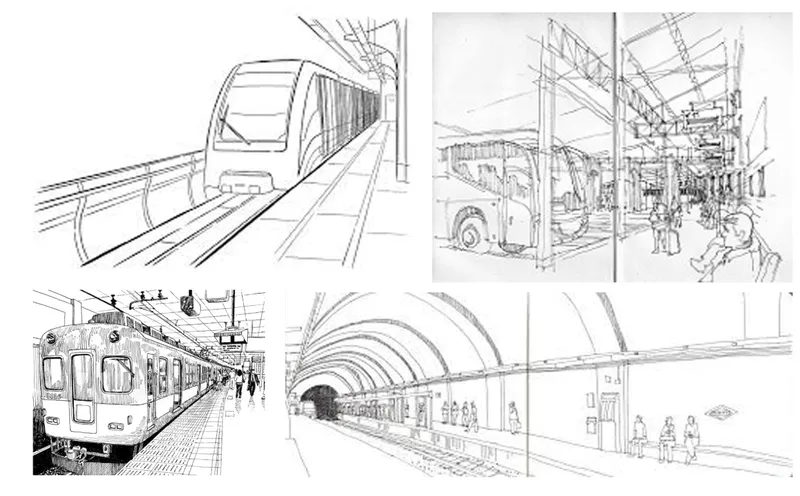
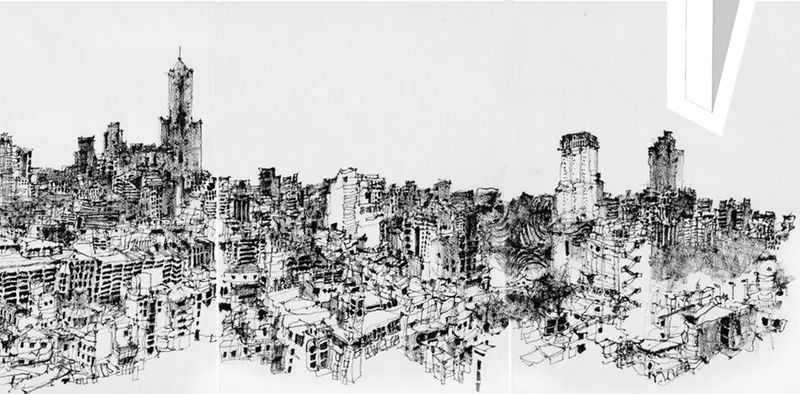
The opening sketches lay out the problem space with clarity. Transit platforms, stations, and urban corridors are drawn as zones of waiting, standing, and enduring. Commuters occupy spaces designed for throughput, not for rest. The dense urban skyline rendered in ink underscores the scale mismatch: cities build massive infrastructure for movement, yet the individual experience within those systems often comes down to standing on a crowded platform with nowhere to sit.
These drawings establish the critical gap REPOS aims to fill. Public transit architecture optimizes for flow, capacity, and scheduling. Comfort, when it appears at all, is an afterthought bolted to the edges of the system. The designers argue that this gap between collective efficiency and personal well-being is not trivial; it shapes how millions of people experience their daily lives.
A Seat That Folds to Nothing
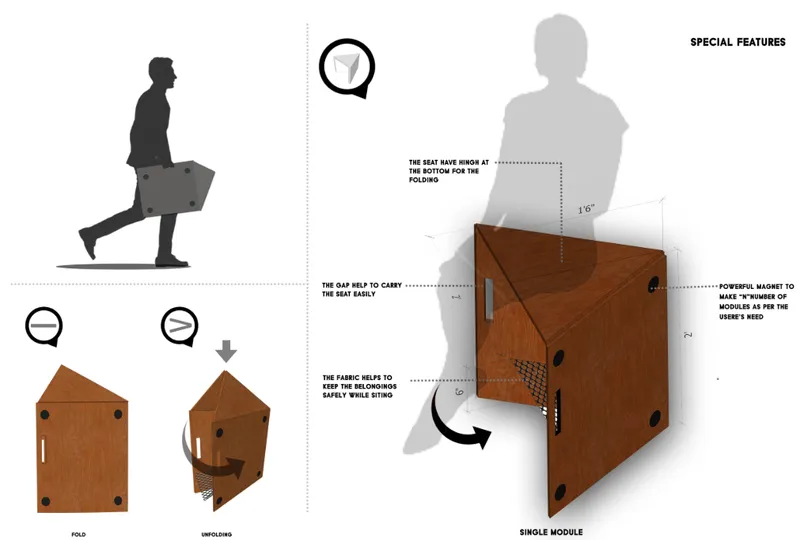
The core of the project is a folding wooden seat module with a fabric sling and an integrated carrying handle. In its collapsed state, REPOS becomes a flat, two-dimensional object light enough to transport between transit nodes. The diagram reveals a straightforward mechanism: hinged wooden members open to create a stable seating frame, while a fabric mesh element spans between them to form the sitting surface. That same fabric doubles as storage, with mesh pockets sized for personal belongings.
The design prioritizes what the team calls ergonomic portability. Compact geometry and the integrated handle mean the module can be carried like a briefcase or a small bag. When deployed, individual modules can also connect magnetically to form group seating configurations. This detail is significant: it means REPOS functions as both a solitary comfort device and a social piece of furniture, depending on the situation. A single commuter gets a seat; a group of friends or colleagues gets a bench.
From Metro Platform to Park Bench

The section drawing is where REPOS moves beyond product design into spatial thinking. The designers place their modules across three distinct contexts: a public plaza, a park, and a transit station. In each scenario, the same object adapts to different postures, social configurations, and environmental conditions. The drawing makes a compelling argument that portable furniture isn't limited to the vehicle or the platform; it extends into every pause point in the urban journey.
By showing REPOS in section rather than in perspective, the designers foreground the relationship between body, object, and ground plane. You see how the seat height works relative to standing passengers, how the modules cluster without crowding walkways, and how the furniture occupies leftover space that fixed infrastructure cannot reach. It is a quiet but effective demonstration that human-scale interventions can reshape the experience of places designed for much larger systems.
Sustainability at the Scale of the Object
REPOS aligns its material logic with its conceptual ambitions. The wooden frame and fabric sling suggest durability without excess, using materials that are repairable and replaceable rather than disposable. The designers frame this as eco-conscious urban design, but the real sustainability argument is more nuanced: by distributing comfort across individual portable objects rather than embedding it in fixed infrastructure, REPOS reduces the material and energy cost of furnishing every platform, stop, and waiting area in a transit network.
The flatpack form factor also reduces shipping volume and storage footprint, practical considerations that matter when scaling a product across a city. There is something appealing about a design philosophy that treats sustainability not as a grand systemic gesture but as a property of the smallest useful object in the urban landscape.
Why This Project Matters
REPOS reframes the transit comfort problem as a design opportunity at the scale of the individual. Instead of lobbying for better benches on every platform or softer seats on every bus, it asks: what if the commuter simply brought their own? The question is provocative because it shifts responsibility and agency simultaneously, empowering users while acknowledging the limits of centralized infrastructure investment.
For a competition focused on portable comfort, this entry succeeds because it resists overcomplication. A folding wooden seat with a fabric sling, a handle, and magnetic connectors is not a technological moonshot. It is a legible, buildable, testable object that could exist tomorrow on any metro platform in the world. That groundedness, paired with the spatial ambition shown in the section drawings, makes REPOS a thoughtful contribution to the conversation about what compassionate city planning actually looks like at the human scale.
View the Full Project
About the Designers
Designers: Ramkumar, Ginu Shajan, Vivek Vijayan
Enter a Design Competition on uni.xyz
uni.xyz runs architecture and design competitions year-round that reward proposals with spatial conviction and real site intelligence.
Project credits: REPOS – Transit @Ease by Ramkumar, Ginu Shajan, Vivek Vijayan @ease (uni.xyz).


Popular Articles
Popular articles from the community

Temporary Home for Dogs: A Reversed Zoo Rethinks Animal Shelter Architecture
In Bucharest, a sinuous corridor and freed landscape flip the logic of containment, designing a shelter that works to make itself unnecessary.
Extended Shell: Retrofitting Kolkata's Balconies as Living Urban Thresholds
A modular retrofit system recovers the social and environmental intelligence of Kolkata's historic verandas for contemporary Park Street residents.

Singing Woman: Contemporary Architecture Inspired by Estonia’s Voice and the Sea
Singing Woman turns Estonia’s song culture into flowing opera house architecture, blending public life, landscape, sea, and national memory.

The Amber Palace Opera: A Geological Fiction Surfaces on Tallinn's Baltic Waterfront
Pierre Brillard reimagines a Baltic legend as a public landscape, opera house, and waterfront promenade rooted in Tallinn's coastal identity.

Similar Reads
You might also enjoy these articles
The Amber Palace Opera: A Geological Fiction Surfaces on Tallinn's Baltic Waterfront
Pierre Brillard reimagines a Baltic legend as a public landscape, opera house, and waterfront promenade rooted in Tallinn's coastal identity.
Dynamic Modules Shelter: A Telescopic Ring for Mountain Pilgrimage
A circular modular framework of steel, bamboo, and fabric grows vertically with demand, wrapping communal ground in adaptable shelter.
Singing Woman: Contemporary Architecture Inspired by Estonia’s Voice and the Sea
Singing Woman turns Estonia’s song culture into flowing opera house architecture, blending public life, landscape, sea, and national memory.
HYPERBLOCK: Flexible Urban Design for Barcelona’s Future City
HYPERBLOCK reimagines Barcelona as flexible urban design, layering density, daylight, public space and adaptable housing above Cerdà’s grid.


Comments (0)
Please login or sign up to add comments
No comments yet. Be the first to comment!