
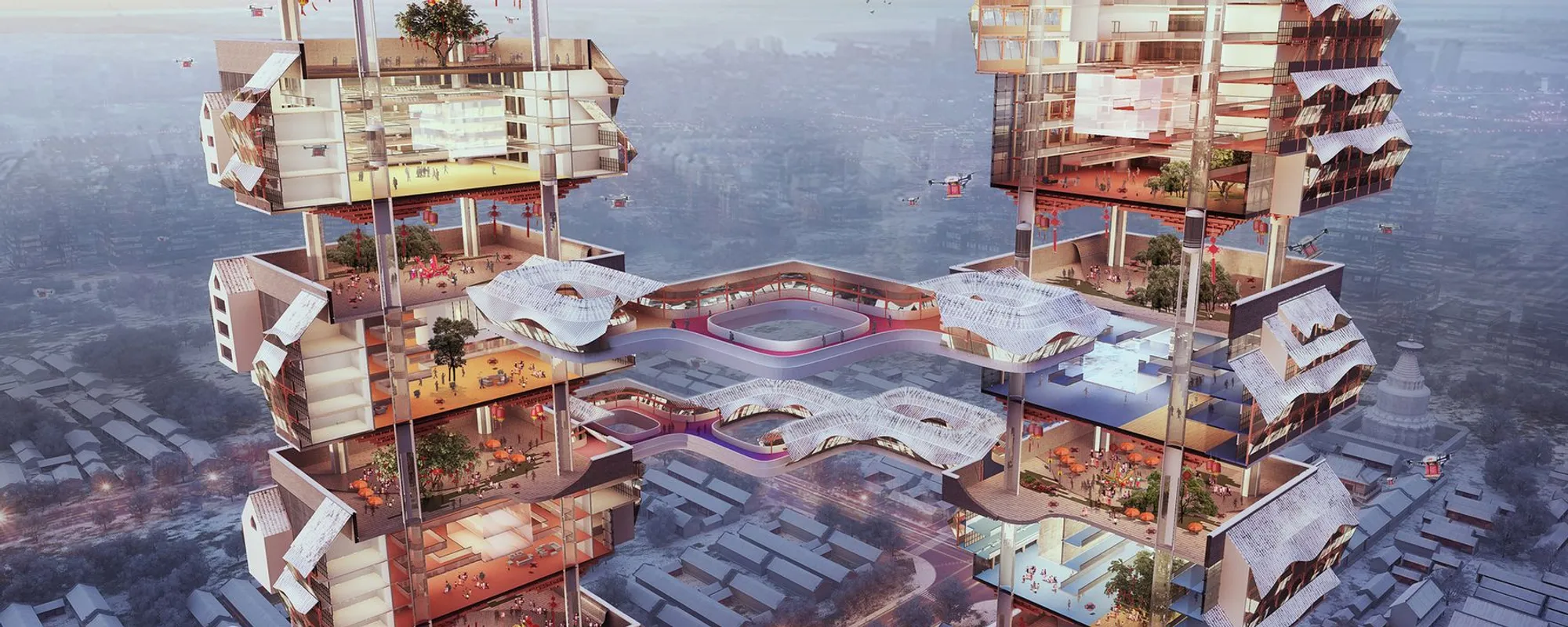
Overlapping Courtyards: Stacking Beijing's Siheyuan into a Vertical Senior Living Typology
A vertical reinterpretation of Beijing's historic courtyard housing, layered with smart care systems and intergenerational social infrastructure.


What if the courtyard house, Beijing's most enduring spatial archetype, could be pulled upward into a tower and reprogrammed to care for an aging population? That is the provocation at the heart of Overlapping Courtyards, a project that refuses to treat senior living as a problem of healthcare logistics alone. Instead, it treats it as an architectural question: how to reconfigure density, circulation, and communal space so that a building itself becomes a caregiver.
Designed by Yaohong Liu and Xiangyu Zhang, the project is sited near Beijing's longest hutong, where the grain of traditional low-rise courtyard living collides with the pressures of a city where more than 35% of the population is projected to be over 60 by 2050. The design responds to this collision directly, reinterpreting the siheyuan's horizontal logic of shared enclosure into a vertical typology stacked with social, medical, and cultural infrastructure.
Courtyards Suspended in Air Above the Hutong
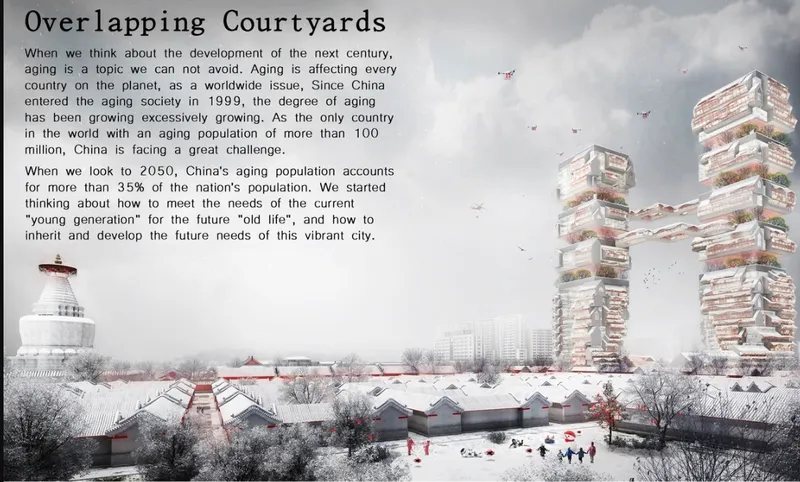
The rendering captures the project's most striking spatial move: layered platforms and stacked tower forms rising above the snow-covered rooftops and winter trees of a traditional Beijing neighborhood. The massing is not a single extrusion but a composite of interlocking volumes, each offset to create suspended courtyards at multiple levels. These three-dimensional voids bring daylight, greenery, and cross-ventilation deep into the building's section, replicating the spatial generosity of a ground-level siheyuan at every floor. The visual dialogue between the crisp geometry of the new towers and the textured roofscape below is deliberate; it frames the project as an act of layering, not replacement.
Multiple pathways and shared courtyards interlace through the towers, designed to encourage spontaneous interaction and mobility flexibility. The goal is a reduction in urban loneliness, a condition that disproportionately affects elderly residents in high-density cities. By suspending communal space in the air rather than relegating it to a ground-floor lobby, the design distributes social life vertically, making encounter and connection a structural condition of the building rather than a programmatic afterthought.
A Color-Coded Section from Libraries to Medical Suites
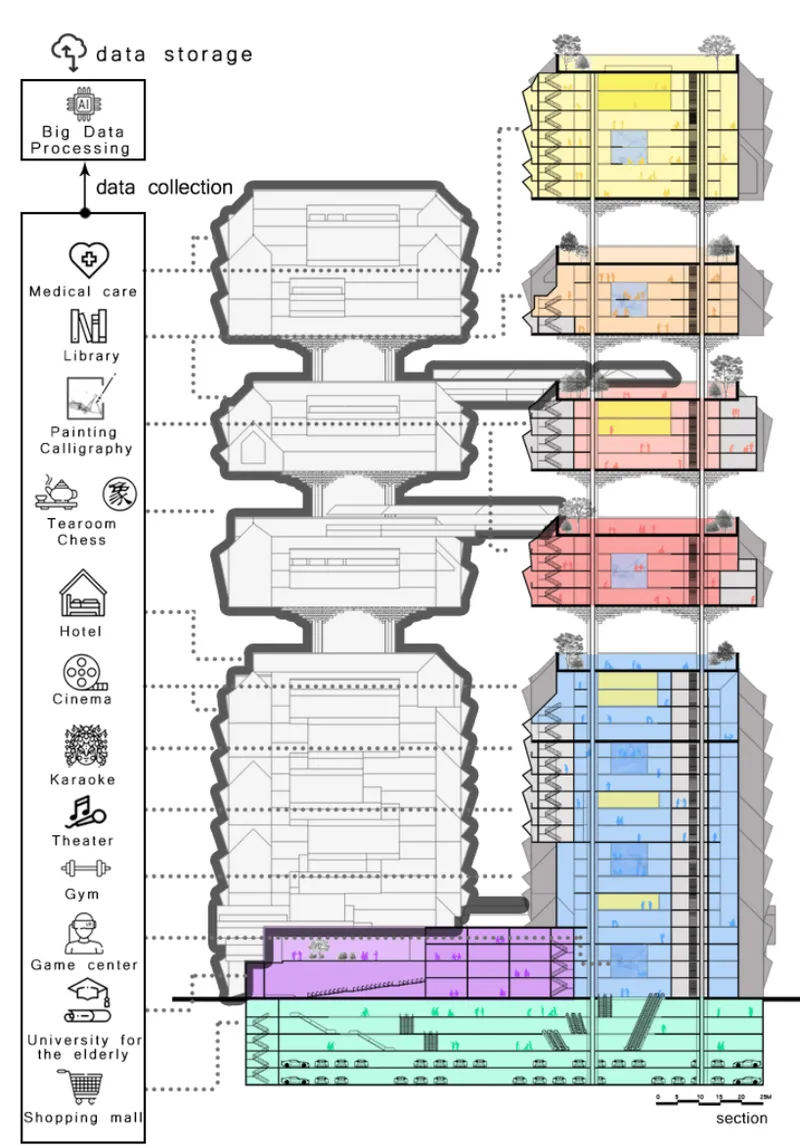
The building section drawing reveals the project's organizational ambition. Each floor is uniquely themed and color-coded: libraries, tea rooms, gyms, community kitchens, and private residential zones are stacked in a legible vertical sequence connected by circulation cores. The color-coding is not decorative; it serves as a wayfinding system for elderly residents navigating the building, reducing cognitive load and supporting orientation for people with varying levels of mobility and memory.
The top levels are dedicated to advanced medical care facilities, big data centers, and provisions for future capabilities like air-ambulance access and remote surgical suites. Below them, social programming encourages continued learning, skill-sharing, and cultural storytelling, creating a gradient from intimate domestic life at the lower levels to high-tech care infrastructure at the top. The section reads as a manifesto for what senior housing could be: not a ward, but a city in miniature, layered with the full complexity of urban life.
Smart Skins and Thermal Strategies for Responsive Aging-in-Place
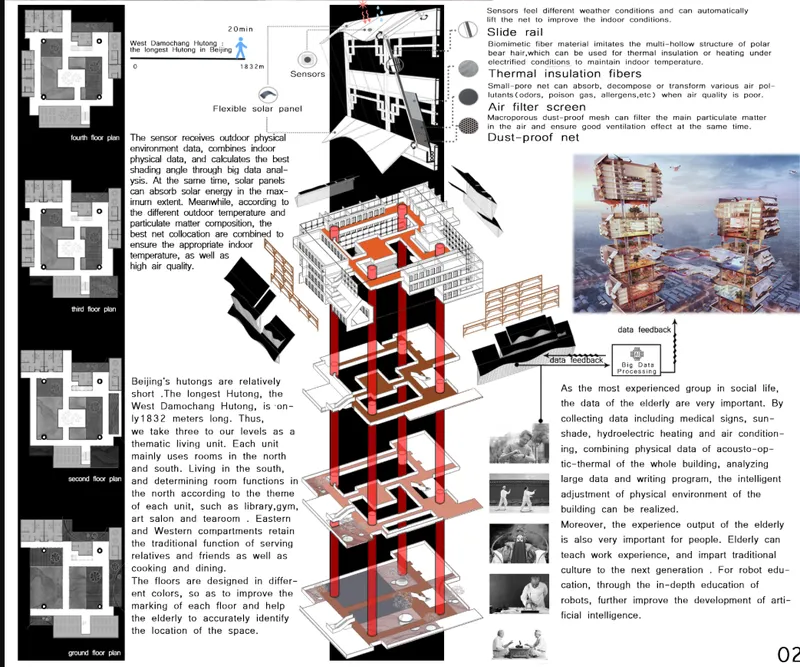
The presentation board unpacks the technical intelligence embedded in the design. Smart sensors optimize shading, indoor air quality, and thermal insulation across the building envelope. Solar panels dynamically adjust to environmental data, maximizing energy efficiency while maintaining comfort for residents whose thermal sensitivity increases with age. Floor plans and axonometric diagrams show how private reflection spaces and communal activity zones are carefully calibrated to accommodate a range of physical and cognitive needs, with clear spatial hierarchies and generous circulation widths.
Material details and thermal insulation system explanations round out the technical narrative. The building is conceived not as a static enclosure but as a responsive environment, extending into a smart caregiving system that links physical architecture to digital healthcare networks. The integration of environmental controls with elder safety systems and efficient circulation planning demonstrates a design intelligence that goes well beyond formal ambition.
Intergenerational Exchange as a Design Principle
One of the project's most significant conceptual moves is its insistence on intergenerational mixing. Rather than isolating the elderly in a dedicated facility, the design integrates younger generations into the care ecosystem. Shared courtyards, cultural programs, and community kitchens are positioned to draw in residents and visitors of all ages, turning the building into a node of neighborhood life rather than a sealed institution. The siheyuan was always a multigenerational spatial type; this project extends that tradition vertically, using architecture to foster the social bonds that sustain wellbeing in old age.
Why This Project Matters
Overlapping Courtyards confronts a demographic reality that most architectural practice still treats as a niche concern. With China's aging population set to reshape its cities within a generation, the project makes a compelling case that senior living is not a subcategory of housing design but a central urban challenge requiring new typologies. By rooting its spatial logic in the siheyuan, the proposal avoids the sterile universalism of most institutional care models and offers instead a culturally specific, spatially rich alternative.
What makes the work by Yaohong Liu and Xiangyu Zhang particularly persuasive is the refusal to separate technological ambition from social intent. Smart sensors, dynamic solar panels, and telemedicine infrastructure are not bolted onto a conventional building; they are woven into a spatial framework that prioritizes dignity, legibility, and encounter. The result is a proposal that treats architecture as both caretaker and cultural record, a building that does not merely house the elderly but actively participates in the life they continue to lead.
View the Full Project
About the Designers
Designers: Yaohong Liu, Xiangyu Zhang
Enter a Design Competition on uni.xyz
uni.xyz runs architecture and design competitions year-round that reward proposals with spatial conviction and real site intelligence.
Project credits: Overlapping Courtyards by Yaohong Liu, Xiangyu Zhang.



Popular Articles
Popular articles from the community


The Earth Pod: 3D Printed Homes for Resilient Refugee Communities
The Earth Pod reimagines refugee housing through 3D printed homes made from clay, combining resilience, self-sufficiency, and rapid shelter.

Conexión: Biophilic Design Reimagines High-Rise Living in Hong Kong
Conexión reimagines high-rise living in Hong Kong through biophilic design, green facades, shared spaces, daylight, water and nature within.

The Musturak Paradise: Senior Living Architecture for a Connected Future in Temara, Morocco
The Musturak Paradise reimagines senior living architecture in Temara via private homes, social spaces, culture, community, and shared care.

Riyadh For All: Intergenerational Urban Design for Active Aging in Rabat
Riyadh For All reimagines urban design in Rabat with intergenerational co-living, adaptive courtyards, and Moroccan cultural exchange today.


Similar Reads
You might also enjoy these articles

Day and Night Park: A Time-Based Urban Newsstand in Beijing
A temporary urban newsstand in Beijing blending travel, light, and reading through poetic colors, compact form, and community-focused design.

Modernist Patio Renovation in El Masnou, Barcelona by Oliver Segura Arquitectura + Cebrià Arquitectura
Modernist patio renovation blending tradition and innovation with a movable pool, leveled floors, and Catalan materials in El Masnou.

Alto Residencial Coop: Cooperative Housing Development in Santiago de Compostela by Carbajo Barrios Arquitectos
A linear cooperative housing complex blending white volumes and perforated metal façades, enhancing community living, natural light, privacy, and urban integration.
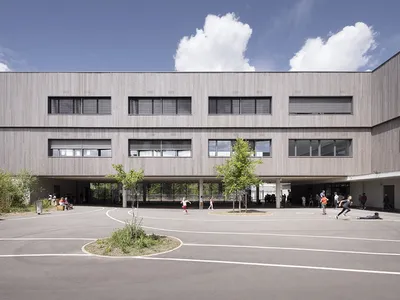
Vil Genis School by BPA ARCHITECTURE – Massy, France
Vil Genis School in Massy, France, features sustainable design, south-facing classrooms, community integration, accessible spaces, and modern educational architecture.


Comments (0)
Please login or sign up to add comments
No comments yet. Be the first to comment!