

Waterfront Redevelopment and Urban Revitalization in Mumbai: Forging a New Dawn for Darukhana
A transformative waterfront redevelopment project reimagining Darukhana’s shipbreaking heritage into an inclusive urban future.


Introduction: Reclaiming Mumbai’s Industrial Waterfront
Across global cities, waterfront redevelopment has emerged as one of the most powerful tools for urban transformation. Former industrial docks, shipyards, and port lands are being reimagined as cultural, civic, and economic engines. Forging a New Dawn – Revitalization of Darukhana positions itself within this global discourse, proposing a bold urban revitalization project for Mumbai’s historic shipbreaking district.
Developed by Rishu Jaiswal Winner in UnIATA 25, this thesis envisions Darukhana not as a neglected industrial edge, but as a layered urban landscape where community, industry, and heritage coexist. The proposal integrates a community and training center, a public waterfront promenade, a Shipyard Museum, and safer, reorganized shipbreaking yards—collectively forging a more dignified and inclusive future.
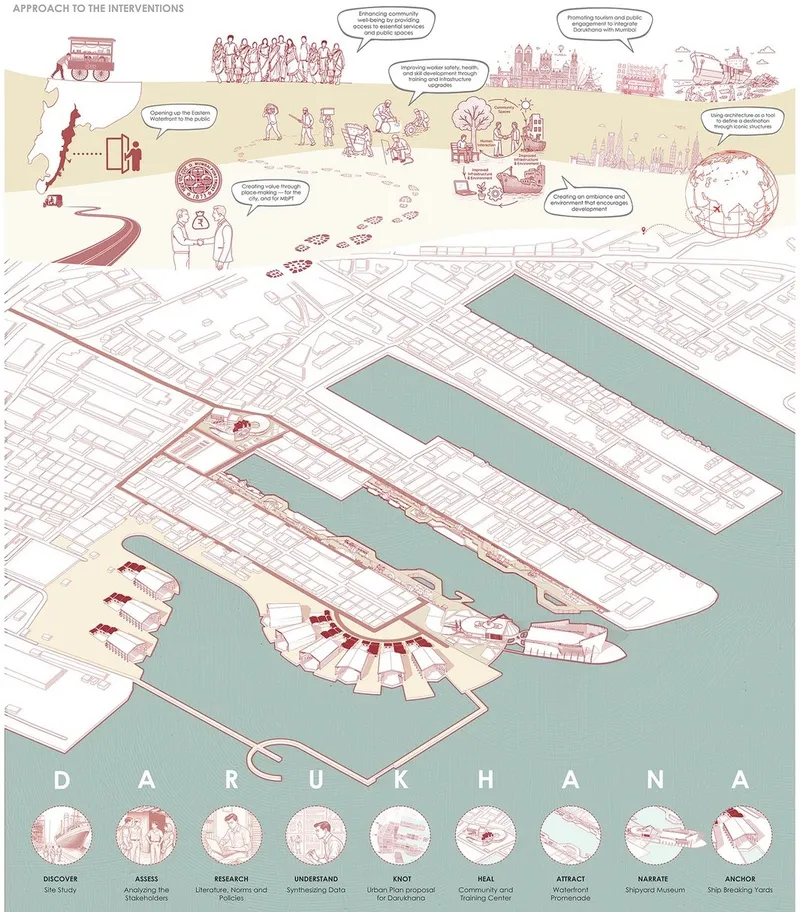
Darukhana: Context of Industry, Risk, and Identity
Located along Mumbai’s eastern waterfront, Darukhana has long functioned as one of India’s significant shipbreaking hubs. The district contributes to the recycling economy, yet it has historically operated under precarious working conditions, fragmented infrastructure, and environmental stress.
While industrial productivity defines the site, its urban integration remains limited. Workers face health and safety hazards, and the surrounding communities experience infrastructural neglect. This thesis recognizes that meaningful urban regeneration must not erase industry—but reform and integrate it.
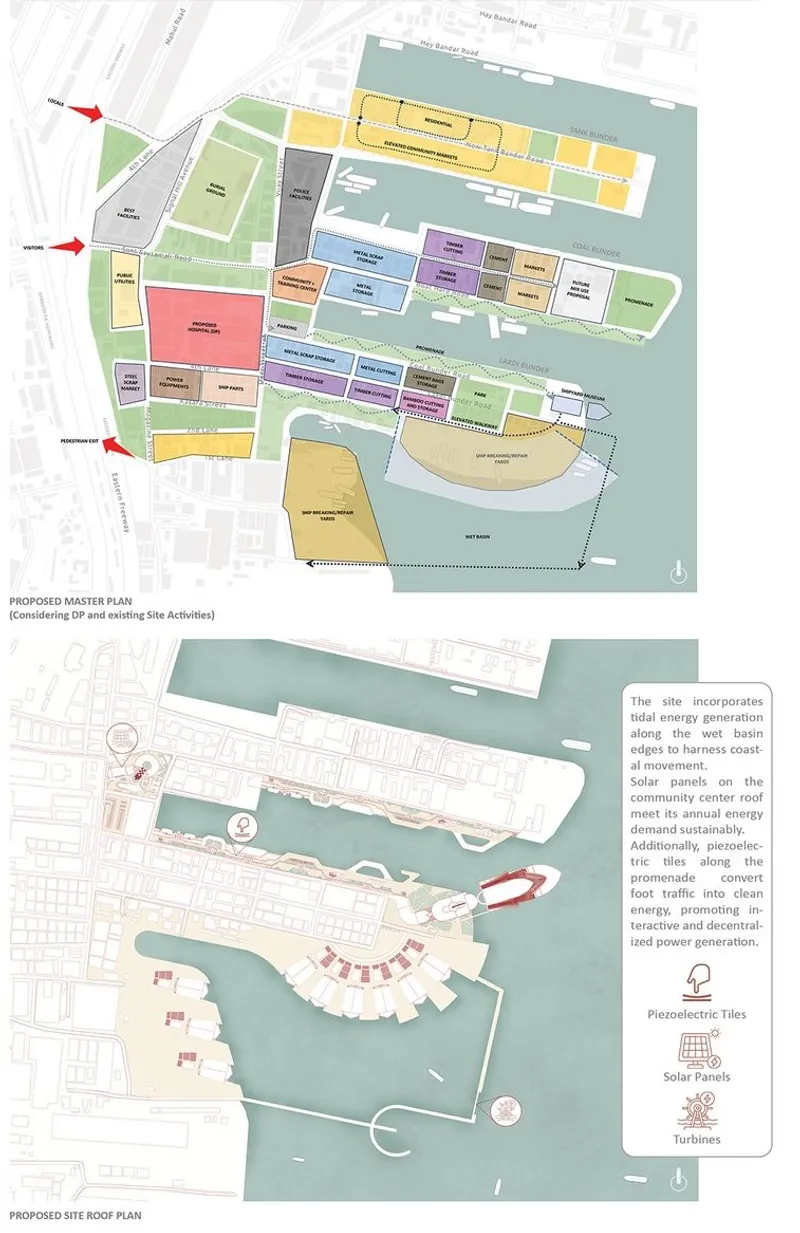
The Vision: Urban Revitalization Through Integration
At the heart of the proposal lies a critical question: How can an active industrial landscape be transformed into a resilient civic waterfront without displacing its economic backbone?
The master plan responds by:
- Retaining shipbreaking as a core identity
- Introducing structured, safer dock infrastructure
- Creating accessible public waterfront spaces
- Establishing cultural anchors that narrate history
- Strengthening community facilities and workforce training
This approach aligns with contemporary sustainable urban development principles—balancing economic continuity with social equity and environmental responsibility.
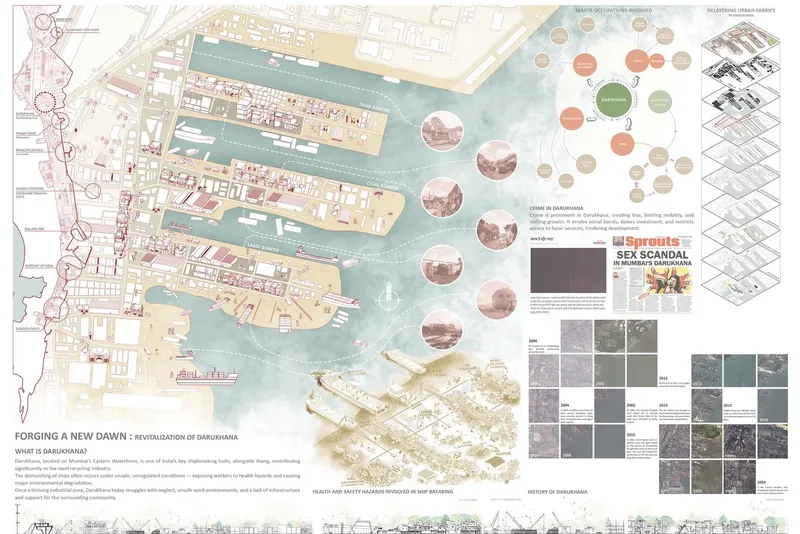
Community and Training Center: Empowering the Workforce
The Community and Training Center forms the social nucleus of the revitalization strategy. Designed as a multi-level civic structure, it provides:
- Skill development programs
- Health and safety workshops
- Flexible learning environments
- Public gathering spaces
- Amphitheater and community terraces
Architecturally, the building responds to the site’s industrial character while offering open, inviting public edges. Its curved geometry and layered terraces foster accessibility and collective participation. The center ensures that waterfront redevelopment is not purely aesthetic—but socially transformative.
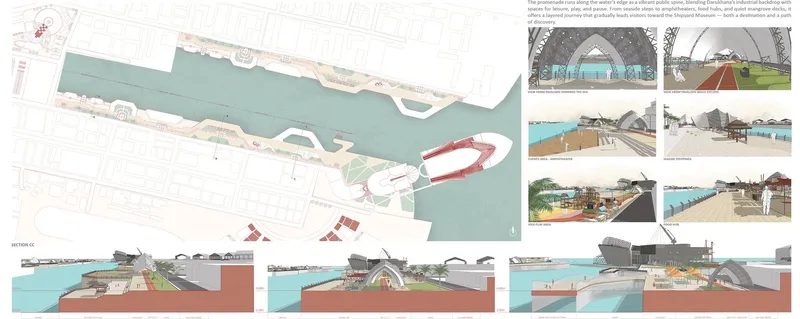
Waterfront Promenade: Reconnecting City and Sea
One of the most powerful gestures in the project is the creation of a continuous waterfront promenade. Historically inaccessible and fragmented, the edge is restructured into a pedestrian-friendly public realm.
The promenade includes:
- Viewing decks overlooking active shipbreaking docks
- Landscaped rest zones
- Cultural performance spaces
- Public seating and shaded walkways
Rather than concealing industry, the design frames it—turning working docks into an educational and experiential landscape. This strategy fosters transparency and urban awareness while maintaining operational efficiency.
Shipyard Museum: Narrating Industrial Heritage
The Shipyard Museum acts as a symbolic and cultural anchor. Designed in the form of a ship-inspired structure, the museum narrates Darukhana’s evolution—from colonial maritime trade to contemporary ship recycling.
The architectural language incorporates:
- Steel structural canopies referencing dock cranes
- Dramatic sectional volumes evoking ship hull forms
- Integrated exhibition and public event spaces
- Suspended entry canopies inspired by maritime frameworks
Through this cultural infrastructure, the project situates Darukhana within Mumbai’s broader historical narrative—ensuring that revitalization preserves memory rather than erases it.
Reorganizing Shipbreaking Yards: Safety and Efficiency
Unlike many waterfront redevelopment proposals that displace industry, this thesis restructures and upgrades existing shipbreaking operations.
The design introduces:
- Covered dry docks for safer dismantling
- Elevated working platforms
- Organized material sorting zones
- Clear circulation hierarchies
- Improved environmental management systems
This intervention enhances worker safety while optimizing productivity—demonstrating that industrial urban regeneration can coexist with operational continuity.
Environmental and Sustainable Strategies
The revitalization incorporates passive and active environmental measures, including:
- Stormwater management along the waterfront
- Renewable energy integration
- Solar panel installations
- Efficient waste recycling loops
- Reduced industrial runoff into marine ecosystems
By embedding sustainability within both public and industrial domains, the project strengthens its alignment with global sustainable waterfront development models.
Spatial Strategy: Layered Urban Fabric
The master plan stitches together multiple spatial layers:
- Industrial core (shipbreaking docks)
- Civic and training infrastructure
- Cultural museum zone
- Public waterfront promenade
- Urban residential interface
This layered strategy transforms Darukhana from a mono-functional industrial enclave into a mixed-use waterfront district.
Social Equity and Dignity Through Design
More than physical transformation, the thesis advocates for dignity in labor. By providing safer work environments, community facilities, and cultural representation, the project reframes the identity of shipbreaking workers—from invisible laborers to recognized stakeholders in Mumbai’s maritime narrative.
In doing so, it elevates the conversation around inclusive urban redevelopment in rapidly industrializing cities.


Popular Articles
Popular articles from the community


David Ortega Stacks a Two-Story Mexico City Penthouse Around a Steel Stair and a Pergola-Shaded Roof Terrace
In Colonia Roma, a 300 m² penthouse uses oak joinery, a planted steel stair and a slatted roof pergola to make a new-build apartment feel like a house.

LT2A and OPEN Architectes Thread a Brick and Glass High School Through a Wooded Belgian Campus
In Braine-l'Alleud, a 3,000 m² wing for Collège Cardinal Mercier pairs pale brick with a glazed colonnade, deferring to a small chapel and a dense wood.

Juan García Correa, John González and Claudia Rueda Sink a Circular Amphitheater into a Manizales Engineering Building
On the La Nubia campus in Manizales, Colombia, the S1 Building folds labs and offices into a hillside of ramped lawns that double as a campus route.

Jaramillo Van Sluys Arquitectura and Urbanismo Turn a Demolished Registry Lot in Quito into an Orchard Plaza
In Quito's Centro Histórico, a 2,800 m² plaza exposes the San Agustín convent wall and redraws its lost Augustinian orchard in volcanic stone.

Similar Reads
You might also enjoy these articles


Vereda Arquitetos Renovates a 40-Square-Meter Apartment Inside Niemeyer's Copan Building
A compact unit in São Paulo's most iconic residential tower gets a material overhaul that pairs exposed concrete with bold blue Formica.

Shakur's House: Exposed Brick as an Interior Organiser in a 168 m² Mashhad Residence
Brick moves indoors in this Mashhad residence, where masonry walls, glass partitions and teal planes sequence a compact home without closing it off.

Day and Night Park: A Time-Based Urban Newsstand in Beijing
A temporary urban newsstand in Beijing blending travel, light, and reading through poetic colors, compact form, and community-focused design.

Modernist Patio Renovation in El Masnou, Barcelona by Oliver Segura Arquitectura + Cebrià Arquitectura
Modernist patio renovation blending tradition and innovation with a movable pool, leveled floors, and Catalan materials in El Masnou.

Explore Urban Renewal Competitions
Discover active competitions in this discipline

Challenge to design locus for the upliftment of human rights

Design challenge to equip cities with modern furniture

Design challenge to reuse E-waste
Comments (0)
Please login or sign up to add comments
No comments yet. Be the first to comment!