
Shakur's House: Exposed Brick as an Interior Organiser in a 168 m² Mashhad Residence
Brick moves indoors in this Mashhad residence, where masonry walls, glass partitions and teal planes sequence a compact home without closing it off.


Brick in Iranian architecture has rarely been a surface. For centuries it carried roofs, regulated heat and defined enclosure. Shakur's House takes that load-bearing tradition and turns it inward: here, exposed brick stops being a façade material and becomes the instrument that organises a home. Instead of dividing the plan into sealed rooms, the masonry marks thresholds, holds furniture and frames light, so a modest interior reads as a sequence of related spaces.
The 168-square-meter residence sits in Mashhad, Iran, and was designed, supervised and executed by MDC under the direction of architect Muhammad Khodae. The project treats vernacular material as a contemporary design tool. It responds to how households live now while keeping a visible connection to the masonry culture that shaped Iranian domestic space.
A Brick Wall, a Timber Screen and a Window Full of Trees

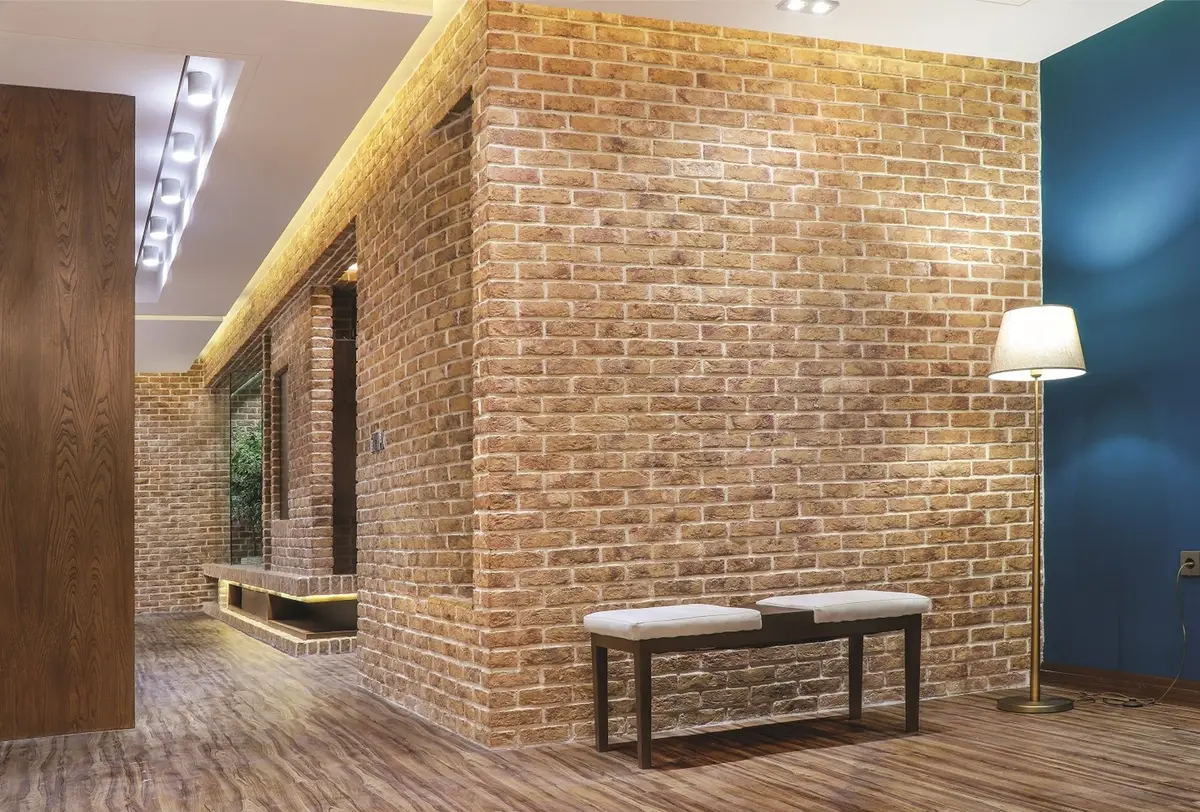
This view states the project's argument in a single frame. A plane of exposed brick stands beside a dark timber lattice screen, and the pairing is deliberate: the brick reads as mass and permanence, while the lattice filters sightlines without fully blocking them. Between them, a recessed window niche framed in brick holds potted trees, so the plants become part of the architecture rather than decoration placed afterwards. The branch-form chandelier extends that botanical thread into the room's upper volume and adds a sculptural note without competing with the walls.
The niche matters because it changes what a window does in a compact home. A plain opening would simply let light in. This one turns daylight into a small interior landscape, giving the living space a focal depth that its floor area alone could not supply.
Teal Planes and Brick Platforms Define Zones Without Walls
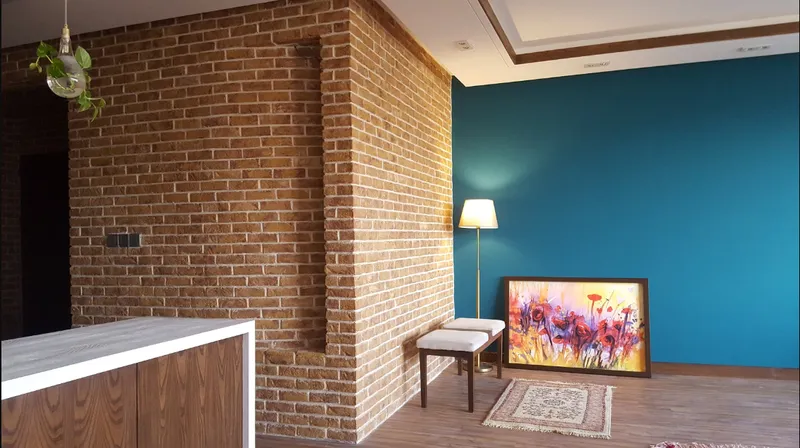

The palette stays restrained, but it works hard. Where brick meets a teal painted wall, the change in material does the job a partition would normally do, marking the edge of a seating corner furnished with only a bench, a floor lamp, a small rug and a framed floral painting. The furniture is sparse on purpose. With so little in the room, the architecture carries the composition.
The media wall develops the same idea through level. A low brick platform rises from the floor beneath a wall-mounted television set against a teal panel, and warm strip lighting traces the edges. Behind it, more potted trees sit behind glass, and that glass partition lets the brick-framed greenery stay visible across zones. The tension between solid masonry and transparent glazing is the project's most persuasive move: spaces feel distinct, but the eye keeps travelling, which keeps 168 square meters from feeling subdivided.
The Exploded Axonometric Reveals a Layered Intervention
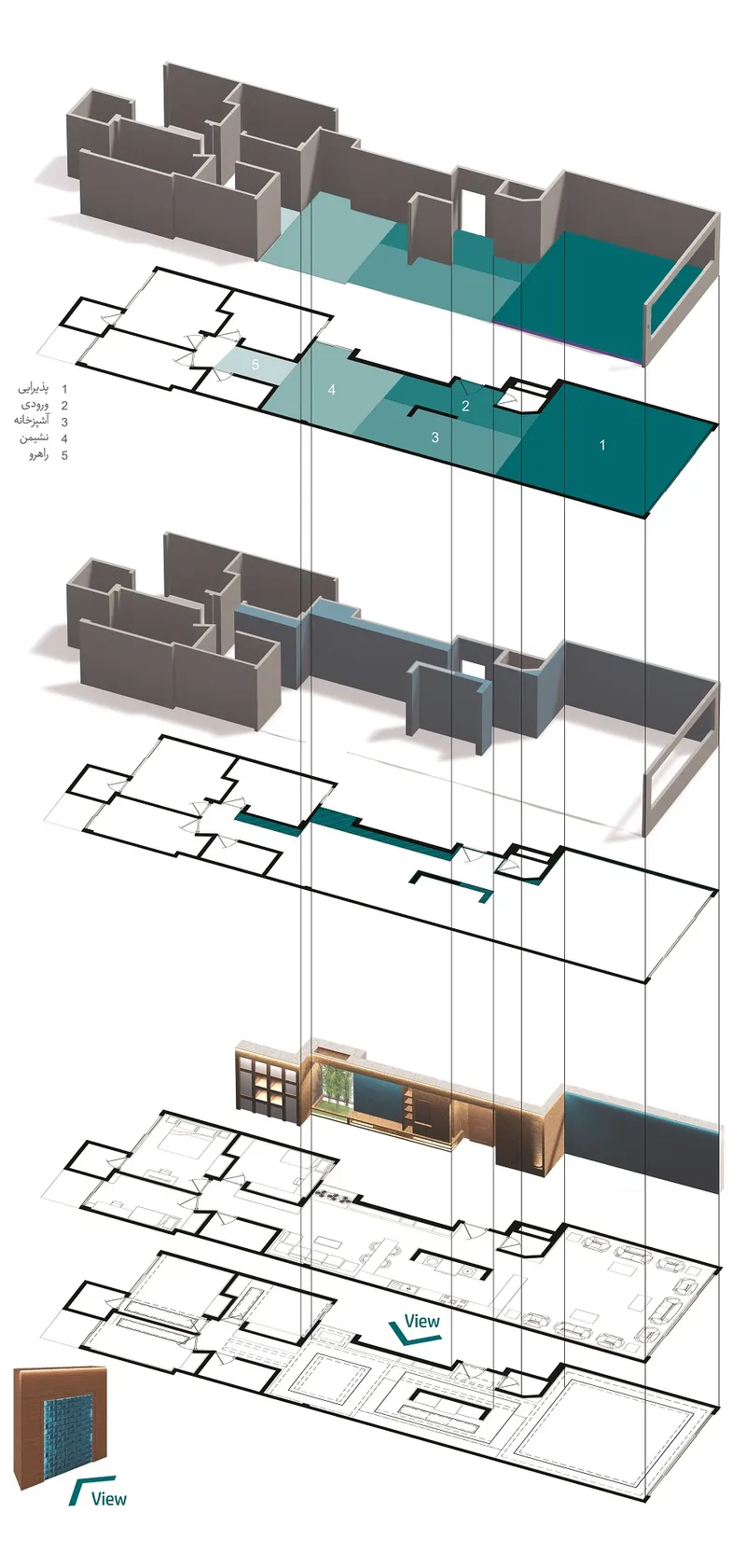
The exploded axonometric explains the logic behind the photographs. Stacked floor plans and separated wall layers show the intervention as a set of overlays rather than a single gesture, with teal zones marking the numbered living areas. Read this way, the shifts in material, level and light seen in the interiors appear as a planned spatial sequence, one that moves from public to private through gradual transitions instead of abrupt doors.
The drawing also shows how efficiently the plan is zoned. Living areas are grouped and coded so each function has a clear place, yet the continuous flow that the photographs suggest stays intact. For a residence of this size, that balance between openness and functional clarity determines whether the home feels generous or cramped.
Why This Project Matters
Shakur's House shows that reinterpreting a vernacular material does not require nostalgia or pastiche. Khodae and MDC treat brick with the precision of contemporary interior detailing, through careful joints, controlled planes and deliberate adjacencies, so it reads as current rather than rustic. The material keeps its cultural associations of enclosure, thermal mass and comfort while taking on a new role as a spatial mediator inside the home.
The broader lesson concerns small residences. Rather than adding walls to create order, the project relies on material shifts, raised levels, glass and planted light to separate uses while keeping the plan open. It is a useful model for designers working with limited square meters and strong material traditions, and it adds to a growing body of Iranian work that treats heritage as a working method rather than a style.
View the Full Project
About the Designers
Designer: Muhammad Khodae
Enter a Design Competition on uni.xyz
uni.xyz runs architecture and design competitions year-round that reward proposals with spatial conviction and real site intelligence.
Project credits: Shakur’s House by Muhammad Khodae.


Popular Articles
Popular articles from the community


Singing Woman: An Opera House That Performs Before the Curtain Rises
Ovidiu Cristian Pavel's conceptual opera house translates Estonia's choral identity into a sculpted waterfront landmark facing the Baltic Sea.
Manzana Morphosis: Stretching Barcelona's Grid into a Living Landscape for 2050
A radical reworking of the Eixample manzana turns density into a tool for generous public space, vertical ecology, and environmental performance.

Cloaked Colonization: A Mobile Underwater Habitat That Moves Like a Fish
Micah Abaya's shortlisted EHC Pacific entry reimagines ocean settlement as a dispersed network of self-sustaining architectural organisms.

Opera on the Sea: Driftwood Logic Shapes a Timber Opera House on Estonia's Coast
Trevor Orgill's opera house translates the entangled drift of floating timber into a civic building where wood, water, and music converge.

Similar Reads
You might also enjoy these articles


Hodi-Mandai Geram
Project Function: Preservation and revitalization of the Intangible heritage and socio-spatial identity of the Hodi by Housing, Cultural Memory Center, Sacred Grove, landscape, local tourism economy


Olio Towers: A Mid-Rise for Performers That Fuses Housing, Rehearsal, and Stage
Located blocks from Houston's Theater District, this modular tower stacks living units around a central performance atrium.

Oasis: Modular Green Housing Carved into Dhaka's Urban Fabric
A shortlisted Plugin Housing entry reclaims unauthorized settlements in Dhaka with stepped concrete volumes, green roofs, and ventilation-driven design.

Black Hole: A Floating Megastructure for the Post-Physical Era
Emiliano Mazzarotto envisions a spherical, self-scaling arena where e-sports, digital hotels, and holographic stadiums replace traditional public space.

Explore Conceptual Architecture Competitions
Discover active competitions in this discipline

Challenge to design luxury tourism on rails

VR headsets Storefront design competition

Designing a staircase for a client
Comments (0)
Please login or sign up to add comments
No comments yet. Be the first to comment!