

Hoberman Dome: A Deployable Arctic Settlement That Grows From 1,000 to 1,000,000
On Ellesmere Island, a kinetic geodesic habitat built from ETFE hexagons expands in stages to shelter life at minus 56 degrees Celsius.


What if a building could compress into a compact transportable unit, then unfold on site like a mechanical organism, rising on telescopic supports to create a climate-controlled settlement in one of the coldest places on Earth? The Hoberman Dome takes Chuck Hoberman's isokinetic structures as its starting point and scales the idea to urban proportions: a geodesic shelter clad in ETFE hexagonal panels that can deploy in stages, eventually linking into a networked settlement capable of housing up to one million people on Canada's Ellesmere Island, where temperatures plummet below minus 56°C and polar night lasts five months.
Designed by Кира Матвеева, the project was shortlisted in the EHC - Arctic competition, which challenges entrants to envision resilient habitats for extreme polar environments. The proposal addresses not just shelter but an entire self-sustaining urban system: energy generation through solar, wind, and nuclear power; a Hyperloop-integrated transport network; and a modular zoning strategy that balances living, work, and recreation as the population grows.
Hexagonal Logic: A Settlement Pattern Borrowed From Celestial Systems
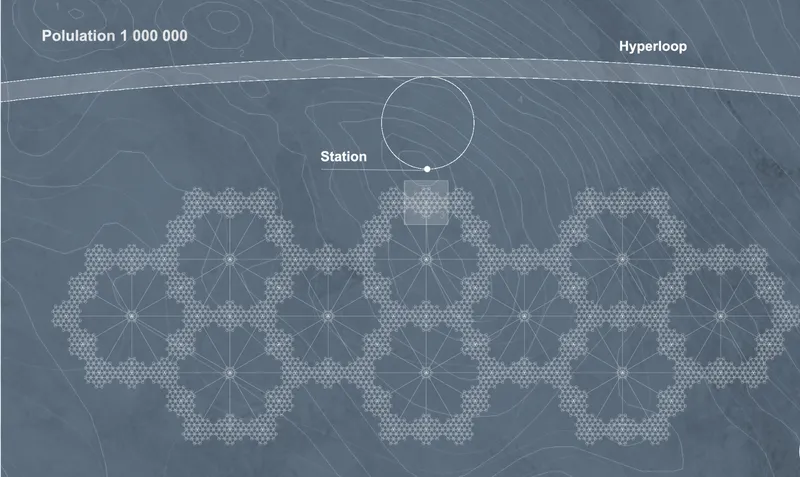
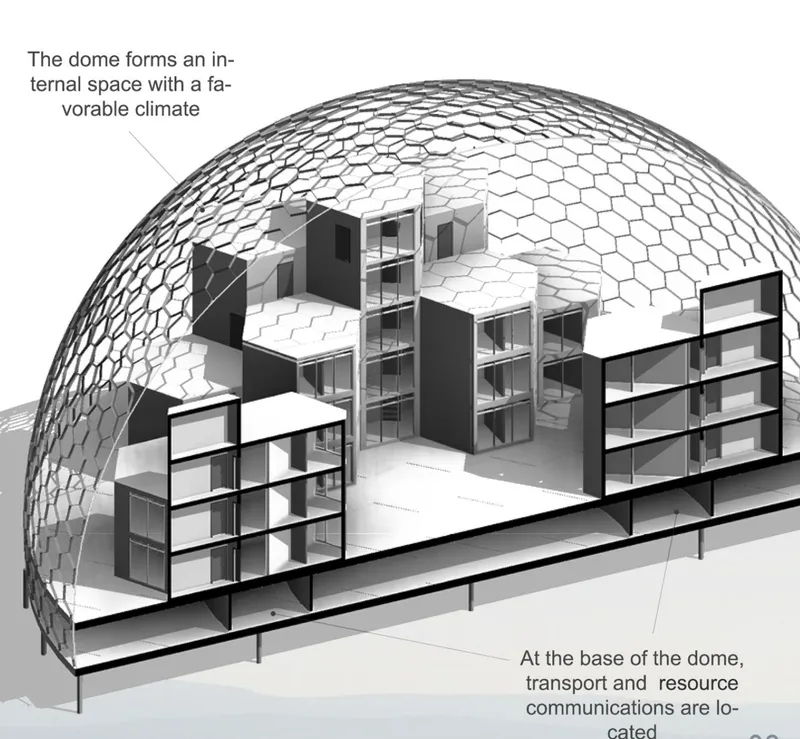
The masterplan draws on celestial system geometry to organize its settlement in a hexagonal pattern, with a central energy module radiating outward to supply power and define zones. The site diagram reveals how contour lines of Ellesmere Island's terrain interact with the Hyperloop station, positioning the habitat for efficient connectivity to a broader Arctic transportation network. A sectional cut through a single dome shows housing units nested beneath a geodesic roof of hexagonal panels, elevated above grade on telescopic supports that allow airflow beneath the structure. That raised floor is not merely aesthetic: it prevents heat transfer to the permafrost below, a critical move in any Arctic construction.
The hexagonal module is repeated at every scale, from individual room clusters up to the settlement's overall footprint. This fractal consistency is not decorative; it optimizes material use and ensures each dome can connect to its neighbors through standardized linking corridors, allowing the settlement to expand without redesigning its infrastructure.
Warm Interiors Behind Curved Glass: Living at Minus 56°C
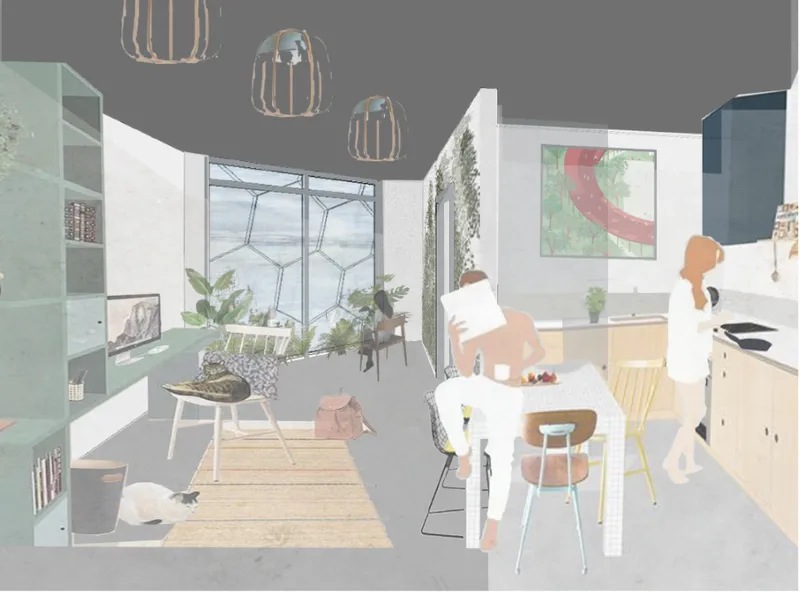
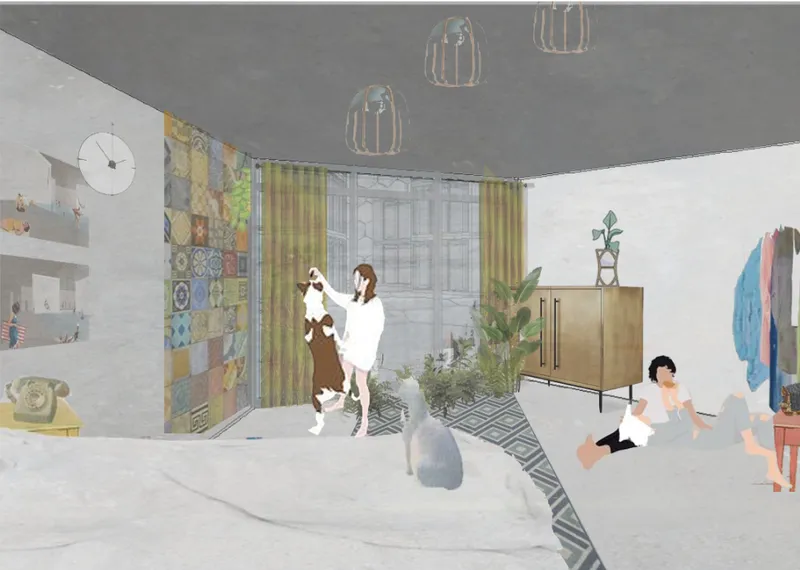
Step inside and the Arctic disappears. The kitchen and dining rendering shows a curved window wall that wraps the living space in daylight (or what passes for it during Ellesmere's brief summers), while pendant lighting compensates during the five-month polar night. Surfaces feel residential, not industrial: warm tones, domestic-scale furniture, and spatial proportions that counter the psychological toll of prolonged darkness and isolation. A second interior view reveals patterned tile walls and a textile floor runner, deliberate choices that bring visual richness to a place where the outdoor palette is relentlessly monochrome.
These interiors are maintained by an infrared heating system paired with Energy Recovery Ventilation, which recaptures heat from exhaust air to minimize energy loss. The ETFE hexagonal panels forming the dome's skin provide high insulation values while remaining lightweight, a material decision that directly serves both the dome's deployability and its thermal performance in extreme cold and low humidity.
Dome Clusters and Linking Corridors: The Aerial View
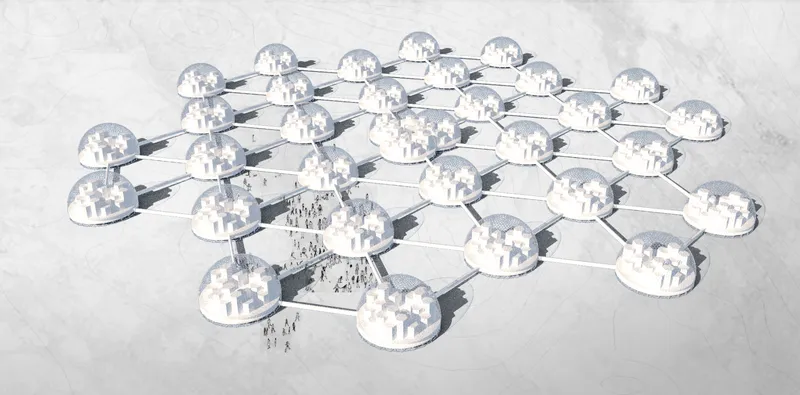
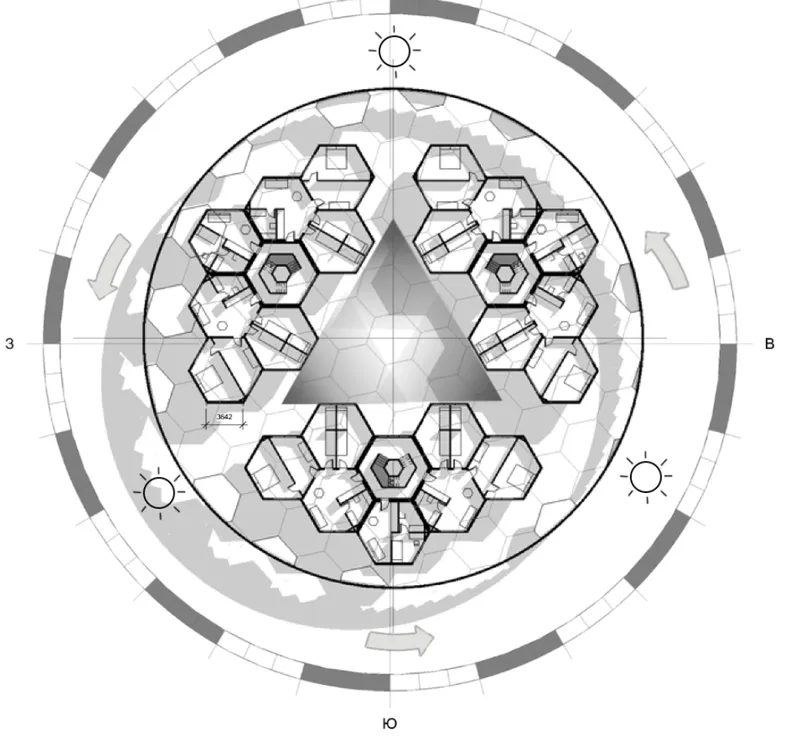
From above, the settlement reads as a constellation of interconnected domes joined by hexagonal linking corridors. Long shadows cast across the terrain hint at the extreme solar angles the site experiences for much of the year, reinforcing why renewable energy generation here relies on wind and nuclear power alongside solar. The circular floor plan of a single dome shows how hexagonal housing units cluster within the geodesic shell, oriented according to a solar diagram that maximizes passive gains during the brief periods of daylight.
The construction sequence is designed around four stages. First, the parental dome deploys and adapts to terrain. Second, telescopic supports elevate the structure. Third, living units unfold within. Fourth, inter-unit connections lock the urban framework together. This staged approach means the settlement can begin supporting inhabitants well before the full build-out is complete, a practical necessity when construction windows in the high Arctic are vanishingly short.
Stacking Hexagons: How the Floors Taper Upward
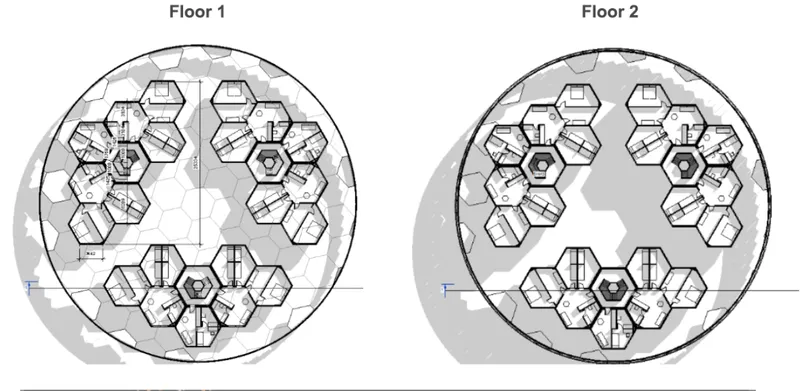
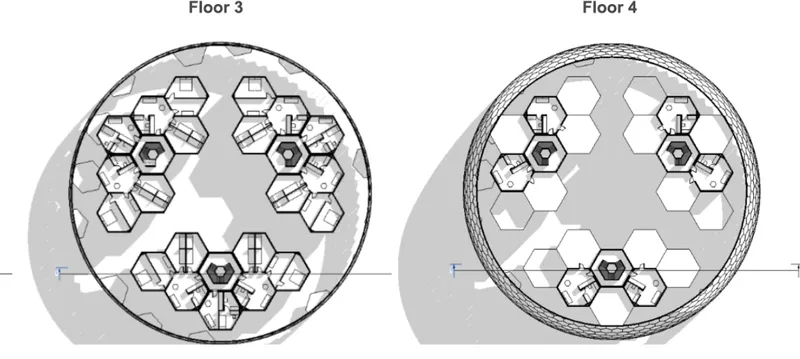
The floor plan drawings expose the dome's vertical logic. At the base, hexagonal room clusters pack tightly in a circular formation across two levels, maximizing usable area where the dome's diameter is greatest. As the structure tapers upward, each successive level contains progressively fewer modules, following the geodesic curvature rather than fighting it. The result is a building section that feels intuitively proportioned: communal and dense at the ground, more intimate and private above.
This tapering also carries structural benefits. Fewer modules at higher levels reduce dead load on the dome's upper segments, keeping the deployable mechanism viable and the telescopic supports within reasonable load limits. It is a geometry that serves construction logistics, thermal performance, and spatial quality simultaneously.
Why This Project Matters
Arctic design projects often fall into one of two traps: they treat the site as a blank canvas for futuristic spectacle, or they become so consumed by engineering constraints that habitation quality disappears. Кира Матвеева's Hoberman Dome navigates between these poles with a clear-eyed systems approach. The hexagonal geometry is not a stylistic choice but a structural, thermal, and urban planning decision that repeats from the room scale to the masterplan. The deployable construction sequence acknowledges that building in the Arctic is as much a logistical problem as a design one.
What elevates the proposal beyond concept is its ambition to scale. A settlement designed for 1,000 people that can grow to one million demands modular thinking at every level, from the ETFE panel to the Hyperloop connection. Whether or not the specific population target is achievable, the underlying framework, a self-sustaining habitat powered by diversified renewable and nuclear energy, deployable in stages, and organized around a repeatable spatial unit, offers a serious template for extreme environment architecture. In a world where climate change is making more territory simultaneously accessible and hostile, that template has value well beyond Ellesmere Island.
View the Full Project
About the Designers
Designer: Кира Матвеева
Enter a Design Competition on uni.xyz
uni.xyz runs architecture and design competitions year-round that reward proposals with spatial conviction and real site intelligence.
Project credits: Hoberman Dome by Кира Матвеева EHC - Arctic (uni.xyz).


Popular Articles
Popular articles from the community


Extended Shell: Retrofitting Kolkata's Balconies as Living Urban Thresholds
A modular retrofit system recovers the social and environmental intelligence of Kolkata's historic verandas for contemporary Park Street residents.

Temporary Home for Dogs: A Reversed Zoo Rethinks Animal Shelter Architecture
In Bucharest, a sinuous corridor and freed landscape flip the logic of containment, designing a shelter that works to make itself unnecessary.

Cloaked Colonization: A Mobile Underwater Habitat That Moves Like a Fish
Micah Abaya's shortlisted EHC Pacific entry reimagines ocean settlement as a dispersed network of self-sustaining architectural organisms.

Faces of the Soviet Avant-Garde: Turning Moscow's Street Names into an Open-Air Museum
A network of sculptural installations across a Moscow residential district transforms forgotten architect names into spatial encounters with cultural memor

Similar Reads
You might also enjoy these articles

Shakur's House: Exposed Brick as an Interior Organiser in a 168 m² Mashhad Residence
Brick moves indoors in this Mashhad residence, where masonry walls, glass partitions and teal planes sequence a compact home without closing it off.

Day and Night Park: A Time-Based Urban Newsstand in Beijing
A temporary urban newsstand in Beijing blending travel, light, and reading through poetic colors, compact form, and community-focused design.

Modernist Patio Renovation in El Masnou, Barcelona by Oliver Segura Arquitectura + Cebrià Arquitectura
Modernist patio renovation blending tradition and innovation with a movable pool, leveled floors, and Catalan materials in El Masnou.

Alto Residencial Coop: Cooperative Housing Development in Santiago de Compostela by Carbajo Barrios Arquitectos
A linear cooperative housing complex blending white volumes and perforated metal façades, enhancing community living, natural light, privacy, and urban integration.

Comments (0)
Please login or sign up to add comments
No comments yet. Be the first to comment!