

Vereda Arquitetos Splits a Bahia Beach House into Three Blocks Strung Along a Single Circulation Spine
In Praia do Forte, near a sea turtle reserve, board-formed concrete, stone and slatted timber shape a house that opens like a veranda.


Praia do Forte, on the coast of Bahia, attracts beach houses that look alike: a big white box, a glass wall and a pool in front. Vereda Arquitetos, led by João Paulo Meirelles de Faria, took a different route on a flat 1,260 m² plot about 300 metres from the sand. The house sits in the coastal restinga, close to a base of the Tamar Project, the sea turtle conservation programme. It is not one large volume. It is split into three independent blocks laid out along the long axis of the site and tied together by a central circulation spine.
The interesting part is not the split, which many architects use. It is how far the house commits to it. One block holds the social program: living, dining and kitchens. The second holds the main suite, with an office and an atelier upstairs that face opposite views. The third and largest block holds the daughters' rooms, the guest rooms and the service areas. Each block has its own relationship to the garden, its own roof and its own sense of enclosure. The result reads less like a single residence and more like a small settlement of 630 m², built from board-formed concrete, stone and slatted timber.
A Quiet Face to the Lane
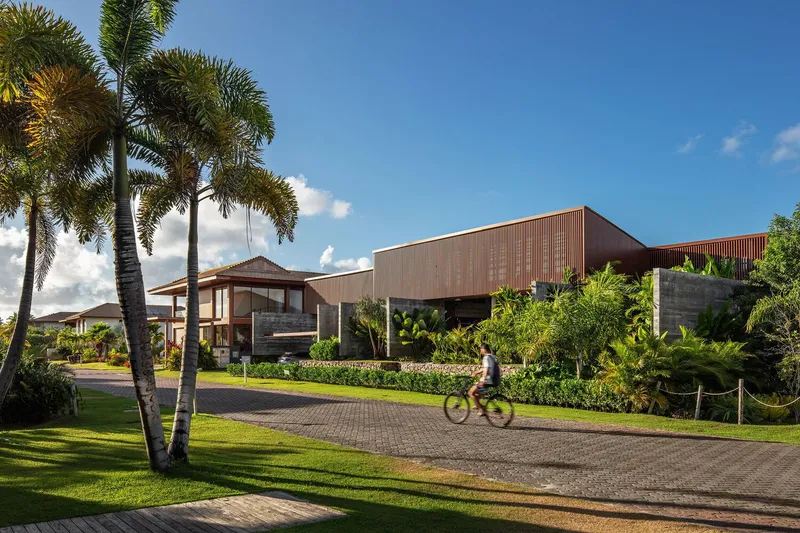
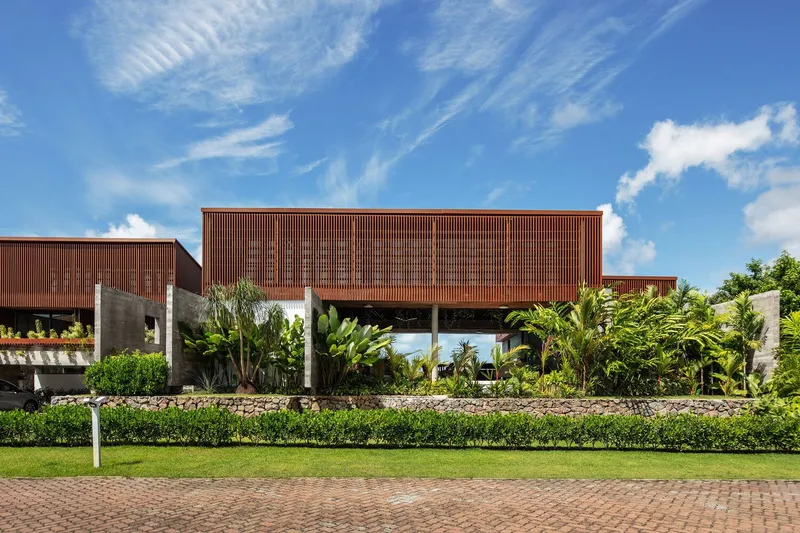
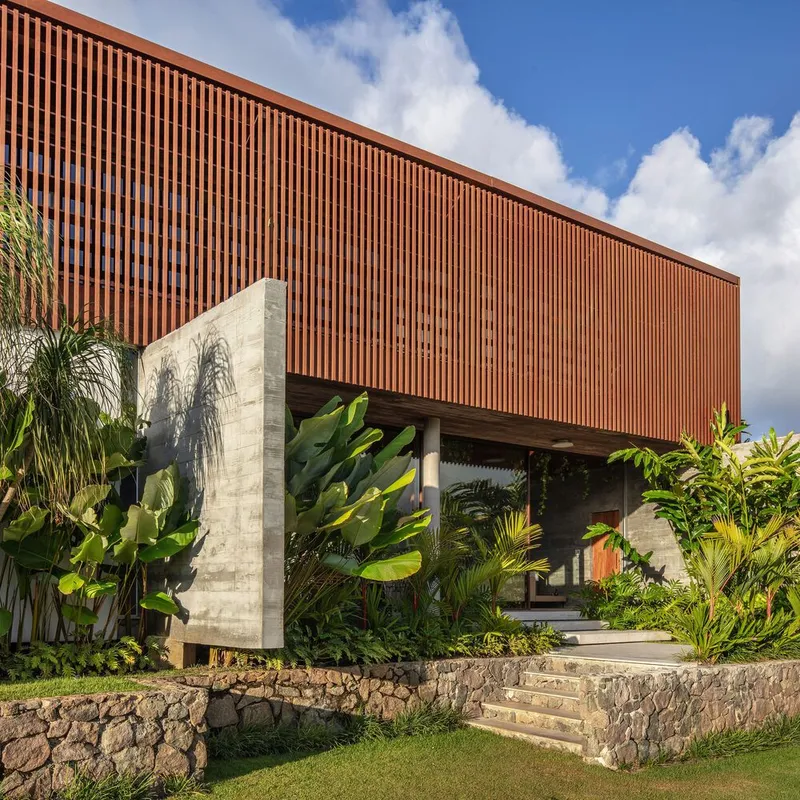
From the street, the house holds back. You see a slatted, rust-toned upper volume resting on a slim column above dense tropical planting. Below it run a stone wall and a clipped hedge. The cyclist passing among the palms shows how well this works: the building gives the lane texture and shade without a blank garage door or a security wall facing the street.
The entrance repeats this approach. A freestanding concrete wall stands in front, with a timber screen above it and stone steps climbing between banana plants. Privacy comes from layers rather than solid mass. This suits a resort town, where the line between the private plot and the coastal vegetation is part of why people come.
Concrete Walls on a Stone Ground
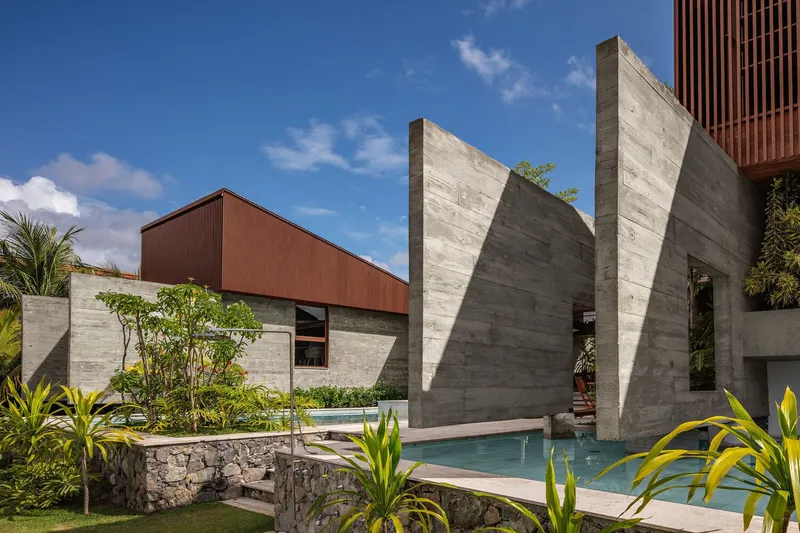
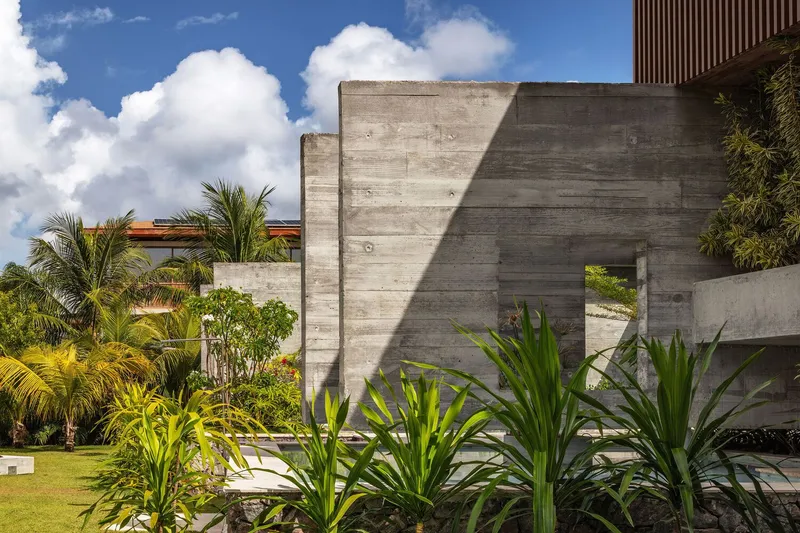
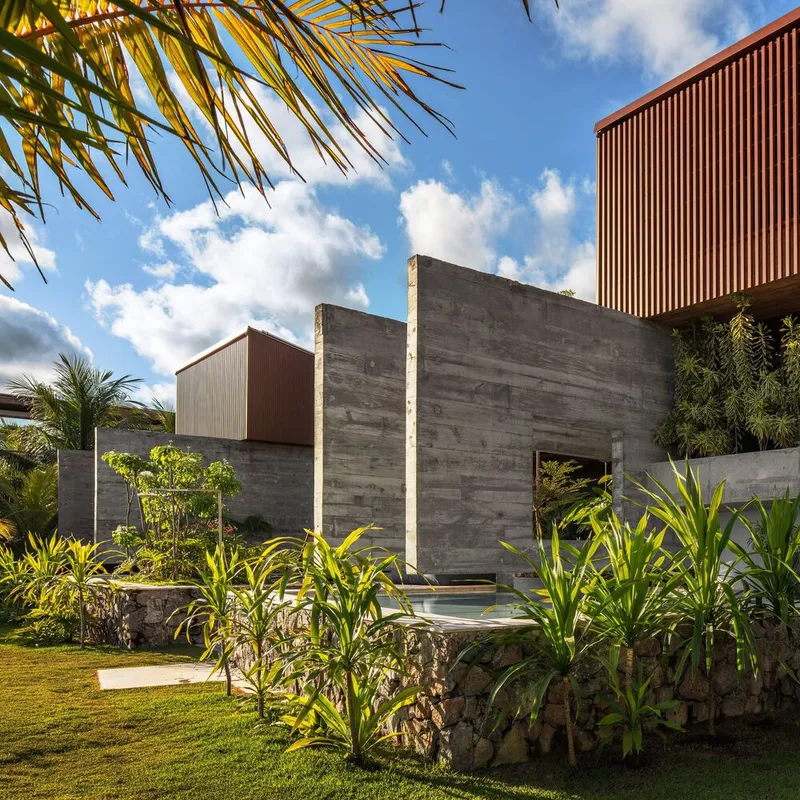
The building works in clear layers. At the bottom, stone retaining walls and planters set the base of the site. Above them, freestanding board-formed concrete walls run past the edges of the rooms, so they read as walls in the landscape rather than as the shell of a box. On top sit the lighter volumes: slatted screens and metal-clad roofs.
The concrete walls carry most of the architecture. They are staggered, so each block keeps its own garden and its own boundary. The board marks on their surface catch the raking Bahian light. The framed opening in image 8, shaded by the slatted volume above, shows the approach at small scale: thick walls below, filtered light above, and planting packed against both.
The Social Block as Veranda

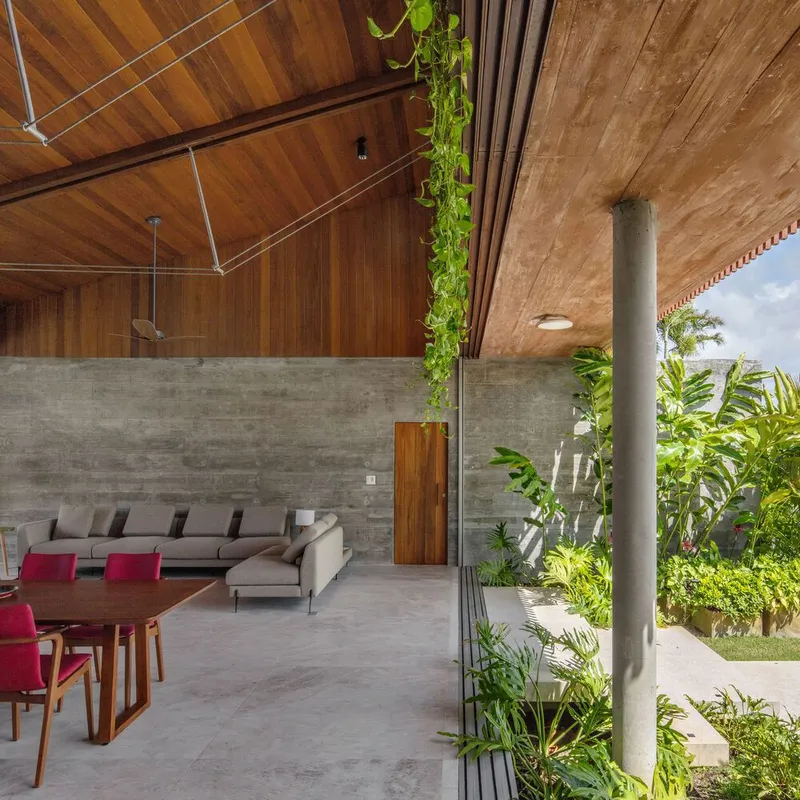

The aluminium-framed glass walls of the social block slide away completely. When they are open, living, dining and kitchen become one large covered veranda facing the pool and sun deck. This is the most important climate move in the house that we can confirm. In this climate the veranda is the typical living room anyway, and Vereda simply builds it in at full size.
Inside, a pitched timber ceiling sits above board-formed concrete walls. A slim column stands beside a strip of planting, and trailing vines hang from a planter above a slatted clerestory. The red chairs in the kitchen provide almost all the colour. The rest of the palette is concrete, wood and the green of the garden outside.
Pool Court and Outdoor Kitchen
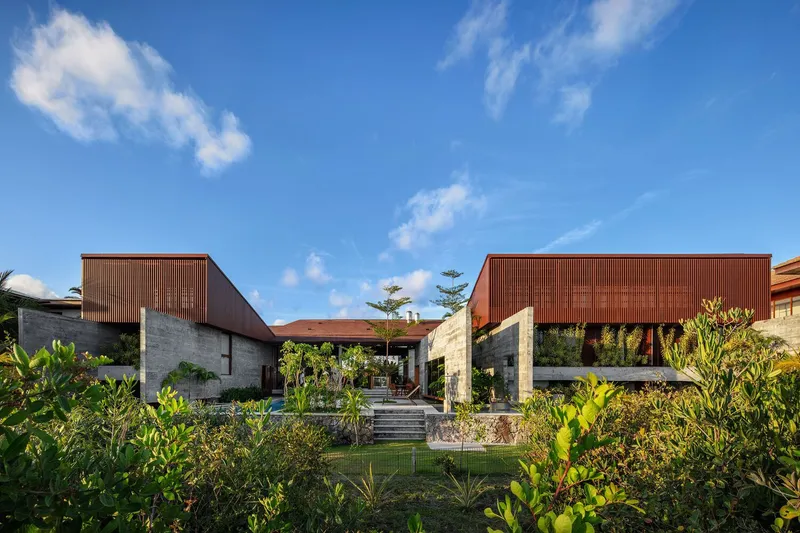
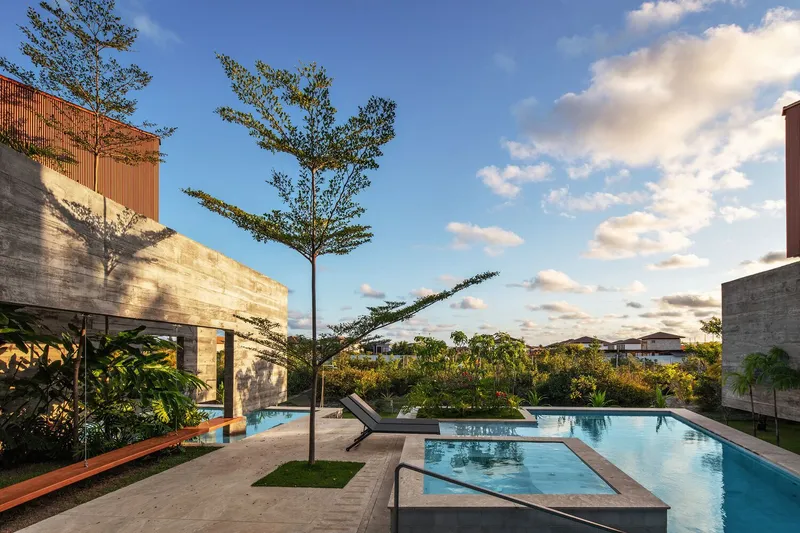
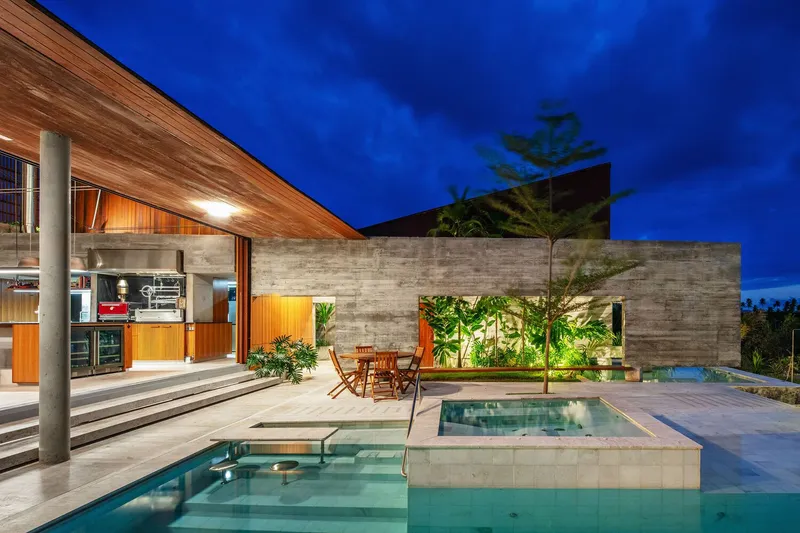
Two slatted volumes frame the pool court, with a raised concrete base between them. In practice it works as the house's main square. The landscape design is by Patrícia Oldemburg. It avoids a manicured lawn and uses shrubs and a few slender trees that give shade without blocking views toward the protected land.
The outdoor kitchen sits under a cantilevered timber roof held by a single concrete column, and it may be the best small piece of the project. It extends the veranda into the evening and keeps cooking smoke and noise out of the enclosed rooms. It also shows that the architects treated outdoor spaces as finished rooms, not leftover space.
Timber Interiors for the Private Wings
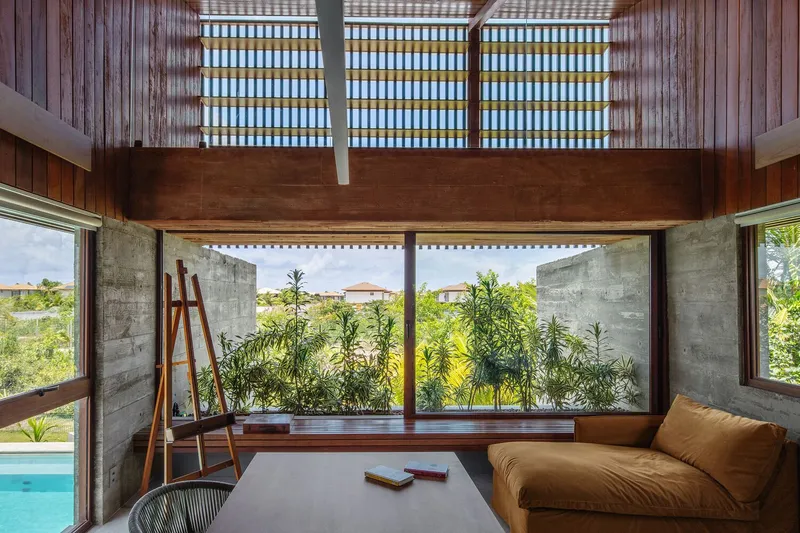
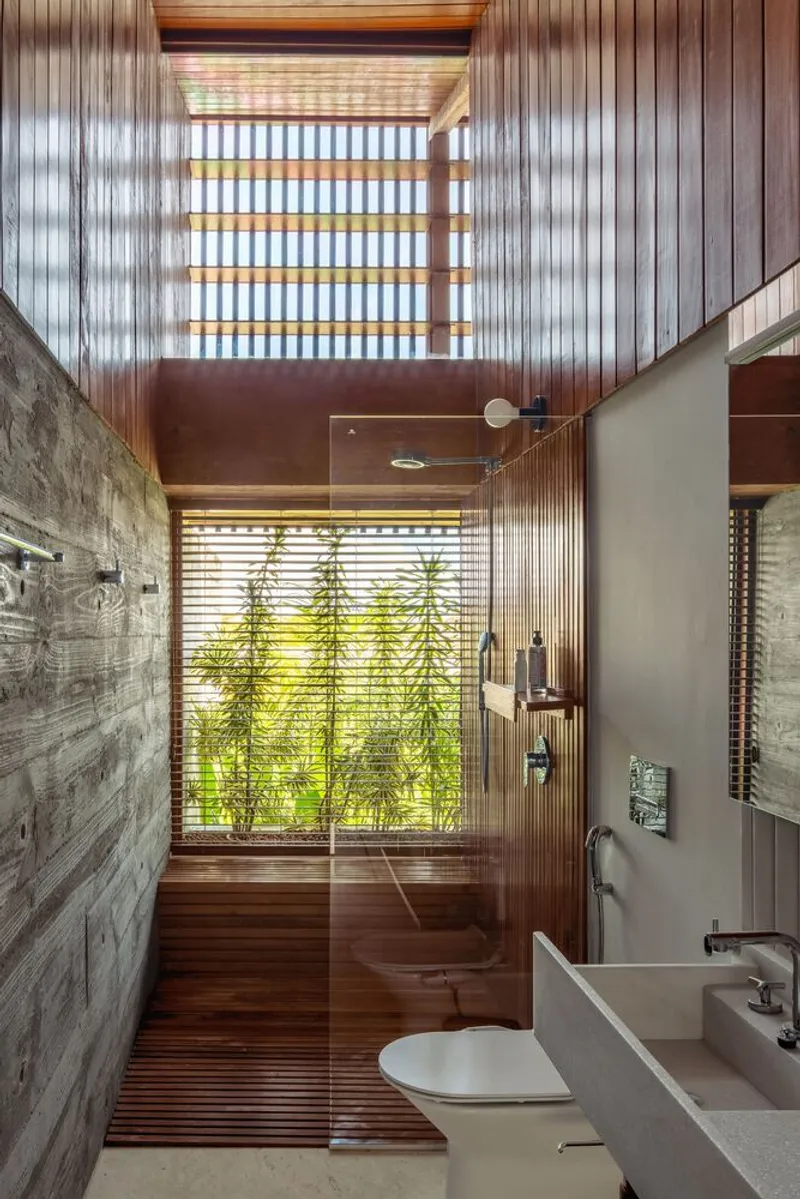
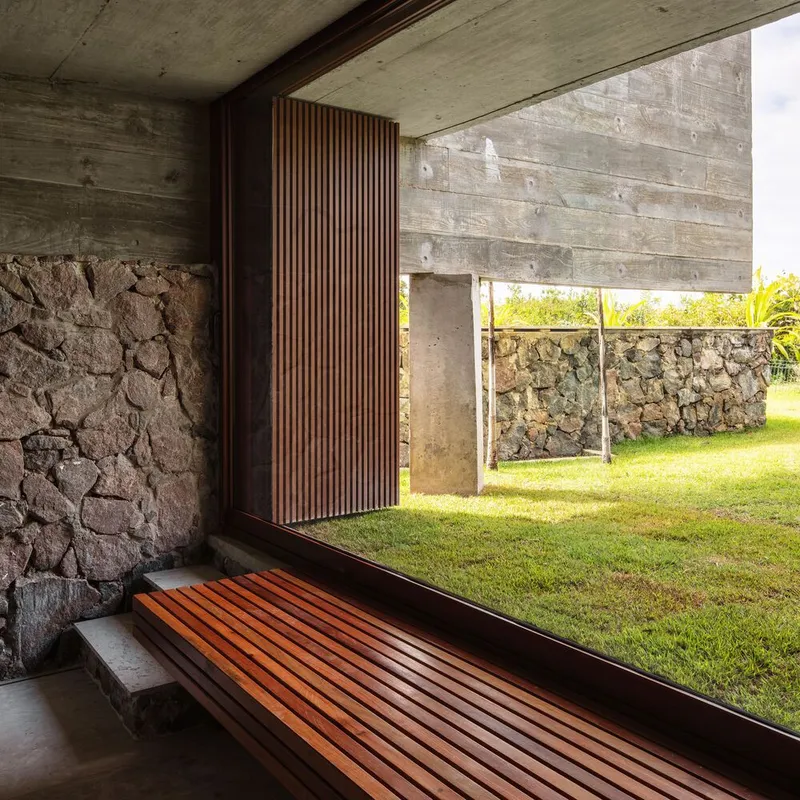
The private blocks feel warmer. The upper rooms are lined in timber and set against board-formed concrete, and window benches look down onto the pool and the planting. In the bathroom, a timber-clad shower sits under a skylight and a slatted window that let in green, filtered light. Most beach house bathrooms are bright white, so this is a welcome change.
The pivoting slatted panel next to a timber bench is a good example of the house's approach. It is a piece of joinery that also adjusts the climate: you swing it to control light and air. Because the slats are built into furniture and screens, rather than added as decoration, they give the house a consistent texture throughout.
Courtyards Around a Single Tree
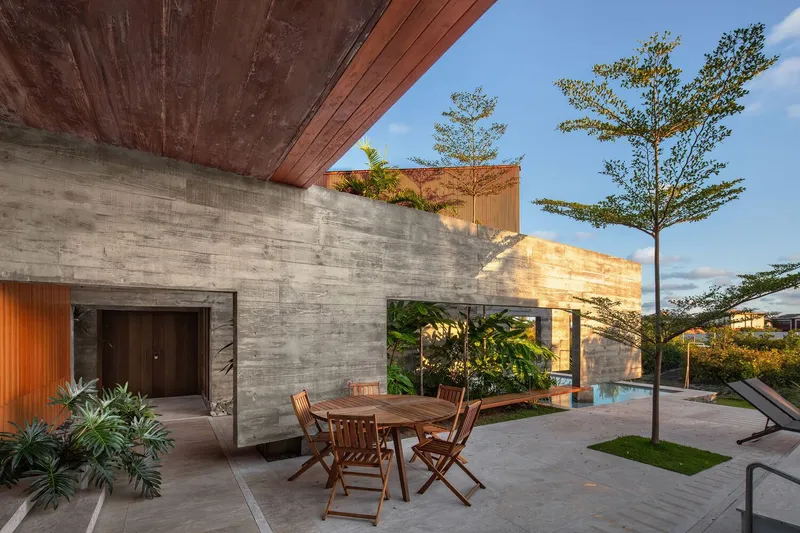
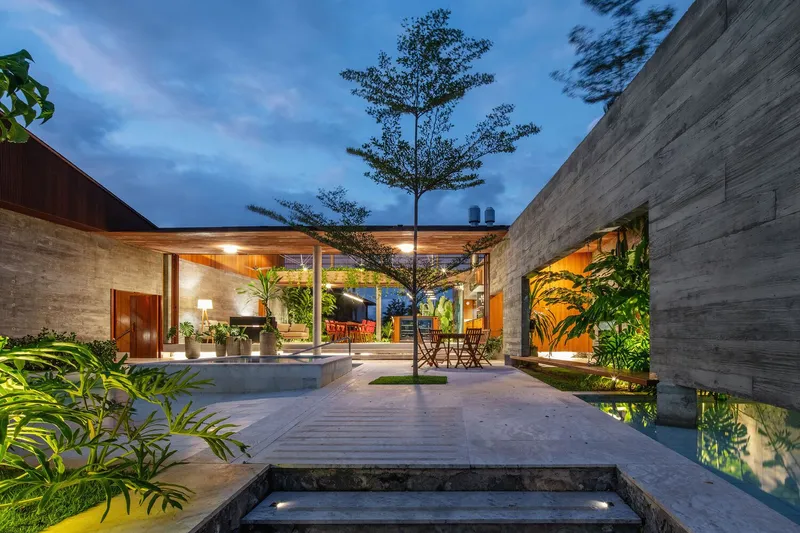
Several courtyards are organised around one slender tree, set against a concrete wall and, in one case, a shallow reflecting pool. A tree like this is easy to build into a design. Here it does real work. It scales down the concrete, casts moving shadows across the board-formed surface and marks the in-between spaces where the three blocks meet.
The House After Dark
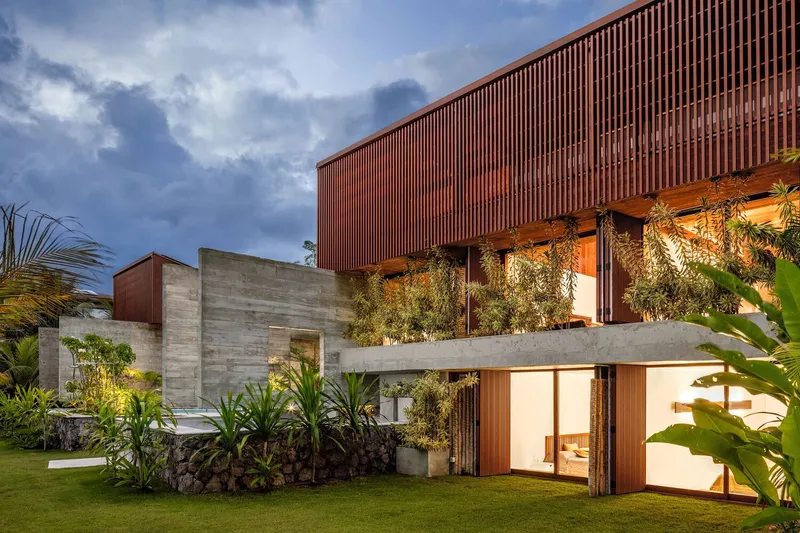
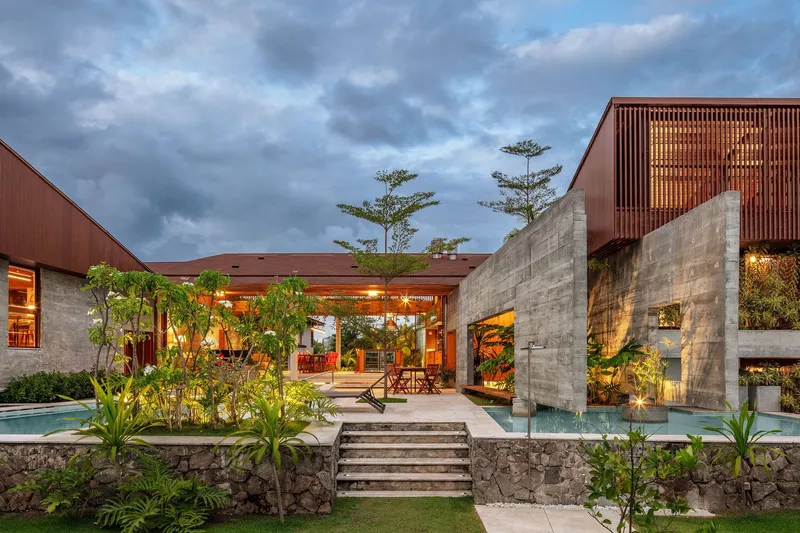
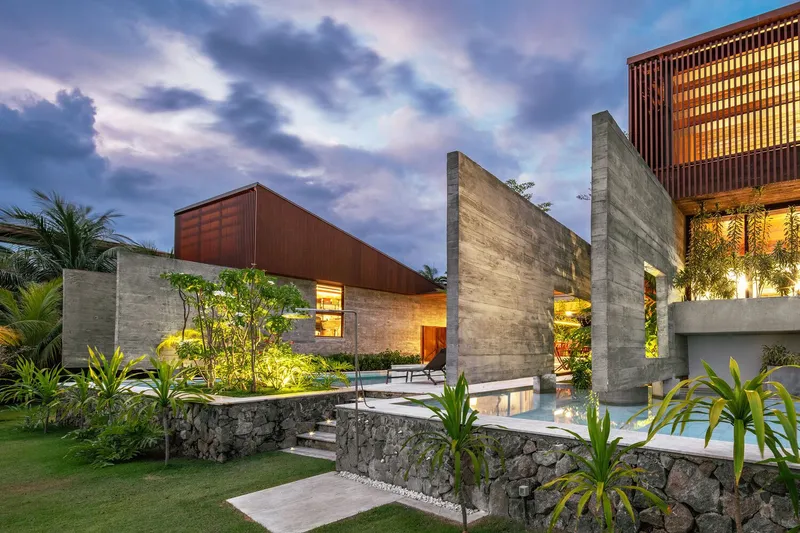
At dusk the layers become easy to read. Lit bedrooms glow behind tall planting, the pavilion lights up beyond the pool court, and the copper-toned roof volumes stand out against stormy skies. The freestanding concrete walls stay dark, so the house appears as a set of lit pavilions separated by solid walls. This is the three-block layout made visible.
Plans and Drawings
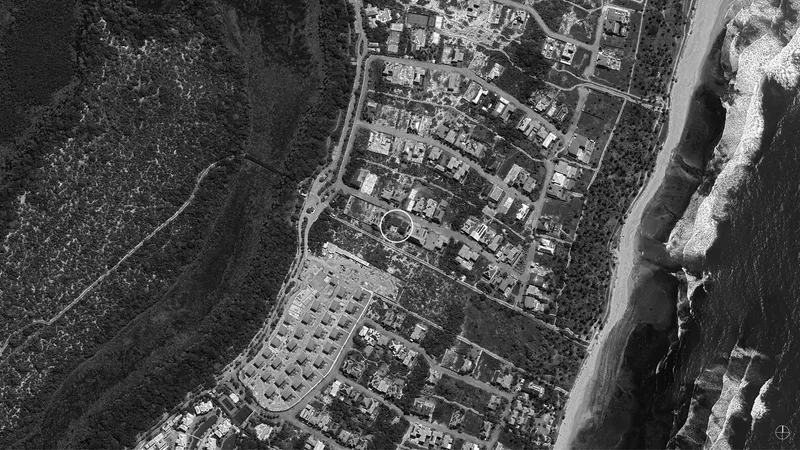
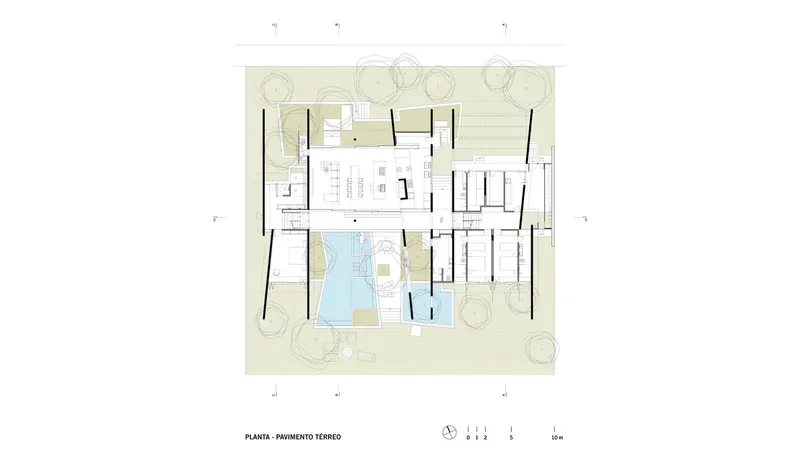
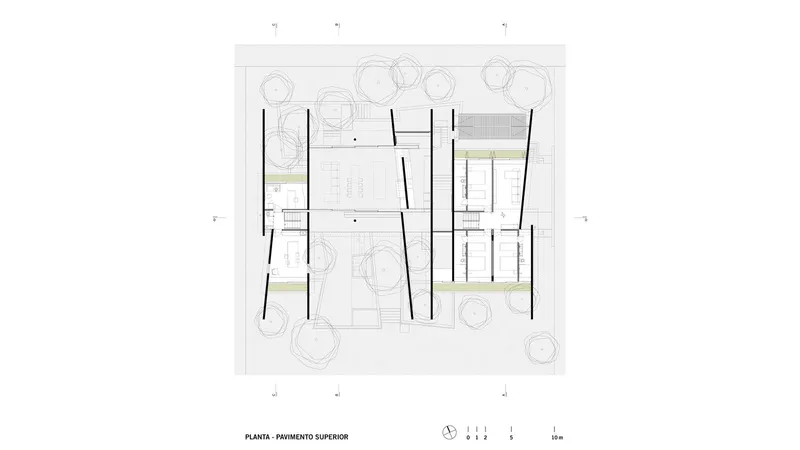
The aerial view places the house among streets, dunes and surf, a short walk from the shore. The ground floor plan shows the angled walls and the three blocks set among existing trees. Upstairs, the bedroom suites sit on either side of a central void instead of a corridor.
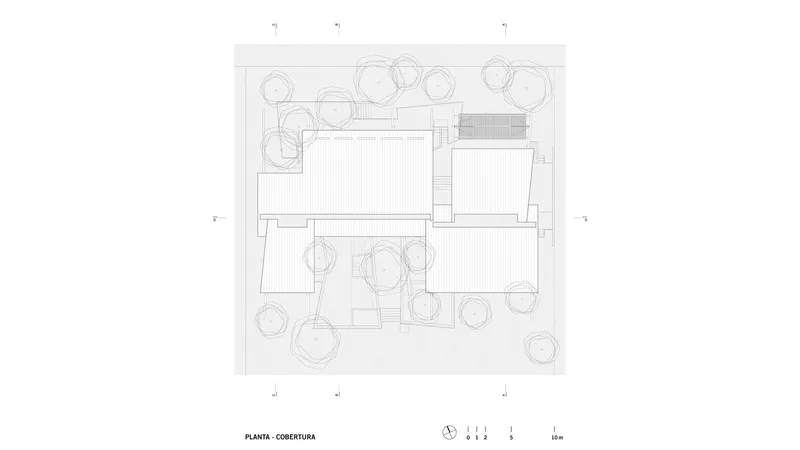
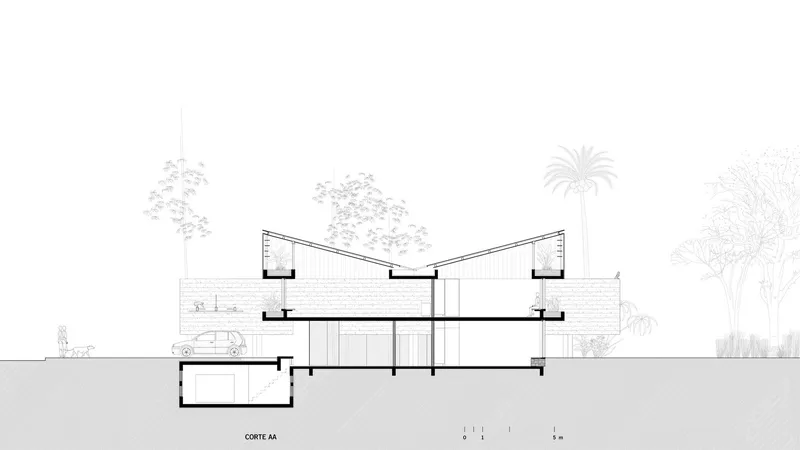

The roof plan shows overlapping rectangular roof planes, one per block. The sections reveal a butterfly roof with planted gutters, a basement garage that keeps the car out of the garden, and a sunken pool set behind a stone wall with a large tree rising beyond it.
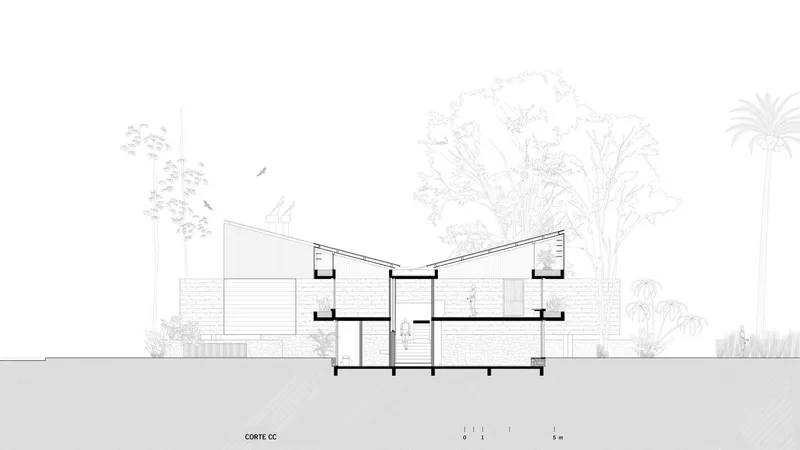
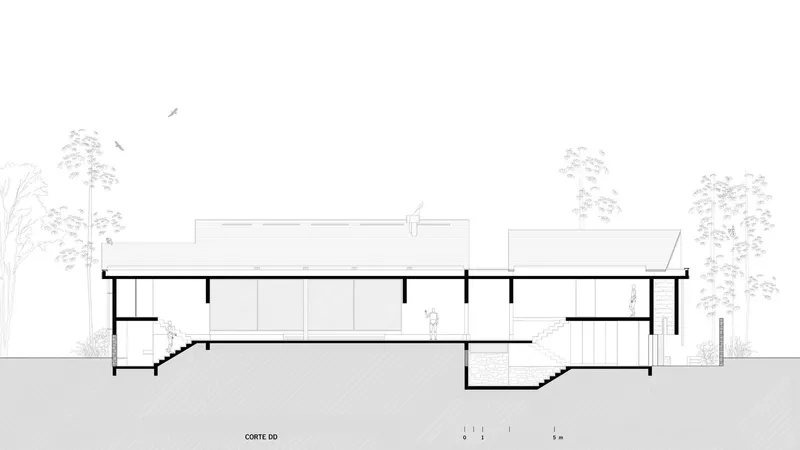
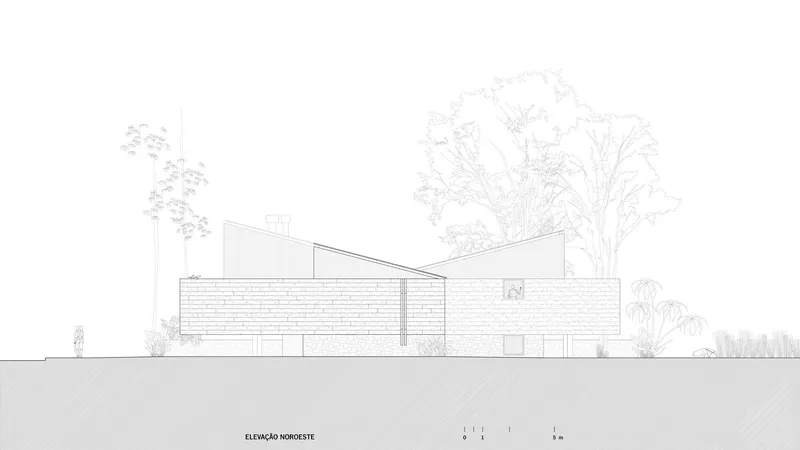
The cross section through the stair core shows the spine that links the blocks, with sloping roof wings on either side. The long section shows interior stairs stepping between levels, which suggests circulation built from changes in level rather than stacked floors. The northwest elevation sets angled roofs on a stone-clad base.
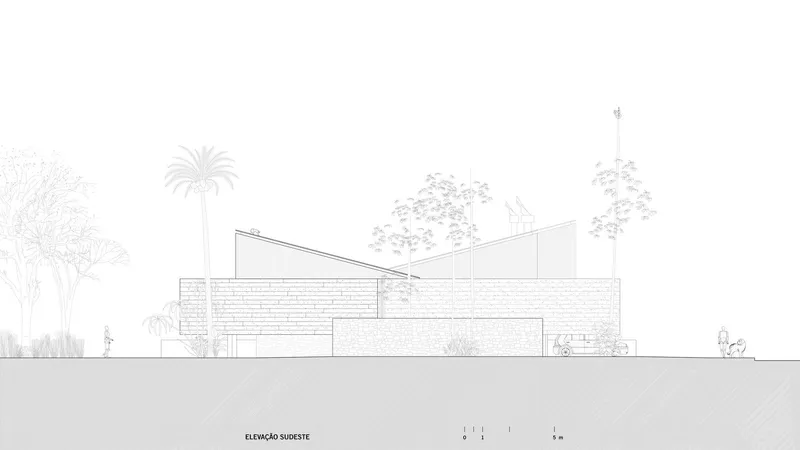
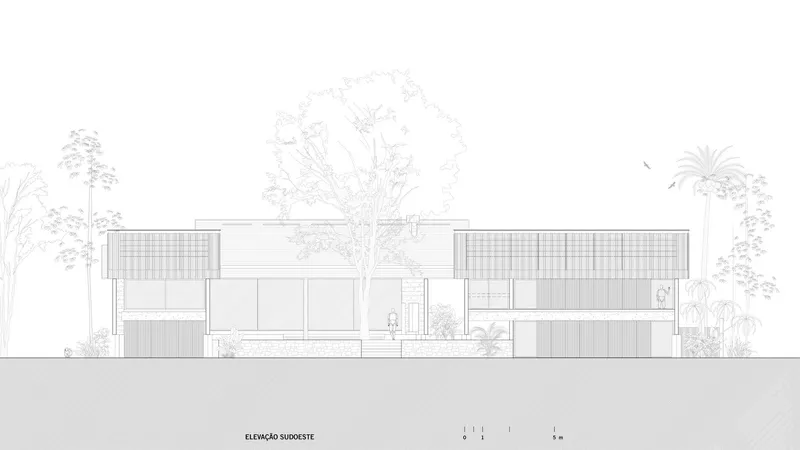
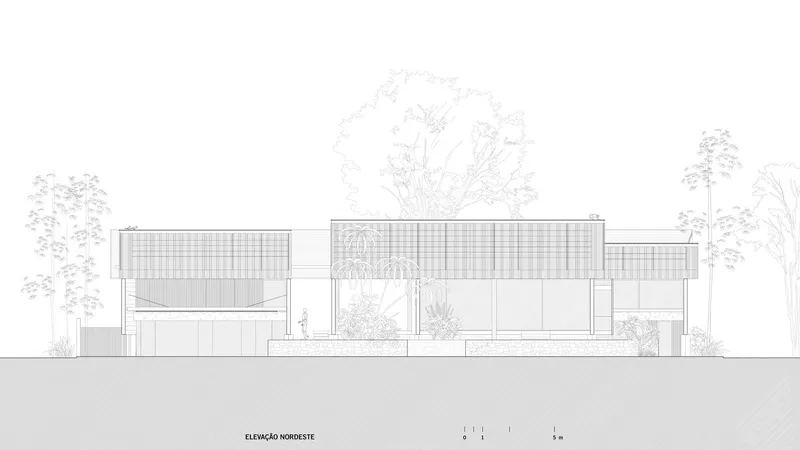
The remaining elevations confirm the layered composition: a long stone wall facing the street, slatted screens above glazed ground floors, and planting beds that keep the building low next to the trees around it.
Why This Project Matters
Coastal Brazil has a long modernist tradition of houses that work as verandas, and many recent beach houses have lost it under air conditioning and floor-to-ceiling glass. The House in Praia do Forte goes back to that tradition without copying it. The social block opens fully. Screens and slats filter the light. Courtyards and trees do the shading that mechanical systems would otherwise do. We would have liked more published detail on orientation and ventilation, but the main strategy is clear.
The broader lesson is about breaking up the program. Dividing a 630 m² house into three blocks along one spine keeps each part at a human scale, gives every room a garden, and lets the house sit gently on a plot next to protected restinga. For architects working on generous coastal sites, this is a useful alternative to the single large box: build a group of smaller pieces and let the landscape run between them.
House in Praia do Forte by Vereda Arquitetos (lead architect João Paulo Meirelles de Faria), Praia do Forte, Mata de São João, Bahia, Brazil. Area: 630 m². Year: 2023. Photography by Nelson Kon.
About the Studio
Share Your Own Work on uni.xyz
If projects like this are the kind of work you want to make, uni.xyz is a place to publish your own, find collaborators, and enter design competitions.


Popular Articles
Popular articles from the community


Cube Design Draws an Ecological Corridor Between Two Shenzhen Hills with the Nankai Building
Beside Shenzhen's container docks, the Nankai Building pairs stacked balconies with a climbing green screen to connect two hillsides across its height.

U.GA Architects Wraps an Oval Rooftop Pool in Curved Board-Formed Concrete on Busan's Jeollidan-gil
In Busan's Jeonpo-dong, a 454 m² mixed-use block stacks a neighborhood facility, guest rooms and an oval rooftop pool inside spiraling concrete walls.

Juan García Correa, John González and Claudia Rueda Sink a Circular Amphitheater into a Manizales Engineering Building
On the La Nubia campus in Manizales, Colombia, the S1 Building folds labs and offices into a hillside of ramped lawns that double as a campus route.

LT2A and OPEN Architectes Thread a Brick and Glass High School Through a Wooded Belgian Campus
In Braine-l'Alleud, a 3,000 m² wing for Collège Cardinal Mercier pairs pale brick with a glazed colonnade, deferring to a small chapel and a dense wood.

Similar Reads
You might also enjoy these articles

Gil Mello Arquitetura Tilts a Single Roof Toward the Waterfalls on a Plateau Above Aiuruoca, Brazil
In Aiuruoca, Minas Gerais, a 200 m² house of local labor and reclaimed poles pairs a low valley veranda with a tall mountain one.
U.GA Architects Wraps an Oval Rooftop Pool in Curved Board-Formed Concrete on Busan's Jeollidan-gil
In Busan's Jeonpo-dong, a 454 m² mixed-use block stacks a neighborhood facility, guest rooms and an oval rooftop pool inside spiraling concrete walls.

Felipe Hess Arquitetos Turns a Blind Stone Wall to the Street and Opens a Brazilian House onto a Courtyard and Canal
A canal-front house in Brazil hides behind painted stone and planting, then opens to an olive-tree courtyard, a reed-ceilinged porch and a curving pool.

David Macias Steps a Doorless Stone and Plaster House Down a Tropical Colombian Hillside
In the humid hills of Colombia, Threshold House replaces the front door with an open void and terraces its 850 m² down the slope instead of fighting it.

Explore Architecture Competitions
Discover active competitions in this discipline

Challenge to reimagine the Iron Throne

Photograph architecture without architects

Illustrate the lost glory of Angkor Wat - Render Challenge

Design challenge to reuse E-waste
Comments (0)
Please login or sign up to add comments
No comments yet. Be the first to comment!