
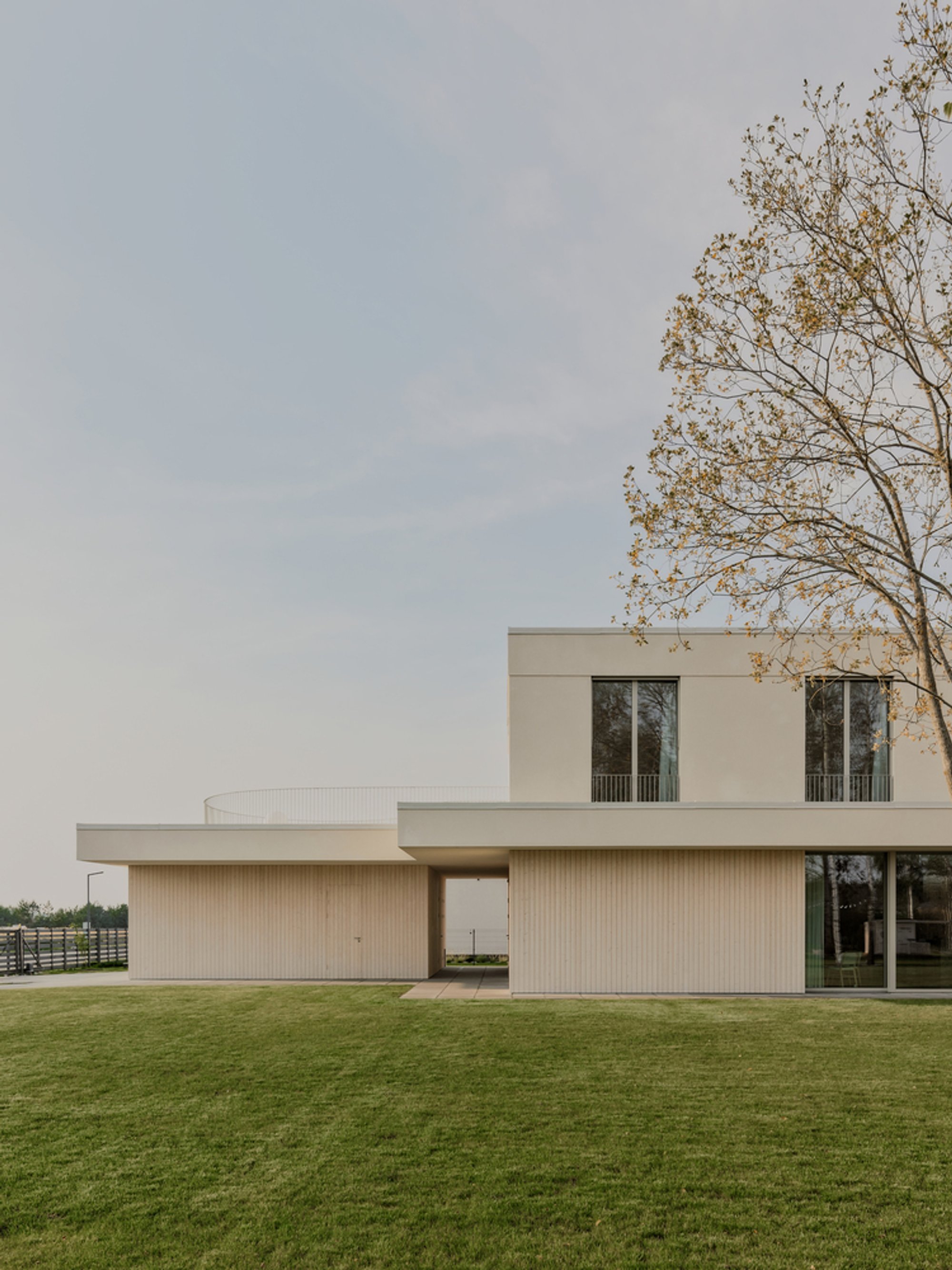
GAISS Wraps a Latvian Family Home in Lime Plaster and Timber for a Quiet Suburban Life
A 370-square-metre timber-framed house in Mārupe, Latvia, balances passive solar strategy with honest, breathable materials.

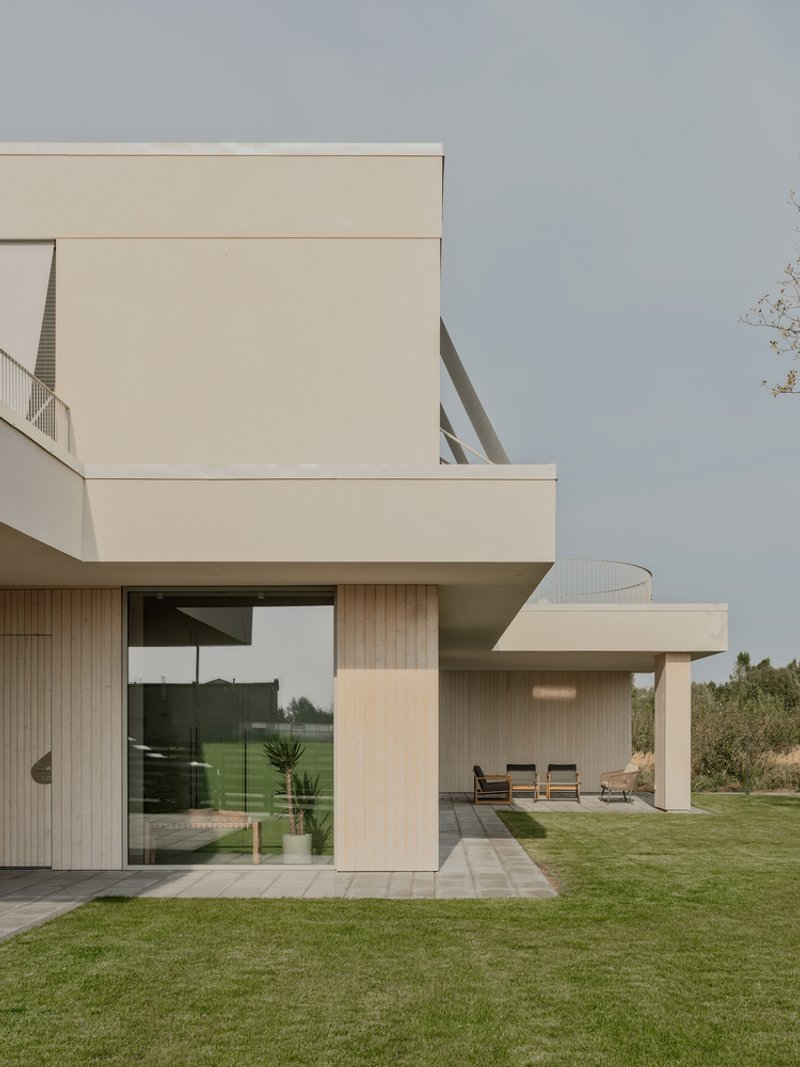
There is a particular kind of restraint that separates a well-built timber house from an interesting one. Plenty of architects reach for wood cladding and natural plaster to signal sustainability, then stop there. GAISS, with their Lime and Timber House completed in 2024 outside Riga, pushes further. The 370-square-metre residence in Mārupe Municipality is a compact cuboid wrapped in two materials: vertical timber boards at the ground floor and warm-toned lime plaster above. Those two layers are not decorative skins. They work together with a cellulose-insulated timber frame to create a wall assembly that breathes, insulates, and ages honestly.
What holds the project together, literally and conceptually, is its roof. A single extended plane links the main house, the garage, and a generous garden terrace into one continuous figure. Beneath that roof, unheated service zones buffer the conditioned living volume, and the majority of glazing faces south to capture passive solar heat. The result is a house that looks almost plain from the street but reveals, on closer inspection, a disciplined logic of climate, material, and daily routine.
Two Materials, One Composition
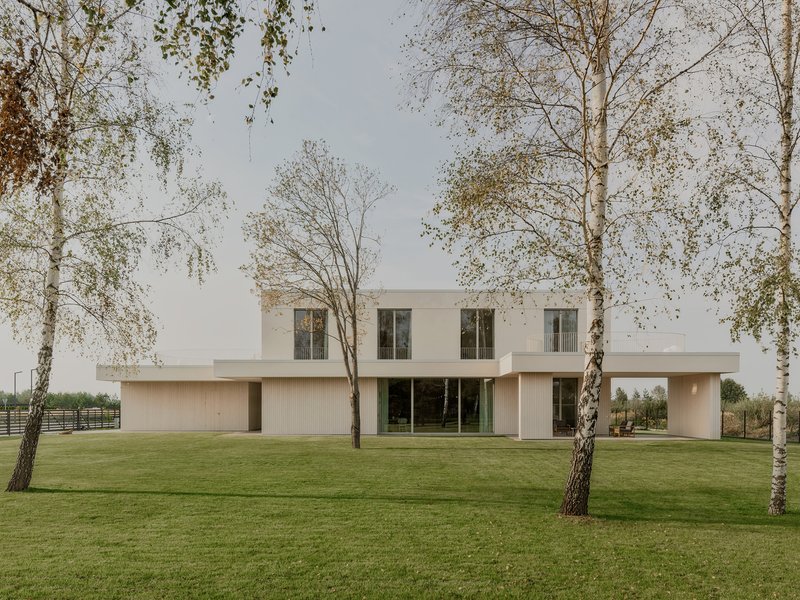
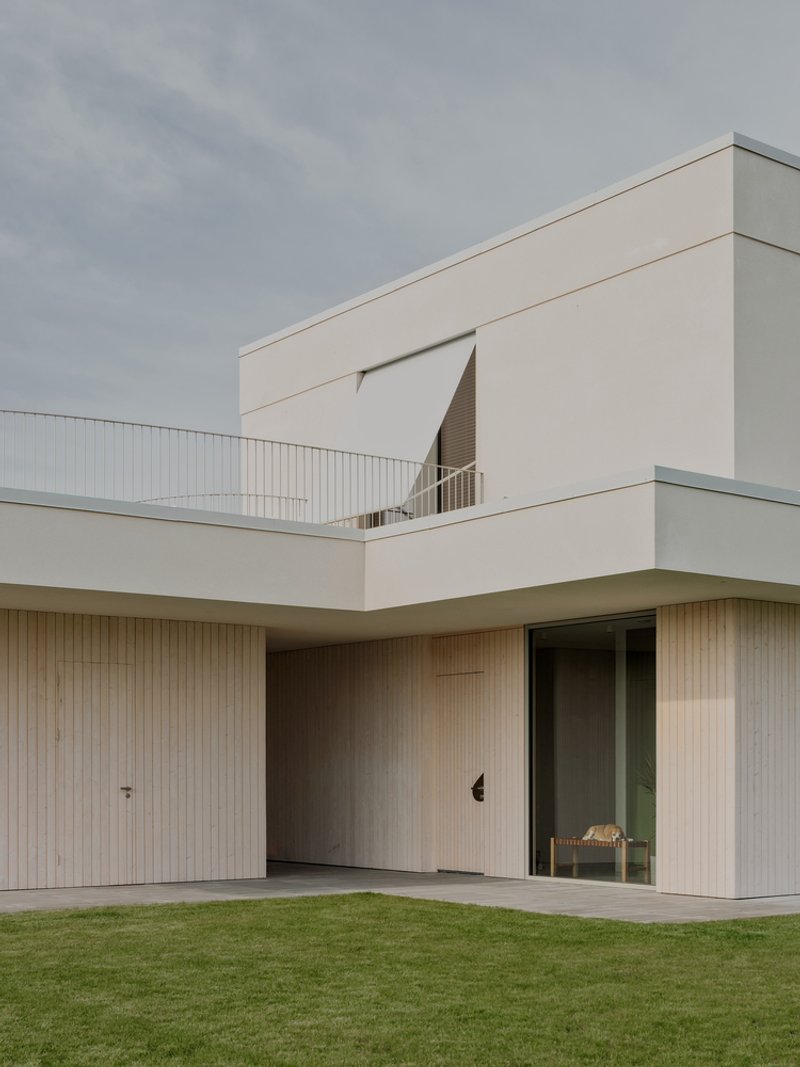
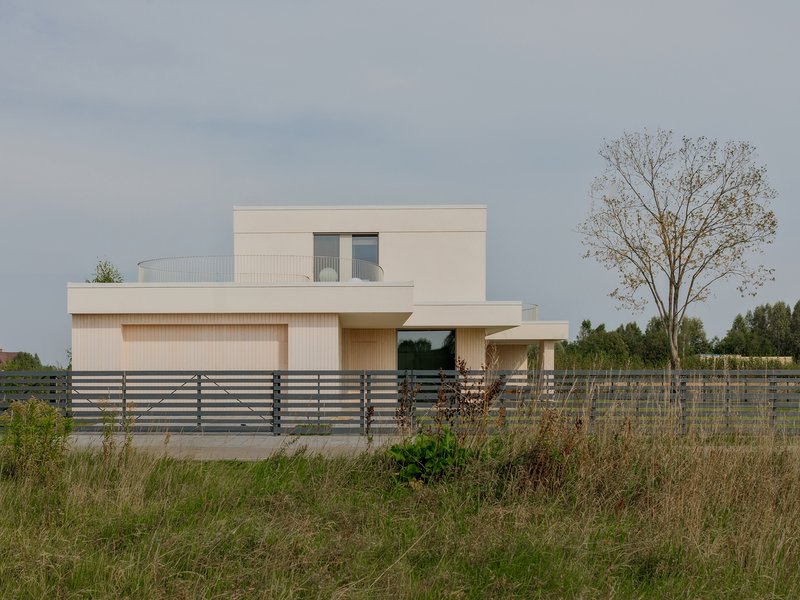
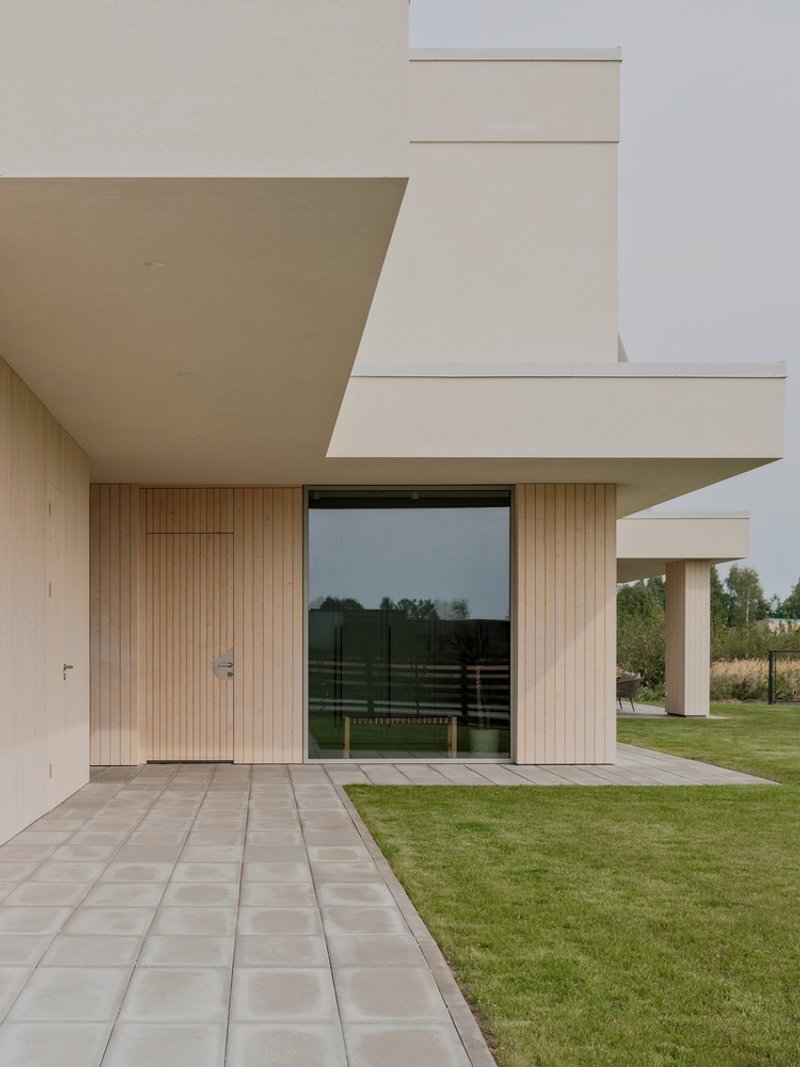
The split between timber cladding below and lime plaster above is the most immediate reading of the house. Seen from the rear garden, the vertical ribs of the timber base anchor the building to the ground, while the white upper volume appears to float. From the street, the same logic reads as a layered stack: a horizontal slat fence, timber cladding, stucco, and a flat roof, each band progressively lighter. The symmetrical window arrangement on the upper floor reinforces an almost classical sense of order.
The lime plaster is not perfectly smooth. Its slightly rough, warm-toned finish catches raking light in ways that shift across the day, giving the building a material presence that flat render cannot. Timber boards on the ground floor are deliberately vertical, elongating the proportions and drawing the eye up toward the recessed upper level. It is a simple palette, and GAISS trusts it completely.
The Roof as Connective Tissue
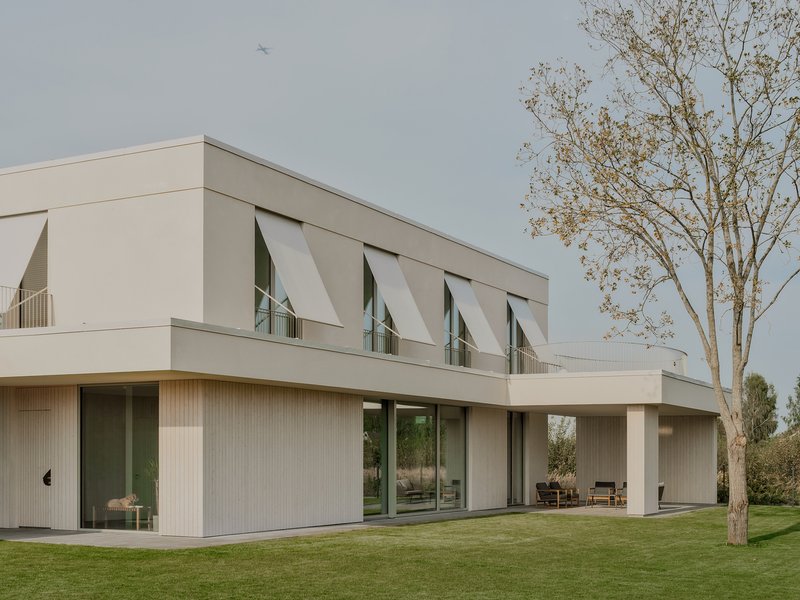
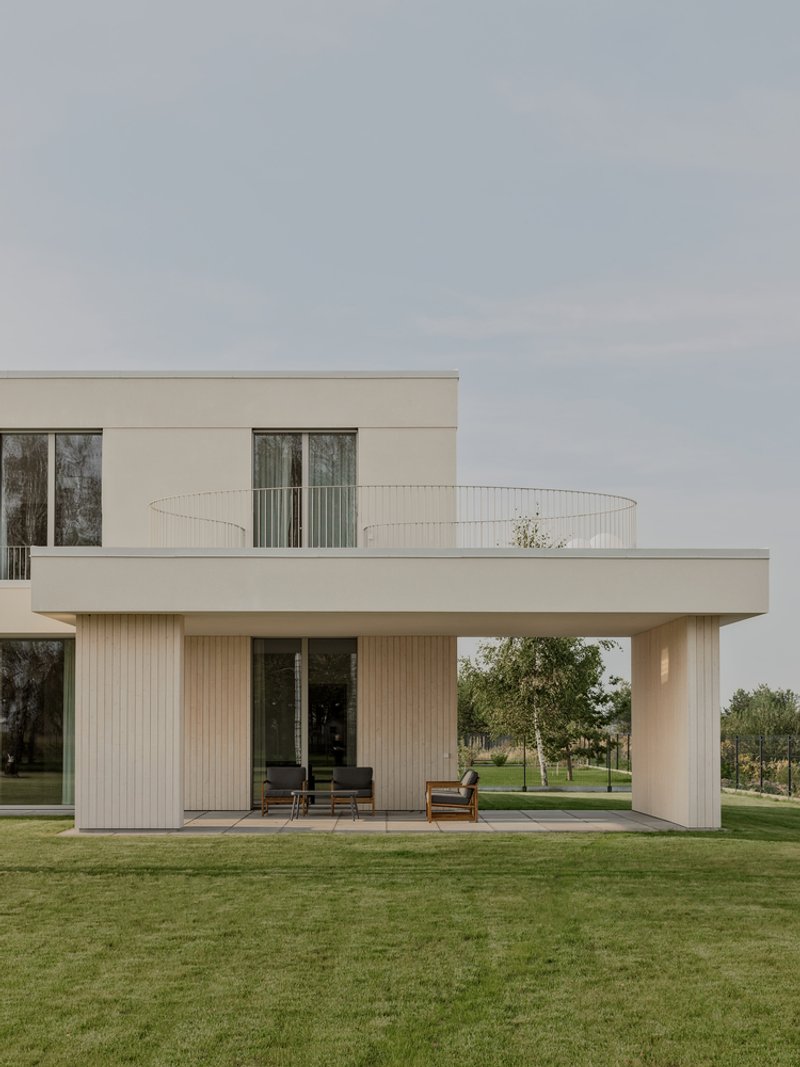
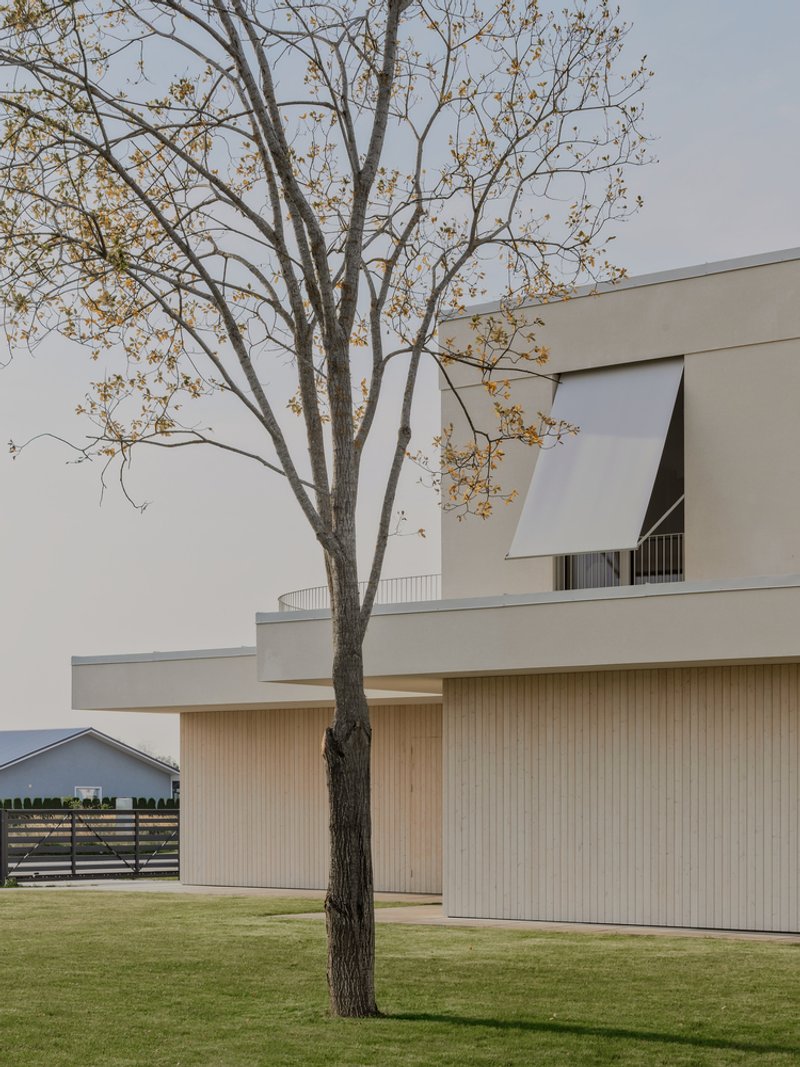
Many suburban houses treat the garage, the terrace, and the living volume as separate objects. Here, the overhanging roof welds them into a single composition. Deep overhangs at the ground floor shade south-facing glass in summer, while triangular awnings protect the upper-level doors. The roof also creates the covered breezeway that serves as the approach sequence: you arrive between the garage and the main house, sheltered from rain, and pass through a bespoke entrance door clad in the same facade boards.
On the garden side, the roof cantilevers over a generous terrace supported by slender white columns. Above, a curved balcony with wire railings softens the otherwise rectilinear silhouette. These curves are not arbitrary; they recur at the upper terrace and in the handrail details, introducing just enough formal variation to relieve the cubic discipline without undermining it.
Threshold and Arrival
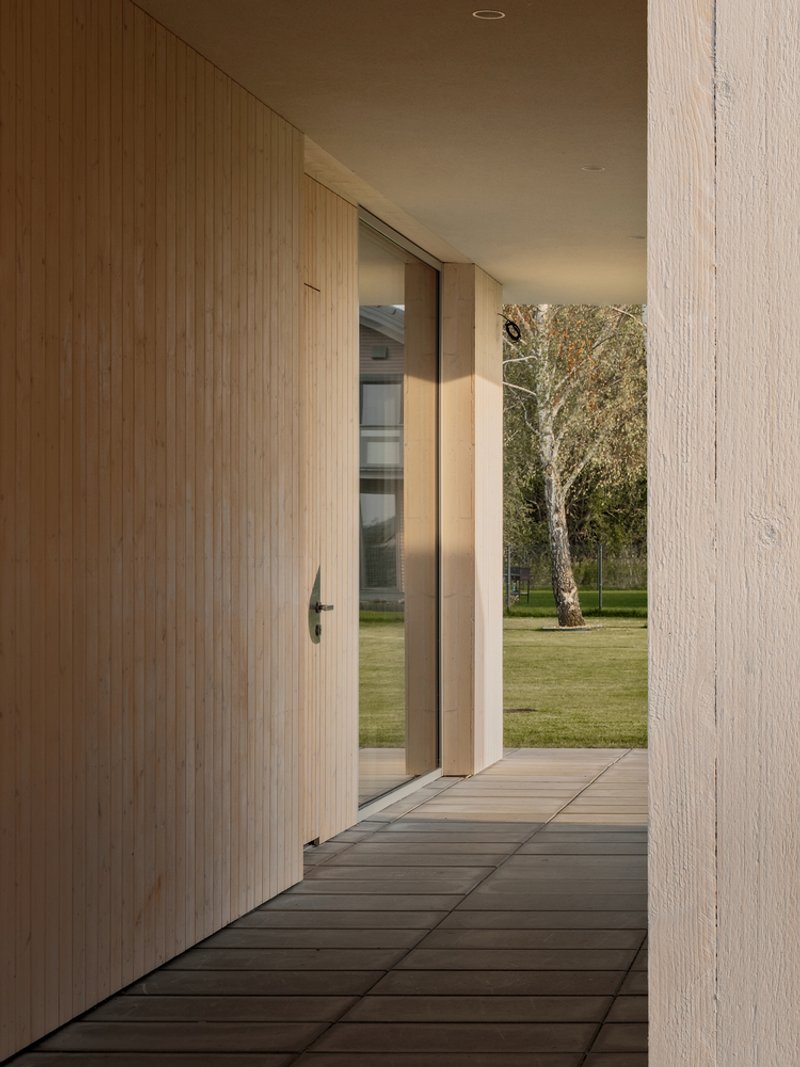
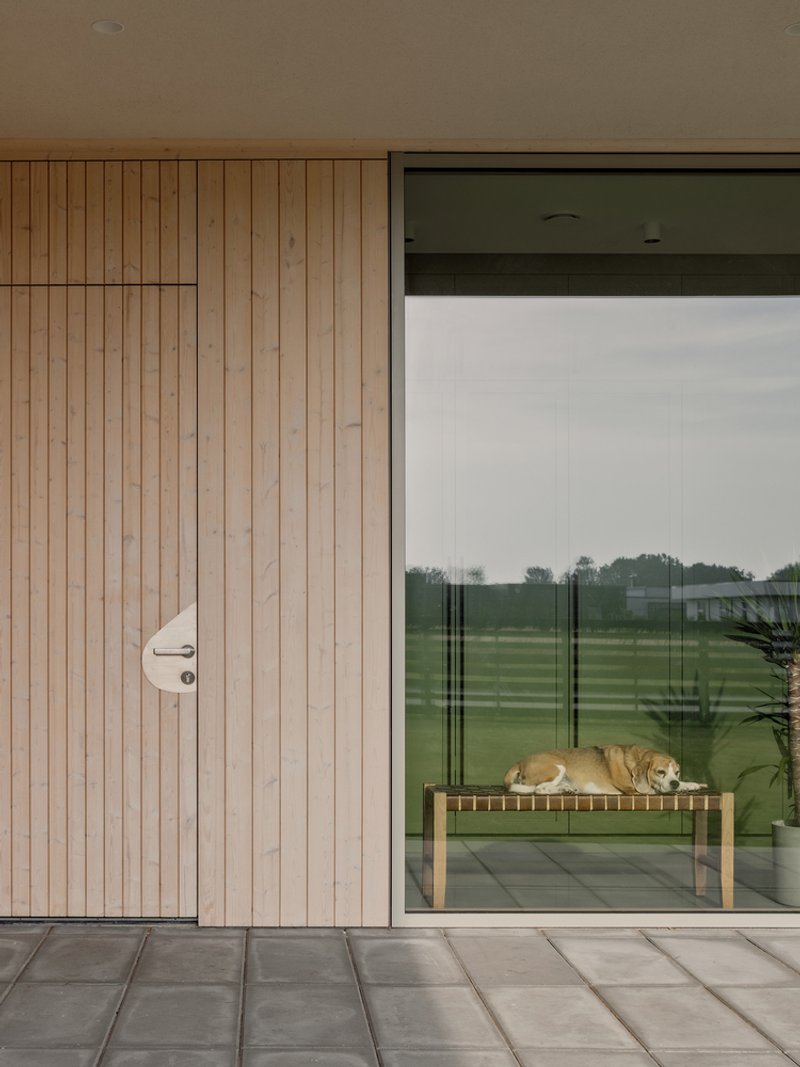
The entry sequence is among the most considered moments in the project. A corridor framed by timber cladding and slatted flooring channels your view through to the garden before you step inside. The entrance door itself, clad in the same vertical boards as the facade, disappears into the wall plane, making the threshold almost invisible. A small curved steel plate at the door handle signals the transition: a crafted, tactile moment in an otherwise restrained assembly.
Once inside, the covered terrace alongside the living room acts as a decompression zone between the garden and the interior. Large sliding glass doors dissolve that boundary entirely when open, extending the concrete floor plane onto pale stone paving. The house does not announce itself; it draws you through a sequence of compressed and released spaces until you are already settled.
Open Ground Floor and Material Continuity
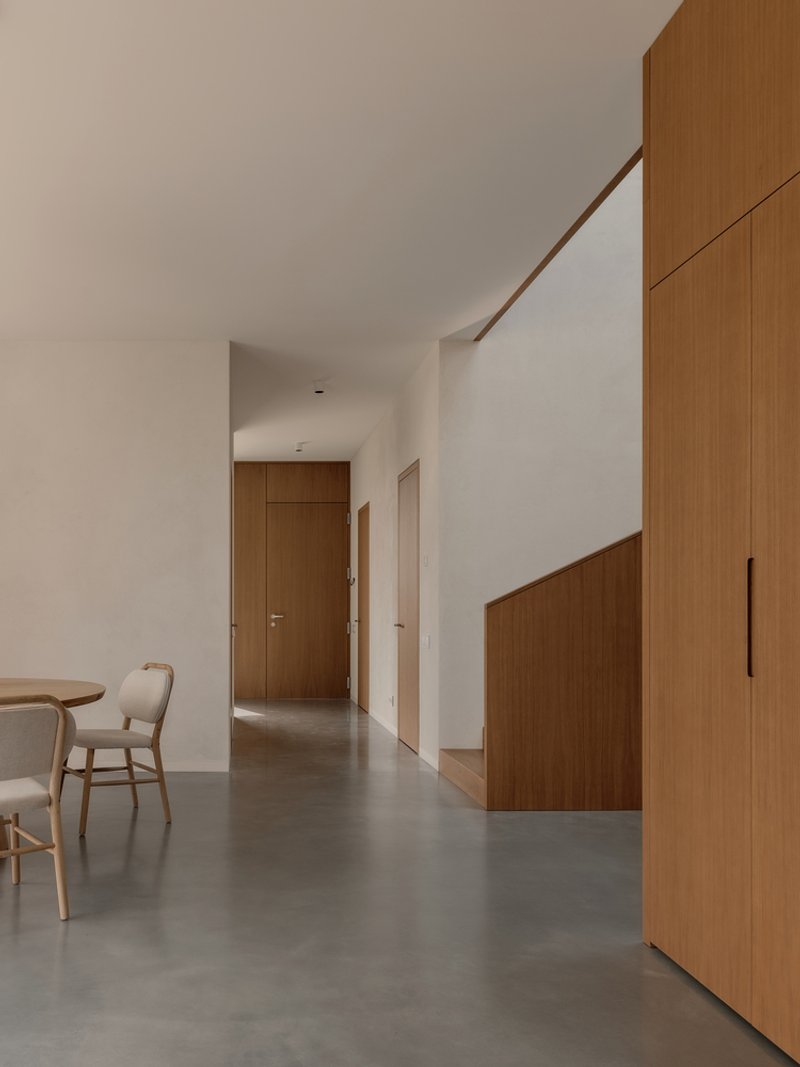
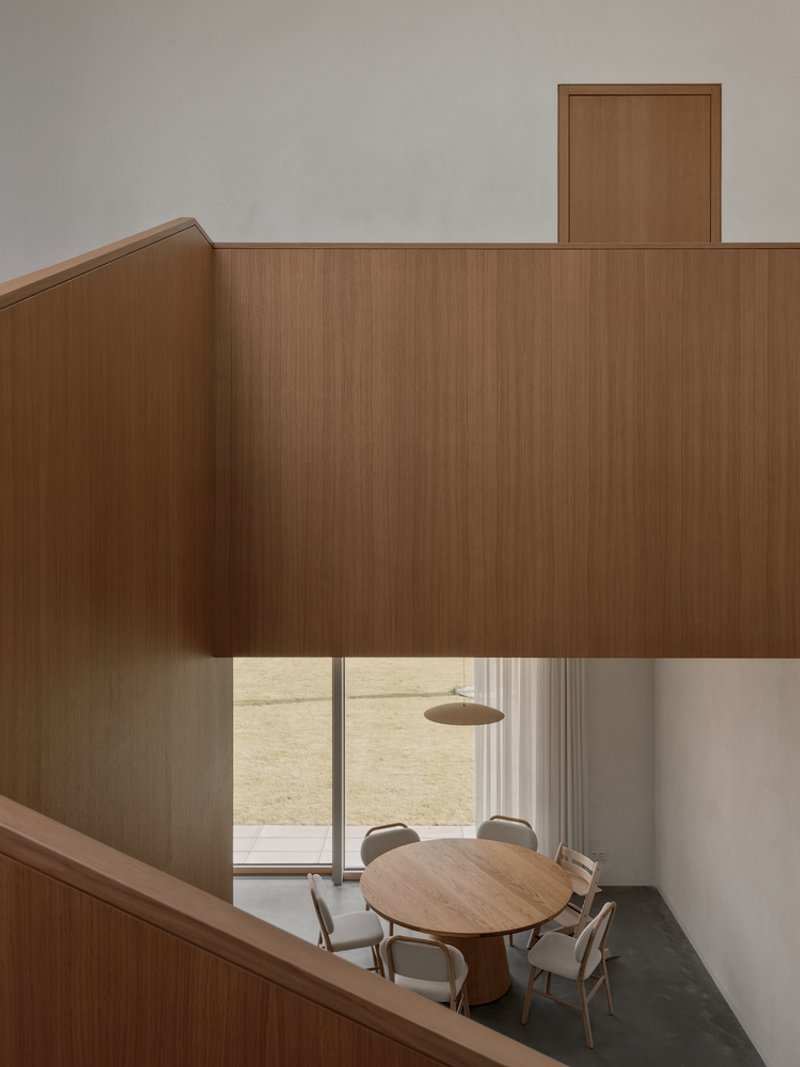
The ground floor is essentially one room. A continuous polished concrete floor runs from the entrance through the kitchen, dining area, and living space without interruption. The only vertical element dividing the plan is the timber-clad stair enclosure, which acts as a freestanding box within the larger volume. From the upper balcony, you can look down into the double-height dining space and see the circular table below, the timber box, and the garden beyond in a single frame.
Lime plaster on the interior walls matches the exterior in tone and texture, blurring the inside-outside distinction. Against the grey concrete and pale timber, the warm plaster becomes the dominant material presence, giving every room a quiet, chalky warmth. It is a house where you feel the walls, not just see them.
The Staircase as Vertical Core
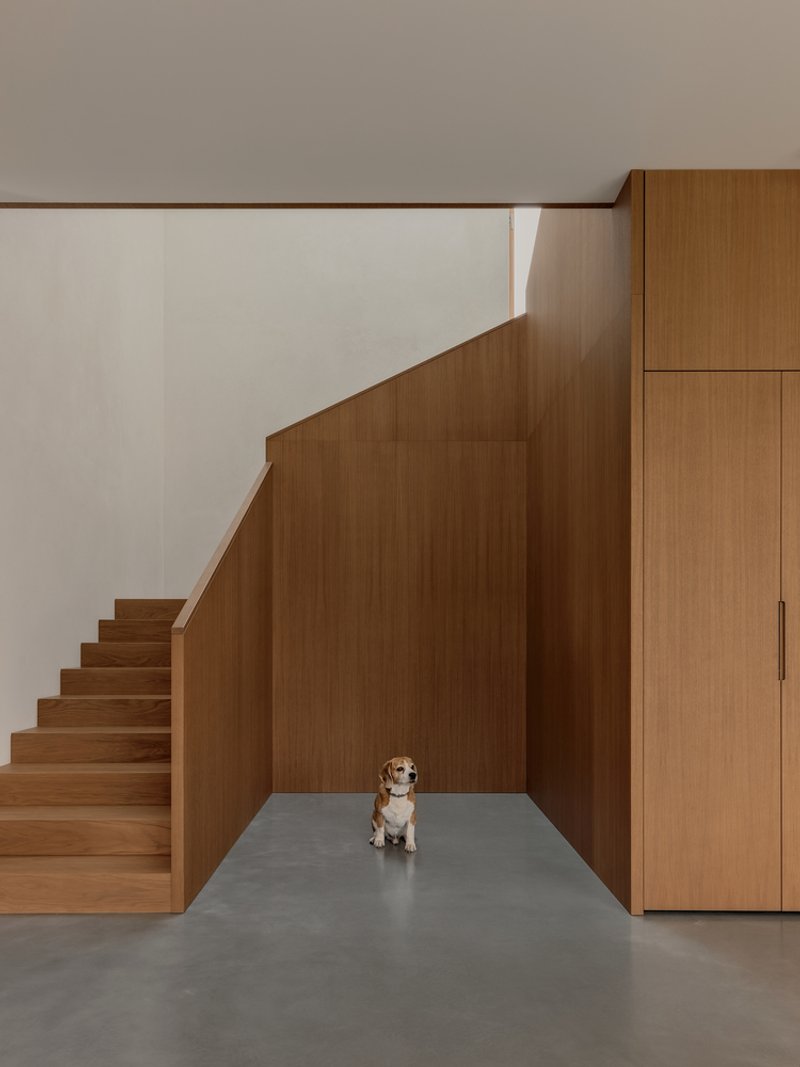
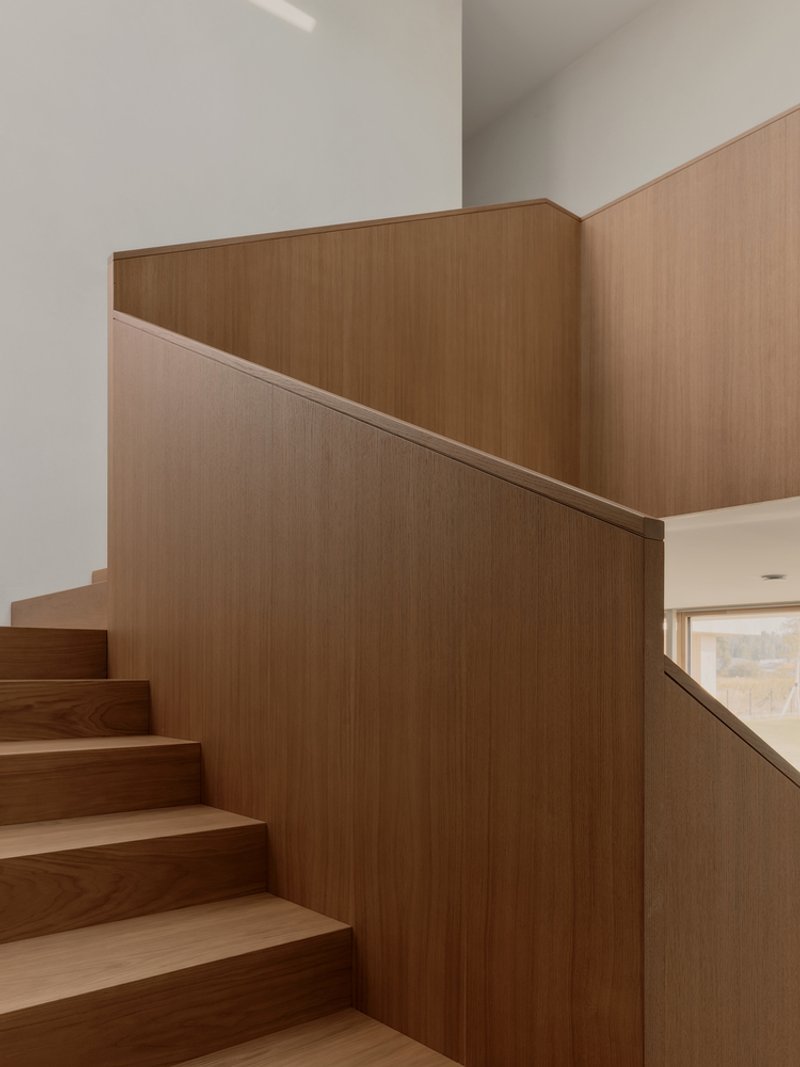
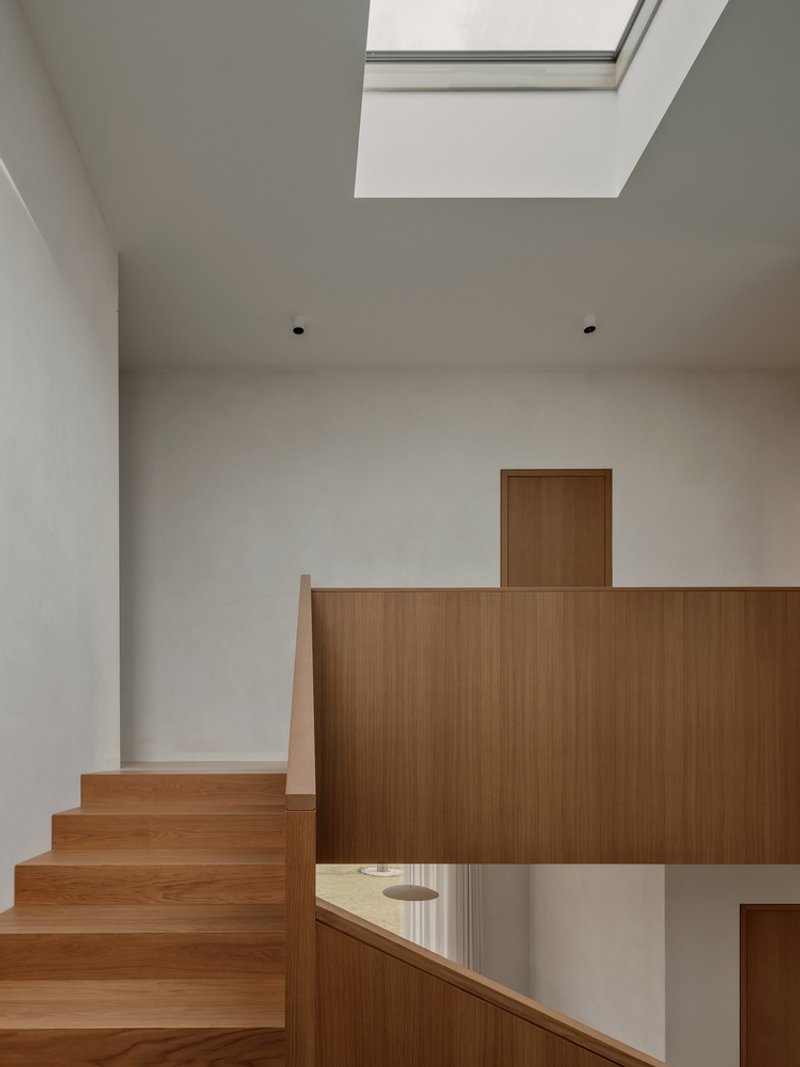
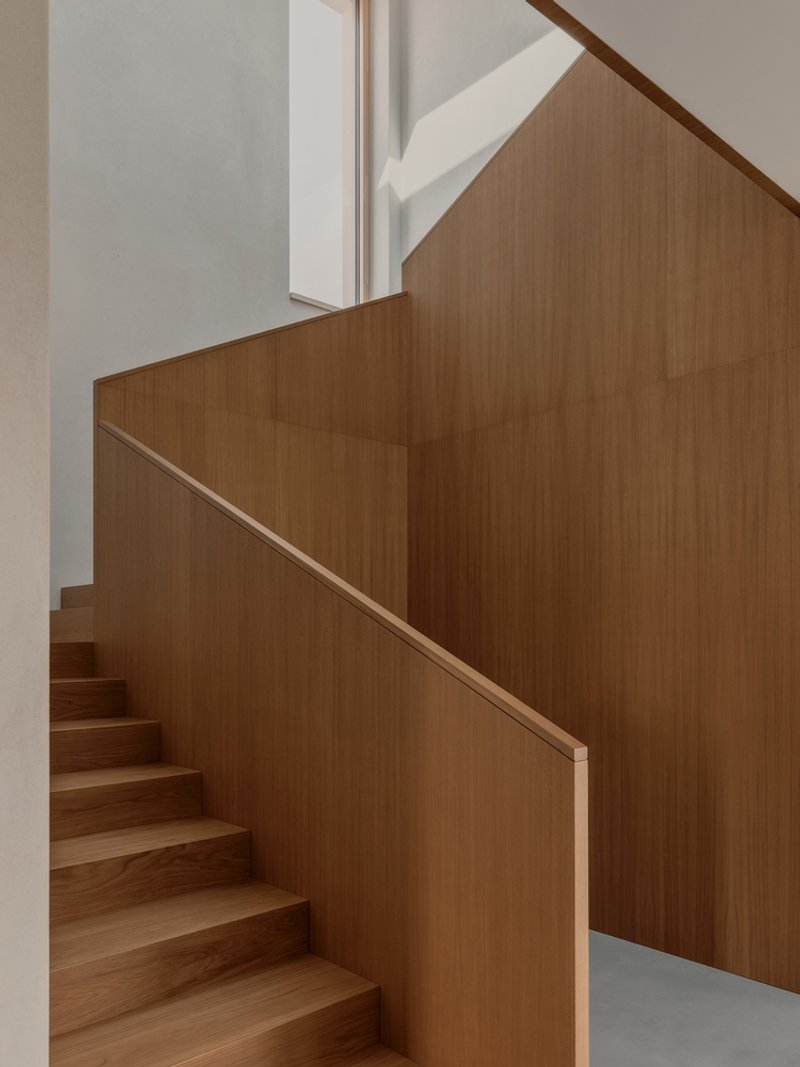
If the roof holds the house together horizontally, the staircase does the same vertically. Built from solid timber with veneered handrails, it rises through a tall, paneled enclosure that reads almost as furniture at an architectural scale. The joinery is precise: treads meet angled wall panels in clean, gapless intersections. A skylight at the top of the double-height shaft floods the stair with daylight, turning the circulation core into the brightest space in the house.
The stair landing splits at the upper level, offering a framed view out to a distant field through a narrow window. It is a deliberate pause in the ascent, a moment where the house reminds you of its setting. The family dog, incidentally, seems perfectly at home on the concrete floor below, which speaks to the pragmatism of the material choices as much as any technical specification could.
Upper Floor and Private Rooms
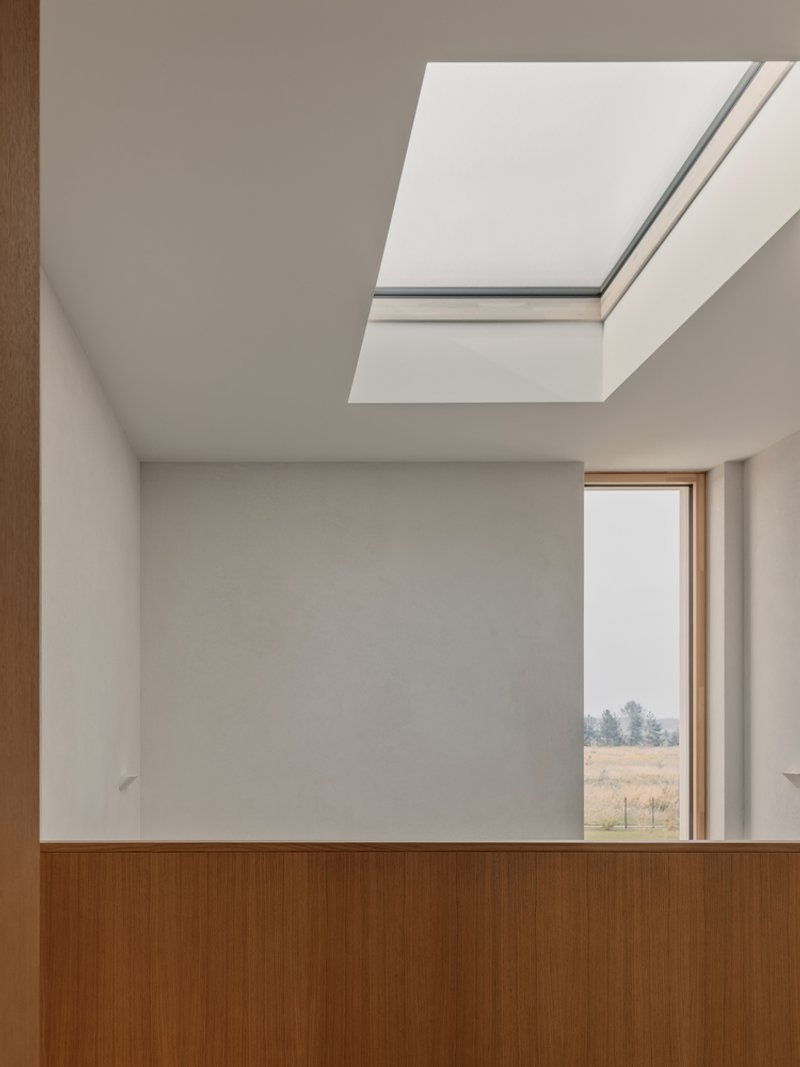
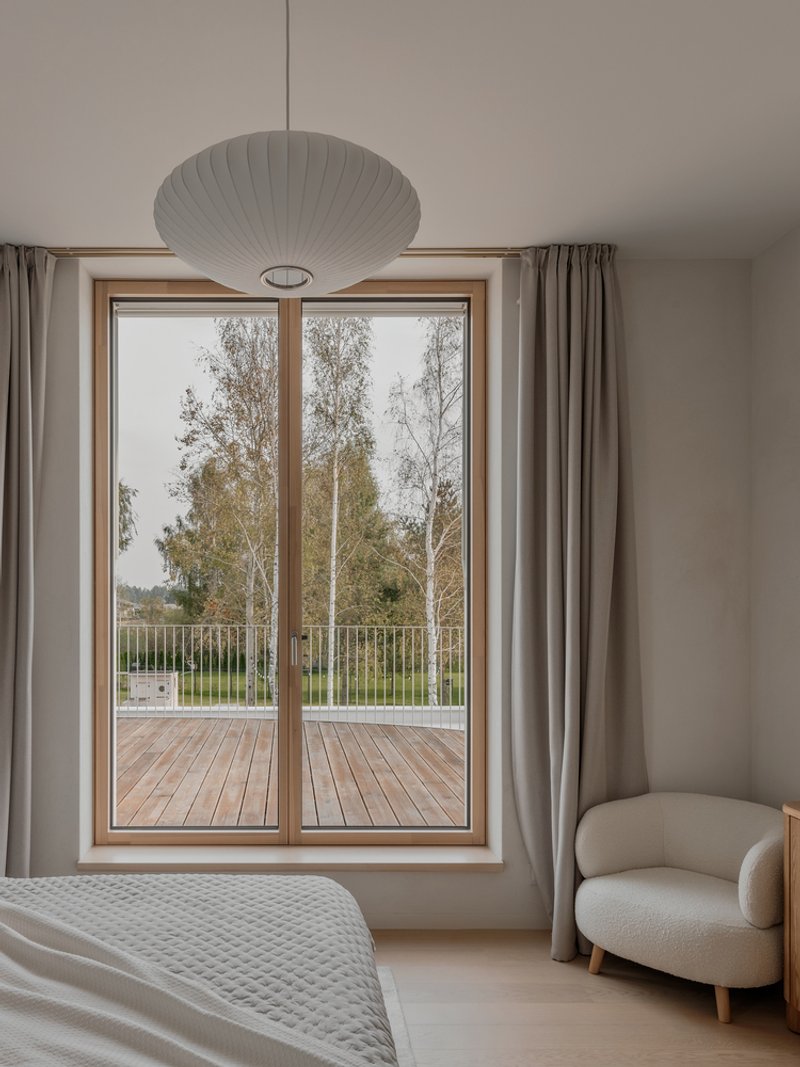
The upper level shifts from the open sociability of the ground floor to a quieter, more enclosed register. Bedrooms open through timber-framed glass doors onto wooden decks, with views through bare birch branches to the surrounding garden. The hallway catches borrowed light from the skylight above the stair, so corridors never feel like dead zones. A timber balustrade at the stairwell edge maintains visual connection to the double-height space below.
Detail quality remains consistent at this level. The stair joinery, visible in close-up, shows treads joining angled panels without filler or trim. It is the kind of craftsmanship that relies on accurate setting-out rather than applied mouldings, and it rewards close looking. The curved outdoor terraces at each end of the upper floor, visible in the plan, give the bedrooms their own private outdoor spaces while contributing to the gently varied roofline.
Garden and Site
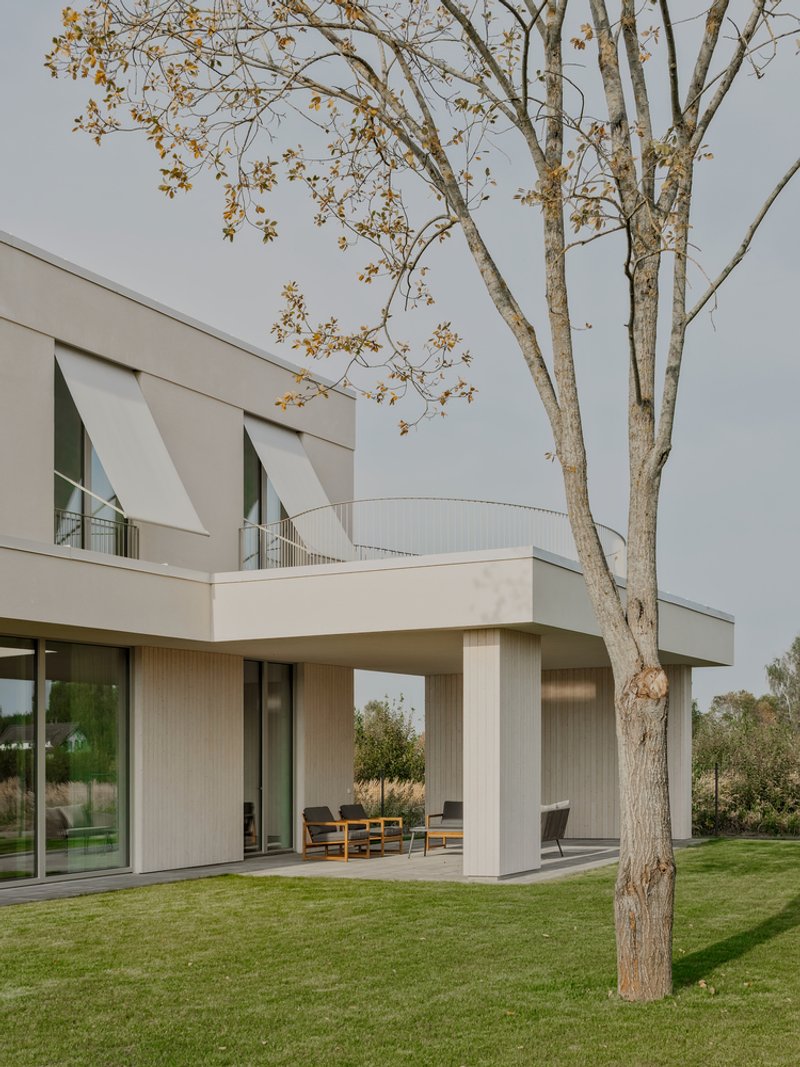
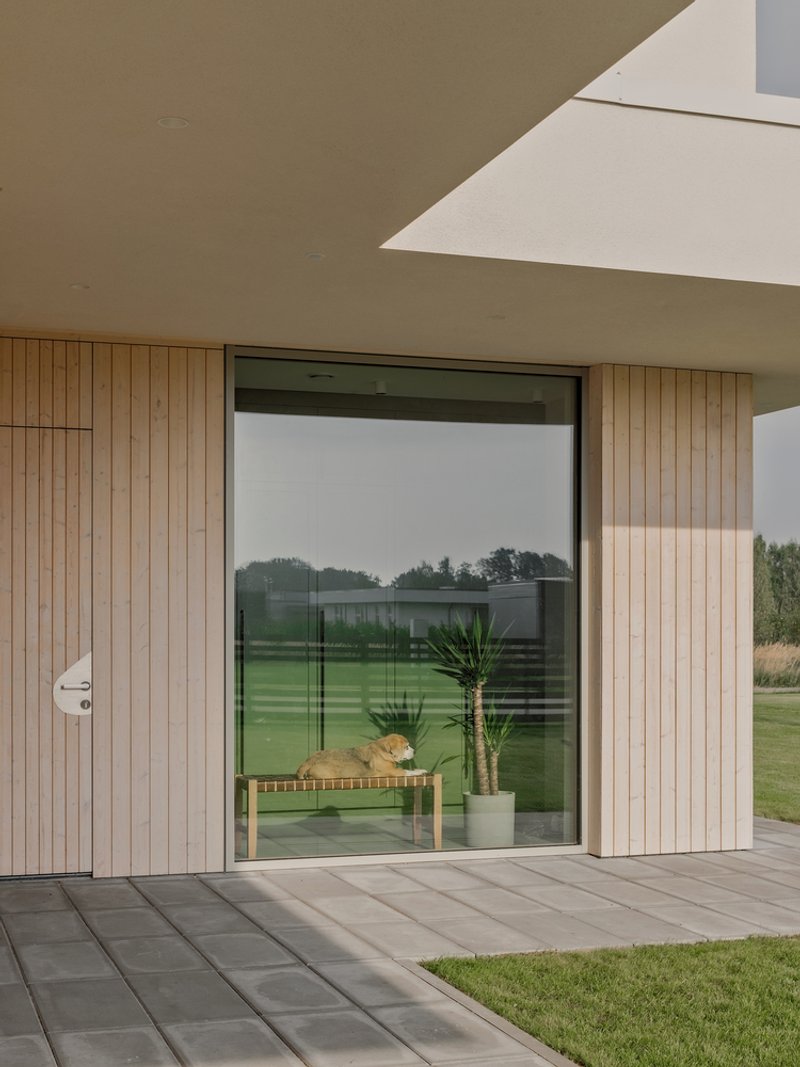
The house sits within a garden of birch trees, and the architects clearly designed with those trees in mind. The south-facing glazing captures winter sun through bare branches while the overhangs and awnings block high summer sun. The covered terrace under the upper balcony creates a sheltered outdoor room that works in rain or heat. White columns, thin enough to read as structural rather than decorative, support the canopy without obstructing garden views.
From the garden, the house presents its most composed elevation: a base of timber, columns supporting a deep overhang, and the lime-plastered upper volume with its curved balcony. A single deciduous tree stands close enough to frame the facade, its organic silhouette a counterpoint to the rectilinear form. The relationship feels calibrated, not accidental.
Plans and Drawings
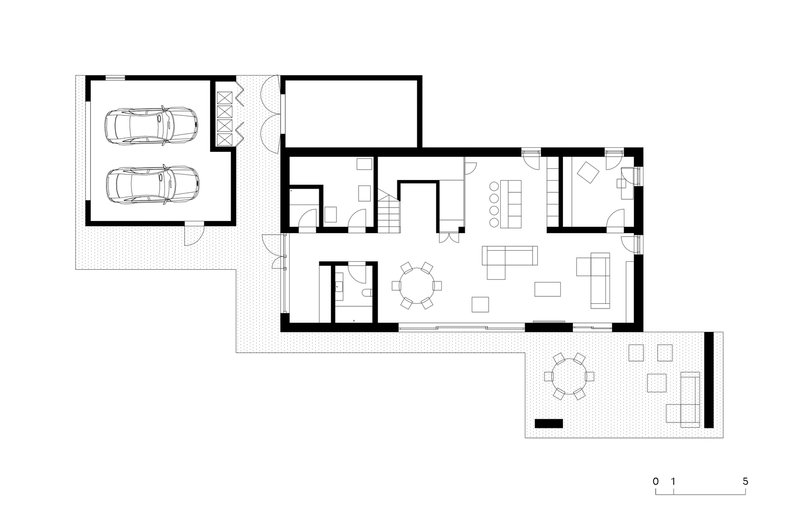
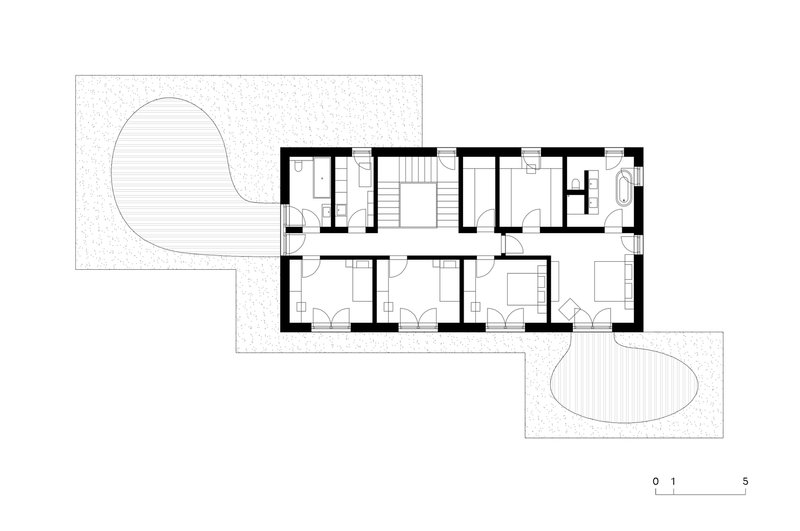
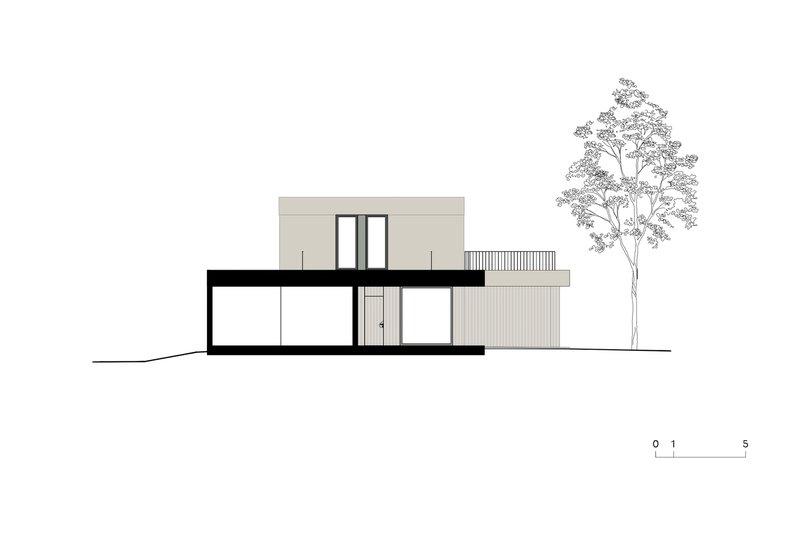
The ground floor plan confirms the open-plan strategy: kitchen, dining, and living areas flow around the central stair enclosure, with the garage and terrace extending the footprint under the shared roof. The upper floor plan shows a bedroom wing with curved outdoor terraces at each end, introducing the gentle formal variations visible in the elevations. The section drawing reveals the double-height stair volume and its skylight, as well as the flat roof profile that unifies the composition.
What the drawings make clear is how tightly the passive strategy is embedded in the plan. The compact cuboid minimizes exposed surface area for its volume. Unheated zones, the garage and the terraces, are appended to the sides rather than integrated into the conditioned envelope. South-facing glazing is concentrated on the garden facade, while the street-facing elevation is relatively closed. None of this is visible from the photographs alone, which is precisely why plans still matter.
Why This Project Matters
The Lime and Timber House does not advance any radical thesis about sustainable housing. Its timber frame, cellulose insulation, and lime plaster are well-established techniques in northern European construction. What GAISS achieves here is something harder than invention: consistency. Every decision, from the plan organization to the door handle, follows the same logic of natural materials, passive climate response, and honest detailing. The house does not perform sustainability; it simply is sustainable, from the wall section outward.
For a family of four and a dog in suburban Latvia, that consistency translates into a home that will age well. Lime plaster weathers rather than degrades. Timber cladding will silver over time and match the birch bark in the garden. Concrete floors resist the daily punishment of family life. The house is designed not for the photograph but for the decade, and that patience is what makes it worth studying.
Lime and Timber House by GAISS, Mārupe Municipality, Latvia. 370 m². Completed 2024. Photography by Alvis Rozenbergs.
About the Studio
Share Your Own Work on uni.xyz
If projects like this are the kind of work you want to make, uni.xyz is a place to publish your own, find collaborators, and enter design competitions.




Popular Articles
Popular articles from the community

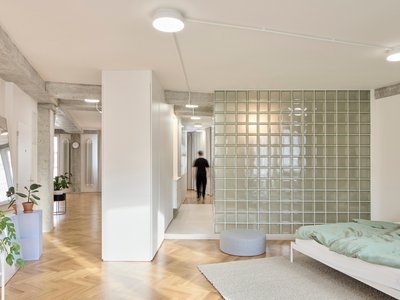
RDTH architekti Rips Out Nearly Every Wall in a Prague Apartment and Replaces Them with Furniture
A 101-square-meter post-war flat in Prague trades rigid partitions for a single rotated furniture block, curtains, and glass concrete.
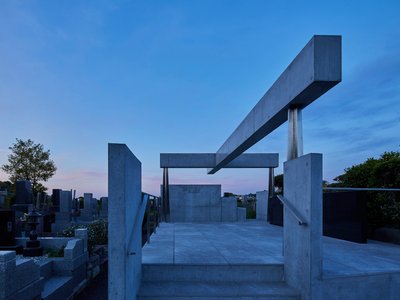
Takeshi Hosaka Architects Suspends a Concrete Cross Above a Yokohama Cemetery
A 28-square-meter burial renovation in Yokohama lifts the symbol of resurrection into the sky so mourners see it against heaven.
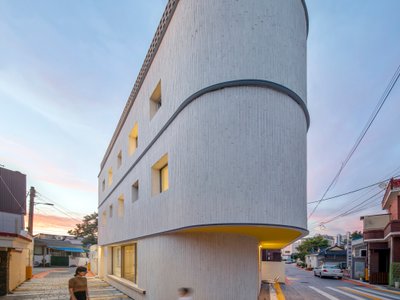
YOAP Architects Round a Corner in Yeongcheon with a Cylindrical Community Hub
A 197-square-meter brick and ribbed-clad tower turns a forgotten alley corner in South Korea into a public garden with a low threshold.
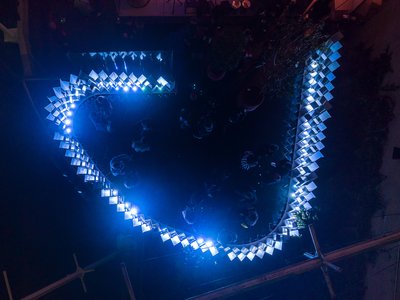
Rojkind Arquitectos and Think Parametric Build a Glueless Pavilion from 67 Interlocking Panels
A serpentine fiber-cement installation in Chapultepec Park celebrates a decade of architectural media in Mexico City.

Similar Reads
You might also enjoy these articles

Kokaistudios Wraps a Shanghai Retail Podium in Horizontal Louvers That Echo Its Foster + Partners Neighbor
A four-storey glass-roofed gateway links an underground commercial valley to the revitalized north bank of Shanghai's Suzhou River.
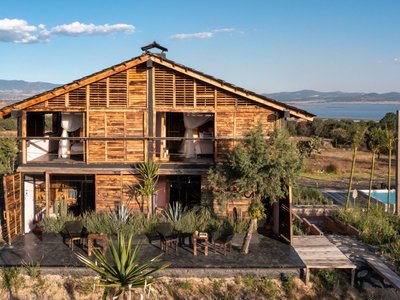
Fausto Terán and Toro Fuse Japanese Craft with Mexican Tradition in a Lakeside Retreat
Nakamura House pairs Shou-Sugi-Ban charred pine with handmade clay tile at the foot of Atlangatepec Lagoon in Mexico.
RDTH architekti Rips Out Nearly Every Wall in a Prague Apartment and Replaces Them with Furniture
A 101-square-meter post-war flat in Prague trades rigid partitions for a single rotated furniture block, curtains, and glass concrete.

SWA Group Spirals a Landscape Memorial into the Woods of Sandy Hook
A 1.8-acre clearing in Newtown, Connecticut, honors 26 lives lost with water, stone, and a single sycamore tree.


Explore Architecture Competitions
Discover active competitions in this discipline




The International Standard for Design Portfolios


The Global Benchmark for Architecture Dissertation Awards


The Global Benchmark for Graduation Excellence


Challenge to reimagine the Iron Throne
Comments (0)
Please login or sign up to add comments
No comments yet. Be the first to comment!