
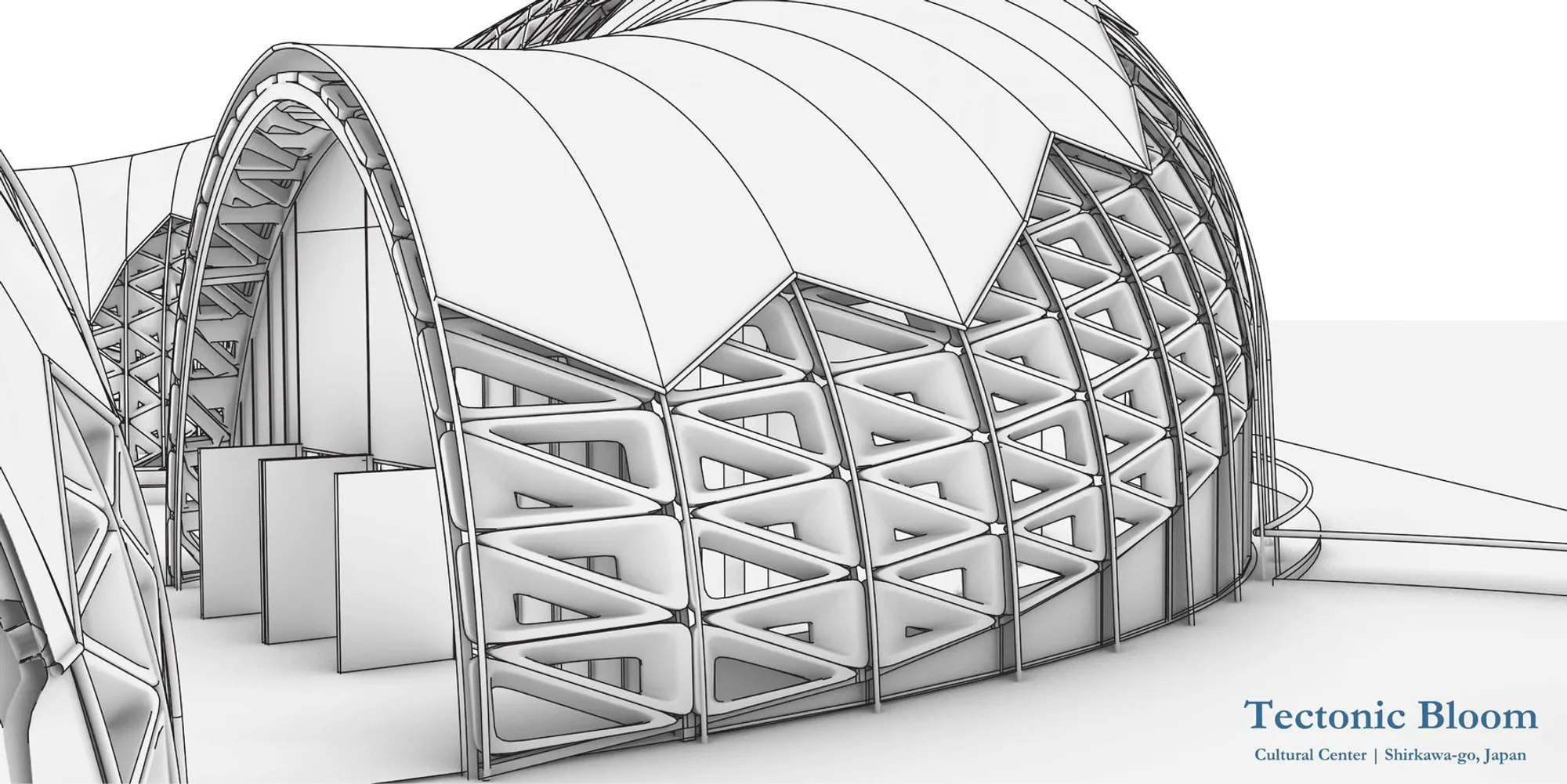
Tectonic Bloom: Modular Wood Joinery Meets Sakura Symbolism in Shirakawa-go
Three interconnected domes frame a sunlit courtyard, built from a single repeating wooden unit that scales into a cultural landmark.


A single wooden joint, repeated and scaled, becomes a building. Tectonic Bloom takes the logic of traditional Japanese structural expression and pushes it into a modular system where one human-scaled timber unit generates three interconnected domes, a central courtyard, and an entire cultural program. The project draws its identity from the Sakura tree: not as decorative motif but as organizational principle, with ceramic tiles shifting in color across elevations to mark the seasonal transitions of cherry blossoms against the climatic extremes of the site.
Designed by Shaikha AlSalman and Sherina AlThani, Tectonic Bloom received an Honorable Mention in the Cultural Conserve competition. Sited in the topographically rich landscape surrounding Shirakawa-go, framed by mountains and forest, the design responds to its terrain by strategically elevating and grounding spaces to echo the contours of the land. The result is a cultural building that feels both rooted in the hands-on craftsmanship traditions of the village and open to new material possibilities.
From Unit to Vault: A Structural System Built on Repetition
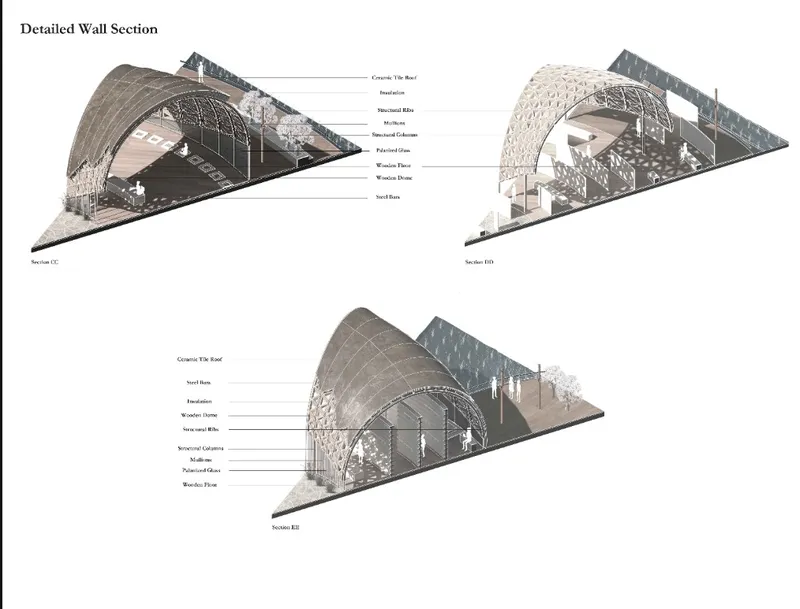
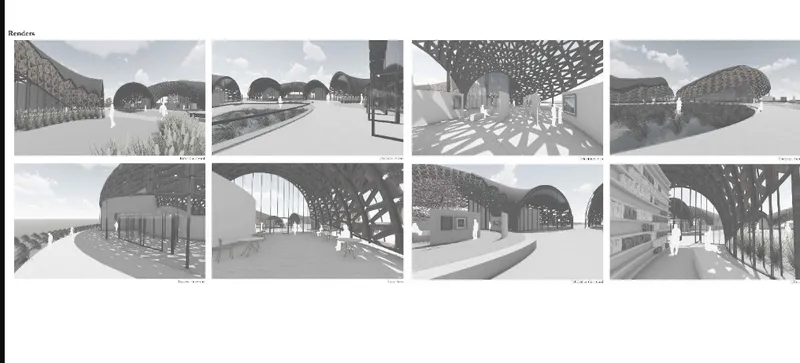
The wall section drawing reveals the tectonic intelligence at the heart of this project. Three variations of the vaulted roof structure are documented with labeled material assemblies, showing how a single wooden module is configured differently to produce distinct spatial conditions. Wood dominates the structural system, reflecting local building customs, while ceramic tiles are introduced as cladding that varies in hue across different elevations. The rendered views confirm what the sections promise: perforated screens cast dappled shadows across paved surfaces, producing a light quality that recalls sunlight filtering through a canopy of cherry blossoms. The effect is not incidental. It is engineered through the geometry of the modular screen units, which control solar gain while creating constantly shifting interior atmospheres throughout the day.
Three Domes Against the Mountains
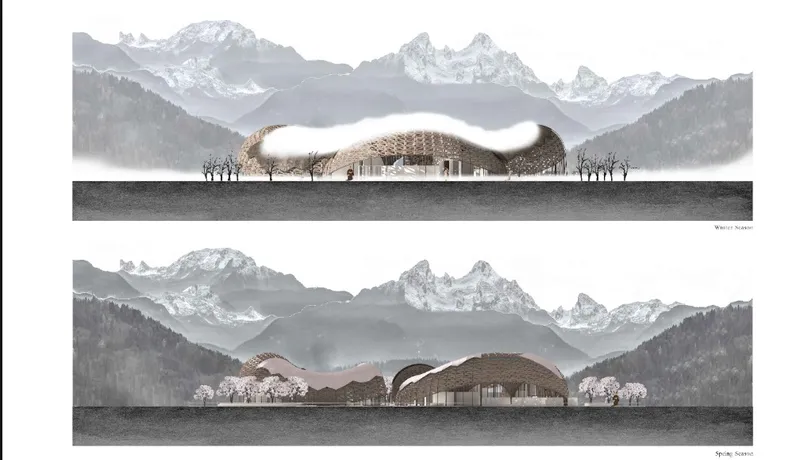
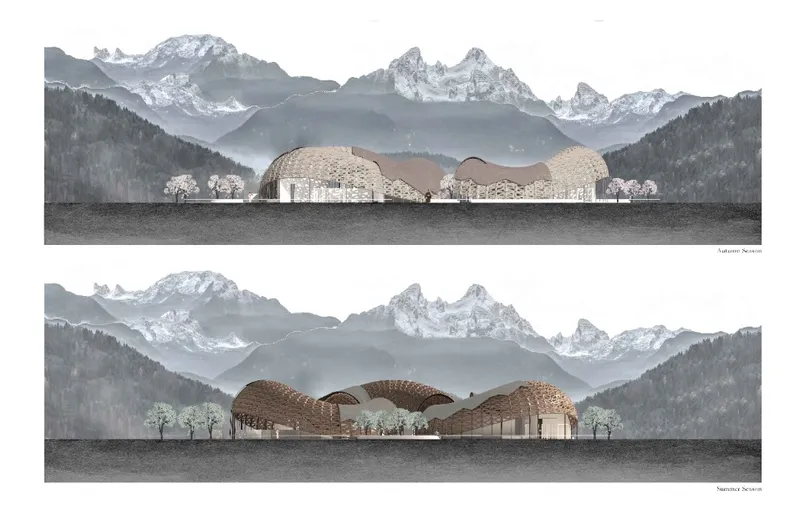
Set against snow-capped mountain peaks and dense forest, the elevation sections communicate the project's scale and posture within its landscape. Three vaulted volumes rise from the terrain with a profile that neither dominates nor retreats, sitting in dialogue with the surrounding ridgelines. The latticed structure of the vaults is legible from the exterior, making the building's construction logic visible in a way that aligns with the tectonic tradition of expressing joinery and assembly.
The color variation of the ceramic tiles becomes clear in these drawings. Different elevations carry distinct tonal registers, symbolizing the Sakura's seasonal cycle: budding pink, full bloom white, and the warm tones of autumn decay. It is a restrained symbolic gesture, one that avoids literal representation and instead allows the material palette itself to carry cultural meaning. The layered mountain backdrop reinforces the project's site sensitivity, grounding the formal ambition in geographic specificity.
Courtyard as Climate Machine and Social Core
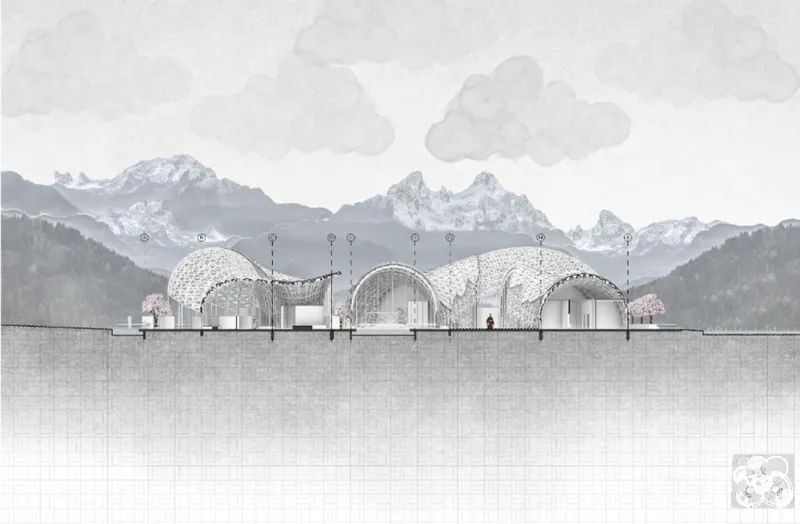
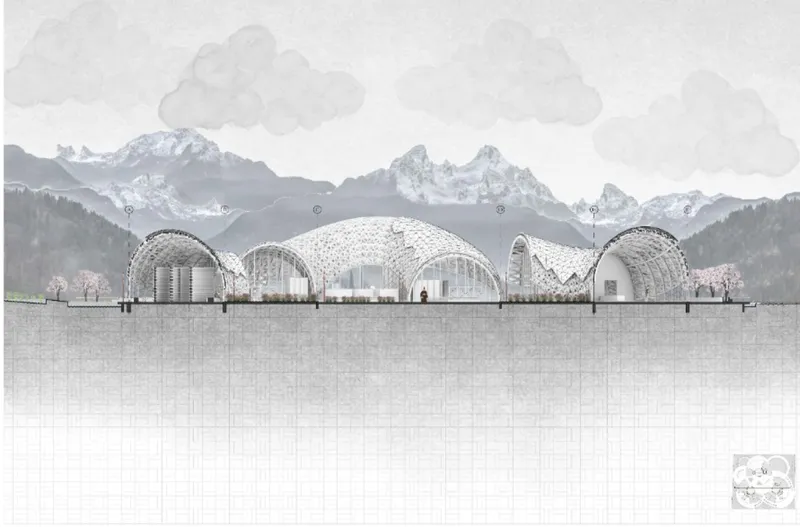
The section cuts through the interconnected domed and vaulted spaces reveal the project's spatial sequence. Five chambers of varying height and enclosure are linked by a central courtyard that captures sunlight throughout the day, generating dramatic shadow play while providing thermal comfort across hot summers and cold winters. Human figures in the drawings establish the scale: these are generous but not monumental spaces, calibrated for public gathering, exhibition, and contemplation. The circular layout encourages continuous movement, guiding visitors from semi-open sheltered areas through air-conditioned zones and back into open courtyards.
Accessibility is handled pragmatically. Parking sits in close proximity, and two entrances serve distinct user groups: one public, one semi-private for library or administrative functions. Inside, curved walls in the exhibition zone create a spatial experience built on curiosity and discovery, with hidden artifacts and moments that reward exploration. The misty mountain landscape visible beyond the building's profile reminds viewers that this architecture is not self-referential. It exists in service of a place, a climate, and a community whose craft traditions it seeks to continue.
Why This Project Matters
Tectonic Bloom succeeds because it treats modularity as a cultural proposition, not just a construction strategy. Starting from a single wooden unit that can be assembled, dismantled, and adjusted by hand, AlSalman and AlThani have designed a system that respects the craft culture of Shirakawa-go while producing spatial complexity far beyond what the individual component suggests. The decision to introduce ceramic tiles as a complement to the wood structure is a calibrated risk: it introduces a new tactile and visual register without abandoning the material honesty that defines tectonic architecture.
In a competition focused on cultural conservation, the project offers a persuasive argument that preservation need not mean replication. The Sakura reference is handled with intelligence, manifesting not as ornament but as a principle of change and adaptation embedded in the material palette and spatial sequence. The result is architecture that is familiar yet forward-looking, grounded in its site yet structured for transformation. That duality is precisely what makes it worth studying.
View the Full Project
About the Designers
Designers: Shaikha AlSalman, Sherina AlThani
Enter a Design Competition on uni.xyz
uni.xyz runs architecture and design competitions year-round that reward proposals with spatial conviction and real site intelligence.
Project credits: Tectonic Bloom by Shaikha AlSalman, Sherina AlThani Cultural Conserve (uni.xyz).




Popular Articles
Popular articles from the community


Hill & Cross Opera: Sculptural Opera House Architecture Shaped by Tallinn’s Landscape and Identity
Hill & Cross Opera reimagines opera house architecture in Tallinn through its sculptural hill, civic plaza, glass wave and a luminous cross.

The Ocean Hive: Sustainable Architecture for a Self-Sufficient Civilization at Sea
The Ocean Hive imagines sustainable architecture at sea, where modular habitats, algae, wave power and ocean waste sustain a growing colony.

Play: Fragments of Their World
Familiar architecture becomes modular playground design, creating safe spaces where displaced children can learn, connect, imagine and play.

Conexión: Biophilic Design Reimagines High-Rise Living in Hong Kong
Conexión reimagines high-rise living in Hong Kong through biophilic design, green facades, shared spaces, daylight, water and nature within.


Similar Reads
You might also enjoy these articles

Day and Night Park: A Time-Based Urban Newsstand in Beijing
A temporary urban newsstand in Beijing blending travel, light, and reading through poetic colors, compact form, and community-focused design.

Modernist Patio Renovation in El Masnou, Barcelona by Oliver Segura Arquitectura + Cebrià Arquitectura
Modernist patio renovation blending tradition and innovation with a movable pool, leveled floors, and Catalan materials in El Masnou.

Alto Residencial Coop: Cooperative Housing Development in Santiago de Compostela by Carbajo Barrios Arquitectos
A linear cooperative housing complex blending white volumes and perforated metal façades, enhancing community living, natural light, privacy, and urban integration.

Vil Genis School by BPA ARCHITECTURE – Massy, France
Vil Genis School in Massy, France, features sustainable design, south-facing classrooms, community integration, accessible spaces, and modern educational architecture.


Explore Cultural Architecture Competitions
Discover active competitions in this discipline



Challenge to reimagine the Iron Throne


Photograph architecture without architects


Illustrate the lost glory of Angkor Wat - Render Challenge


Bring back Drive In's
Comments (0)
Please login or sign up to add comments
No comments yet. Be the first to comment!