

The Architecture of Bathing: A Mughal Hammam Reimagined Across the Yamuna
Charlotte May's honorable mention entry for The Black Taj reinterprets Agra's bathing rituals through red sandstone, water, and framed views of the Taj Mah


The Taj Mahal is a monument to death. What would a monument to continuity look like if it sat directly across the Yamuna, built from the same red sandstone, channeling the same geometric rigor, but dedicated not to a tomb but to the living body submerged in water? That is the provocation at the center of The Architecture of Bathing, a project that resurrects the Mughal hammam as a contemporary public bathhouse in Agra. Rather than reconstructing a historical typology, the design treats bathing as a ritual that is simultaneously spiritual, social, and spatial, using water, light, and stone to forge a living dialogue between empire and the everyday.
Designed by Charlotte May, this entry received an Honorable Mention in The Black Taj competition. Sited on the northern bank of the Yamuna opposite the Taj Mahal, the proposal occupies one of the most charged landscapes in architectural history. May's response is neither mimicry nor contrast: it extends the legacy of Mughal sacred architecture by translating its spiritual vocabulary into a contemporary idiom rooted in minimalism, materiality, and sensory choreography.
Warm Stone, Concealed Light, and the Act of Submersion
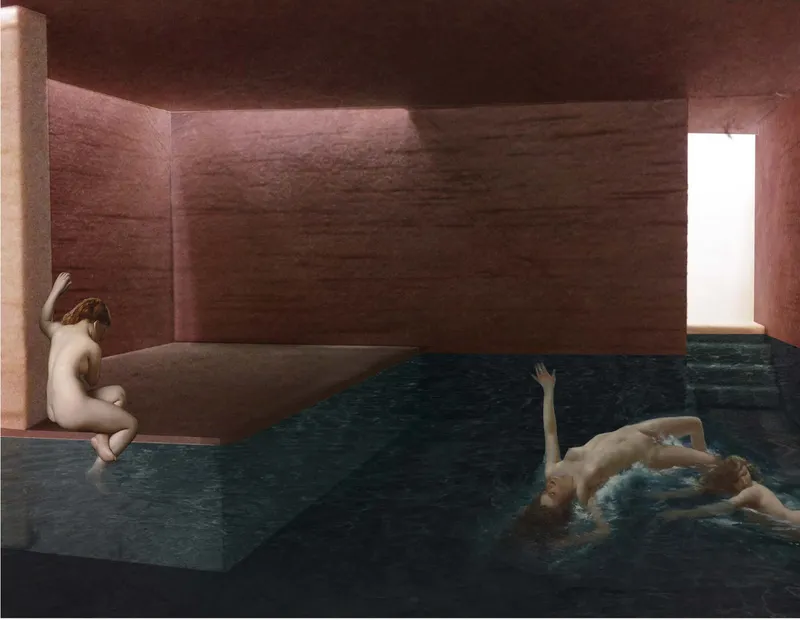
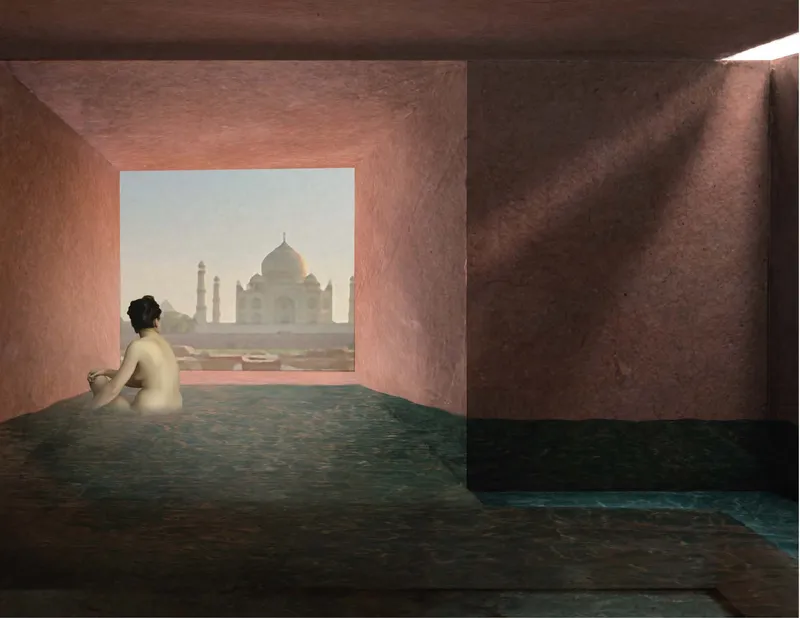
The interior pool spaces establish the project's central atmosphere: meditative, warm, and tactile. Rammed earth walls and red sandstone surfaces absorb and diffuse light that enters through narrow apertures, creating a soft, almost subterranean glow. Figures bathe in shallow pools where the water surface becomes a second architecture, reflecting vaulted ceilings and dissolving the boundary between enclosure and openness. The sequence is deliberate. Visitors enter through a shaded lookout and transition gradually from Agra's bright landscape into the still, echoing interior. Each chamber, from private bathing niches to communal pools, is choreographed to heighten awareness of the body and surroundings.
A window opening in the pool chamber frames a domed monument in hazy afternoon light, collapsing the distance between the bathhouse and the Taj Mahal into a single composed view. This is not incidental scenery. The Mughal garden tradition understood framed vistas as instruments of spiritual orientation, and May deploys them with the same precision. The bather, immersed in water, looks outward toward the silhouette of the mausoleum. Water as life, reflection as divinity: the Mughal ideal of paradise is restated through direct spatial experience rather than ornamental representation.
Geometric Screens and the Threshold Between Interior and Sky
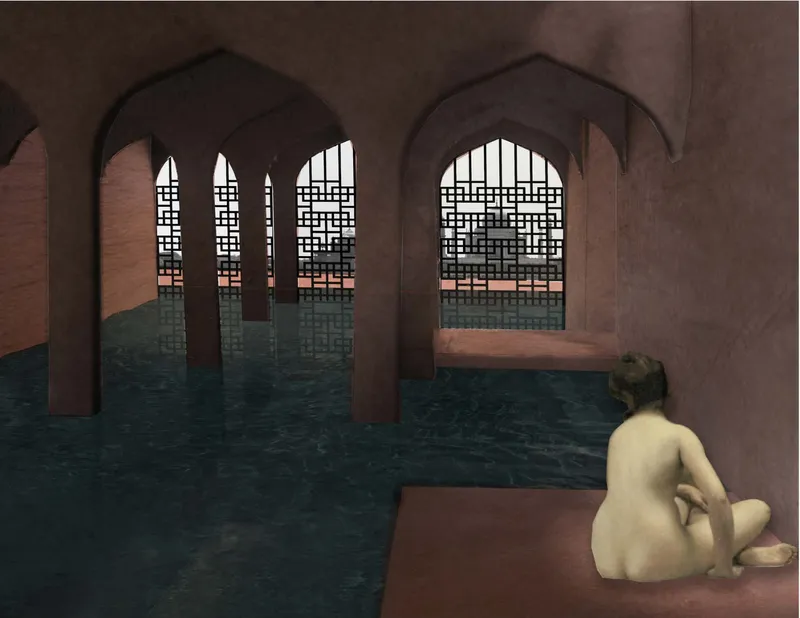
Arched openings fitted with geometric screens filter light into the flooded pool space, casting patterned shadows across water and stone. A seated figure occupies the threshold, neither fully inside nor outside. This liminal condition is fundamental to the project's spatial narrative: the hammam is conceived as a series of gradients between temperature, brightness, and exposure, never a simple binary of open and closed. The screens reference Mughal jali work, but their composition leans toward abstraction, avoiding pastiche while honoring the tradition of perforated stone as both climate device and decorative surface.
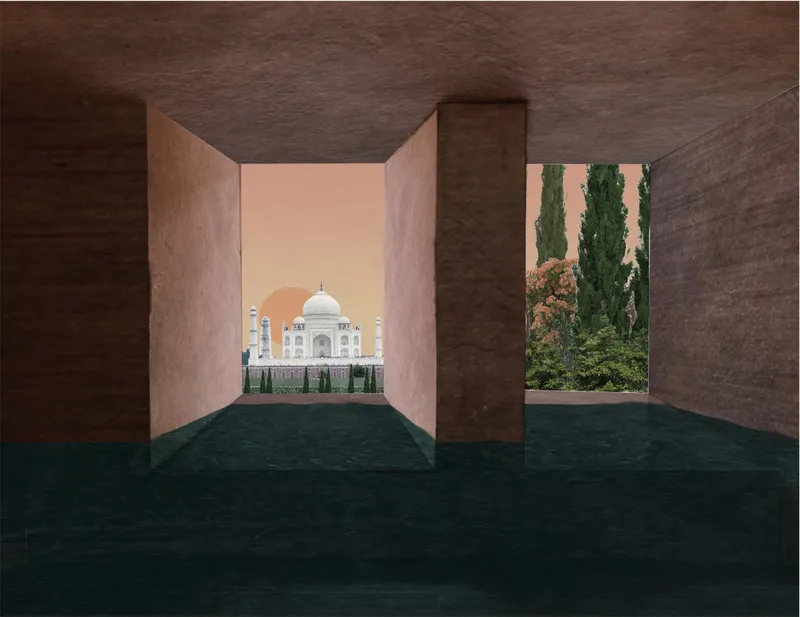
Twin openings frame the white dome of the Taj Mahal and a garden planted with cypress trees at dusk. The visual corridors align with the Mughal garden's axial organization, establishing a precise geometric relationship between the new structure and the mausoleum. These are not casual windows; they are calibrated instruments that capture vignettes of love, loss, and transcendence. The cypress trees, traditional symbols of mourning in Persian garden culture, reinforce the tension between the bathhouse's dedication to the living body and its neighbor's dedication to memorializing the dead.
Layered Courtyards: Plan as Ritual Sequence
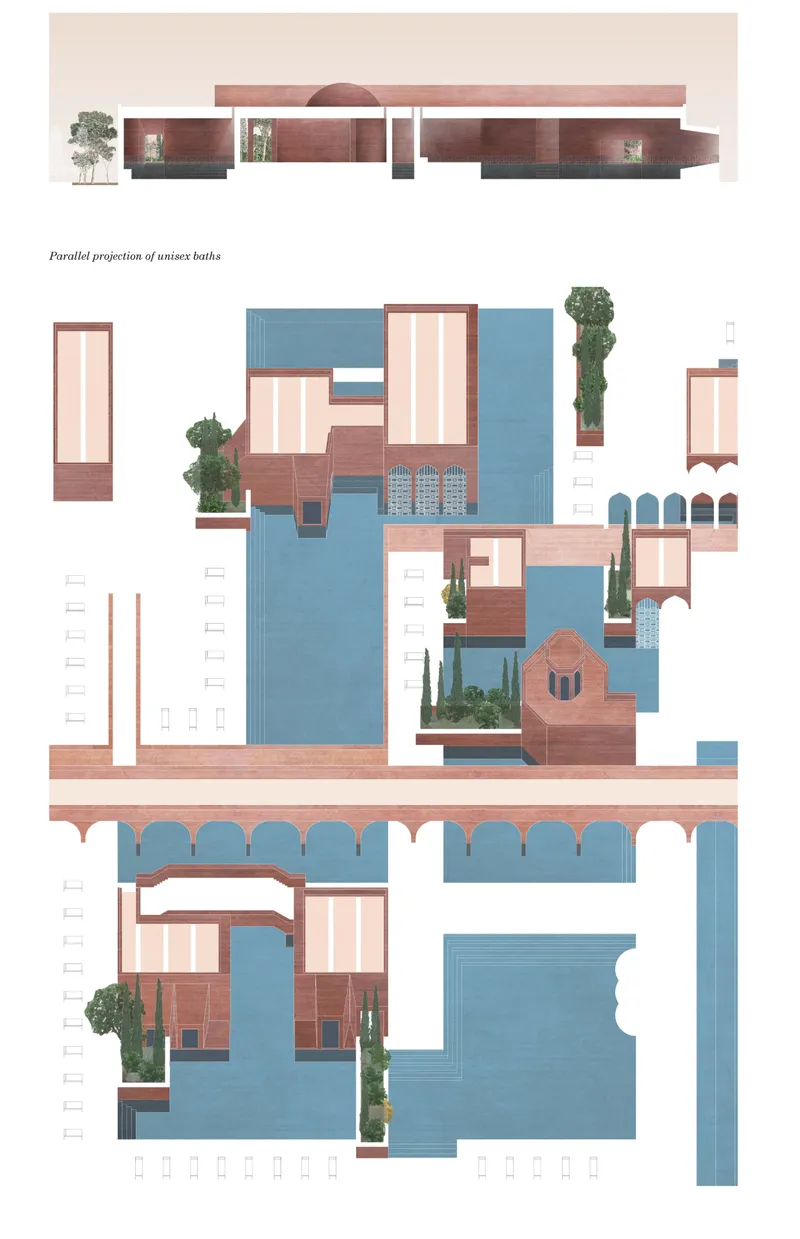
The plan drawing reveals the project's organizational logic: a series of layered courtyards containing pools, arched passages, and scattered trees, rendered in pink and blue to distinguish stone from water. The layout mirrors the Mughal garden's quadripartite geometry while introducing an asymmetry that responds to the existing urban fabric. Pools occupy the center of each courtyard, pulling the visitor inward through a sequence of increasingly intimate spaces. Arches act as both structural rhythm and spatial punctuation, marking transitions between temperature zones and levels of privacy.
What the plan makes legible is the project's ambition to integrate within Agra's historical context without competing with its monumental neighbor. The footprint is modest, the massing low. Trees soften the boundary between building and landscape. The architectural language remains rooted in Agra's traditional materials (red sandstone, marble, water) but their composition shifts toward minimalism, privileging proportion and atmospheric quality over decorative elaboration. The result is a building that reads as both ancient and contemporary, a condition that allows it to participate in the continuum of Mughal sacred architecture rather than standing apart from it.
Why This Project Matters
The most difficult problem in heritage-adjacent design is the question of voice: how does a new building speak in the presence of one of the most recognized structures on earth? Charlotte May's answer is to speak quietly and about something different. The Taj Mahal addresses eternity through stillness and perfection. The bathhouse addresses continuity through the moving body, warm water, and shifting light. By choosing the hammam, a typology that was once vital to Agra's public life but has since disappeared, May identifies a genuine cultural absence and fills it with a program that is both historically grounded and globally resonant.
The project succeeds because it treats bathing not as a wellness amenity but as an architectural act: a choreographed sequence of spatial conditions that engage the body, frame the landscape, and invoke collective memory. Every opening, every change in temperature, every reflected surface participates in a larger narrative about cleansing, renewal, and togetherness. In a competition that asked designers to imagine what the legendary Black Taj might have been, May's proposal sidesteps the trap of building another monument. Instead, she offers something the city might actually need: a place where heritage is not observed but inhabited, where architecture serves the living rather than commemorating the dead.
View the Full Project
About the Designers
Designer: Charlotte May
Enter a Design Competition on uni.xyz
uni.xyz runs architecture and design competitions year-round that reward proposals with spatial conviction and real site intelligence.
Project credits: The Black Taj – The Architecture of Bathing by Charlotte May The Black Taj (uni.xyz).



Popular Articles
Popular articles from the community


Riyadh For All: Intergenerational Urban Design for Active Aging in Rabat
Riyadh For All reimagines urban design in Rabat with intergenerational co-living, adaptive courtyards, and Moroccan cultural exchange today.

Hill & Cross Opera: Sculptural Opera House Architecture Shaped by Tallinn’s Landscape and Identity
Hill & Cross Opera reimagines opera house architecture in Tallinn through its sculptural hill, civic plaza, glass wave and a luminous cross.

The Ocean Hive: Sustainable Architecture for a Self-Sufficient Civilization at Sea
The Ocean Hive imagines sustainable architecture at sea, where modular habitats, algae, wave power and ocean waste sustain a growing colony.

Co-life: Sustainable Architecture for Age-Friendly Community Living
Co-life reimagines sustainable architecture for seniors through courtyards, rammed earth, shared gardens, and spaces designed for belonging.


Similar Reads
You might also enjoy these articles
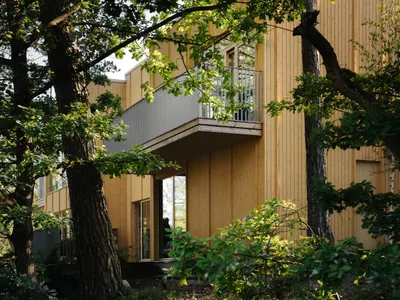
Sustainable Architecture Design: Embracing Nature and Modernity at Villa Solsidan
The article explores Villa Solsidan by AndrénFogelström, showcasing its sustainable architecture design and integration with the natural surroundings in Saltsjöbaden, Sweden.
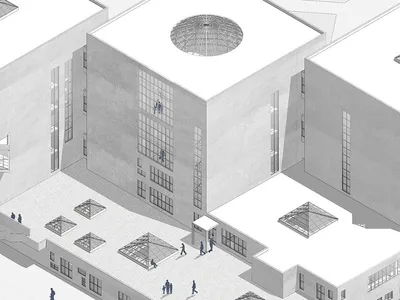
Scientific and Educational Monitoring Center of the Yenisei, Krasnoyarsk
Architecture as an instrument for ecological research, education, and environmental awareness along Russia’s largest river.
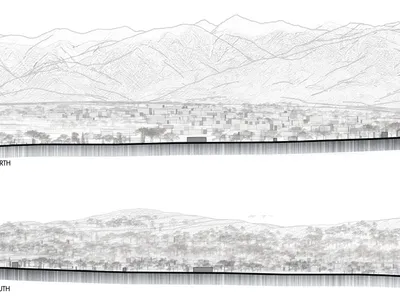
Development of Andretta Artist’s Village, Palampur, Himachal Pradesh, India
Reimagining Andretta as a living cultural landscape where art, architecture, and community converge to shape a global creative village.
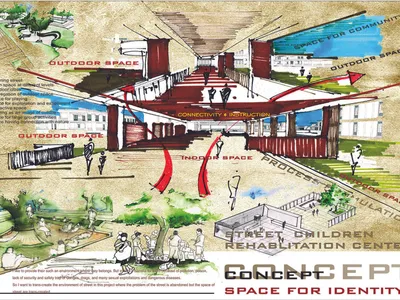
Street Children Rehabilitation Center: A Model of Social Architecture for Community Rehabilitation
An inclusive social architecture project that transforms streets into nurturing environments, restoring dignity, identity, and opportunity for vulnerable children.


Explore Mughal Architecture Competitions
Discover active competitions in this discipline



Challenge to reimagine the Iron Throne


Photograph architecture without architects


Illustrate the lost glory of Angkor Wat - Render Challenge


Design challenge to reuse E-waste
Comments (0)
Please login or sign up to add comments
No comments yet. Be the first to comment!