

MU Architecture Gives a Laurentian Lake House a Rock-Like Street Front and a Wide-Open Face Toward the Water
On Lake Revdor in Saint-Hippolyte, Quebec, a three-level family home turns a dark, guarded front to the road and opens wide to the lake.


The Break Residence sits on a narrow, sloping lot on the shore of Lake Revdor in Saint-Hippolyte, in Quebec's Laurentians. Montreal studio MU Architecture completed it in September 2022. The house replaces an older structure and covers about 6,700 square feet. The brief was personal: the client wanted a final home on land his family has held for generations, in a small lakeside community of only a few neighbouring houses.
The house has two faces, and it treats them very differently. From the street it reads as a cluster of dark, interlocking volumes that look like boulders. From the lake it opens up under sail-like overhangs with golden-toned soffits. Many lake houses split this way. What makes this one worth a closer look is how MU uses the slope to hide a whole floor, and how it builds a heavy stone core that lets the house act as a gathering place for the neighbours, not only as a private retreat.
A Guarded Face to the Street
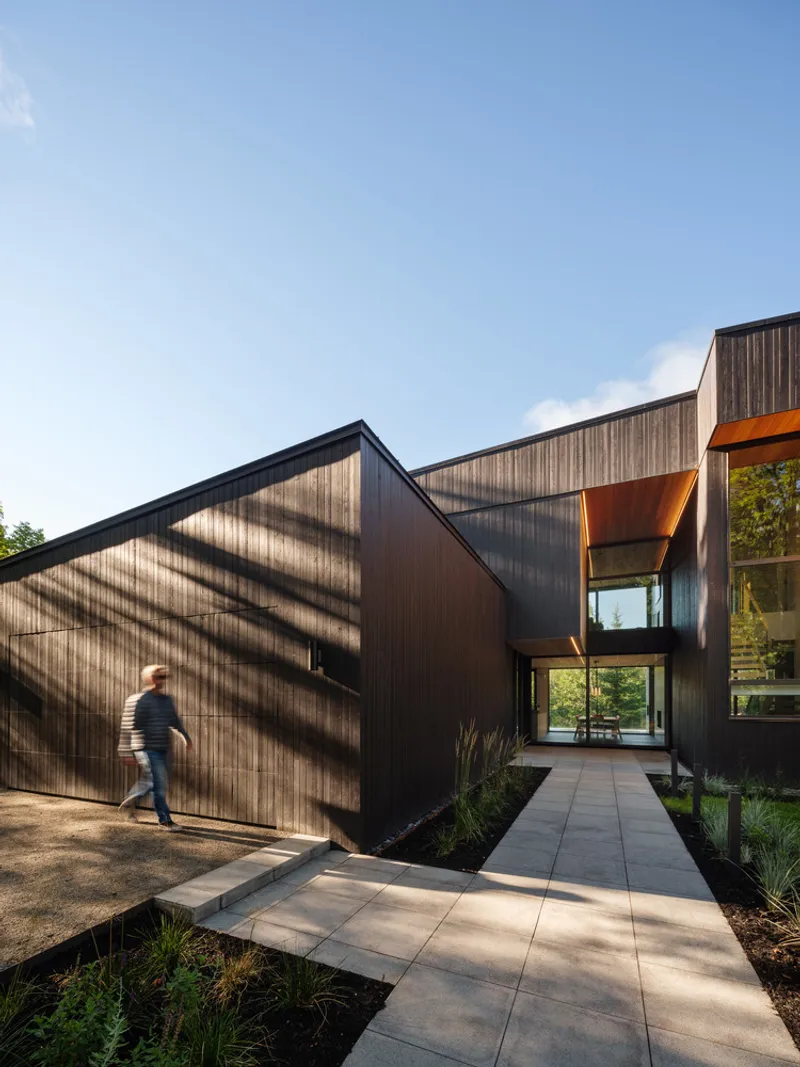
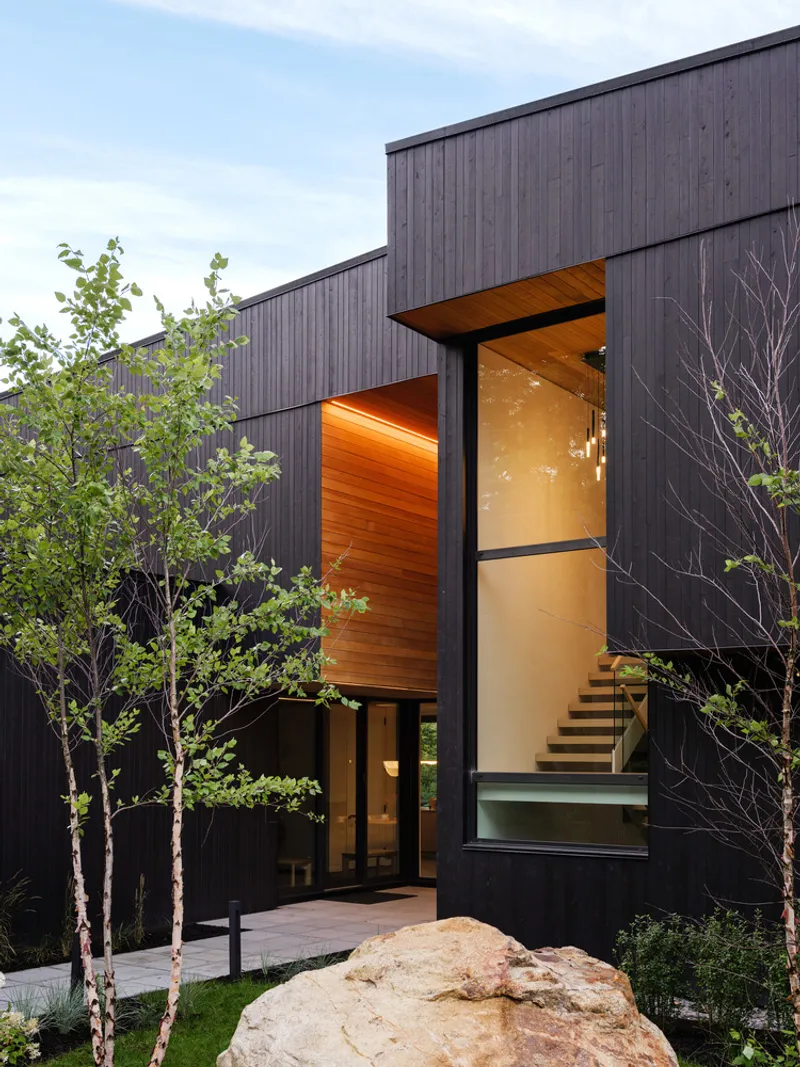
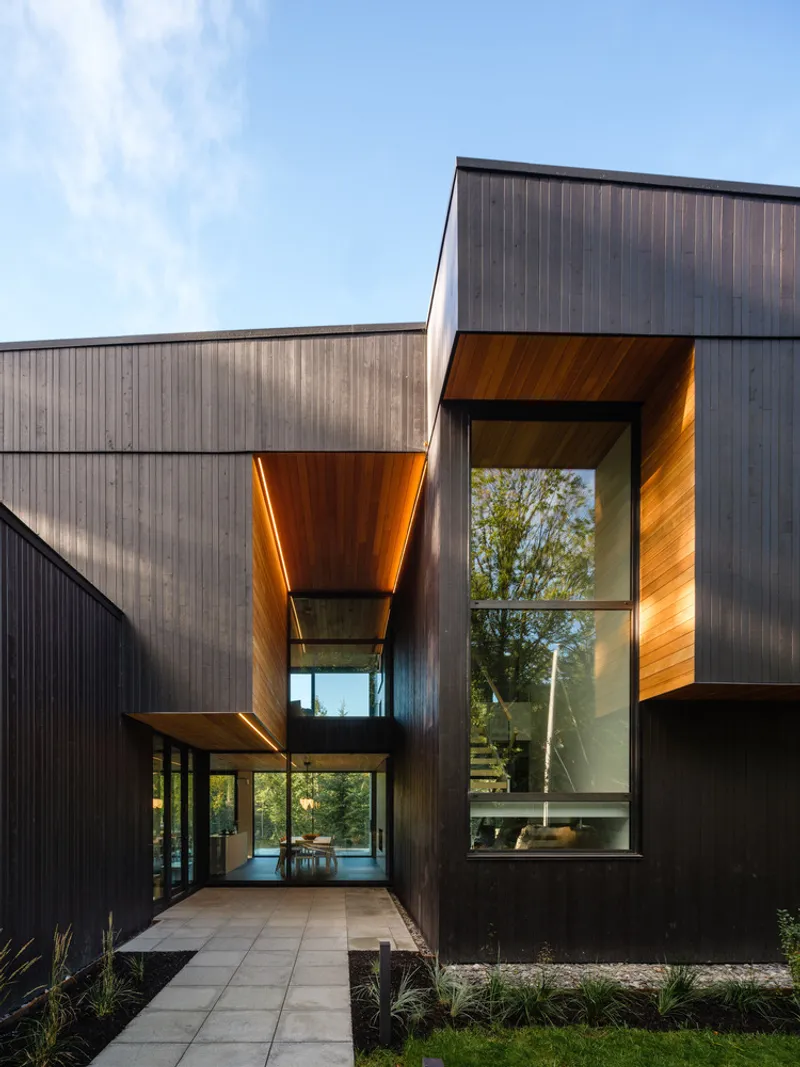
From the road, the residence keeps its back turned. Dark vertical cladding, which appears to be charred timber, wraps volumes that step and lock into each other like rock outcrops. Only two of the three levels are visible. The garden level drops out of sight behind the slope. On a narrow lot with neighbours close by, this restraint is a sensible choice, and it also makes arrival feel considered.
The cedar-lined undersides of the overhangs do a lot of work here. Against the near-black walls, they give warmth exactly where people approach. The tall stair window at the entrance corner shows the vertical circulation from outside and hints at the house's structure before you go in.
An Entry Carved Between Volumes
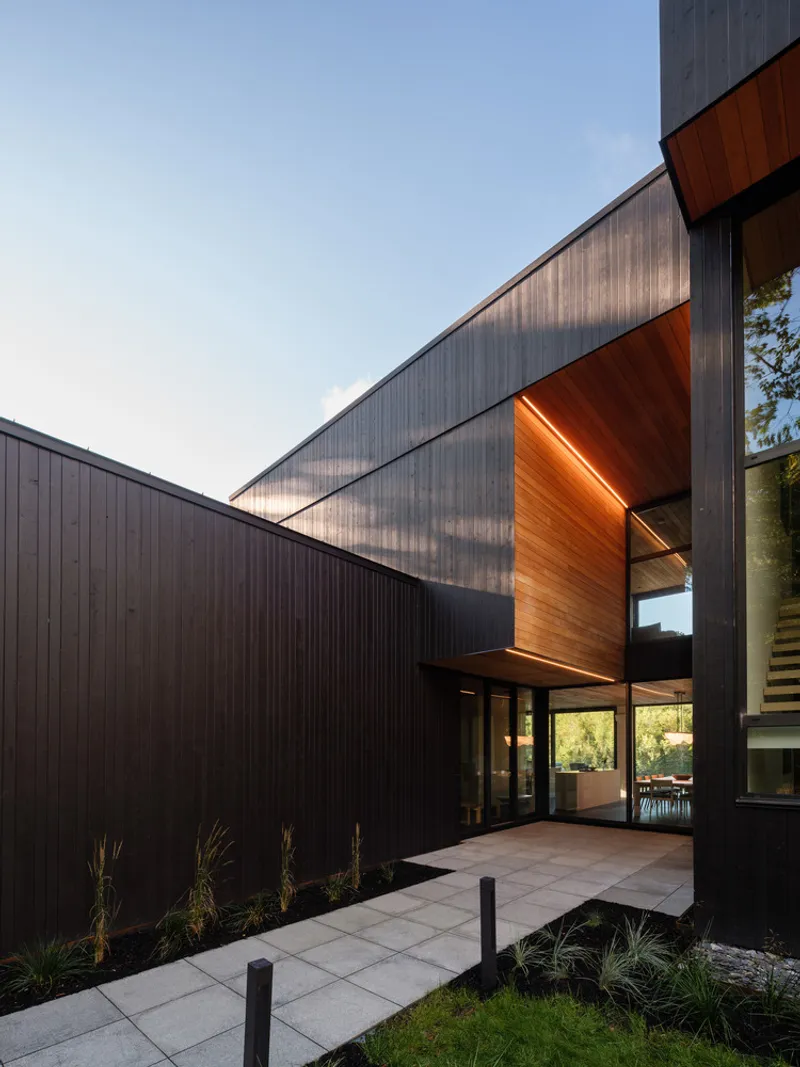
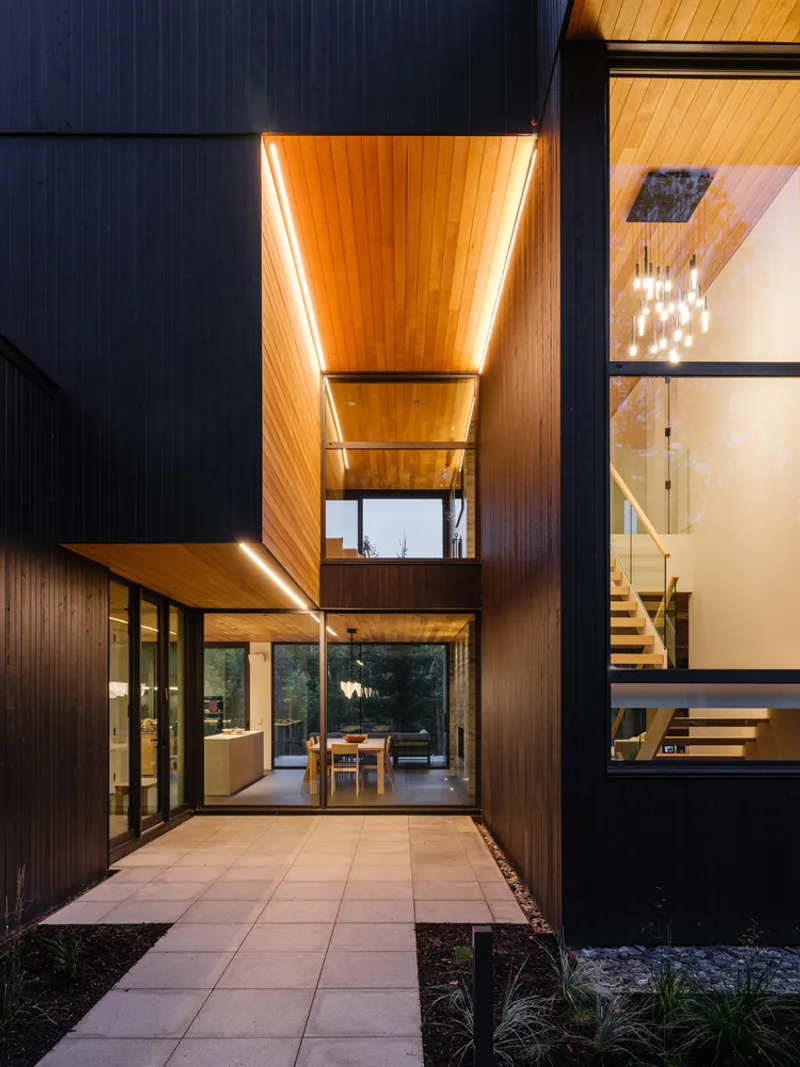
The main entrance sits under a double-height canopy cut into the gap between two volumes. At dusk, the paved court becomes a lit channel: the cedar soffits glow, and the kitchen and stair show through the glass beyond. This is where the house's social purpose first appears. Instead of a closed front door, the openings frame the circulation and gathering spaces, so visitors see the shared life of the house before they reach the threshold.
We think this is the most successful moment in the project. The street side is closed, yet it is not hostile. The slot between the volumes reads as an invitation, which matters for a client who wanted the house to welcome the surrounding community.
Opening Up to Lake Revdor
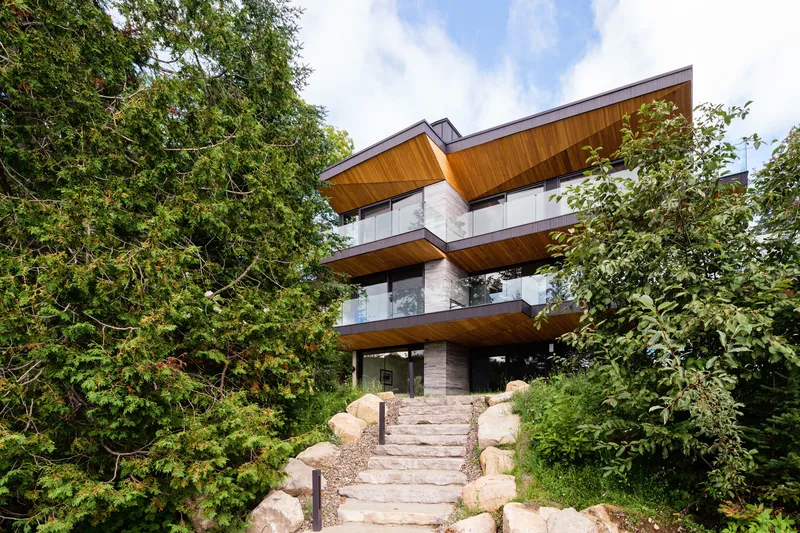
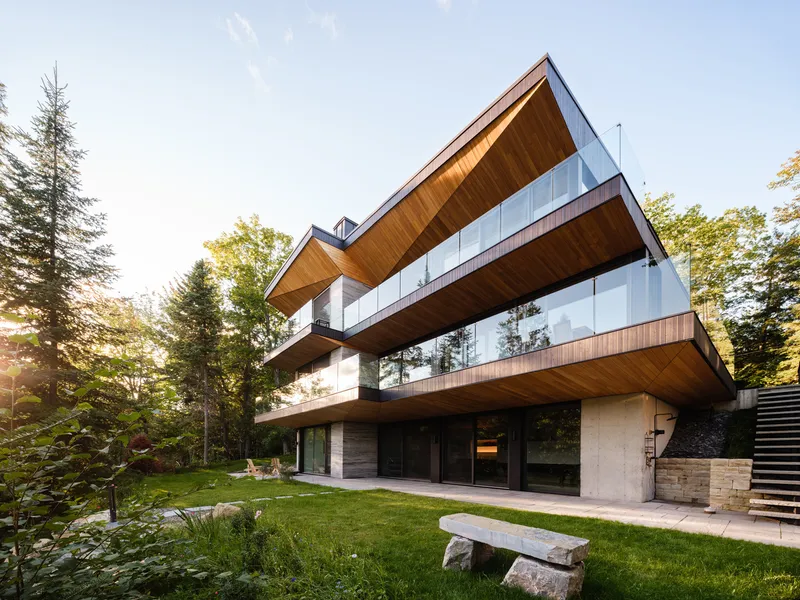
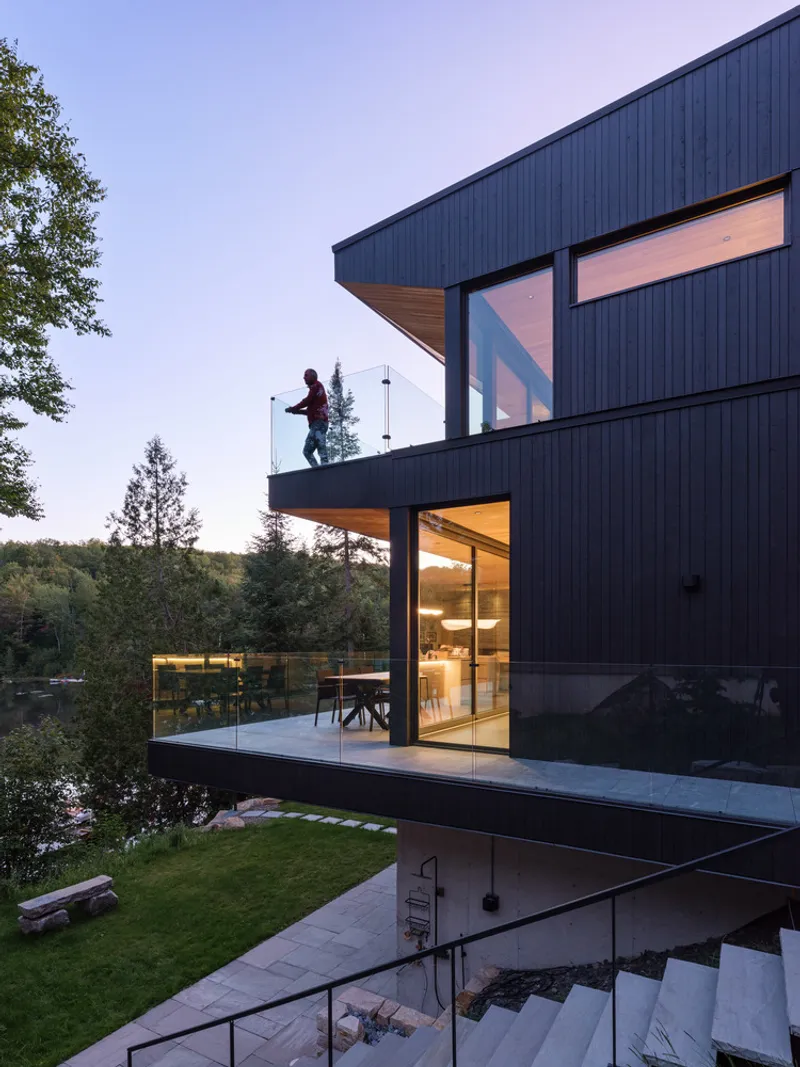
Walk around to the water and the logic flips. Here all three levels are visible, stacked above a concrete base. A stepped stone path climbs through cedars and boulders toward the house. The roofs cantilever outward with timber-clad undersides, and glass balustrades keep the views open. The garden level, hidden from the street, now becomes the house's direct link to the shoreline.
The slope does the important work. Instead of levelling the site, MU lets the terrain set the section, so the house can be modest at the road and generous at the lake without adding bulk to either side. In low evening light the stacked decks read as a series of viewing platforms aimed at the water.
Soffits, Terraces and Light
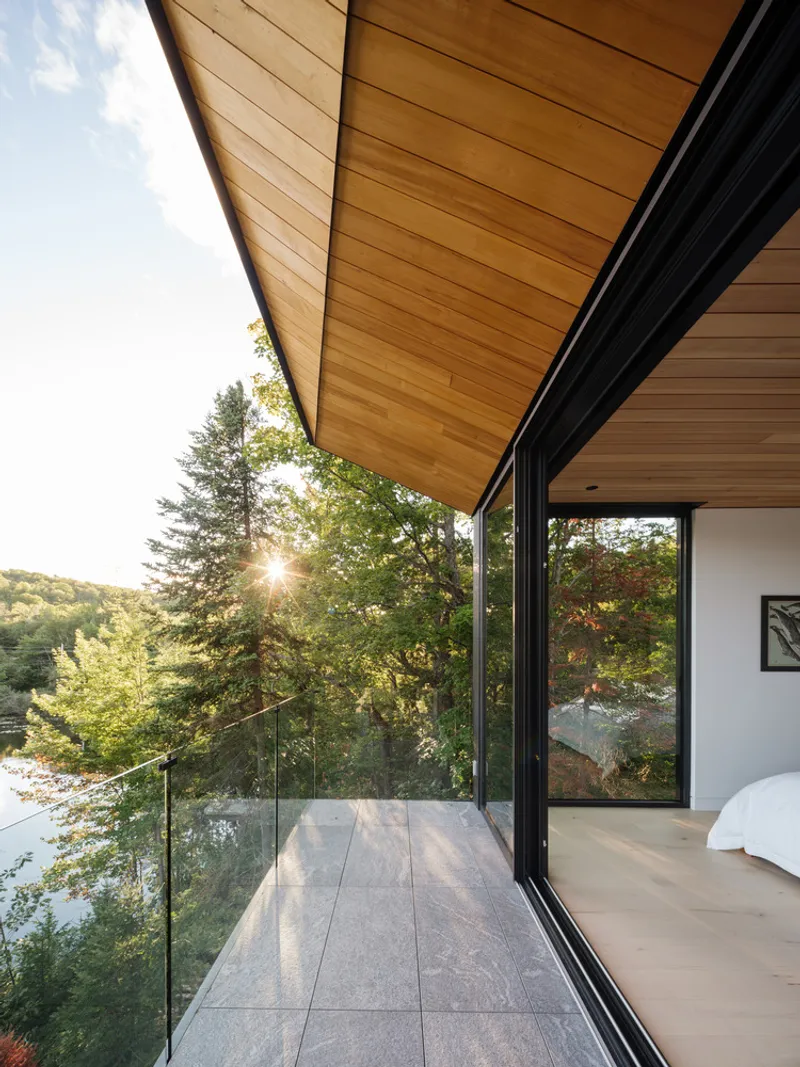
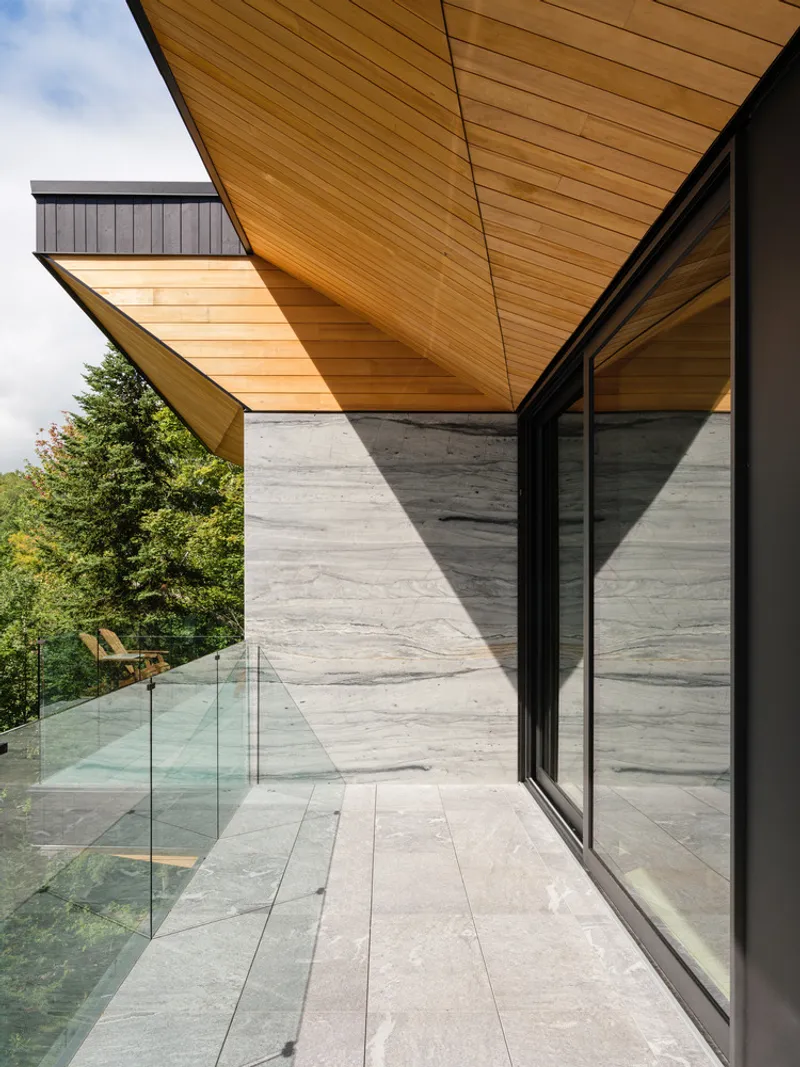
The angled soffits are the project's signature, and the terraces are where you experience them up close. Faceted cedar planes fold overhead, frameless glass edges the decks, and granite and tile paving extend the interior floors outward. The tilted undersides pick up light from the lake and the low sun, which explains the golden accents: they turn a roof edge into a reflective surface.
The overhangs also suit the climate. Deep eaves in the Laurentians shelter terraces from snow and summer glare. The sources we reviewed do not detail a passive strategy, but the geometry clearly favours sheltered outdoor space over exposed decks.
The Stone Core That Holds It Together
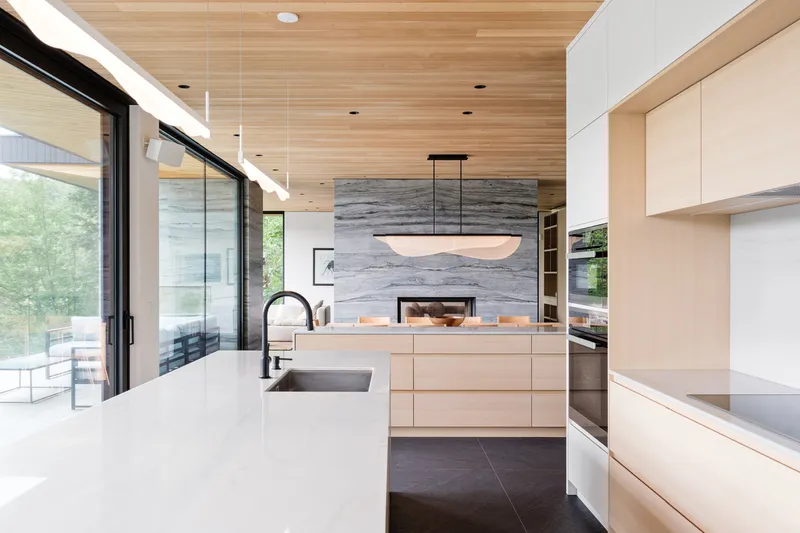
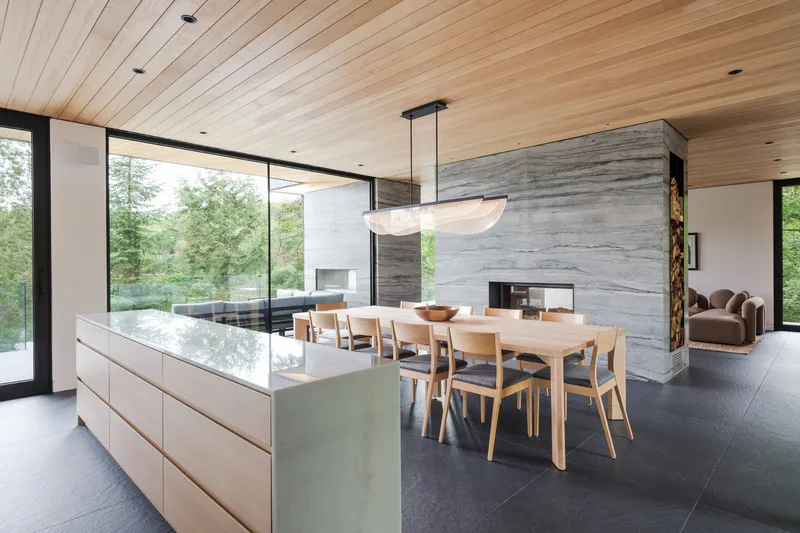
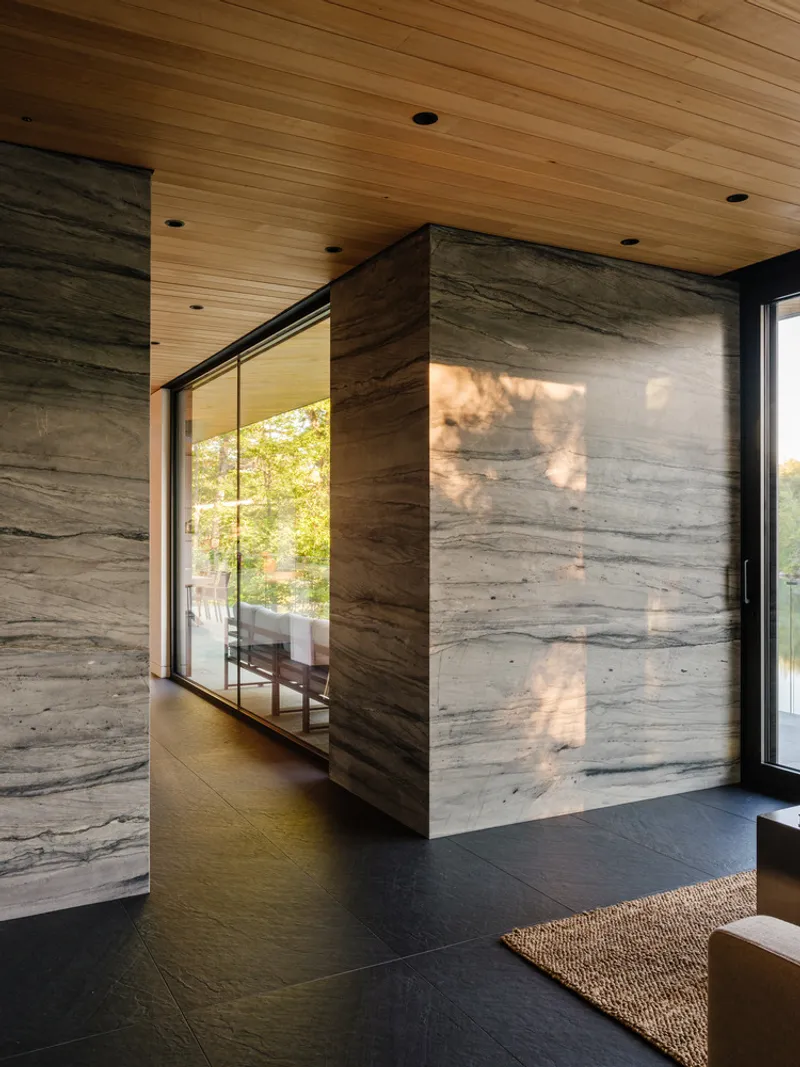
Inside, a monumental stone wall runs through several levels and holds three fireplaces. It is the house's spine. The kitchen, with its white stone island and pale wood cabinetry, sits against it. A long wooden dining table runs beside it, under a ceiling of western Canadian hemlock. Where the stone meets a glazed corner, dappled light shows off the grey veining and the slate floor beneath.
This mass gives the open plan an anchor. Without it, a glass-walled lakeside living space can feel like a pavilion with nothing to hold onto. The wall also carries the outside material language indoors, linking the rock imagery of the street facade to the rooms where people actually gather. Quartzite with veining that suggests moving water and slate with a rougher texture keep the palette mineral. Maple floors and oak and maple furniture warm it up.
Lounges Built for Lingering
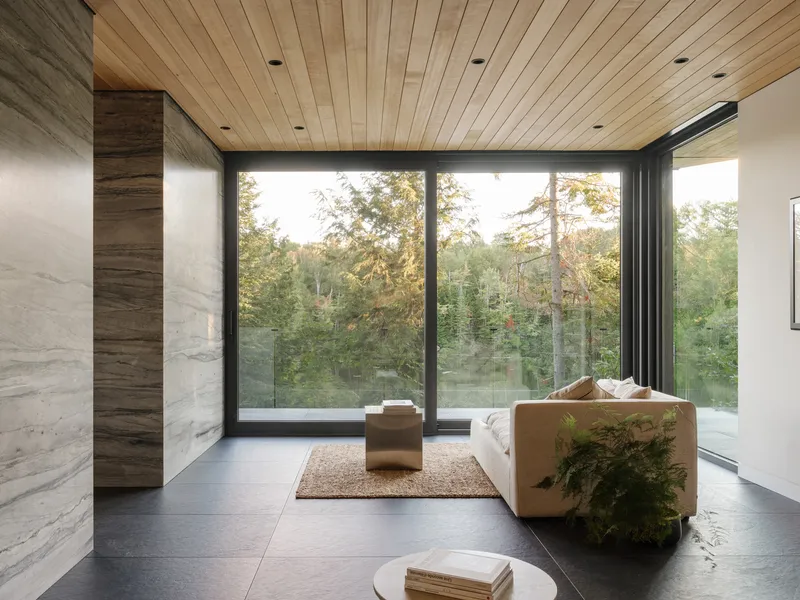
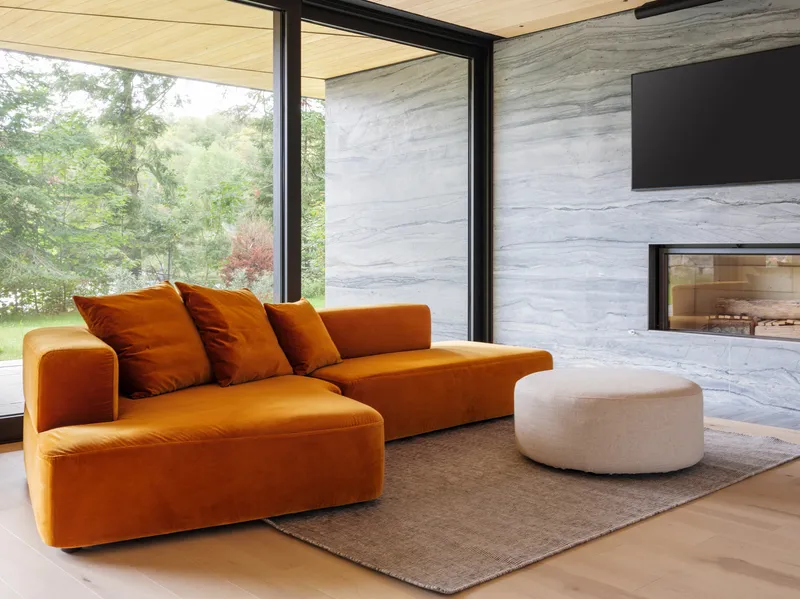
The living spaces are set up for long stays. A rust-orange velvet sectional faces a stone fireplace wall, with full-height glass to one side looking into the trees. A separate sitting area pairs banded stone with a timber ceiling and sliding doors that open straight into the conifers. Hospitality runs through the program. Each level has its own service areas, coffee stations and bars, so hosting does not depend on a single kitchen.
Boudoirs and Quiet Corners
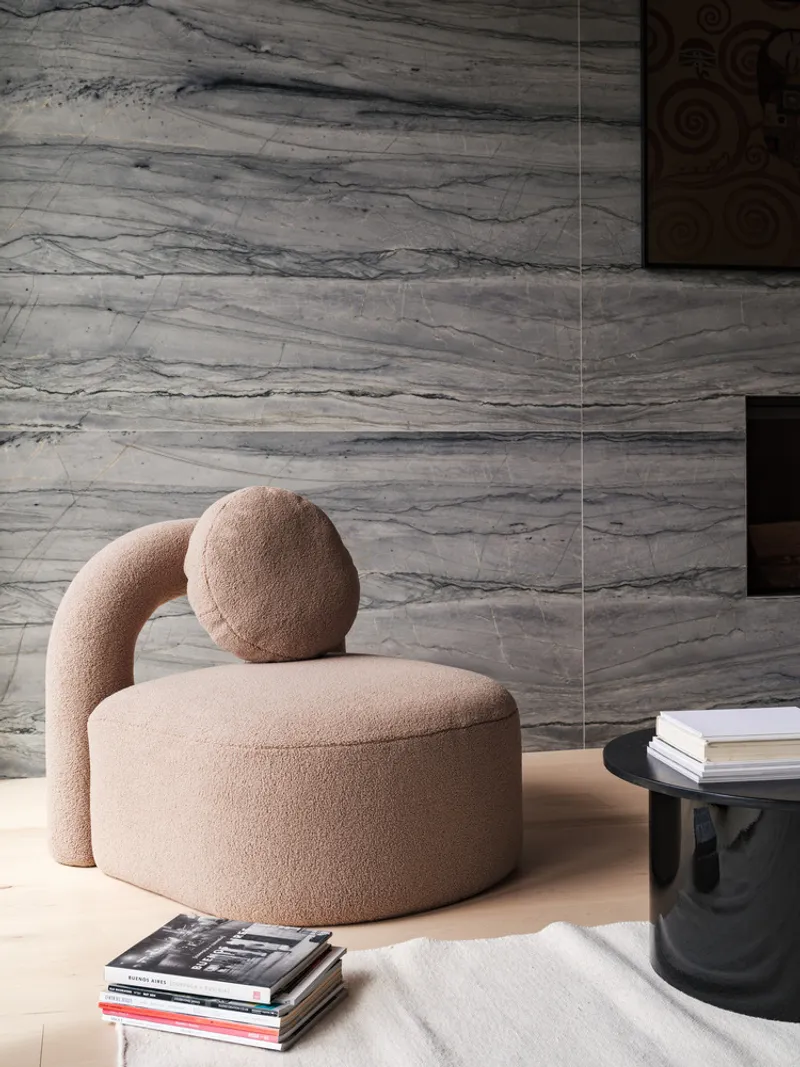
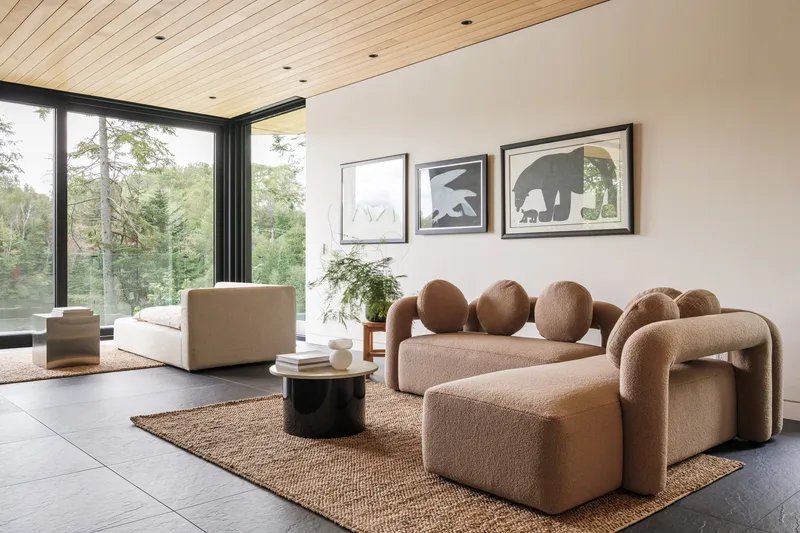
Alongside the big shared rooms, MU sets aside small lounges and boudoirs for pausing. A blush bouclé armchair sits against veined stone with a stack of books. A rounded sofa on a jute rug faces corner glazing and tall trunks. These spaces matter in a house designed for gatherings. They give guests and family somewhere to step back from the crowd without leaving the view behind. Furniture by Element de Base and millwork by Illo keep these corners soft and tactile against the heavy stone.
Why This Project Matters
The Break Residence shows how a sloping, constrained lakeside lot can shape a house instead of limiting it. By burying one level from the street and revealing it to the water, MU Architecture avoids the usual oversized lake home that crowds its neighbours. The two-faced approach is familiar, but here it serves a clear purpose: privacy and good manners toward the road, and openness and shelter toward the lake.
Its more interesting lesson is social. This is a large private house deliberately designed to receive a community: an entry that shows its gathering spaces, bars and coffee stations on every level, and an elevator that keeps all three floors accessible. For a client building a last home on ancestral land, that generosity is the real brief, and the stone core and sheltering soffits are how the architecture delivers it.
The Break Residence by MU Architecture (design team: Jean-Sébastien Herr, Charles Côté, Magda Telenga, Andrée-Anne Godin, Emilie Vinet Gagnon, Baptiste Balbrick). Location: Saint-Hippolyte, Quebec, Canada. Area: approx. 6,700 sq ft. Year: 2022. Photography: Ulysse Lemerise Bouchard.
About the Studio
Share Your Own Work on uni.xyz
If projects like this are the kind of work you want to make, uni.xyz is a place to publish your own, find collaborators, and enter design competitions.


Popular Articles
Popular articles from the community


GROUP A Strips a 1969 Rotterdam Harbor Headquarters to Its Frame and Wraps It in Timber Louvers
In Rotterdam's M4H harbor district, Ferro Offices reuses a 1969 frame, adds one timber storey and reaches BREEAM-NL Outstanding.

U.GA Architects Wraps an Oval Rooftop Pool in Curved Board-Formed Concrete on Busan's Jeollidan-gil
In Busan's Jeonpo-dong, a 454 m² mixed-use block stacks a neighborhood facility, guest rooms and an oval rooftop pool inside spiraling concrete walls.

Architekt Andreas Gruber Scatters 23 Dark Timber Chalets Across a South Tyrolean Forest Edge
In Molini di Tures, Amonti Chalets breaks a resort into a hamlet of gabled timber houses, with parking, storage and services pushed into the slope.

longwave studio Reorganizes a 112 m² Tainan Apartment Around the Daily Routines of a Family and Two Cats
In Tainan, Taiwan, birch plywood, rust-red furniture and a freestanding plaster wall link arrival, storage, work and family life in one apartment.

Similar Reads
You might also enjoy these articles

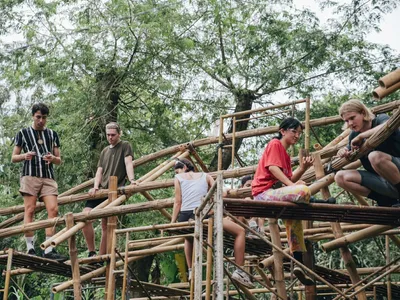
Bamboo Housing Challenge 2026: Design Affordable, Sustainable Homes Using Bamboo
An international design competition by Bamboo U and IBUKU inviting architects and designers to reimagine affordable housing using bamboo — with the winning design built full-scale in Bali.

Computational Design & Education: Beegraphy Design Awards Introduces 7th Category (Featuring Jiyun's Innovative Approach)
Dive into Beegraphy’s 7th Design Awards category, where computational design meets education to create immersive, interactive learning tools, inspired by Jiyun’s work.

From Parametric Lighting to Urban Furniture: Join the 2nd Workshop in Beegraphy’s Computational Design Series
Dive into Cutting-Edge Design Techniques and Practical Applications with Industry Experts

Last Call: Unleash Your Architectural Genius in SHAK's Kindergarten Design Competition
Urgent call for architects to join SHAK's kindergarten design competition before the looming deadline

Explore Architecture Competitions
Discover active competitions in this discipline

Challenge to reimagine the Iron Throne

Photograph architecture without architects

Illustrate the lost glory of Angkor Wat - Render Challenge

Design challenge to reuse E-waste
Comments (0)
Please login or sign up to add comments
No comments yet. Be the first to comment!