

UNIVERSITY OF URBAN ARCHEOLOGY
A PLACE FOR CULTURE, LEARNING, AND REVITALIZATION

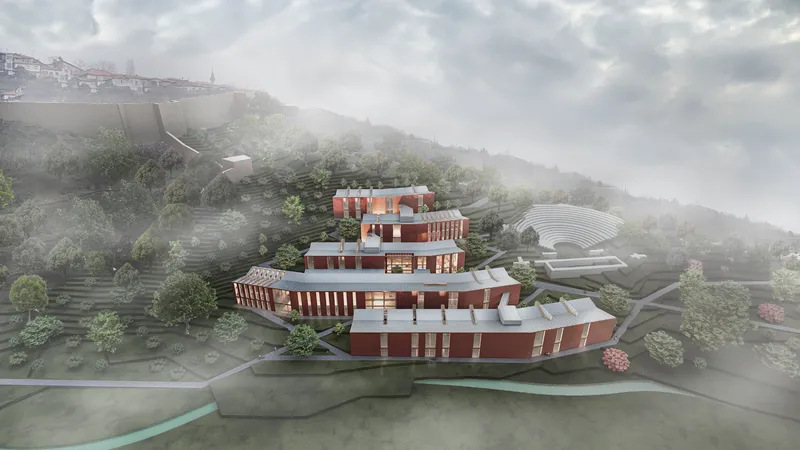 University of Urban Archeology
The project, University of Urban Archeology, aims to provide more than just an educational facility for the students. With the right approaches, it draws attention to the historical and cultural heritages located in the site. Blending into the context and becoming a part of it. It sustains the spirit of the place by strengthening the relationship between the natural environment and the built environment. Last but not least, it provides a gathering and socializing space in the heart of Ulus, among the educational facilities. The design consists of approaches for urban planning, sustainability, and building technology, among the strategies to preserve the spirit of the place.
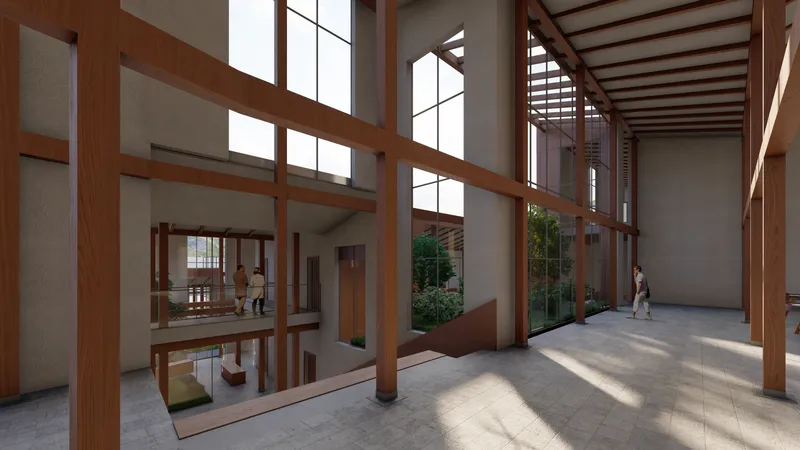 Student Gathering Space
The user profile has a wide range, from students to visitors, locals to tourists, children to elder people, anyone who wants to learn about history, culture, and archeology and be a part of the site is welcomed. The University of Archeology provides workshops, seminars, and group lectures with guest lecturers from all around the world. In addition to learning, there are many more facilities for a variety of activities. From educational facilities to entertainment facilities, gathering spaces to eating spaces, meeting spaces to site living dormitories, and many more functions compose the University of Urban Archeology. With all these functions, the University serves not only the students but also the people who are interested in learning, working, eating, enjoying a quality time, and socializing.
 Site Plan
Ulus is located in Ankara, the capital city of Turkey. Regionally, it has an old town status. The project site is bounded by Bentderesi Street, Kevgirli Street, and Hisar Parkı Street. Since the project site is located in an old town region, there are many traditional, cultural, and historic heritage remains from various nations, that had ever settled in Ankara, such as Ottomans, Romans, Frigs, and many others that reach back to Paleolithic Age. Inside the project site, there are two historic mosques from Seljuks and Ottomans, and fortification walls of the Ankara Castle, which was built by the Byzantine Empire and renovated by many other civilizations. Lastly, a half-buried Roman Amphi Theatre.
 University of Urban Archeology
According to Genius Loci, there are some essences, that are used as guidelines in this project. It is all about strengthening the relation between the built environment and the natural environment. Existing ruins, natural elements, people, animals, light, and sound are embraced in design to provide a better experience to the users of the site. Characteristic materials, forms, and structural systems from the context are used for blending in. Integration of the masses to the topography is made with the minimum intervention, so that, the spirit of the space would not get harmed. Among all the physical design strategies, environmental forces and natural lighting is also embraced. Infiltration of the natural light through the building and breezes through the corridors between the units multiplies the effects of the experience. The topography of the site is highly-sloped, and needed a specific treatment. Platforms for the units’ bases are integrated into the topography, with respect to the isohypse rates. Then, they are joined with forks, as a circulation element. Later on, forks are blended into the topography to keep the intervention minimum. Circulation is arranged according to the site's topographical condition and the historical heritages on the various levels. The goal was to keep the intervention on the topography minimum and draw attention to the historical heritage while embracing the natural elements. After the integration of the ramps, forks, and the platforms was finalized, the volumes of the units were decided. The aim was to settle into the context and become a part of it, without disturbing the surrounding units.
 Program & Functions
The site consists of numerous archeological, historical, and cultural elements. However, there is no awareness of them. Even locals of the site have not been taught about the cultural treasure they were living next to. So that, providing a complex, which would be drawing attention, organizing lectures, seminars, and events for people, who wants to develop themselves, and involve in research.
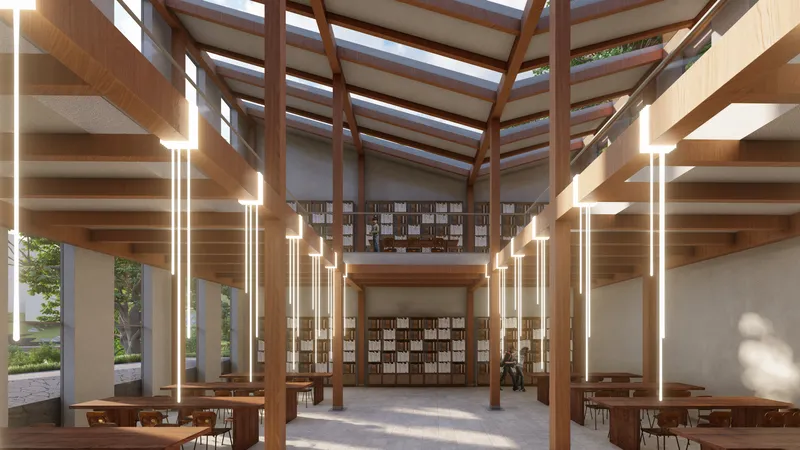 Library
In short term, the university will be raising awareness of the Ottoman and Seljuk Mosques, Fortification Walls of Ankara Castle, and Roman Amphi-Theatre for the local people and attract tourists to the site. In the long term, it will provide knowledge for conservation, preservation, and archeology. It will increase the trade in the site, this will result in economical development. In addition to that, due to the preservation of the site, public security will advance. The last but not least, people will feel the spirit of the site (Genius Loci), due to the design strategies and conservation regulations.
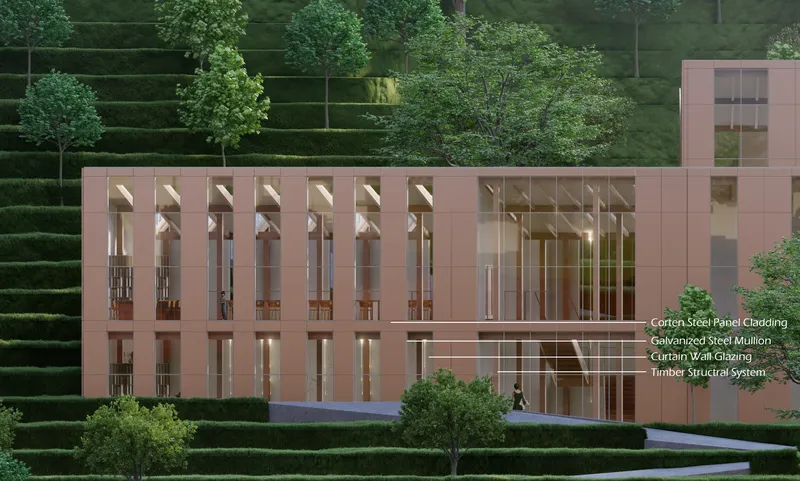 Facade System
On the facade of the building, a panel cladding system is implemented, and the primary element of the system is the corten steel panel, which suits the context completely. Other than that, glass panels are used for creating views of many historical heritages and taking advantage of the natural light as much as possible. Furthermore, galvanized steel is used for mullions, and timber is used for all of the structural elements, which are columns, beams, and purlins.
 Environmental Systems
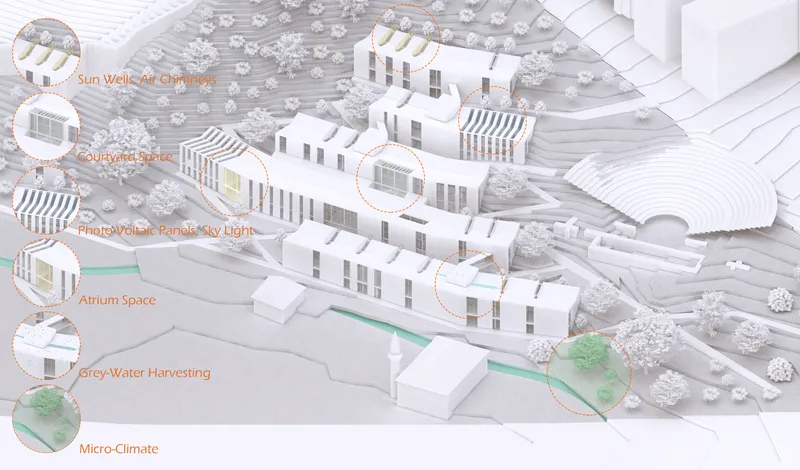
The building consists of many active and passive sustainability systems, that make it environmentally friendly. As passive systems, air chimneys are created for natural air ventilation, sun wells are integrated, and courtyards are created for taking sunlight to the interior and getting benefit from it, as much as possible. Moreover, sloped roofs are preferred for harvesting greywater. Last but not least, the river is resurrected from the underground water, and with vegetation, a micro-climate is created. As active systems, transparent photovoltaic panels are used on the building’s roof with skylight openings, for creating electricity from solar energy. Furthermore, people use greywater in the building and for the vegetation in the courtyards. Other than that, timber structural elements are used as a primary system. 20x20 cm2 timber columns are used as vertical structural elements, that are fixed on the ground with galvanized steel sheet. Columns are connected to each other with 30x20 cm2 timber beams. Beams are joined to each other with 20x10 cm2 purlins.
 Primary Structural System


Popular Articles
Popular articles from the community


The Ocean Hive: Sustainable Architecture for a Self-Sufficient Civilization at Sea
The Ocean Hive imagines sustainable architecture at sea, where modular habitats, algae, wave power and ocean waste sustain a growing colony.

Lunar Spiral: Space Architecture Shaped by the Mathematics of the Universe
Lunar Spiral reimagines space architecture through Fibonacci geometry, lunar regolith, levitating habitats, and self-sustaining Moon living.

Play: Fragments of Their World
Familiar architecture becomes modular playground design, creating safe spaces where displaced children can learn, connect, imagine and play.

Riyadh For All: Intergenerational Urban Design for Active Aging in Rabat
Riyadh For All reimagines urban design in Rabat with intergenerational co-living, adaptive courtyards, and Moroccan cultural exchange today.


Similar Reads
You might also enjoy these articles

Day and Night Park: A Time-Based Urban Newsstand in Beijing
A temporary urban newsstand in Beijing blending travel, light, and reading through poetic colors, compact form, and community-focused design.

Modernist Patio Renovation in El Masnou, Barcelona by Oliver Segura Arquitectura + Cebrià Arquitectura
Modernist patio renovation blending tradition and innovation with a movable pool, leveled floors, and Catalan materials in El Masnou.

Alto Residencial Coop: Cooperative Housing Development in Santiago de Compostela by Carbajo Barrios Arquitectos
A linear cooperative housing complex blending white volumes and perforated metal façades, enhancing community living, natural light, privacy, and urban integration.
Vil Genis School by BPA ARCHITECTURE – Massy, France
Vil Genis School in Massy, France, features sustainable design, south-facing classrooms, community integration, accessible spaces, and modern educational architecture.
Explore Sustainable Urban Design Competitions
Discover active competitions in this discipline



Challenge to design public laboratory


Design challenge to reuse E-waste
Comments (1)
Please login or sign up to add comments
I really appreciate this project as I believe it provides a modern and practical envrironment for university students in a really creative and aesthetic manner.