
Urban Integration and Sustainable School Design in Argenteuil: Fernand and Nadia Léger High School by toa | architectes
Perforated metal-clad high school in Argenteuil integrates sustainable systems, flexible learning spaces, and landscaped courtyards within dynamic urban context.

The Fernand and Nadia Léger High School in Argenteuil, designed by toa | architectes associés, represents a contemporary vision for educational architecture rooted in urban integration, spatial adaptability, and environmental performance. Completed in 2019, the 4,300 m² project redefines the relationship between school infrastructure and the evolving city, positioning itself as both a pedagogical “machine to teach” and a civic landmark within the Val d’Argenteuil district.
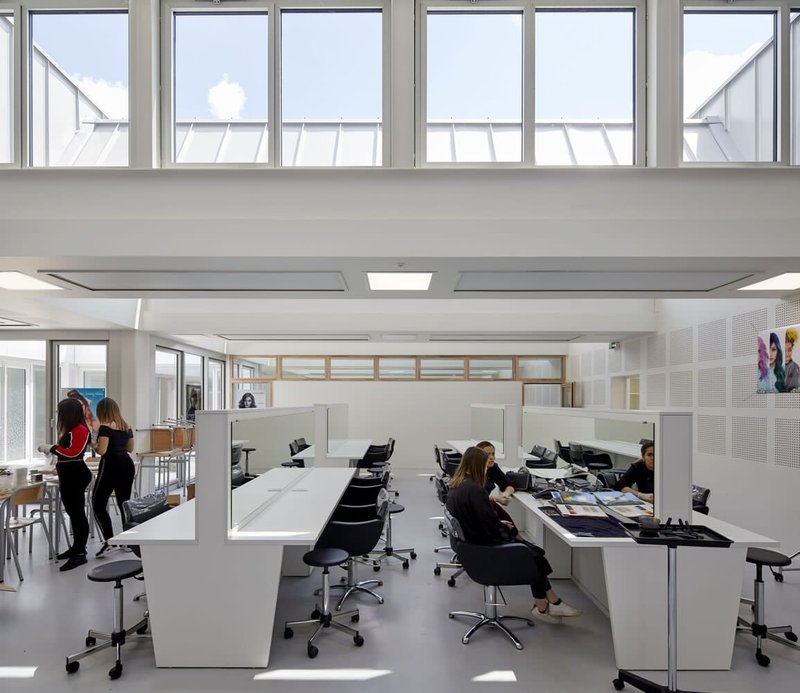
Located near major public facilities, the neighborhood center, and the Val d’Argenteuil train station, the high school is embedded within a wooded and dynamically transforming urban context. Rather than simply inserting a new building into the site, the project initiates a broader urban reorientation. It establishes a unifying civic anchor that engages directly with public space while restructuring the internal logic of the campus.
Urban Strategy: A Landmark at the Edge of the Plot
One of the primary challenges of the project was phasing and maintaining uninterrupted school operations without resorting to temporary buildings. This logistical constraint shaped a clear architectural response: positioning the new volume at the end of the plot, at the interface between the high school and the street.
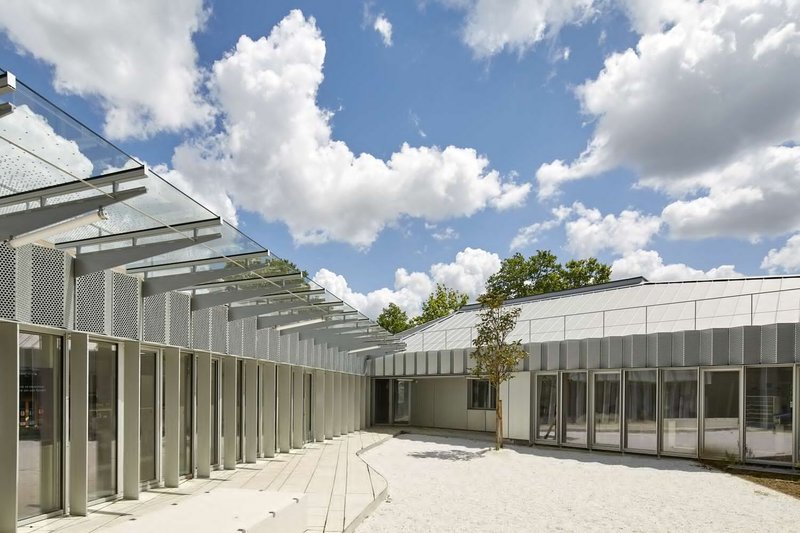
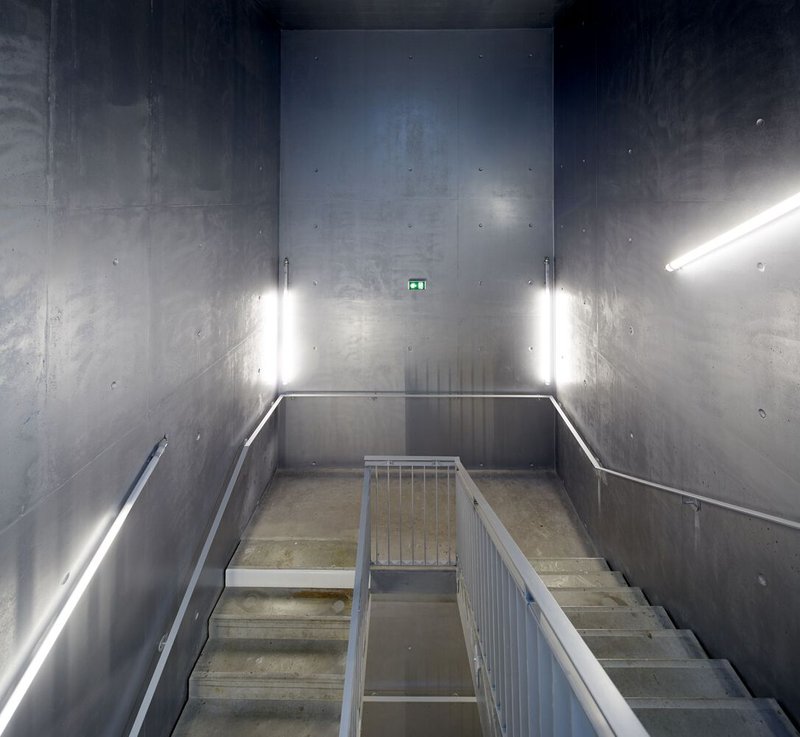
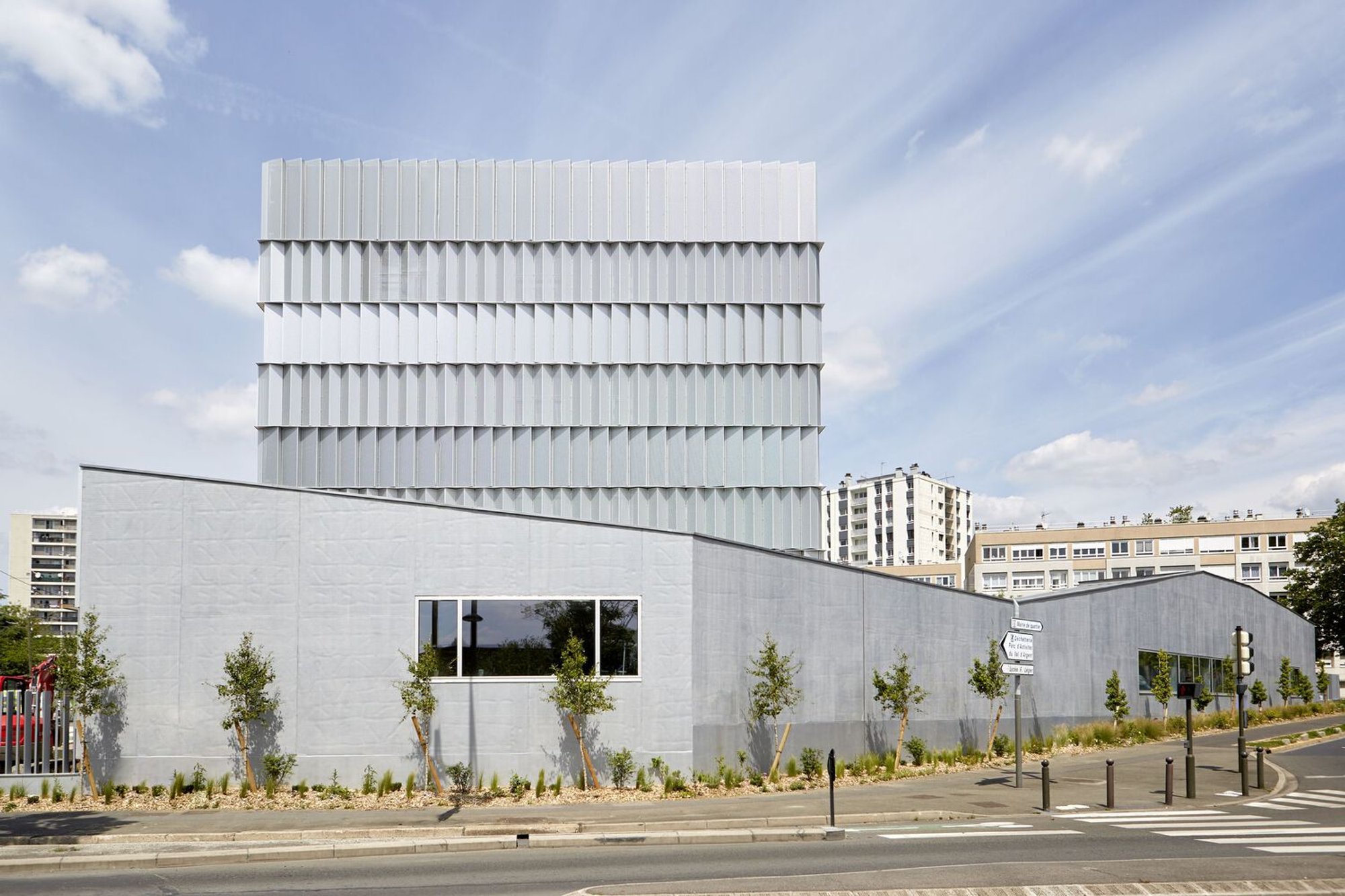
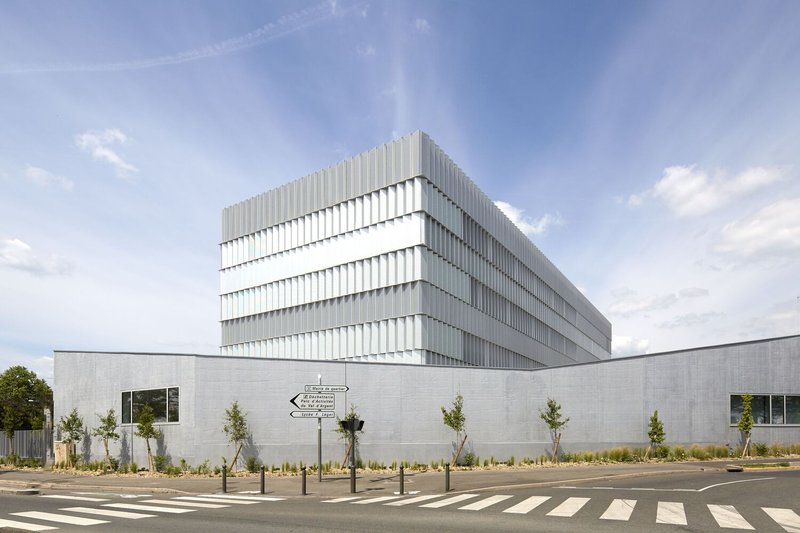
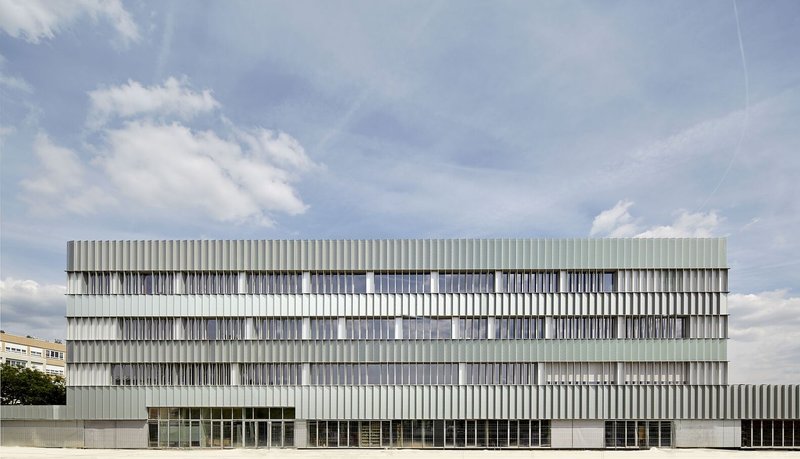
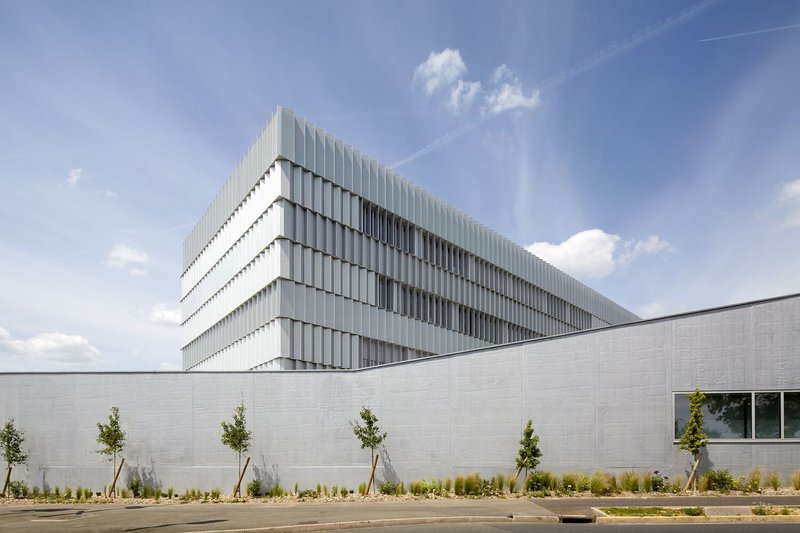
The building asserts itself as an urban object “prowed” toward the public realm. While its overall scale aligns with surrounding structures, the architects carefully decompose the mass into two complementary volumes to articulate different readings at different scales.
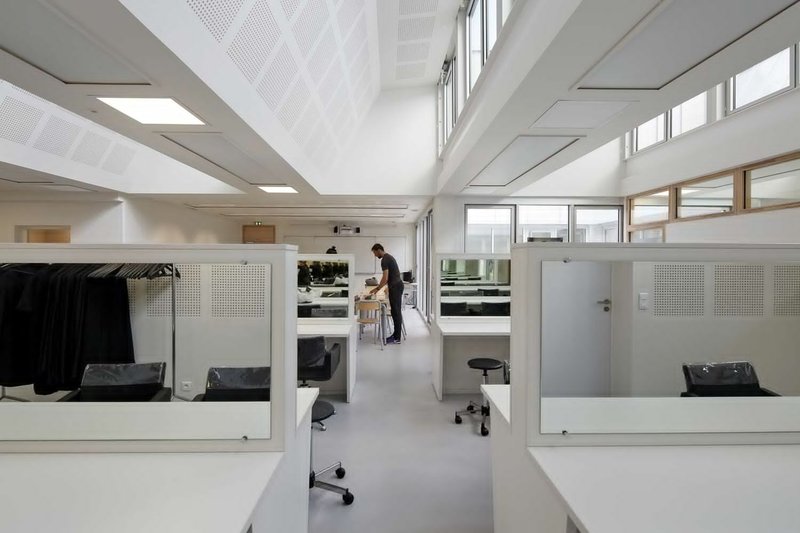
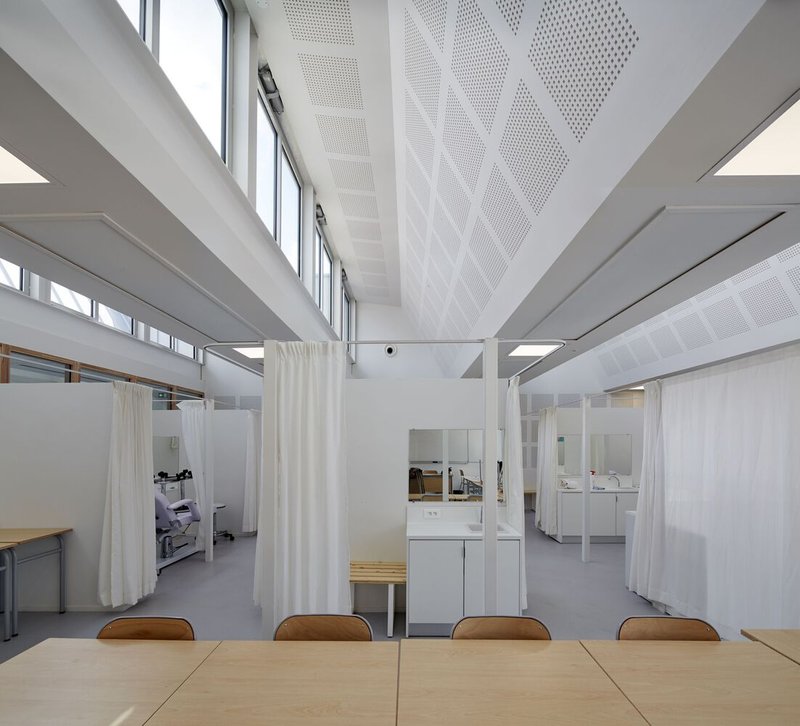
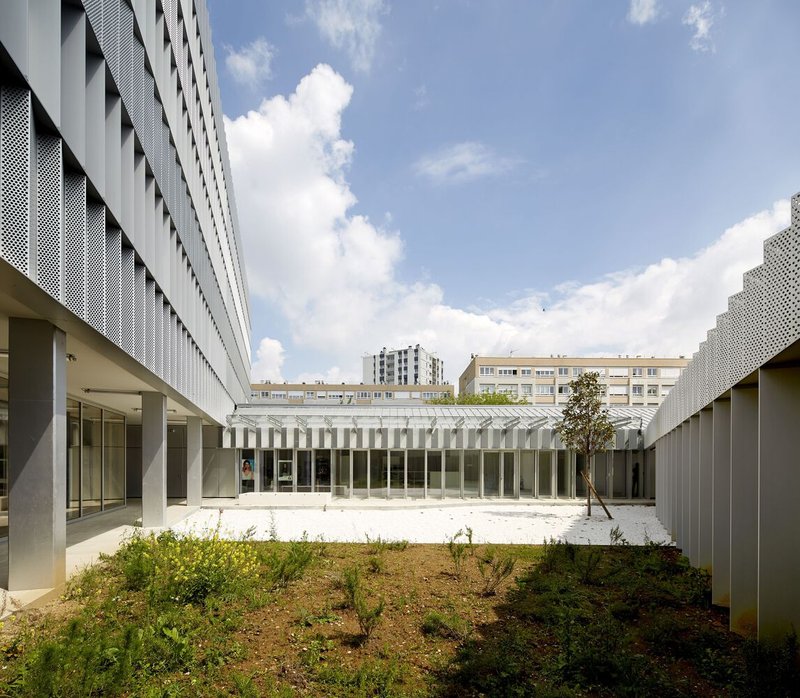
At the city scale, the upper volume—rising to R+3—establishes a strong north–south axis that frames views of the courtyard. Compact and rational, it embodies the logic of a contemporary tertiary high school. The structural system is concentrated along the façades and vertical circulation cores, freeing interior floor plates and ensuring long-term flexibility. This adaptability anticipates evolving educational programs, digital learning environments, and future pedagogical reforms—key considerations in sustainable school design.
A Responsive Envelope: Perforated Metal and Light
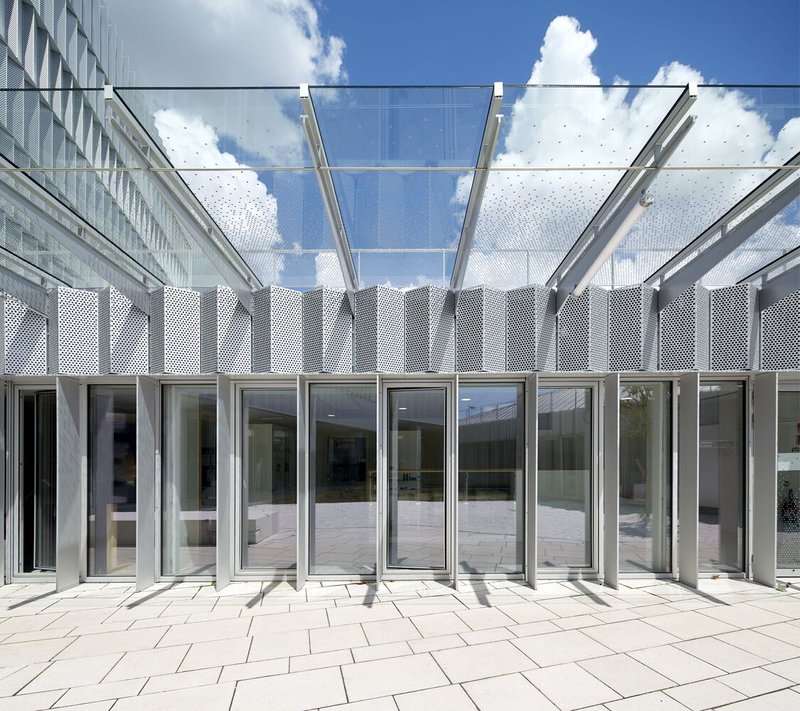
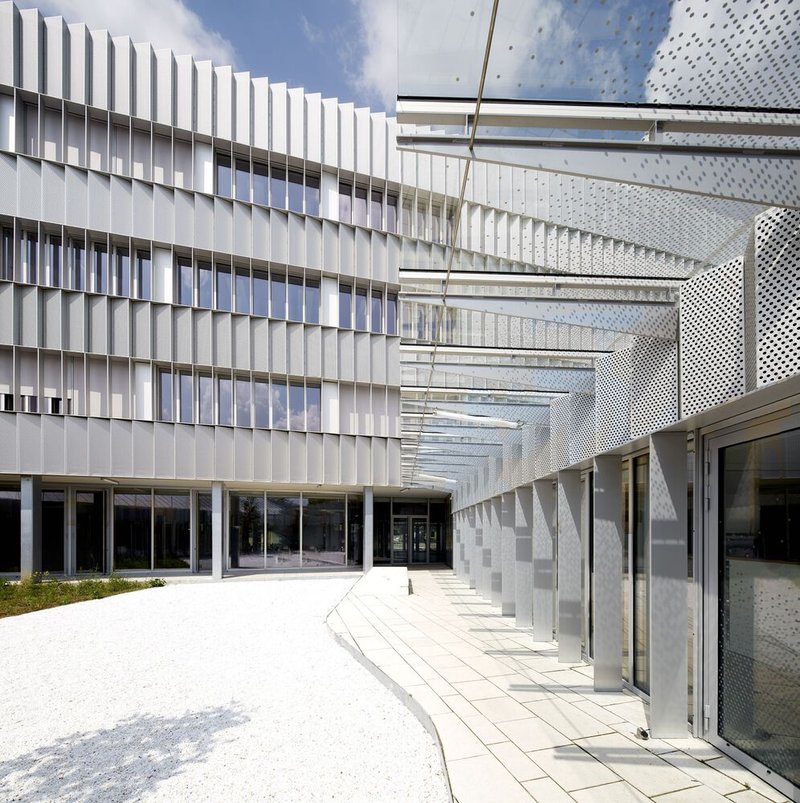
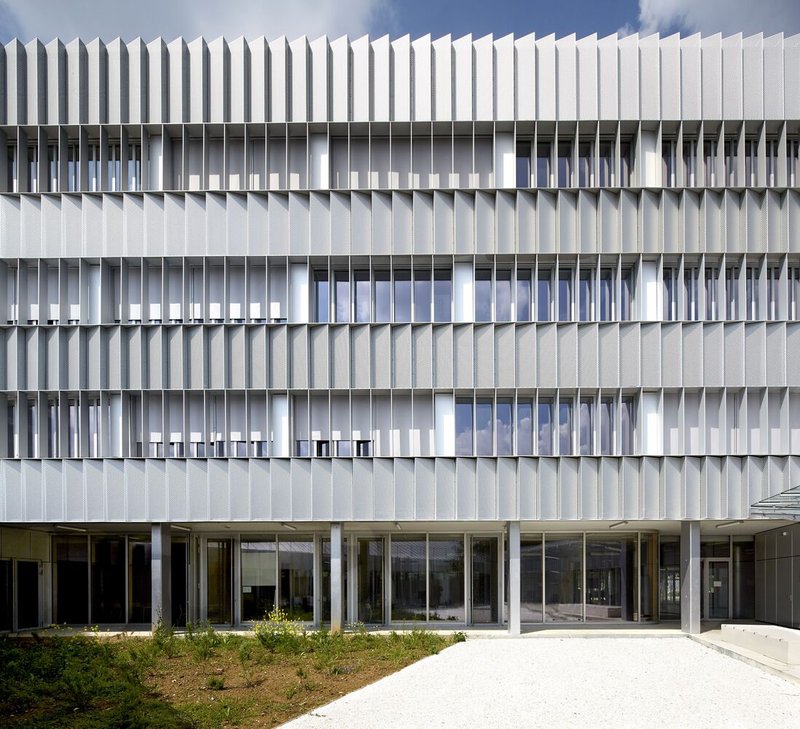
The upper volume is wrapped in a perforated metal mesh, an architectural skin that transforms throughout the day with changing natural light conditions. This double-skin façade functions simultaneously as:
- Solar shading device
- Thermal buffer
- Visual filter framing landscape views
- Protective layer ensuring privacy and security
The mesh generates a dynamic façade identity while enhancing environmental performance. Importantly, all glazing panels are operable from the interior, simplifying maintenance and long-term facility management—an often overlooked aspect of sustainable educational architecture.
Ground-Level Topography and Material Expression
At street level, the tall volume rests on a sculpted base whose free-form geometry introduces a softer urban topography. This lower plinth contrasts with the rigor of the upper block, mediating between institutional scale and pedestrian experience.
Clad in satin white brick, the base echoes the mineral character of the district’s façades while asserting a contemporary identity. The material choice reinforces durability, contextual integration, and tactile quality—key elements in civic architecture. Generous openings establish visual continuity with the street, reinforcing the school’s presence as an accessible and transparent institution.
The visible roofs of the ground floor, overlooked by surrounding dwellings, are treated with large-format metal elements such as Kalzip systems. This refined roofscape integrates technical premises, sheds, and service areas seamlessly into the architectural composition.
The upper roof incorporates a reservoir system for rainwater retention, contributing to sustainable water management strategies. High parapets conceal photovoltaic panels from ground-level views, ensuring the building meets energy performance objectives without compromising aesthetic clarity. Mechanical ventilation rooms are integrated directly within the top level, minimizing rooftop clutter and simplifying maintenance operations.
Reframing the Courtyard: Landscape and Social Connectivity
The project extends beyond architecture to redefine the school’s exterior spaces. By deconstructing former workshop structures and adopting a compact footprint, nearly 2,000 m² of additional courtyard space was reclaimed. This strategic densification enhances both spatial generosity and environmental performance.
A new esplanade extends from the existing courtyard, linking the high school’s main functions—library, hall, dressing rooms, multipurpose areas—and establishing a new principal entrance. The inflection of Rue Léger will eventually create a protected public square, shielded from vehicular traffic and reinforcing the campus as a civic gathering space.
Landscape design plays a central role in integrating the high school into the neighborhood’s green fabric. Existing mature trees are preserved wherever possible, while new plantings align with surrounding streetscapes. The forecourt incorporates permeable paving joints that allow rainwater infiltration, complemented by shallow landscaped valleys designed for phyto-treatment of runoff water. Species such as reed, Japanese horsetail, water lily, and iris contribute to biodiversity while enhancing ecological performance.
Temporary parking areas are planted with street trees, anticipating their future transformation into a tree-lined pedestrian path once relocated. Meanwhile, open meadow zones shaded by boulevard trees reduce future development costs while maintaining spatial continuity.
Educational Architecture as Civic Infrastructure
The Fernand and Nadia Léger High School demonstrates how contemporary high school architecture can serve simultaneously as urban catalyst, sustainable infrastructure, and flexible learning environment. Its compact form, adaptive structural logic, and environmentally responsive envelope align with current best practices in French educational design.
By reframing the courtyard, enhancing permeability, and integrating green infrastructure, the project goes beyond a simple building intervention. It establishes a coherent campus identity while opening new visual connections toward the adjacent park to the west. Exterior spaces are carefully delineated to maintain visibility and safety while offering varied atmospheres for students—spaces for gathering, reflection, and informal learning.
In doing so, toa | architectes associés deliver a project that balances functional efficiency with architectural expression. The result is a resilient, future-oriented educational facility that embodies the transformation of Argenteuil’s urban fabric and sets a benchmark for sustainable secondary school design in France.
All photographs are works of
toa | architectes associés




Popular Articles
Popular articles from the community

Inverted Architecture Installation by Studio Link-Arc: Exploring the Intersection of Architecture and Living Organisms
Inverted Architecture Installation by Studio Link-Arc blends mycelium, sustainability, inverted design, ecological cycles, and urban adaptive architecture in Shenzhen.



Free Architecture Competitions You Can Enter Right Now
No entry fees, real prizes. Here are the best free architecture competitions open for submissions in 2026.


The Ken Roberts Memorial Delineation Competition (Krob)
As the most senior architectural drawing competition currently in operation anywhere in the world, it draws hundreds of entries each year, awarding the very best submissions in a series of medium-based categories.


Similar Reads
You might also enjoy these articles
Free Architecture Competitions You Can Enter Right Now
No entry fees, real prizes. Here are the best free architecture competitions open for submissions in 2026.

Top 15 Architecture Competitions to Enter in 2026
From student-friendly idea competitions to prestigious international awards, here are the best architecture competitions open for entries in 2026. Updated regularly.

DIY & Engineering in Computational Design : Enter the BeeGraphy Design Awards
Showcase Your Creativity with Computational Design and Open Source Projects
Innovative Design Solutions: Award-Winning Projects from Recent Architecture Competitions
Exploring award-winning architectural projects shaping the future of design, sustainability, and community.


Explore Architecture Competitions
Discover active competitions in this discipline




The International Standard for Design Portfolios


The Global Benchmark for Architecture Dissertation Awards


The Global Benchmark for Graduation Excellence


Challenge to design public laboratory
Comments (0)
Please login or sign up to add comments
No comments yet. Be the first to comment!