

WEMAKEPARIS: Turning the Petite Ceinture Into a 24/7 Ring Programmed by Human Actions
A shortlisted Salut Paris entry that reads the railway loop as fifteen stations tied to everyday actions, stitched together by modular pavilions.


Paris has spent decades deciding what to do with the Petite Ceinture, the disused railway that loops around the city. WEMAKEPARIS answers with a refreshingly direct premise: human actions shape urban space, so design the line around actions. The proposal stops treating the railway as a relic waiting for a single grand reuse. Instead it becomes a continuous public ring, open around the clock, where moving, pausing and gathering are written into the architecture.
Designed by Mikhail Skisov, the project was shortlisted in the Salut Paris competition. Skisov proposes a multi-layered corridor that combines mobility, leisure and social life. Its structure rests on a framework of 15 thematic stations, each tied to a human activity. Light modular structures, retained historic rails and a graphic identity system give that framework physical form.
Descending Into the Cutting, With a Lift Tower as Front Door
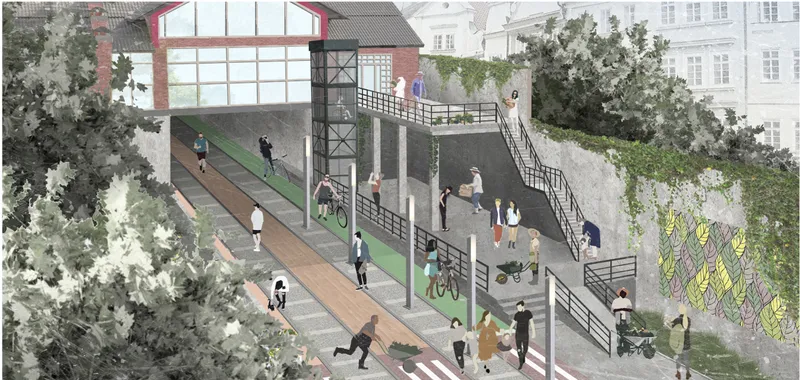
The opening rendering is the clearest statement of how the project handles the railway's peculiar geometry. The line runs in a sunken cutting beneath a bridge, below the level of the street. Skisov does not hide this separation. He places a glass lift tower and a stair at the point of descent. The elevator matters because of the project's emphasis on universal design: a ring that only able-bodied visitors can reach would contradict the whole idea of a shared civic loop.
Look at the retaining wall. Its leaf pattern is more than decoration. It belongs to the graphic identity system that assigns each station its own motif, so a wall of infrastructure doubles as signage. The wall tells visitors where they are on the loop before any map does.
Linearity Broken Into Episodes: Timber Walks, Cycle Lanes and Kiosks
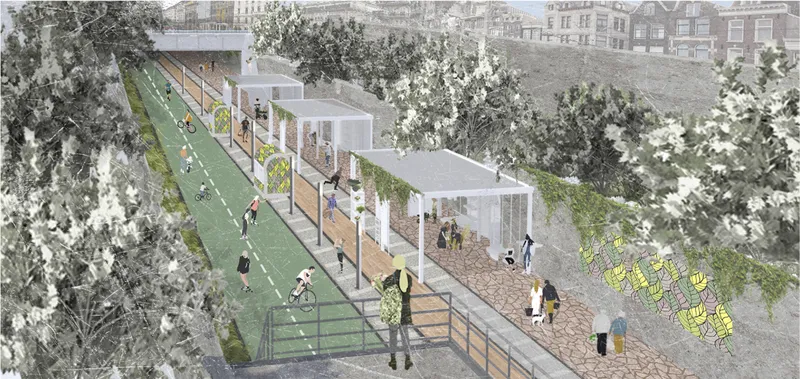
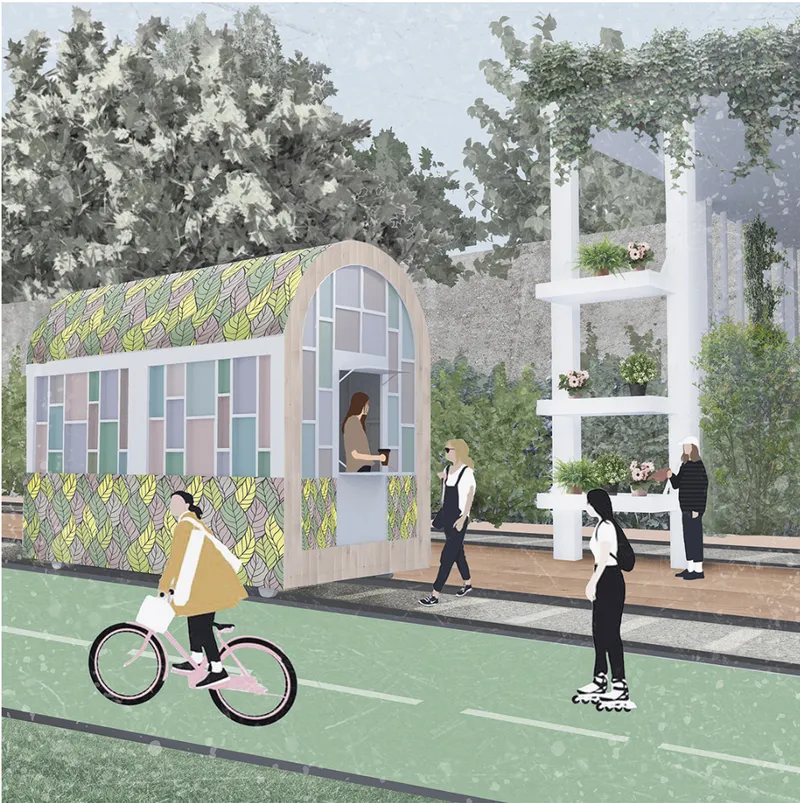
Many linear park proposals fight the monotony of a long, straight line. WEMAKEPARIS uses the line as a structural advantage. The section in these views is legible at a glance. A green cycle lane runs beside a timber walkway, which keeps cyclists and pedestrians on parallel but distinct paths within one continuous corridor. White canopy pavilions punctuate the walk at intervals. The design brief calls these small-scale insertions, pavilions, platforms and canopies, the tools that create episodic experiences without interrupting continuity.
The arched kiosk in the second image shows that episodic logic at its most compact. Leaf-patterned cladding ties it to the station's identity, while stained-glass windows give the small volume an almost chapel-like presence beside the cycle lane. The white plant shelf next to it hints at what the stations are meant to host: occupation that users can rearrange, rather than objects to admire from the path.
A Pavilion That Asks to Be Tended
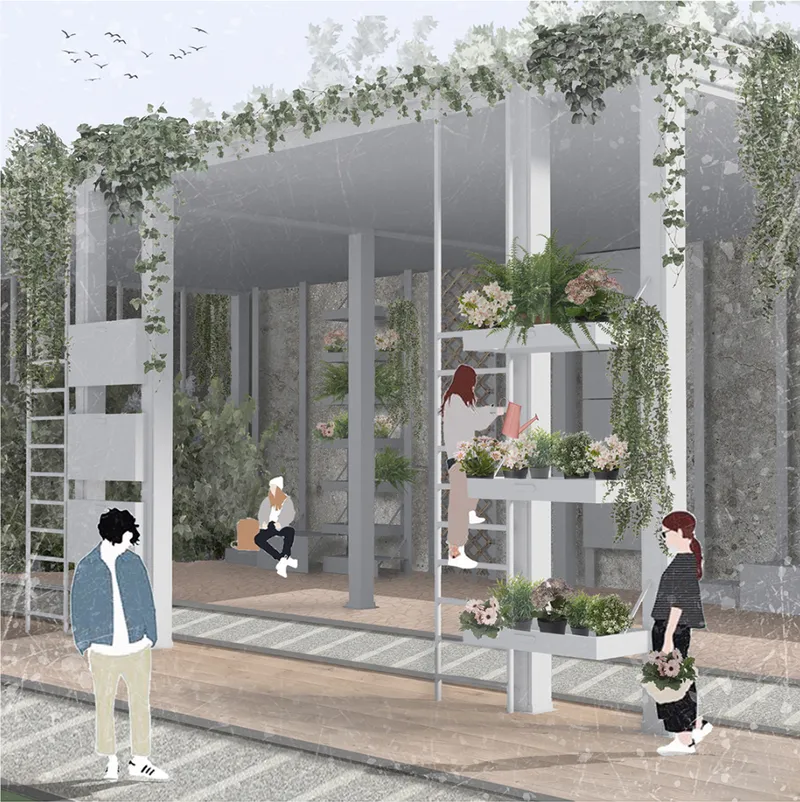
This is the image that best captures the Names-Actions framework. A white canopy pavilion with ivy-draped columns carries shelves of potted flowers, and a woman on a ladder waters them. Here architecture acts as a support for an activity. The structure is lightweight and modular, part of a kit the proposal deploys across different stations so the system can grow or change without large-scale reconstruction.
The framework deliberately avoids locking functions in place. Stations act as programmatic anchors, but users are expected to reinterpret them over time. A pavilion of shelves and columns is open-ended enough to allow that: today a flower stand, tomorrow something its users decide. That open-endedness is a sound bet for a ring meant to serve pedestrians, cyclists, tourists and residents at every hour.
Why This Project Matters
WEMAKEPARIS is persuasive because it is modest in the right places. It keeps the existing rails as visual and historical artifacts. It follows the line rather than reshaping it, and it relies on cost-effective, repeatable structures instead of signature buildings. That restraint turns the Petite Ceinture into a framework that can absorb change, which is exactly what a 24/7 public infrastructure needs.
The proposal also makes a broader case for programming public space through behaviour rather than fixed use. Fifteen stations tied to human activities, each marked by a graphic identity that extends into signage, merchandise and urban branding, give the ring both coherence and character. Skisov has proposed more than a park on an old railway. He has proposed a civic system in which the city's residents complete the design simply by using it.
View the Full Project
About the Designers
Designer: Mikhail Skisov
Enter a Design Competition on uni.xyz
uni.xyz runs architecture and design competitions year-round that reward proposals with spatial conviction and real site intelligence.
Project credits: WEMAKEPARIS by Mikhail Skisov Salut Paris (uni.xyz).


Popular Articles
Popular articles from the community


David Ortega Stacks a Two-Story Mexico City Penthouse Around a Steel Stair and a Pergola-Shaded Roof Terrace
In Colonia Roma, a 300 m² penthouse uses oak joinery, a planted steel stair and a slatted roof pergola to make a new-build apartment feel like a house.


Aquadapt: An Underwater Habitat That Rewrites Its Rooms by the Hour
Curved modules ring the seabed while one shell shifts from breakfast room to cinema, farm and football pitch as residents' needs change.

Manzana Morphosis: Stretching Barcelona's Grid into a Living Landscape for 2050
A radical reworking of the Eixample manzana turns density into a tool for generous public space, vertical ecology, and environmental performance.

ETEH Reworks the Shared Spaces of São Domingos School in Brazil Around Timber, Color and Hanging Plants
At São Domingos School in Brazil, 436 m² of hall, refectory and library are recast with timber joinery, a yellow and blue code and trailing greenery.

Similar Reads
You might also enjoy these articles
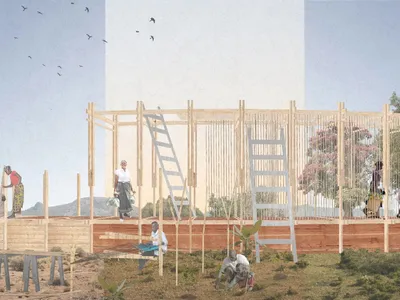
Healing Façade: A Modular Chapel System That Restores Ethiopia's Sacred Forests
Winner of the Eco-Chapel competition, this circular timber façade collects water from air to rebuild soil and reforest degraded Ethiopian landscapes.
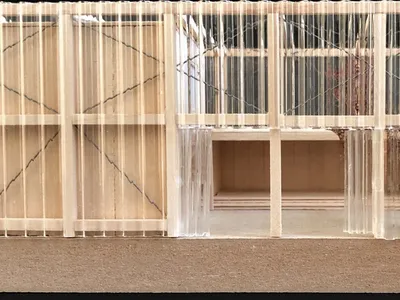
Kaffeebühnen: Where Coffee Shop Architecture Becomes a Civic Stage in Vienna
A linear sequence of timber boxes, transparent shells, and open yards turns the Viennese café tradition into a public performance space.
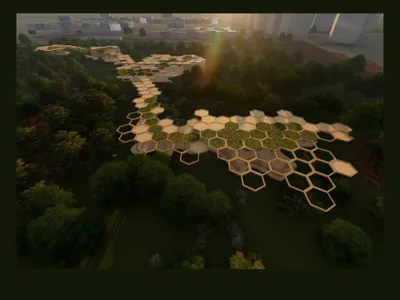
Eco Chapel: A Modular Forest Pavilion That Grows Like the Landscape It Protects
Hexagonal timber modules weave through existing trees, turning a chapel into a living system for prayer, education, and reforestation.


Urban Forest: A Vertical Ecosystem for 5,000 Workers in Singapore's Changi Business Park
Radially stacked pods and layered green decks turn a 7-acre plot into 47 acres of ecological workspace projected for 2040.

Comments (1)
Please login or sign up to add comments
Before reimagining a railway line that has NOT BEEN DECOMMISSIONED—and which remains part of the national rail network—it would be wise to check its status. This railway line is being preserved for potential future transport use, as is the case in other major cities around the world (Tokyo, Berlin, Moscow, etc.). The developments carried out on the right-of-way are REVERSIBLE and not permanent. The author of the article might have had the good sense to consult the reference website dedicated to this line before publishing…