
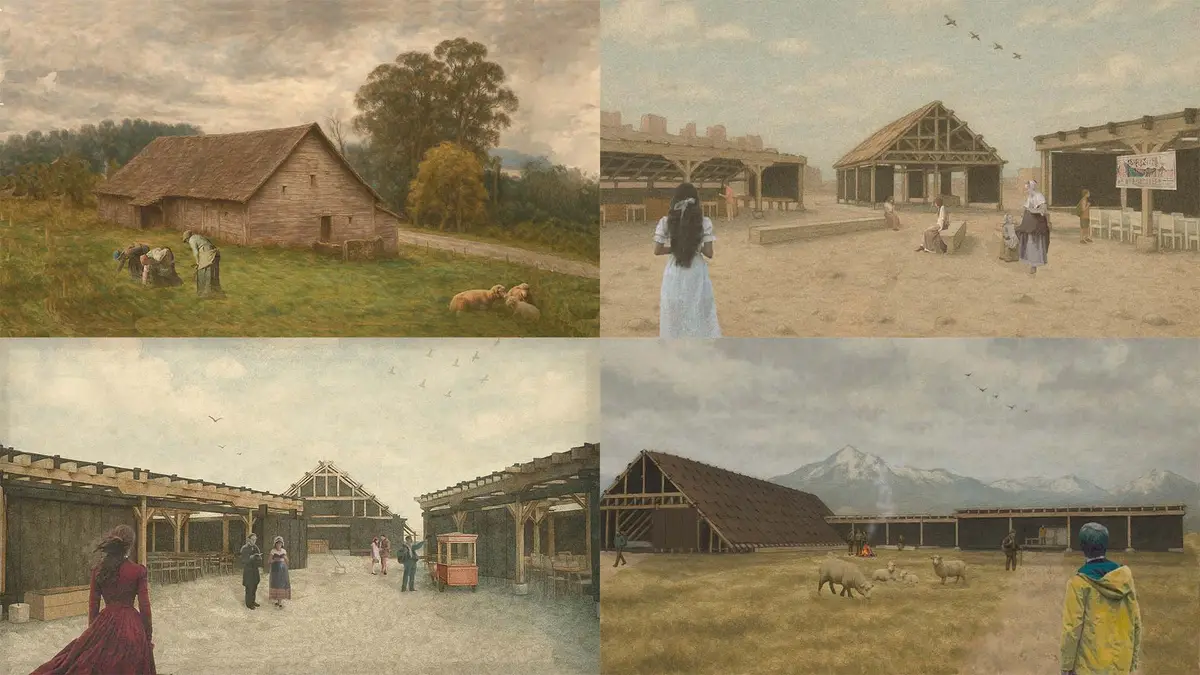
New artifacts based on the typological reformulation of assembled wooden barns
Why build new when we can reuse? This project proposes a methodology to disassemble and enhance heritage warehouses around Lake Llanquihue, quantifying and codifying their parts to create mobile structures for cultural programs across Chile, adaptable to diverse cities and identities.
Project Media
0. ASSAMBLY AND DISASSAMBLY
The methodologies of assembly, order and disassembly and their translation to architecture
01. Inventory and categorization of lake Llanquihie’s barns
SHED AS RUIN TO BE VALUED The ancient wooden sheds around Llanquihue Lake feature wood joinery and connection techniques that offer the possibility of being disassembled and reassembled, allowing for the reuse and relocation of part or the entirety of the structure. Understanding that these sheds have a high historical and cultural value, yet are little recognized, the proposal is to take advantage of their detachable qualities to move them and, while maintaining a cultural role, put them in va
02. Case: Cultural Typologies
Dismantling of the original shed. Structural breakdown, breakdown by role, classification and coding of parts
03. Design strategies
possible architectural typologies to assemble
04. Design strategies. Arming strategies
Typological classification and system of expansion, modification and compatibility. Common parts are established depending on the sector from which the typologies of the original shed originate, simplifying the piece by piece to a common group that helps to know if the typologies are compatible, depending on their size.
05. Design strategies
Relocation and adaptability strategies. New modular support and cladding components
06. Design strategies
Programmatic choices and spatial configuration of each of the three proposed project variants. The most suitable typologies for a geological fair in the desert, an academic forum on the coast, and a gastronomic and sheep-farming cultural gateway in Patagonia.
07. Heritage and wood treatment
The project reuses heritage timber pieces from a disused shed, preserving their constructive logic and historical memory. It proposes a dismantlable, transportable system responding to wear and environmental exposure. Cladding elements embrace the timber without intervening, protecting and revealing its marks and joints, while treatments ensure durability. The structure acts as an active cultural artifact adaptable to new contexts and uses.
08. Construction and structure
The project’s constructive approach stems from a deep respect for the original logic of the dismantled barn. Each piece is understood as both material and bearer of technique and memory. Rather than intervening, it is carefully disassembled, preserved, and reassembled under reversible criteria. Construction becomes language, with mounting and cladding systems that accompany the original structure, enabling adaptation, stability, and reuse across new territories.
09. Design Strategy. Geological fair in Huanchaca’s ruins, Antofagasta, Chile.
The shed’s components are reassembled to create a space dedicated to showcasing and enhancing mining cultural heritage through exhibitions, workshops, and fairs. Four typologies are used (Corridor 1, Corridor 2.1, Corridor 4, and Shade Structure 1). A total of 642 of 1,384 pieces are reused, including 500 plywood panels. 46.5% of the original barn pieces.
10. Design Strategy. Academic forum in Valparaiso, Chile
The barn’s components are reassembled into three distinct stages and an access pavilion organized around a shared courtyard for university gatherings, lectures, and academic activities. Four typologies are used (Corridor 1, Corridor 4, Shade Structure 1, and Nave 0). A total of 738 of 1,384 pieces are reused, including 500 plywood panel. 55% of the original barn pieces.
11. Design strategy. Cultural gateway of Puerto Natales
The original barn’s components are reassembled to create a space dedicated to gastronomic and sheep-farming culture, acting as a gateway to Puerto Natales and its tourist destinations. Three typologies are used (Nave 0, Corridor 1, and Corridor 4). A total of 741 of 1,384 pieces are reused, including 420 SIP plywood panels and 165 plywood panels. 53.5% of the original barn pieces.

Project Score
Project Team (1)

Project Owner
PUBLISHED ON 4th May 2026

Explore Cultural Architecture Competitions
Discover active competitions in this discipline


Challenge to design locus for the upliftment of human rights

Challenge to reimagine the Iron Throne

Photograph architecture without architects

Illustrate the lost glory of Angkor Wat - Render Challenge
Similar Projects
Discover related projects you might like









Comments (1)
Please login or sign up to add comments
A strong and well-researched project that creatively rethinks the reuse of traditional wooden barns. The systematic classification, coding, and reassembly of existing components into adaptable structures is a clear strength. The project has a strong and original idea, although the final architectural and spatial outcomes could be developed further. Overall, a thoughtful and promising approach to heritage reuse.