

Toy Design
Design and development of toys, from concept through production, including mechanics, materials, and user experience.
Toy design is the practice of inventing, shaping and developing objects for play, from a first idea through prototypes, safety testing and manufacture. A toy designer works out how a child will hold, move, build or imagine with an object, then chooses forms, materials and mechanisms that make that play safe, durable and worth returning to. The discipline sits between product design, child development and storytelling.
What is toy design?
Toy design covers every decision that turns a play idea into a physical (or increasingly, connected) product: the play pattern, the age group, the size and weight of parts, the material, the colour, the way pieces join and the packaging that explains it all. It is a branch of product design, and uses the same tools of sketching, 3D modelling, prototyping and design for manufacture. What sets it apart is the user. Children are not small adults: they mouth objects, drop and throw them, use them in ways nobody planned, and outgrow them quickly. A toy has to survive that and still hold a child's attention.
The field also overlaps with game design, which focuses on rules, goals and turns rather than the object itself, and with the design of playgrounds and play spaces, which works at the scale of a room or a park. A board game needs both: a rule system and a set of pieces someone has to design. Toy designers therefore borrow from several disciplines at once. They study how children develop, test ideas through observation rather than surveys, and think about parents and teachers, who usually buy the toy, as a second audience with different priorities.
The output ranges widely: wooden blocks and pull-along animals, construction systems, dolls and figures, puzzles, ride-on toys, science kits and app-connected robots. What links them is the goal of designing a good experience of play, not only a good-looking object.
A short history of toy design
Children have always played with objects, but toy design as a deliberate, theory-led practice is usually traced to the German educator Friedrich Froebel. For the first kindergarten he designed a sequence of play materials, the Froebel gifts, which were made in Bad Blankenburg from 1837. As the Froebel Trust explains, the sequence began with soft balls and a wooden sphere, cylinder and cube, then moved on to wooden blocks based on different divisions of the cube. Each was meant to help children learn about objects, form and spatial relationships through handling.

The blocks reached well beyond the nursery. Frank Lloyd Wright was given a set at about the age of nine and later credited kindergarten play with teaching him the geometry he used as an architect.
"... these were smooth maple-wood blocks. All are in my fingers to this day."
Frank Lloyd Wright, An Autobiography, as quoted by Anthony Alofsin (1993)
In 1901 Frank Hornby, a clerk from Liverpool, patented a construction kit called "Mechanics Made Easy": perforated metal strips, plates and girders joined with nuts and bolts. As the kits spread they became known as Meccano, a trademark Hornby registered in 1907. Meccano turned engineering principles into a toy and set a template for open-ended construction systems.

In Rome, Maria Montessori opened her first Casa dei Bambini in 1907, and the Montessori method built learning around specialised materials, often made of wood, that children learn from by working with them rather than through direct instruction. In Denmark, the carpenter Ole Kirk Christiansen began making wooden toys in 1932; his company, Lego, moved into plastic toys in the late 1940s and filed a Danish patent application for the modern brick design on 28 January 1958. Designers outside the toy trade took toys seriously too: Charles and Ray Eames, better known for furniture, designed The Toy (1951) and House of Cards (1952).
The toy design process
Studios differ, but most toys move through the same stages. Searches for "how to design a toy" are really asking about this sequence.
- Research and play observation. Watch children play with existing toys and everyday objects. Note what they repeat, what frustrates them and where they invent their own rules.
- Age grading. Decide who the toy is for. Age sets part sizes, force needed to operate mechanisms, reading level of any text and the warnings the package must carry.
- Concept sketches. Generate many ideas quickly, then narrow down to a few play patterns worth testing.
- Prototyping and play-testing. Build rough models in foam, card, wood or 3D prints, put them in children's hands early and revise. A prototype that children ignore is useful information.
- Materials and manufacturing. Rigid plastic parts are usually injection moulded, which demands draft angles, even wall thickness and expensive steel tools. Hollow soft vinyl figures and balls are often rotationally moulded, while rubber and silicone parts are moulded under heat and pressure. Wooden toys are turned, cut or routed, then finished with child-safe coatings.
- Safety testing and standards. In the United States the relevant standard is ASTM F963, which covers toys for children under 14 and considers reasonably foreseeable abuse as well as normal use. In the European Union toys must meet the essential requirements of the EU toy safety rules and carry a CE marking; the harmonised EN 71 series of standards sets out the detailed tests.
- Packaging. The box explains the play, shows the age grade and warnings, protects the parts and increasingly has to justify its own material use.

Types of toys
- Construction toys: blocks, bricks, beams and connectors that children assemble into their own structures.
- Educational and STEM toys: objects designed around a learning goal, such as letters, counting, circuits or simple machines. See also educational play.
- Pretend play: dolls, figures, kitchens, tools and vehicles that let children rehearse adult roles.
- Puzzles: jigsaws, shape sorters and logic puzzles with a defined solution.
- Outdoor and active toys: balls, ride-ons, kites and climbing frames that build strength and coordination.
- Sensory toys: textures, sounds, weights and light for babies and for children who seek or avoid sensory input.
- Digital and connected toys: physical toys linked to apps, sensors or programmable logic.

Toy design ideas
For students looking for toy design ideas, these directions are open and well suited to a studio project:
- Sustainable materials: design for wood, cork, recycled or bio-based plastics, and for disassembly so parts can be repaired or recycled.
- Inclusive and accessible toys: tactile markings, high-contrast colours, larger grips or play that works seated, so children with different abilities can play together.
- Toys that grow with the child: a set that starts as stacking blocks and later becomes a building or counting system extends the toy's life.
- Architecture-inspired building toys: kits based on structural systems such as timber frames, arches or tensile structures, an obvious brief for architecture students.
Key principles of toy design
Safety first
Every other decision sits below safety. Designers check for small parts a young child could swallow, sharp edges and points, cords that could strangle, pinch points in hinges, and the chemistry of paints and plastics. Designing for misuse matters as much as designing for use.
Age-appropriate challenge
A good toy is pitched just beyond what the child can already do. Too easy and it is abandoned; too hard and it frustrates. Member Balaji Manoj framed his train toy exactly around this early-learning stage.
"I design the train toy as their learning equipment, they can learn words in their early stage of education."
Balaji Manoj, Educational Train Toy, project statement on uni.xyz

Open-ended play
The toys that last, from Froebel's blocks to Meccano, set few rules. They give children parts and let them decide what to make, which keeps the toy useful as the child's ideas grow.
Durability and materials
Material decides how a toy feels, how long it lasts and how it can be made. Flexible silicone, for example, allows a mould to release a detailed form again and again.

Inclusivity
Toys can widen or narrow who gets to play. Avoiding rigid gender coding, designing for different bodies and senses, and showing a range of people in figures and packaging all broaden the audience.
Sustainability
Toys are often used briefly and then discarded. Designing for durability, repair, hand-me-down use and recyclable materials reduces that waste.
Toy design on uni.xyz
Toy design is a young topic on uni.xyz, and the work published under it so far is small but varied, ranging from learning toys to playful objects and play environments. Here are the pieces that best show the range.
Educational Train Toy by Balaji Manoj is the clearest example of a classic learning toy. It is built around the moment children start learning the alphabet: they assemble words in the train's carriages, with an alphabet chart provided to guide them. It is a neat case study in turning a learning goal into a simple, repeatable play action.
Frozen Mountain by Aron Wai Chun Tsang is a silicone ice mould of some of Hong Kong's most iconic natural mountains. It received a Special Mention in the International Product Design Awards '19 competition. The designer hopes that, through these daily objects, the public will rethink its relationship with nature and notice development policies that could destroy that habitat. It shows how a playful object can carry a message.
Bismuth Digits by Stepan Drunks, entered in the Beegraphy Design Awards competition, is a parametric trinket generated from a pattern inspired by bismuth crystals. It can label keys, become an earring or turn a favourite book title into a 3D object to fidget with.
"Bismuth Digits is a parametric trinket for all your numbering needs."
Stepan Drunks, Bismuth Digits, project statement on uni.xyz

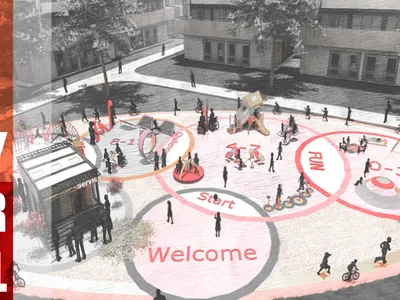
At the larger scale of play, the journal Play for All by Riham Faragallah looks at an interactive playground in a technological era, a useful companion for anyone moving from toys to playground and play space design.

If you design toys, this is an open invitation: publish your prototypes, play-tests and process sheets so other members can learn from them. Play-themed briefs also appear regularly on uni.xyz competitions, and past examples include Sbabam New Toy Design and Re-imagining Play.
Challenges and future directions
Plastics and sustainability. Most toys are plastic, many are short-lived and mixed-material products are hard to recycle. Designers are testing bio-based plastics, recycled feedstock, wood and designs that come apart for repair. New EU rules point the same way: the Toy Safety Regulation adopted in 2025 will require every toy to have a digital product passport once it applies from 2030.

Screen time. Physical toys now compete with tablets and games. The interesting design space is the mix: physical toys that use digital features without replacing hands-on play.
Safety recalls. A single hazard, such as a detachable small part or contaminated paint, can force a recall, so rules have tightened over time. As the overview of toy safety law notes, the CPSIA adopted ASTM F963 as a requirement and restricted lead and phthalates in children's products.
Cost. Injection mould tools are expensive, so small studios often start with wood, 3D printing or short production runs before committing to tooling.
Toy design for students and designers
A toy project makes a strong portfolio piece because it shows the whole design cycle at a small scale: research with real users, iteration, materials and a finished object. Document your play-tests with photos and notes, not only renders. Thesis angles include toys for inclusive play, toys made from local craft traditions, building toys based on architectural systems and toys that link to design for children at the scale of rooms and furniture.
A few art and design schools offer dedicated toy design degrees, but many toy designers come from industrial design or product design courses. Competitions on uni.xyz are a good way to test an idea against a brief and a jury.
Frequently asked questions
What is toy design?
Toy design is the process of creating objects for play, covering the play idea, the age group, form, materials, mechanisms, safety and packaging. It is a specialised form of product design focused on children and play.
How do you design a toy?
Start by observing how children of your target age play, then sketch many concepts. Build quick prototypes, test them with children, refine, and then design for manufacture and safety testing before packaging.
What makes good educational toy design?
Educational toy design starts from a clear learning goal, such as letters or counting, and turns it into a play action children want to repeat. The learning should come from doing, not from instructions.
How are rubber toys designed and developed?
Many "rubber" toys are soft vinyl formed hollow in a rotating mould, while rubber and silicone parts are moulded under heat and pressure. Designers prototype the shape, then work with the manufacturer on wall thickness, mould splits and material safety tests.
What are some good toy design ideas for students?
Try toys that grow with the child, toys made from sustainable materials, accessible toys that children of different abilities can share, or a building set based on an architectural system.
References and further reading
- Froebel gifts, Wikipedia
- Froebel's Gifts, Froebel Trust
- Meccano, Wikipedia
- Montessori education, Wikipedia
- Lego, Wikipedia
- Charles and Ray Eames, Wikipedia
- ASTM F963-23 Standard Consumer Safety Specification for Toy Safety, ASTM International
- Toy safety, European Commission
- EN 71, Wikipedia
- Toy safety, Wikipedia