
Play for All
An interactive playground in a technological era

Playgrounds have occupied a special place in the hearts and minds of several generations. However, far from the humble of childhood playgrounds, with their steel swings, monkey bars and slides, the 21st century playgrounds are much bigger, brighter and even more fun due to the advances in playground thinking and design.
Modern playgrounds are more than just play spaces; they are community spaces. They have the power to create strong, healthy communities where children experience a sense of belonging and benefit of an active lifestyle which ensure that they are given priority to planning and design of cities and towns.
Today’s playgrounds include everything such as technological plays, walking tracks, services, amenities, ….etc. They are inclusive playgrounds which play a significant role in providing physical, emotional and social development opportunities for all children ages, abilities and cultures. The potential to use technology to engage children of all ages in active plays is huge and to date which helped in the development of game-based playground worldwide. In addition, there is a growing awareness of how technology can give parents, careers, schools and child health organizations the ability to monitor play levels and development outcomes, as well as playground usage.
One of the main benefits of introducing technology into playgrounds is that it can encourage children to play games that require them to be active, no matter what their levels of ability. Technology-based games can adapt to the level of the child’s ability, so if a child is quick, for example, a game can speed up to make it harder, while if another child is slower it can slow down to match their abilities. This helps to encourage children of all abilities to play the game and not just those who are naturally agile and fast. Another benefit is the fact that children are used to technology being part of their everyday lives. This means that they will easily engage with technological playground equipment, but, because they are so used to technology, it won’t take them away from traditional playground equipment either.
Instead of making children less sociable and active, technology is a great way of engaging and attracting children to get more from their playtime. This means that although still in its early stages it is likely that over the next few years more and more playgrounds will start embracing technology driven playground equipment and soon it will become as common as the traditional slides and swings.
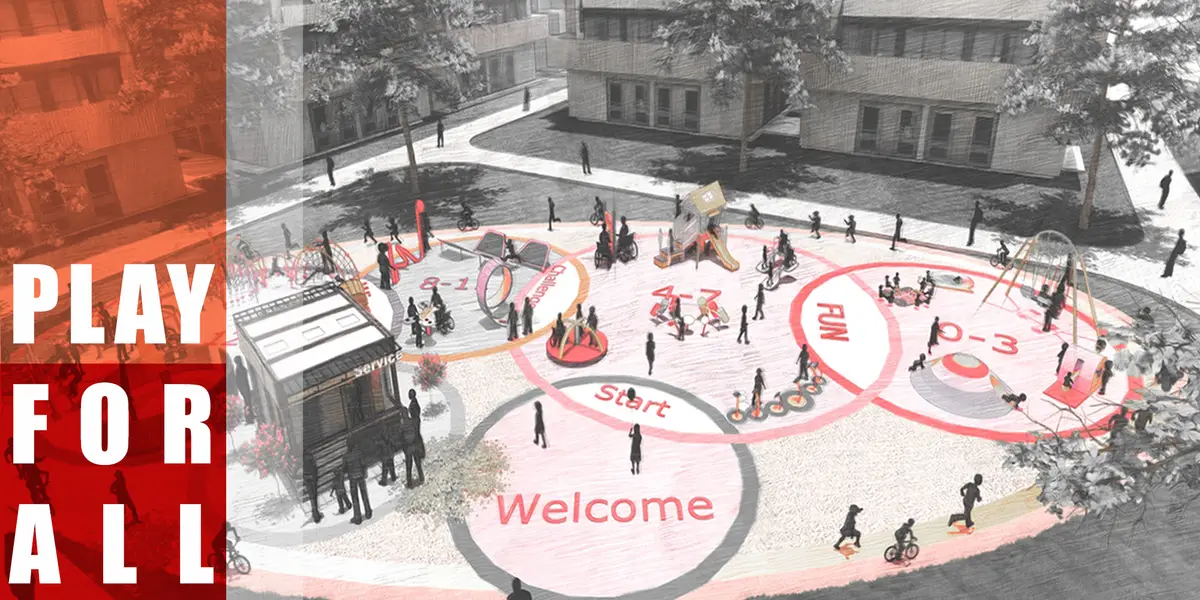
Playground for all is in Madinaty Gated community in Cairo, Egypt. It is a residential community with high-rise residential buildings. The site is located between these towers with a rectangular shape of an area about 1.350 square meter with one main entrance. The concept of the playground generates from the new game-based technologies that kids use today. All the plays are connected to new technologies such as their mobile phones, tablets, ….etc. The main idea is the simulation for transportation systems such as cars, helicopters and others in the form of seasaws, the cockpit and cycling. This simulation tools help the children to understand the surrounding environment around them easily in innovated ways and adventurous at the same time.
The playground is divided into 4 main zones:
- Baby zone (age 0-3)
- Toddlers zone (age 4-7)
- Kids zone (age 8-11)
- Teens zone (age 12-15)
In addition to a break area where parents can sit and monitor their children or can practice any activity such as gathering, reading, training, relaxing, working online, …. etc. or walking around the big track that is located at the edge of the playground.
In this way, playgrounds become virtual landscapes that ignite young imaginations, interactive games drive engagement between parents and children and peer-to-peer relationships, mobile technology encourages older children / teenagers to get active outdoors, data aids motivational development, psychology and health research, technology that enhances playground safety and surveillance and usage data informs capital investment and playground planning. The children gain a big experience concerning their surrounding environment and help them to discover new techniques and skills in themselves which give self-confidence and information for their future life.


Popular Articles
Popular articles from the community


Opera by the Sea Estonia: Three Shells Dissolving Architecture into Tallinn's Coastline
A winning opera house proposal replaces monumental form with interconnected shells that blur the boundary between building, park and Baltic Sea.

Manzana Morphosis: Stretching Barcelona's Grid into a Living Landscape for 2050
A radical reworking of the Eixample manzana turns density into a tool for generous public space, vertical ecology, and environmental performance.

Faces of the Soviet Avant-Garde: Turning Moscow's Street Names into an Open-Air Museum
A network of sculptural installations across a Moscow residential district transforms forgotten architect names into spatial encounters with cultural memor
Temporary Home for Dogs: A Reversed Zoo Rethinks Animal Shelter Architecture
In Bucharest, a sinuous corridor and freed landscape flip the logic of containment, designing a shelter that works to make itself unnecessary.

Similar Reads
You might also enjoy these articles
Sustainable Architecture Design: Embracing Nature and Modernity at Villa Solsidan
The article explores Villa Solsidan by AndrénFogelström, showcasing its sustainable architecture design and integration with the natural surroundings in Saltsjöbaden, Sweden.


Maya Harvest: A Cacao Resort Village Rooted in Mayan Tradition and Local Craft
Situated within a Tabasco cacao plantation, this shortlisted resort proposal merges vernacular materials with hands-on cultural immersion.
Harmonia: A River-Shaped Community That Grows Over Decades in Boa Vista
Curved pathways and modular grid structures along the Branco River create a phased settlement designed to evolve from 2030 to 2050.

The Architecture of Bathing: A Mughal Hammam Reimagined Across the Yamuna
Charlotte May's honorable mention entry for The Black Taj reinterprets Agra's bathing rituals through red sandstone, water, and framed views of the Taj Mah


Comments (0)
Please login or sign up to add comments
No comments yet. Be the first to comment!