

The NEON Culture: A Field of Pavilions Built for the 24-Hour City
Smaran Alva spreads galleries, stages, clubs and markets across a varied site, treating light, sound and ramped movement as the real building materials.


Most buildings are designed to stay put while the city around them changes. The NEON Culture starts from the opposite premise: if trends are fleeting, attention is fragmented and the urban day never really ends, then architecture has to stop behaving like a container and start behaving like a participant. The project calls itself a manifesto for experiential architecture. The more interesting claim sits underneath that label. It suggests that modern users want moments rather than monuments, and that a building's job is to choreograph those moments through atmosphere, movement, sound and light.
Designed by Smaran Alva and published as a project on uni.xyz, the proposal takes on a site analysed layer by layer: vegetation, slope, accessibility, noise and existing man-made features. It then distributes a 24-hour programme across it. Gallery spaces, a performance centre, nightclub spaces, and market and public zones are not stacked into one block. They are dispersed as a family of pavilions, linked by circulation and sightlines into what the designer describes as an experiential ecosystem.
A Long Box in a Grass Field, Tuned for Controlled Light
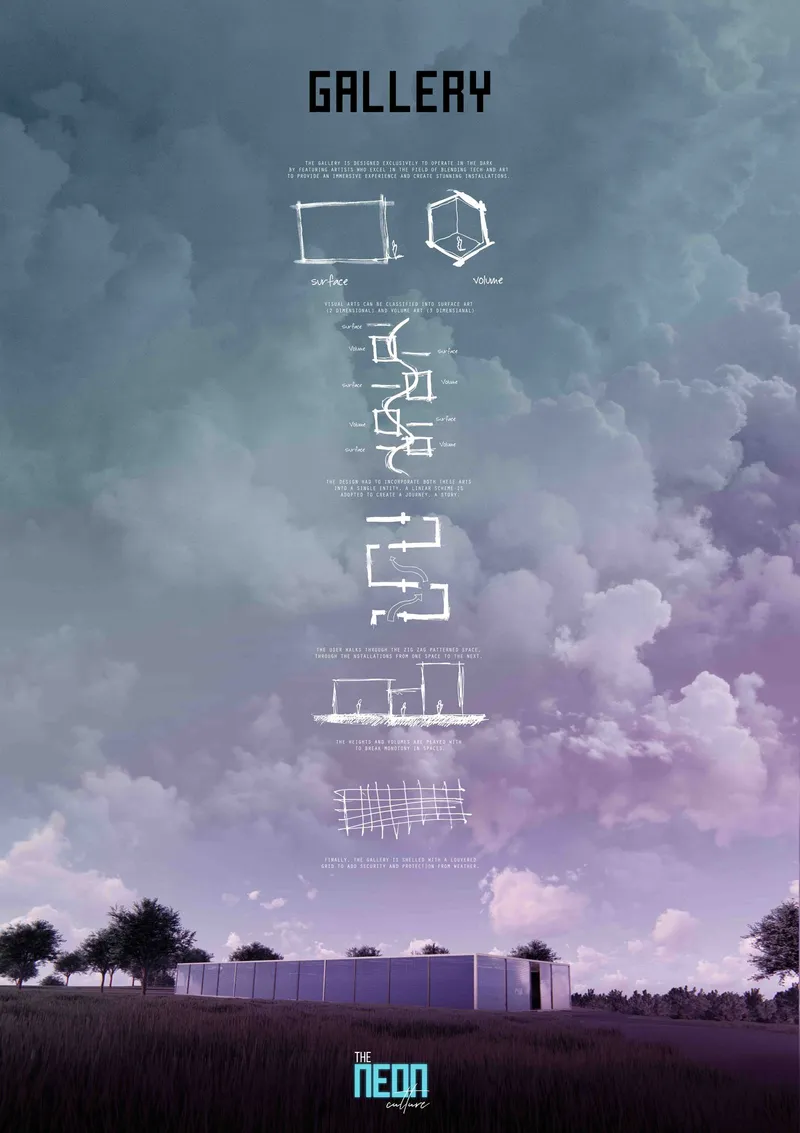
The opening board sets up the gallery pavilion as a long, low, panelled volume sitting in open grass under a purple sky. The concept diagrams treat the box as a filter, not a monument. That reading fits the brief Alva sets for the galleries: spaces for immersive visual and digital art that operate mainly in controlled lighting conditions. A shallow, elongated form like this is a practical choice for that programme. It gives the curator a long run of wall and a sequence of rooms that can be darkened or opened as the work requires.
The render's dusk palette also makes a point. This pavilion is drawn at the hour when the site changes shift, as daytime gallery visitors leave and the evening programmes begin. The image suggests that the 24-hour idea depends less on any single building and more on how each one reads against the light cycle.
Shifting Ceilings and the Logic of Compression
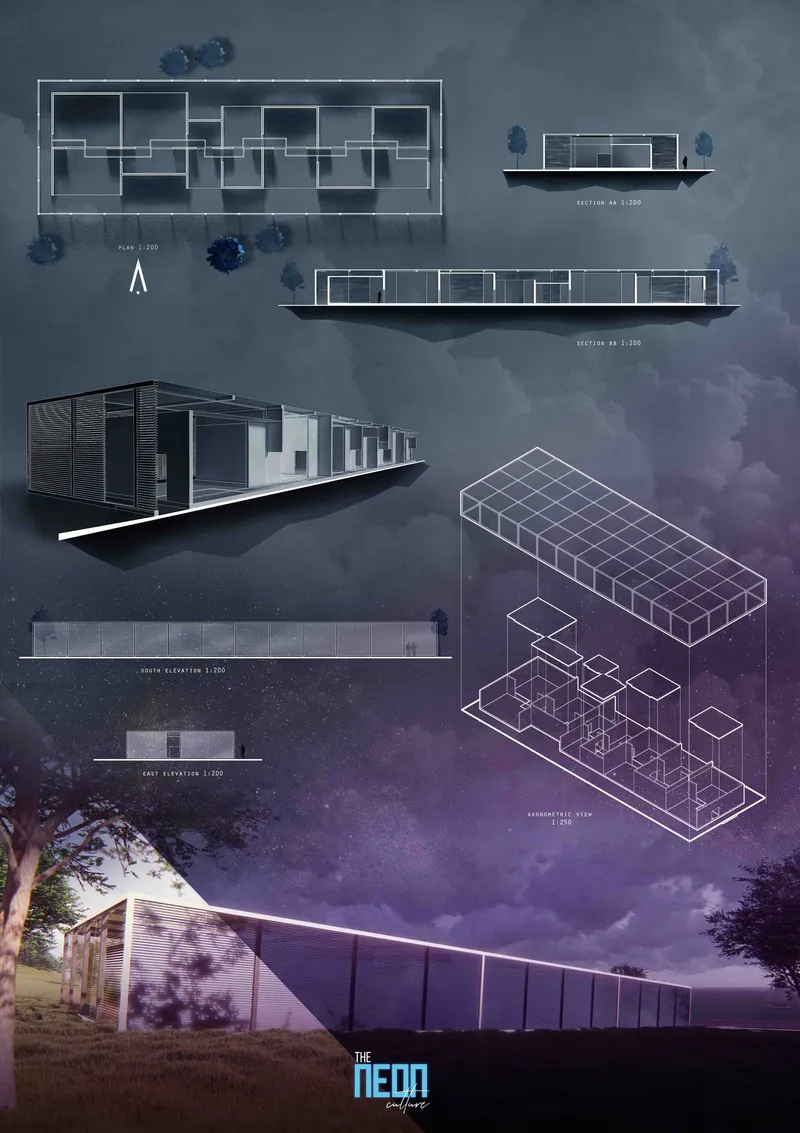
The technical board is where the manifesto has to prove itself, and it largely does. Plan, two sections, elevations and an exploded axonometric break the glass pavilion into its layers. This makes visible the strategy Alva describes in the text: zig-zagging paths, layered volumes and ceiling heights that keep recalibrating perception. The sections matter most. They show that compression and release are built into the profile of the roof and floor, not added later through lighting effects.
This is the project's strongest idea. By refusing rigid linearity, the architecture asks visitors to discover the building rather than pass through it. The glass skin seen in the dusk render below the drawings sets up the second half of that sequence. At night the pavilion becomes a lantern, and the movement inside becomes part of the view from outside.
Lifting Off the Ground Among the Trees
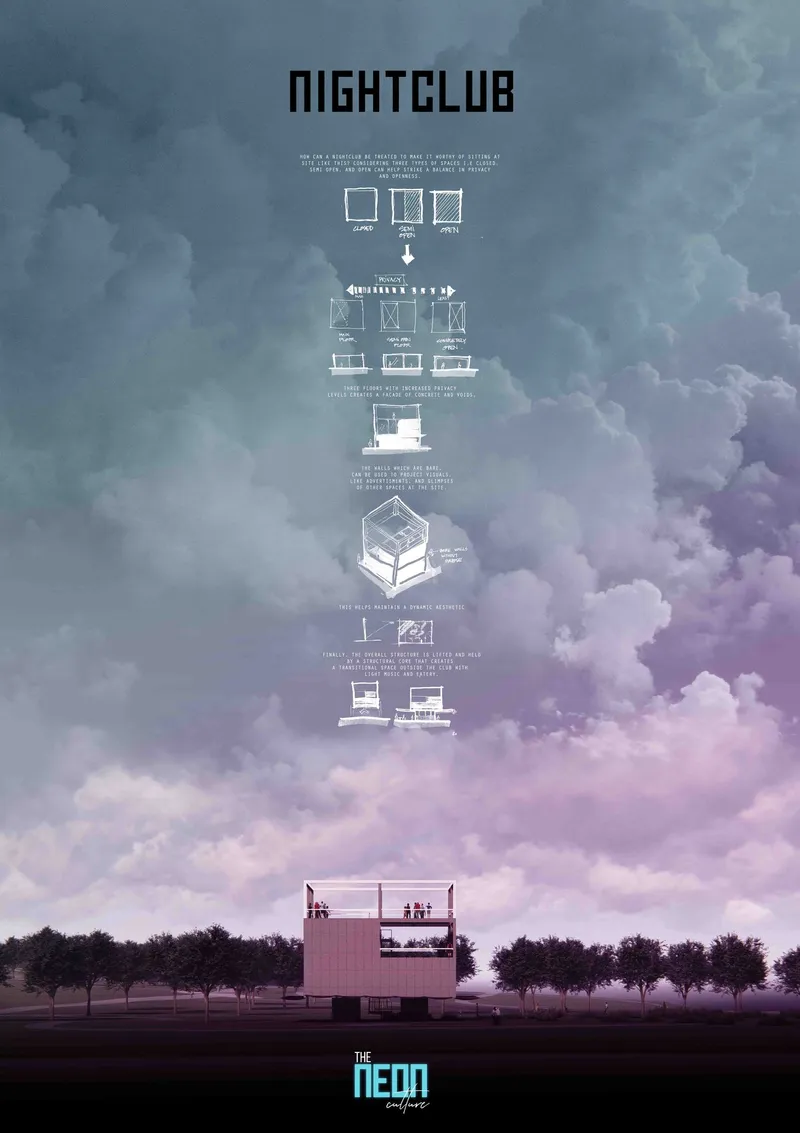
The third board turns from length to height. A boxy volume is raised up, with people occupying a rooftop terrace set among trees at dusk. The site analysis explains why vegetation features so prominently here. Alva uses existing planting to buffer acoustic zones and to mark thresholds between active and contemplative spaces. For a scheme that brings performance and nightlife onto the same ground as galleries, that acoustic buffering is a working necessity, not a garnish.
The elevated terrace gives the project a needed register of pause. Read against the immersive interiors elsewhere, it offers a place to step out, look across the canopy and recover between intensities. The text frames this as the tension between speed and pause, and this sketch is the clearest place where that tension takes physical form.
Rings, Ramps and a Sunken Pavilion That Glows After Dark
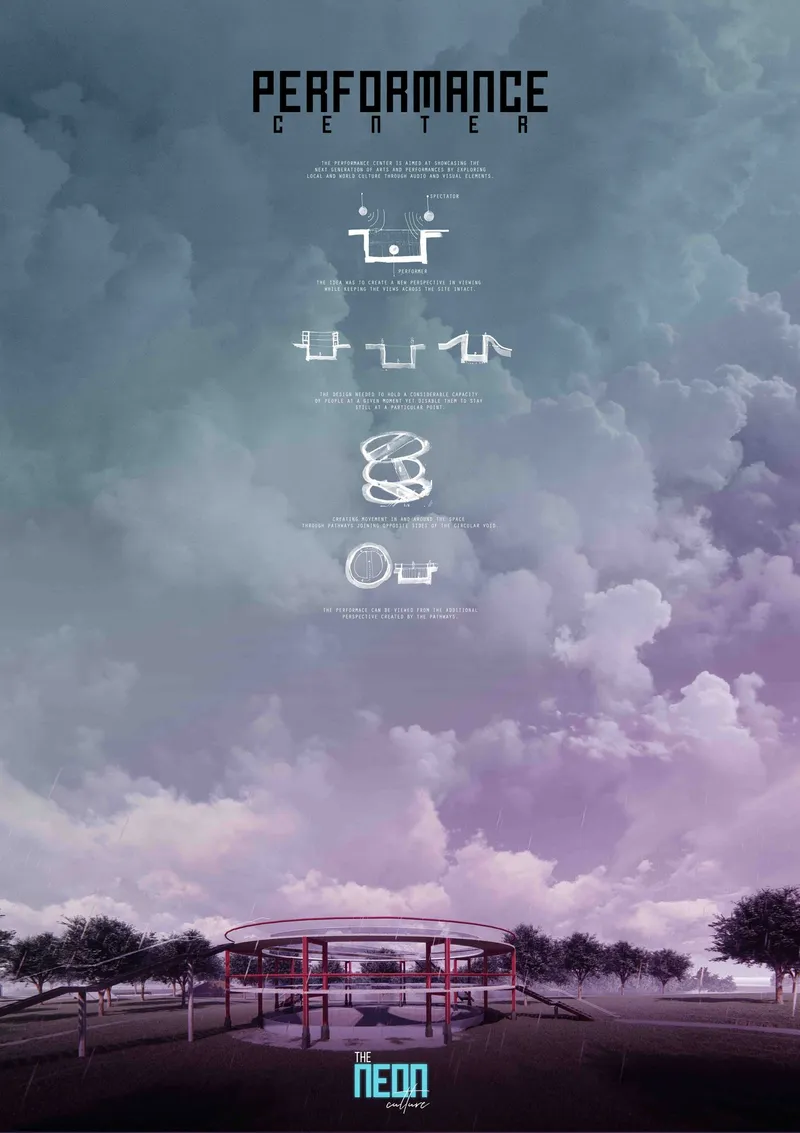
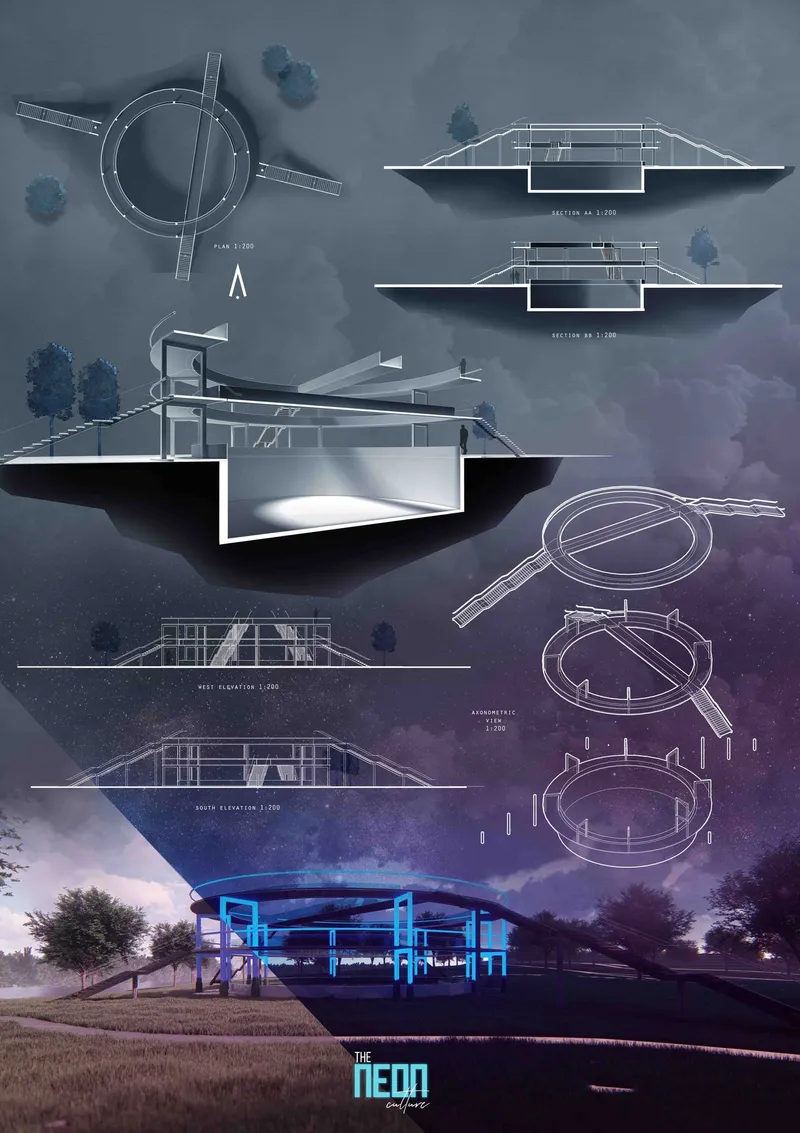
The final pair of boards introduces a different geometry. A circular platform carries red columns and ramps, shown in a rain-lit field render. It then develops into a ring-shaped sunken pavilion documented in plan, sections, elevations and axonometric, with blue glowing frames in the night render. The ramps carry one of the project's more thoughtful positions. Accessibility is treated as an experiential sequence, a gradual descent through changing light, sound and enclosure, rather than a code requirement fitted in at the end.
Sinking the ring into the ground uses the site's topography to choreograph arrival, and it fits the designer's insistence that light and sound act as primary architectural materials. The blue frames in the night view are the most literal expression of the project's title. Their value lies in how they mark the circuit. They turn the ring into a readable loop that invites people to keep moving, and that loop is where the scheme's ideas about continuous circulation come together.
Why This Project Matters
Experiential architecture can easily become a stage set: a mood board of neon and fog with no spatial argument underneath. The NEON Culture avoids that trap because its atmospheres rest on decisions about section, topography, acoustic buffering and circulation. The galleries, clubs, stages and markets form a single 24-hour system because the paths, ramps and sightlines between them are designed as carefully as the pavilions themselves.
There is room to push further. The relationship between the individual pavilions, and how a visitor's night actually unfolds from one to the next, deserves the same drawn rigour given to each object. Still, Smaran Alva puts forward a clear and timely proposition: in a city that never switches off, architecture is measured by how well it paces us, not by how long it lasts.
View the Full Project
About the Designers
Designer: Smaran Alva
Enter a Design Competition on uni.xyz
uni.xyz runs architecture and design competitions year-round that reward proposals with spatial conviction and real site intelligence.
Project credits: The NEON Culture by Smaran Alva.


Popular Articles
Popular articles from the community


Singing Woman: An Opera House That Performs Before the Curtain Rises
Ovidiu Cristian Pavel's conceptual opera house translates Estonia's choral identity into a sculpted waterfront landmark facing the Baltic Sea.

Aquadapt: An Underwater Habitat That Rewrites Its Rooms by the Hour
Curved modules ring the seabed while one shell shifts from breakfast room to cinema, farm and football pitch as residents' needs change.


ETEH Reworks the Shared Spaces of São Domingos School in Brazil Around Timber, Color and Hanging Plants
At São Domingos School in Brazil, 436 m² of hall, refectory and library are recast with timber joinery, a yellow and blue code and trailing greenery.

David Ortega Stacks a Two-Story Mexico City Penthouse Around a Steel Stair and a Pergola-Shaded Roof Terrace
In Colonia Roma, a 300 m² penthouse uses oak joinery, a planted steel stair and a slatted roof pergola to make a new-build apartment feel like a house.

Similar Reads
You might also enjoy these articles

Maya Harvest: A Cacao Resort Village Rooted in Mayan Tradition and Local Craft
Situated within a Tabasco cacao plantation, this shortlisted resort proposal merges vernacular materials with hands-on cultural immersion.
Harmonia: A River-Shaped Community That Grows Over Decades in Boa Vista
Curved pathways and modular grid structures along the Branco River create a phased settlement designed to evolve from 2030 to 2050.
The Architecture of Bathing: A Mughal Hammam Reimagined Across the Yamuna
Charlotte May's honorable mention entry for The Black Taj reinterprets Agra's bathing rituals through red sandstone, water, and framed views of the Taj Mah
Om-1: A Wall-Hung System That Moves Your Workspace Off the Desk
Modular plywood boards, magnetic pegs, and utility elements migrate clutter from the horizontal surface to the vertical plane.

Comments (0)
Please login or sign up to add comments
No comments yet. Be the first to comment!