

Om-1: A Wall-Hung System That Moves Your Workspace Off the Desk
Modular plywood boards, magnetic pegs, and utility elements migrate clutter from the horizontal surface to the vertical plane.


The desk is full. It has been full for years. Paperwork stacks on top of devices, pens roll against phone chargers, and the actual work surface shrinks to a sliver between organized chaos and outright clutter. Om-1 accepts this reality and proposes a spatial correction: stop fighting for horizontal real estate and colonize the wall instead. The system consists of three modular boards paired with five utility elements, all designed to relocate the tools of daily work onto a vertical, organized interface that keeps everything visible and within reach.
Designed by Vuong Nguyen, Om-1 was entered in the BOUN Furniture Design Awards 2018. The project is grounded in research on productivity and spatial constraints, arguing that cluttered horizontal surfaces actively limit focus and creativity. Rather than proposing a bigger desk, Nguyen offers an architectural shift: a wall-hung tasking system that transforms a passive surface into an active, curated workspace.
Three Boards, Five Elements, One System


At its structural core, Om-1 is a family of three precisely dimensioned boards that serve as both the backbone and the display surface of the system. The plan drawing reveals how these boards can interlock across different desk configurations, integrating storage and seating areas into a single spatial logic. Each board uses slots, magnetic connections, and standardized dimensions to accept five utility elements: magnet pegs, a phone holder, a clock, a lamp, and a pen tray. The close-up of the gridded plywood panel, propped against a white kickstand on a work table, shows the material language at play: warm, tactile plywood with subtle grid markings that reference architectural drafting conventions.
The modularity is the point. Users rearrange elements according to personal workflows, whether that means prioritizing note-taking with magnetic pegs front and center or keeping a phone holder and lamp grouped for evening study sessions. The system evolves with its user rather than locking them into a fixed configuration. Every component fits intuitively into the larger composition because every component was designed as part of that composition from the start.
Organization as Display, Not Concealment

Om-1 takes a deliberate stance against hiding tools away. The desktop still life captures this philosophy clearly: a gridded storage tray holds stationery and tape rolls alongside a cube clock, all arranged with the precision of a product catalog but the warmth of an actual workspace. The system puts objects on display in a controlled, architectural manner. Tasking boards support paper organization, magnetic pegs secure notes and reminders, and dedicated holders keep devices within arm's reach.
This openness creates a sense of clarity rather than exposure. By standardizing even the smallest details, from peg diameter to tray depth, Nguyen eliminates the visual noise that comes from mismatched desk accessories. Everything works together because everything was designed together. The result is a workspace where form and function are not in tension but actively reinforcing one another.
Layered Construction and Magnetic Logic
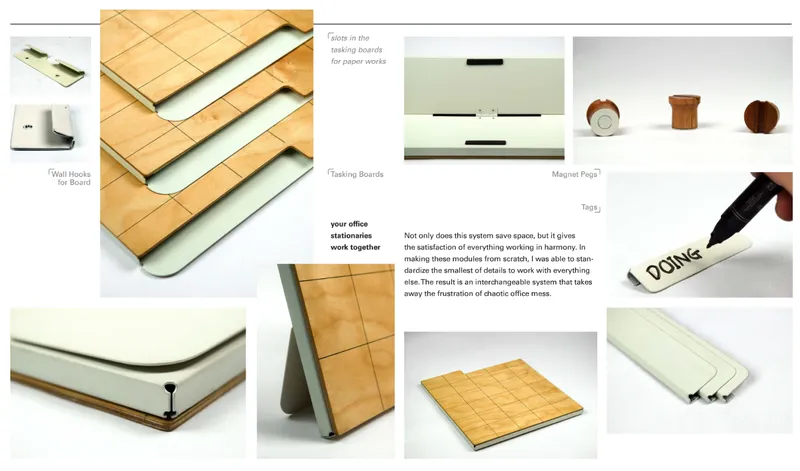
The exploded view diagram reveals the construction logic behind Om-1's clean surfaces. Layered plywood and foam components stack with embedded magnets at corner details, allowing quick assembly and reconfiguration without tools. The magnetic connections serve a dual purpose: they hold the system's elements in place on the boards, and they enable the boards themselves to mount and dismount from the wall with minimal hardware. This approach keeps the system nomadic, portable enough to follow a user between a student room, a home office, or a creative studio.
The material palette is deliberately restrained. Natural wood surfaces provide warmth and tactile interest, while soft-toned finishes add contrast without distraction. Clean geometries and the recurring grid motif tie the system's visual language back to its conceptual roots in architectural drafting and spatial economy. Om-1 does not try to dominate an interior; it acts as an extension of the architecture, blending into varied contexts through material honesty and geometric discipline.
A Complete Kit for the Compact Workspace

The product spread lays out the full family: lamp, phone rest, clock, storage components, and the boards that host them. Seen together, the elements read as a coherent kit rather than a collection of accessories. The interchangeability is visible in the shared proportions and slot geometries, each piece fitting multiple positions across the three board types. This is furniture design thinking at the system level, where no single element makes sense in isolation but every element gains meaning through its relationship to the whole.
Why This Project Matters
Most furniture designed for small spaces focuses on folding, nesting, or shrinking. Om-1 takes a different approach by redistributing the workspace across a new axis entirely. The vertical migration of tools from desk to wall is not a novel concept in itself, but the rigor with which Nguyen develops it, from magnetic joinery to standardized utility elements, transforms a simple idea into a genuinely systematic response to spatial scarcity.
What stands out is the project's refusal to treat the wall-mounted system as a shelf or a pegboard. Om-1 is conceived as an active workspace interface, a surface that participates in the work rather than merely storing its byproducts. For students and young professionals navigating shrinking living and working spaces, that distinction matters. The wall is not dead space to be decorated; it is productive territory to be designed.
View the Full Project
About the Designers
Designer: Vuong Nguyen
Enter a Design Competition on uni.xyz
uni.xyz runs architecture and design competitions year-round that reward proposals with spatial conviction and real site intelligence.
Project credits: OM-1 \\ A Wall-Hung Tasking System by Vuong Nguyen BOUN Furniture Design Awards 2018 (uni.xyz).


Popular Articles
Popular articles from the community


Cloaked Colonization: A Mobile Underwater Habitat That Moves Like a Fish
Micah Abaya's shortlisted EHC Pacific entry reimagines ocean settlement as a dispersed network of self-sustaining architectural organisms.

Manzana Morphosis: Stretching Barcelona's Grid into a Living Landscape for 2050
A radical reworking of the Eixample manzana turns density into a tool for generous public space, vertical ecology, and environmental performance.

Opera on the Sea: Driftwood Logic Shapes a Timber Opera House on Estonia's Coast
Trevor Orgill's opera house translates the entangled drift of floating timber into a civic building where wood, water, and music converge.
Extended Shell: Retrofitting Kolkata's Balconies as Living Urban Thresholds
A modular retrofit system recovers the social and environmental intelligence of Kolkata's historic verandas for contemporary Park Street residents.

Similar Reads
You might also enjoy these articles
Sustainable Architecture Design: Embracing Nature and Modernity at Villa Solsidan
The article explores Villa Solsidan by AndrénFogelström, showcasing its sustainable architecture design and integration with the natural surroundings in Saltsjöbaden, Sweden.
Scientific and Educational Monitoring Center of the Yenisei, Krasnoyarsk
Architecture as an instrument for ecological research, education, and environmental awareness along Russia’s largest river.
Development of Andretta Artist’s Village, Palampur, Himachal Pradesh, India
Reimagining Andretta as a living cultural landscape where art, architecture, and community converge to shape a global creative village.
Street Children Rehabilitation Center: A Model of Social Architecture for Community Rehabilitation
An inclusive social architecture project that transforms streets into nurturing environments, restoring dignity, identity, and opportunity for vulnerable children.

Explore Vertical Space Competitions
Discover active competitions in this discipline

Challenge to design luxury tourism on rails

Design challenge to equip cities with modern furniture

VR headsets Storefront design competition

Designing a staircase for a client
Comments (0)
Please login or sign up to add comments
No comments yet. Be the first to comment!