

Studio Gram Unfurls a Concrete Curve Through an Adelaide Queen Anne Villa
In Rose Park, a billowing concrete threshold stitches a century-old house to a sun-chasing pavilion organized around an existing pool.


From the street, the Rose Park House reads as a conventional early 1900s Queen Anne villa in one of Adelaide's leafiest suburbs. Walk deeper into the plan and the house reveals its true nature: an off-form concrete pavilion that swells outward beneath a curved ceiling, connecting the existing dwelling to a new kitchen, dining, and living wing oriented squarely toward the northern sun. Designed by studio gram and completed in 2021 on Kaurna Country, the project is structured as a journey of compression and release, where sculptural thresholds slow you down before opening into generous, light-filled volumes.
What makes the house genuinely interesting is its single, recurring obsession: the curve. An existing pool at the rear of the property became the formal generator for the entire extension. Its arced profile echoes through the billowing concrete canopy that connects old and new, through the pelmet detail in the front sitting room, and through the vaulted ceiling that extrudes upward to meet the pitch of the new roof. Studio gram treated every room as a station along a greater journey, calibrating color, materiality, and light to the function of each space. The result is a house that feels both deliberate and instinctive, grounded in robust materials chosen to age gracefully with minimal maintenance.
The Concrete Threshold
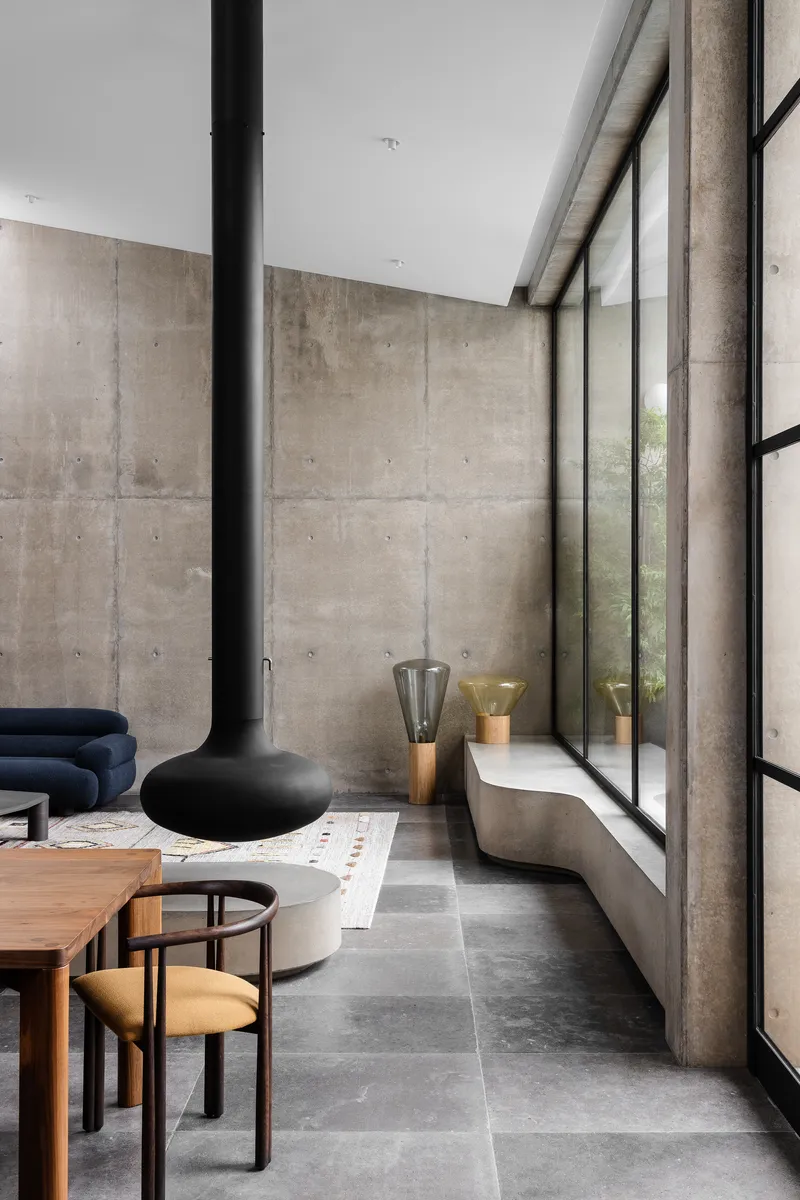

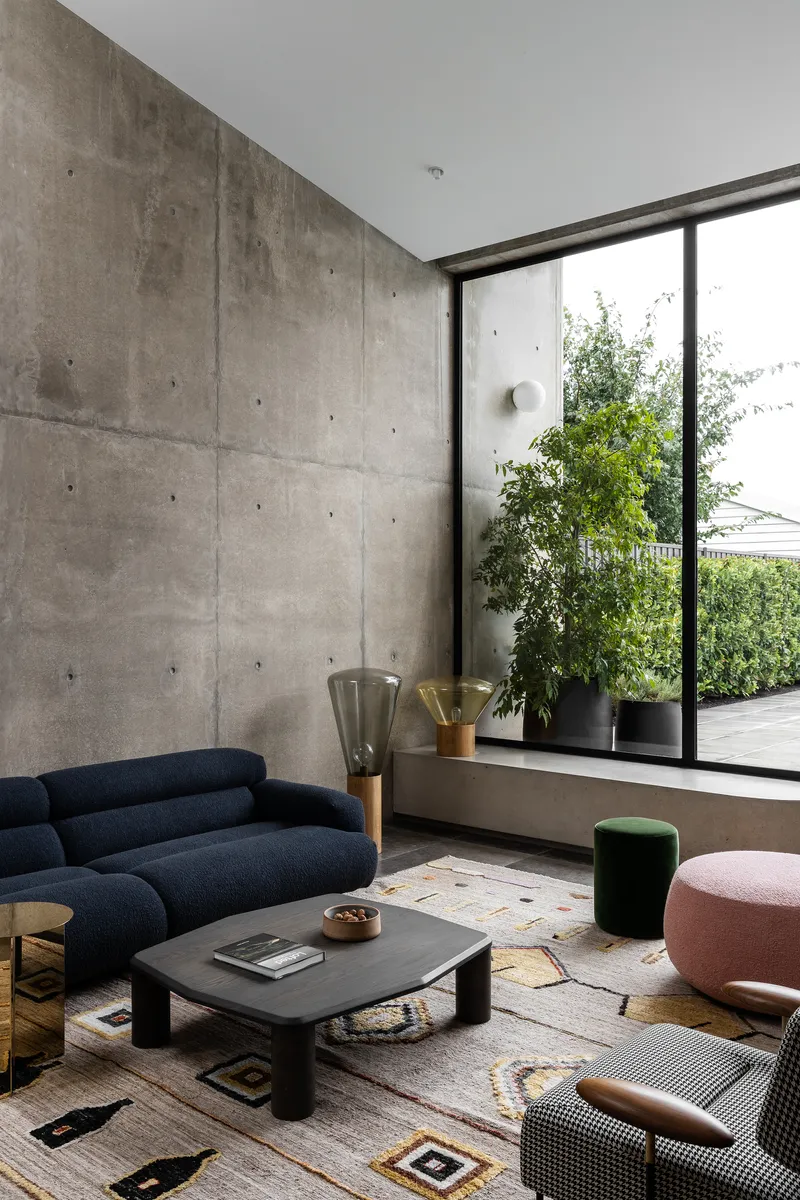
The most architecturally charged moment in the house is the curved concrete wall that mediates between the existing villa and the new pavilion. Board-formed and left exposed, the concrete rises from floor level and billows upward, connecting the old structure's ceiling height with the apex of the new pitched roof. This is not a neutral corridor. It is a deliberate act of spatial compression: the ceiling drops, the walls tighten, and then everything releases into the double-height living space beyond.
Studio gram discovered during demolition that the original dwelling's walls were themselves off-form concrete, an unusual construction for the period and location. Rather than suppress this material lineage, they made concrete the exclusive structural language of the extension, creating a material continuity that spans a century. The board-formed texture gives warmth and grain to what might otherwise feel industrial, and the surfaces are already beginning to acquire the patina the architects anticipated.
Kitchen and Living as Continuous Territory


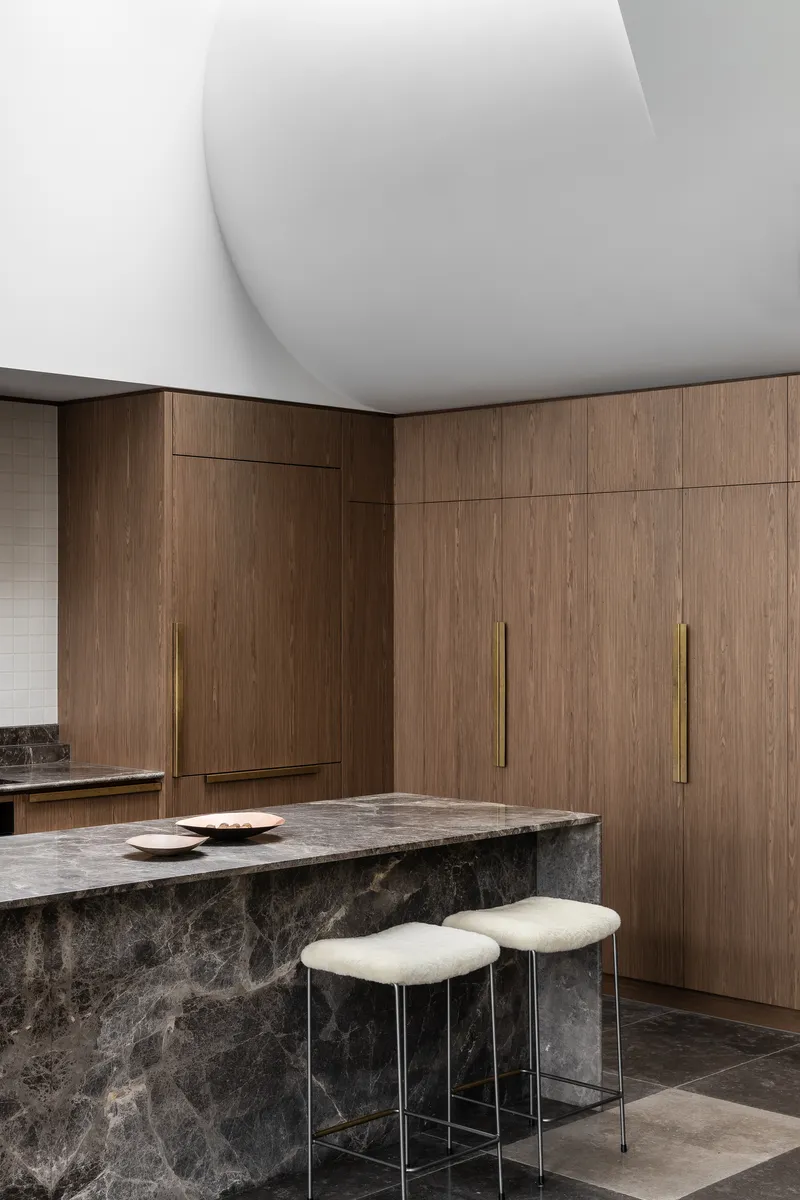
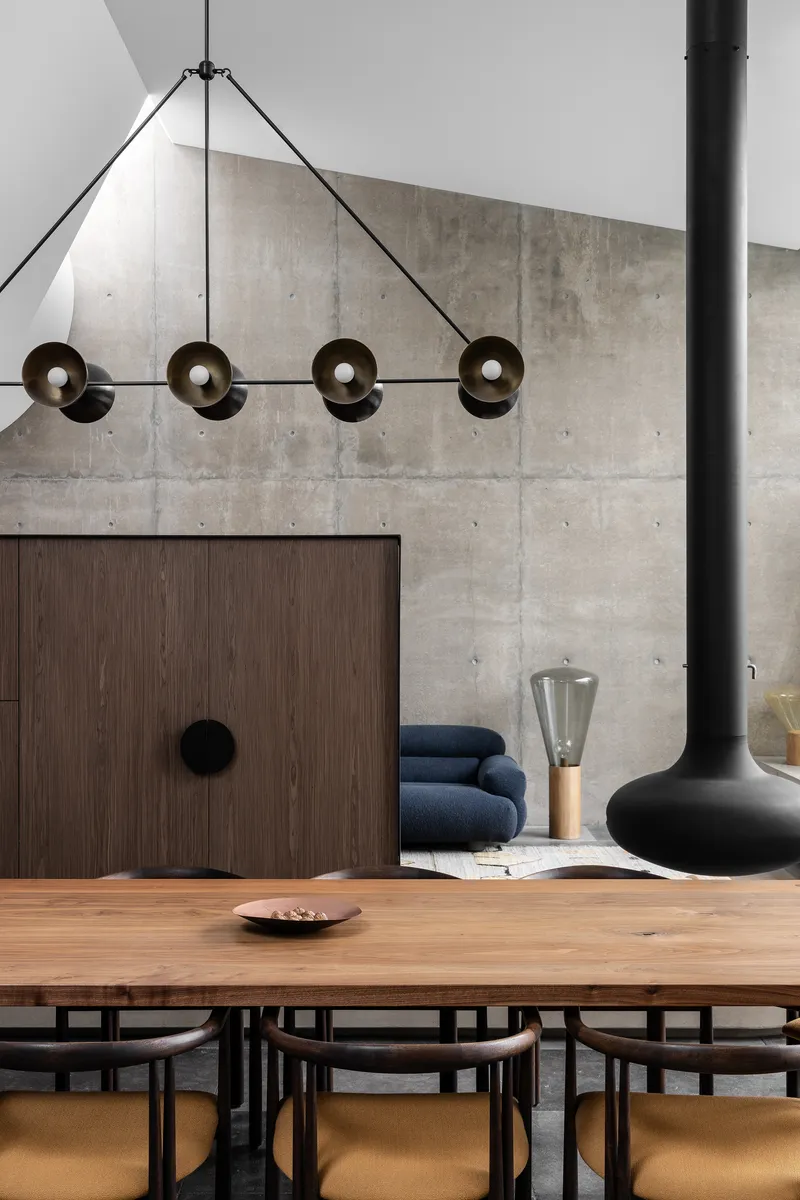
The kitchen occupies the full width of the property, centered on a dark stone island that anchors the open plan without subdividing it. Timber cabinetry wraps around the perimeter with curved profiles that echo the ceiling above, and cylindrical black pendants reinforce the vertical axis of the room. The palette is restrained: dark stone, warm timber, brushed brass hardware. Nothing competes with the architecture.
What works well here is the way the vaulted white ceiling floats over the kitchen and dining zone as a single, continuous surface. It reads as a shell, lightweight and taut, in counterpoint to the heavy concrete walls that frame the adjacent living spaces. Clerestory windows wash the upper reaches with diffused light, and south-facing skylights at either end of the curved form pull daylight deeper into the plan than the floor-to-ceiling glazing alone could manage.
Steel, Glass, and the Art of the Pivot
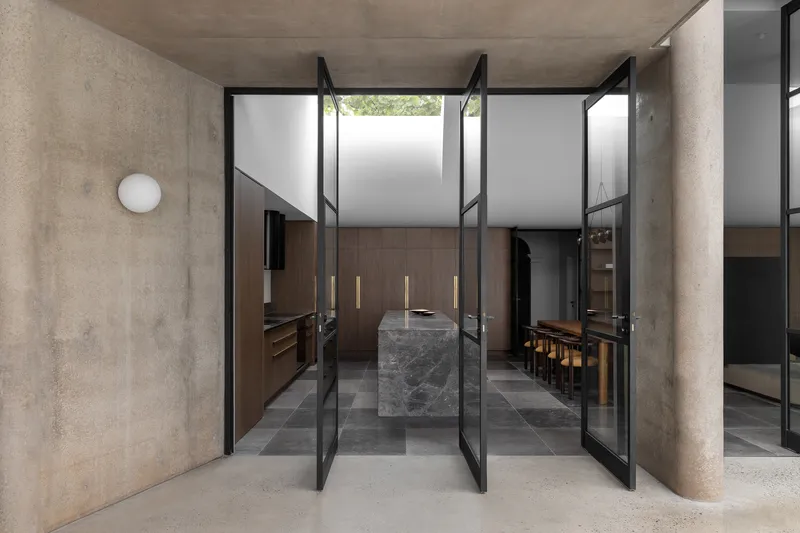
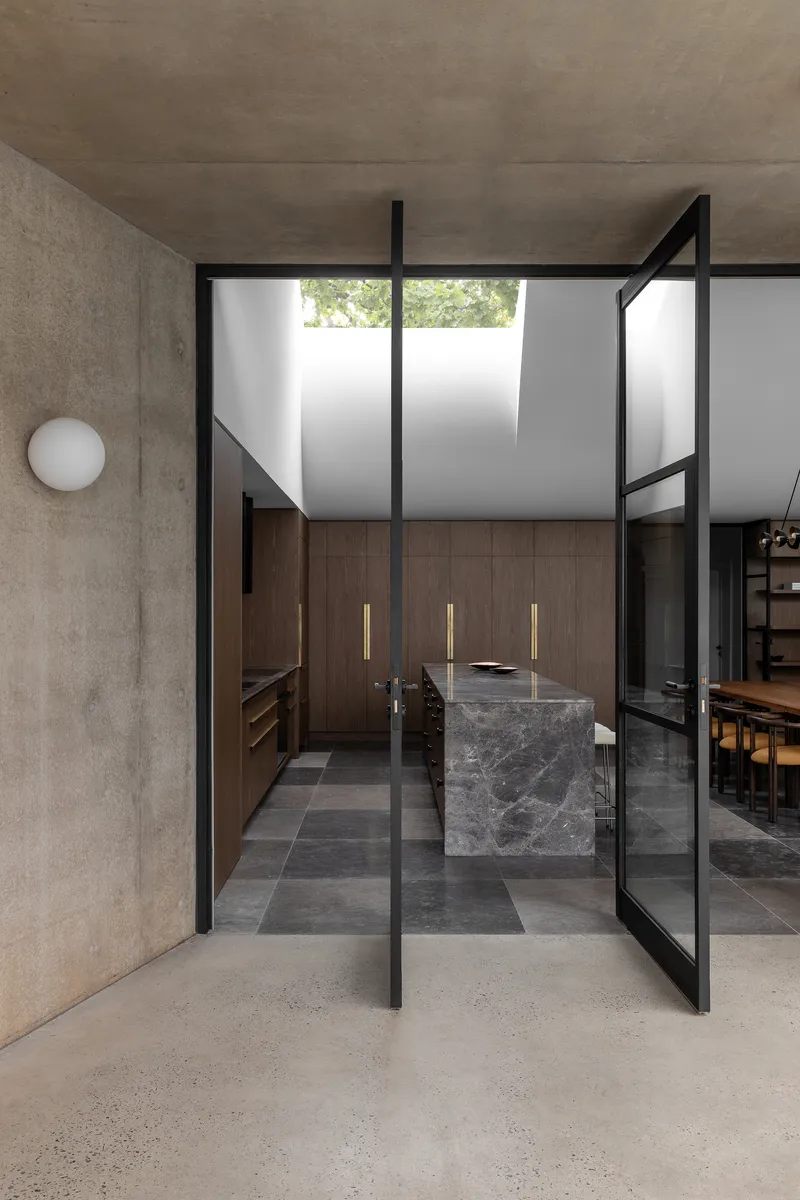
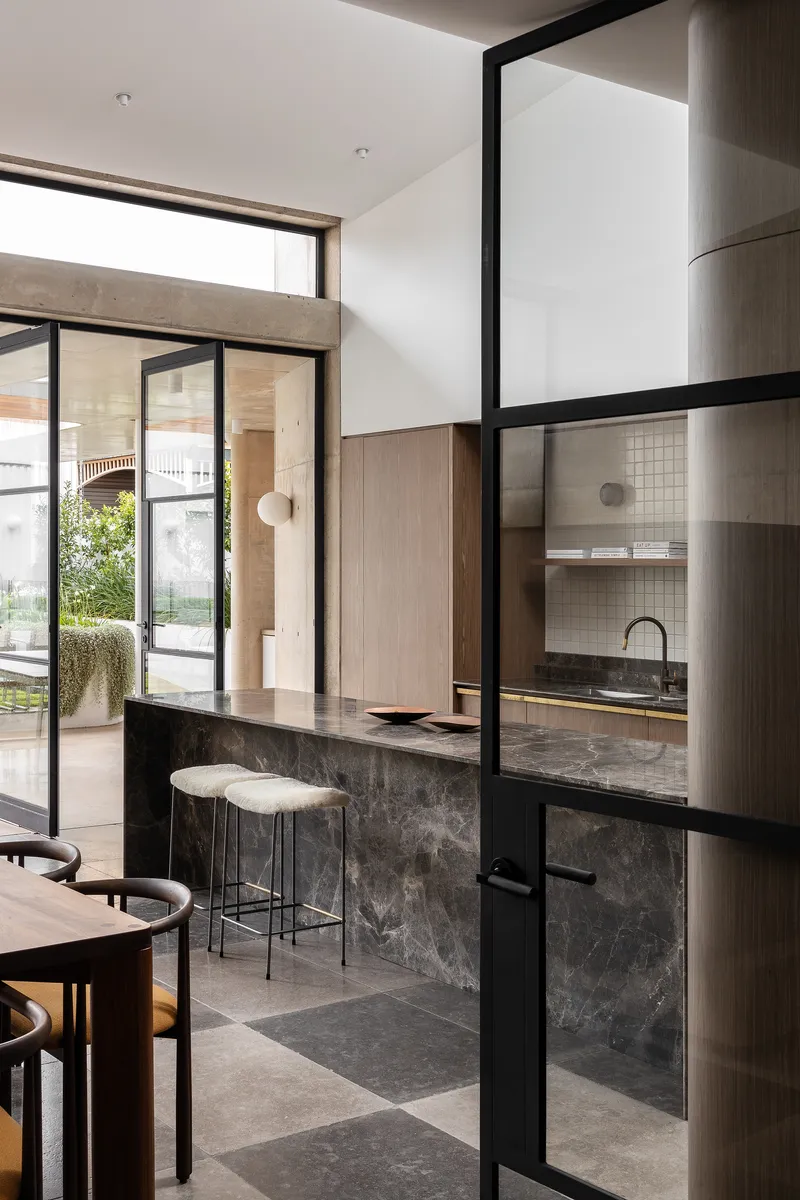
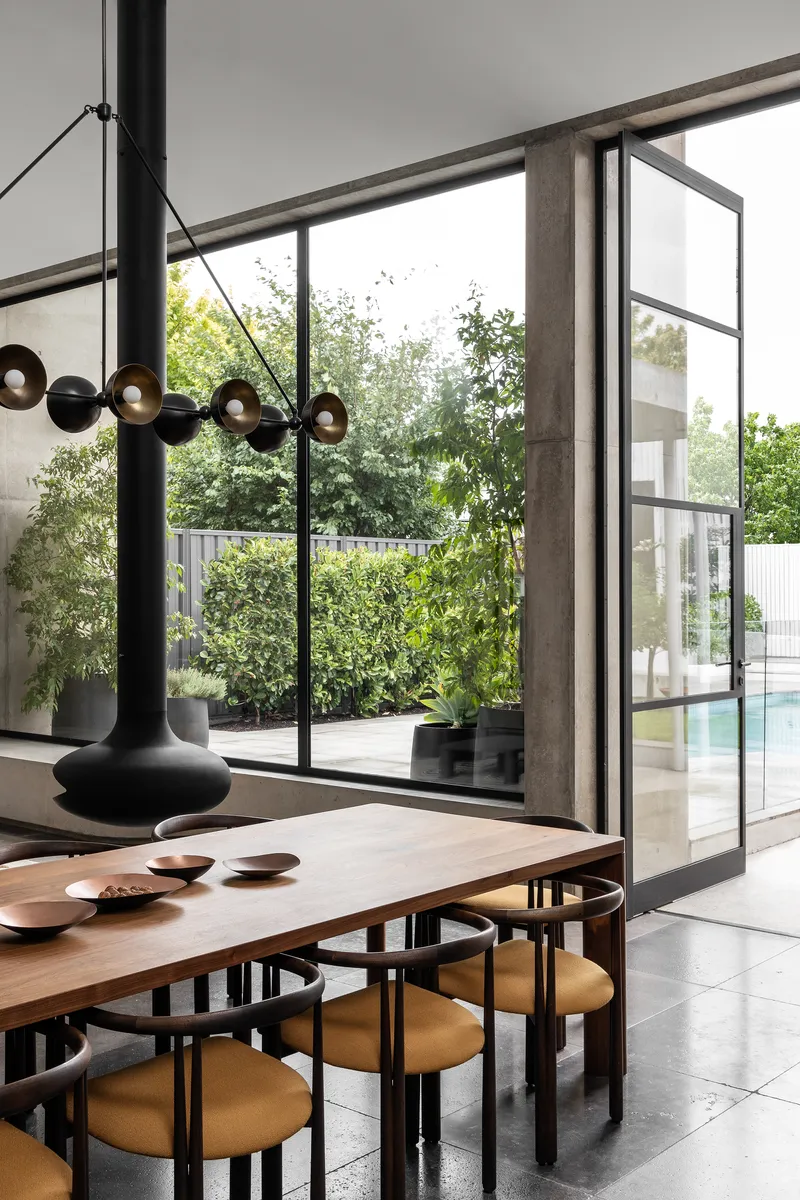
Throughout the extension, steel-framed pivot doors and glass partitions manage the boundary between inside and out with a precision that verges on obsessive. The pivot doors are oversized, with slender black profiles that disappear into the concrete framing when open. Closed, they read as graphic lines against the rough board-form texture. The detailing is sharp enough that you notice the joint tolerances before you notice the hardware.
These partitions do more than open up views to the garden. They create a layered depth of field, framing the kitchen island through one glass plane, the garden through another, and the pool beyond that. The house rewards oblique views: stand at the corridor and you can see four spatial zones stacked in perspective, each filtered through a different material register.
Pool, Pavilion, and Northern Aspect
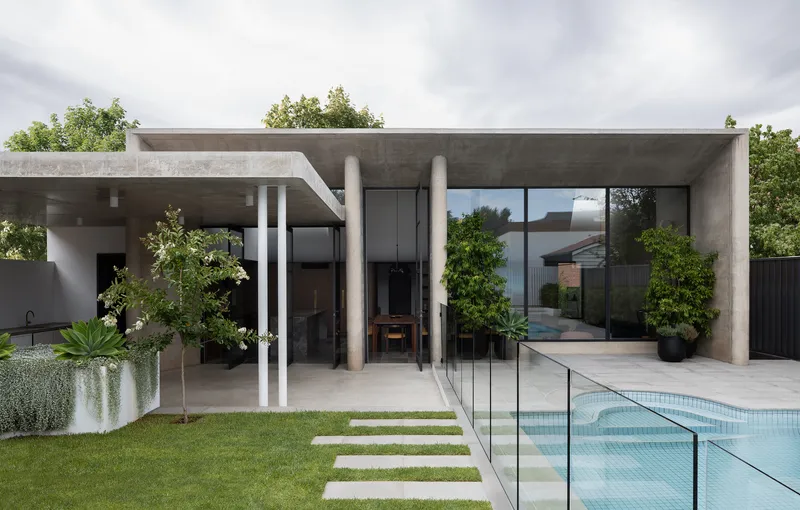

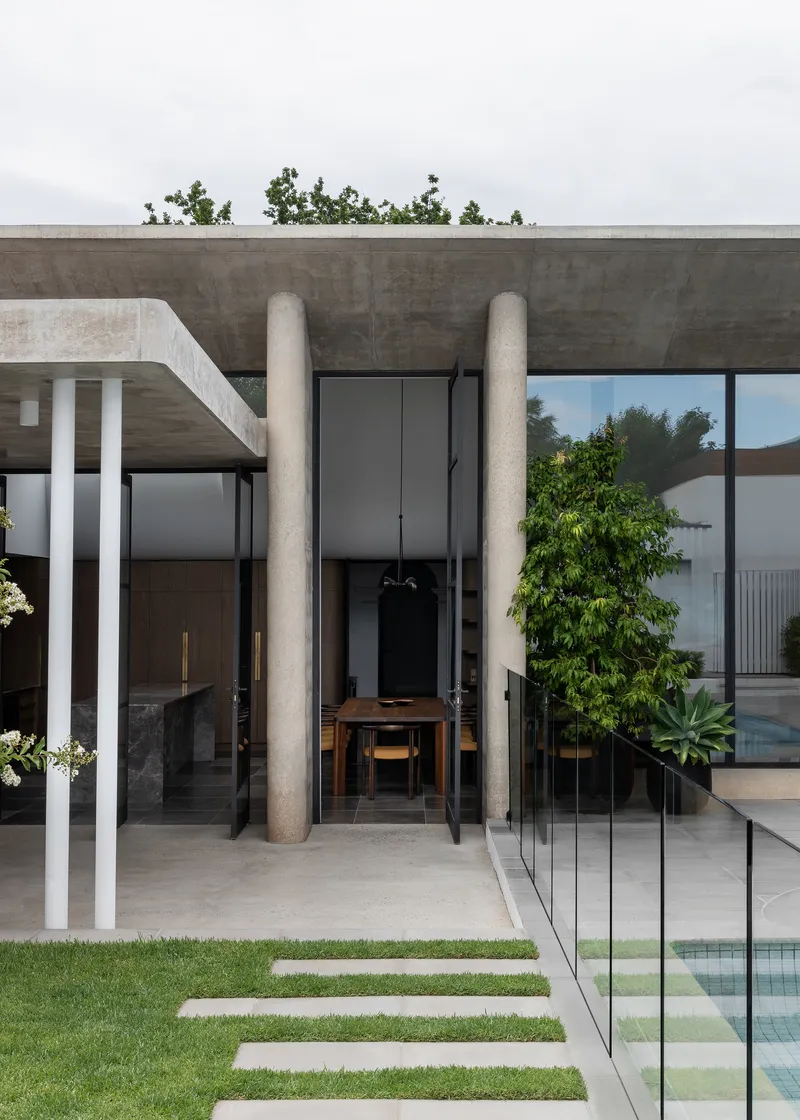
The existing pool was not just retained; it became the organizational premise for everything that followed. Its location and curved form dictated the position of the extension, and its geometry migrated into the concrete canopy overhead and the pelmet profiles inside. This is a case where keeping something fixed generated more design freedom than starting from scratch.
The pavilion's full-height glazing faces north, allowing the concrete "nose-cone" of the canopy to catch midday sun for passive heating while casting protective shadow in summer. A 12-kilowatt solar array on the existing villa's roof handles the electrical load. The approach is not flashy: no louvres, no automated shading systems. Just correct orientation, thermal mass, and generous overhangs doing what they have always done in the Australian climate.
Concrete Columns and Canopy

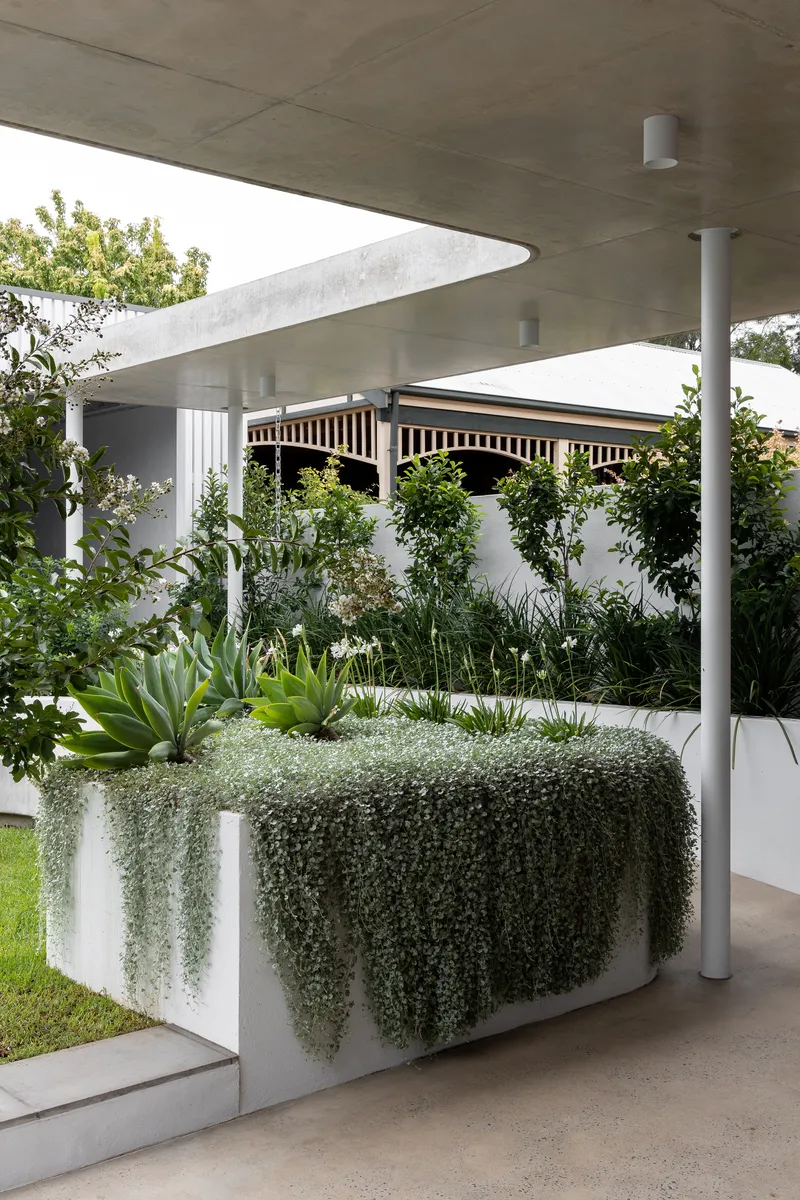

Outside, cylindrical concrete columns support the sweeping canopy that shelters planted beds filled with agave and cascading greenery over white gravel. The columns are deliberately oversized for their structural role, giving the canopy a civic weight that elevates the house beyond domestic scale. The curved soffit overhead continues the arc of the interior ceiling, so the transition from living room to garden terrace feels like a single spatial gesture rather than an abrupt exit.
The planting strategy is low-maintenance by design, consistent with the broader material philosophy. Everything here is expected to weather, to soften, to develop character over time. The white gravel will stain, the concrete will mark, and the agave will spread. The house is built for decades, not for the week it gets photographed.
Color as Program Indicator
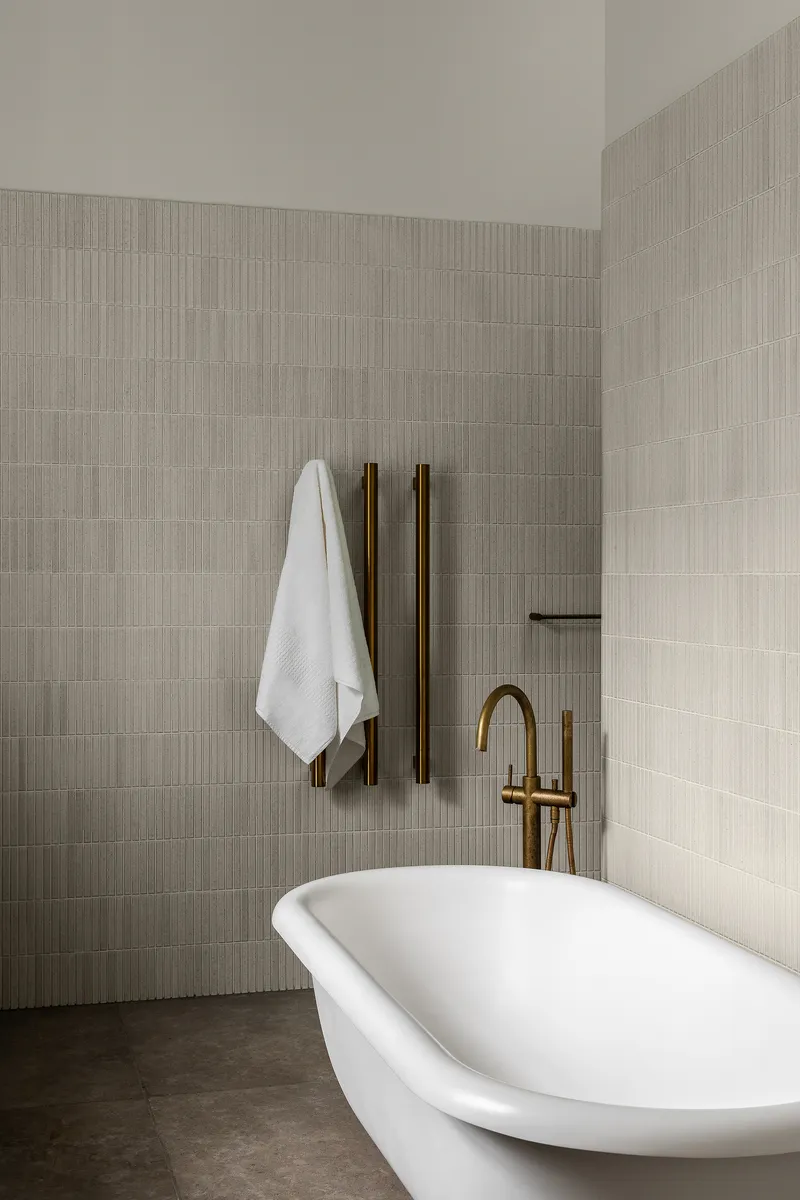

Studio gram assigned each room a color and material tone calibrated to its function. The bathroom is soft and muted, with ribbed ceramic tiles and a freestanding tub in brass fixtures that telegraph calm. A wine room elsewhere in the house is finished in deep burgundy, unapologetically indulgent. Guest bedrooms carry pastel greens. The master suite is bright and open. These are not arbitrary Instagram palette choices; they are spatial cues that tell you what kind of room you are in before you fully register the furniture.
The bar cabinet tucked beneath the curved ceiling captures this philosophy in miniature. A single gesture of opening a door reveals glassware arranged against a dark backdrop, framed by the luminous white vault above. It is a small moment, but it demonstrates the level of care that runs through the project: every niche, every reveal, every threshold has been considered as a piece of the larger journey.
Entry and the Street Facade


The front of the house maintains its Queen Anne composure. A covered porch with circular concrete columns and potted plants gives nothing away about what lies behind. This restraint is intentional. The original floor plan remains largely intact, with only minor modifications to accommodate a master wing with walk-in robe and ensuite. The central corridor preserves the original spatial sequence: formal, measured, domestic.
Inside the existing rooms, the dining space with its timber table, linear pendant, and concrete fireplace surround hints at the material language that will intensify as you move rearward. The laundry is tucked quietly to one side of the extension. Ramps and flush thresholds with wide openings ensure accessibility throughout, a practical decision that also contributes to the seamless flow between old and new. The house does not shout about its accessibility; it simply accommodates it.
Plans and Drawings
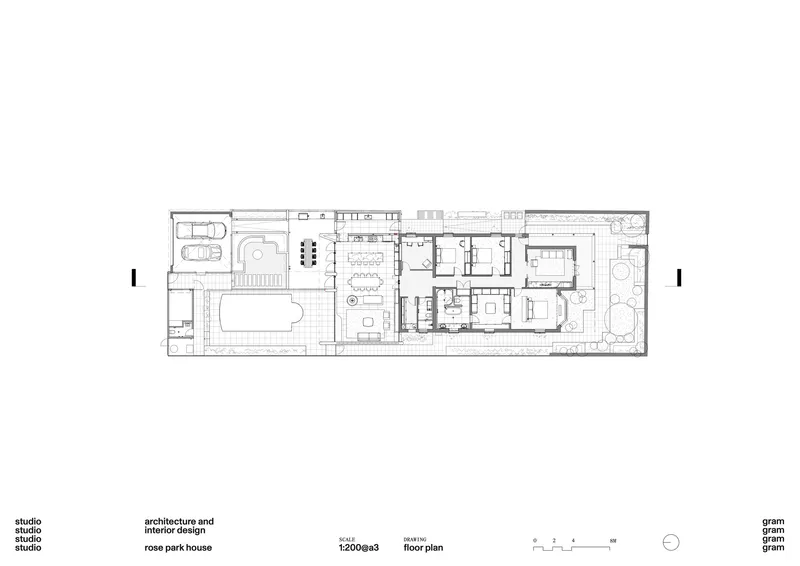
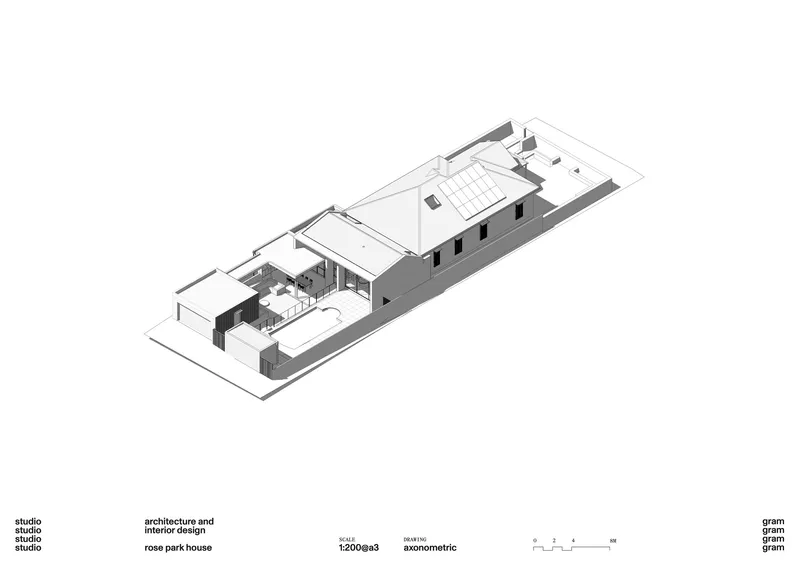
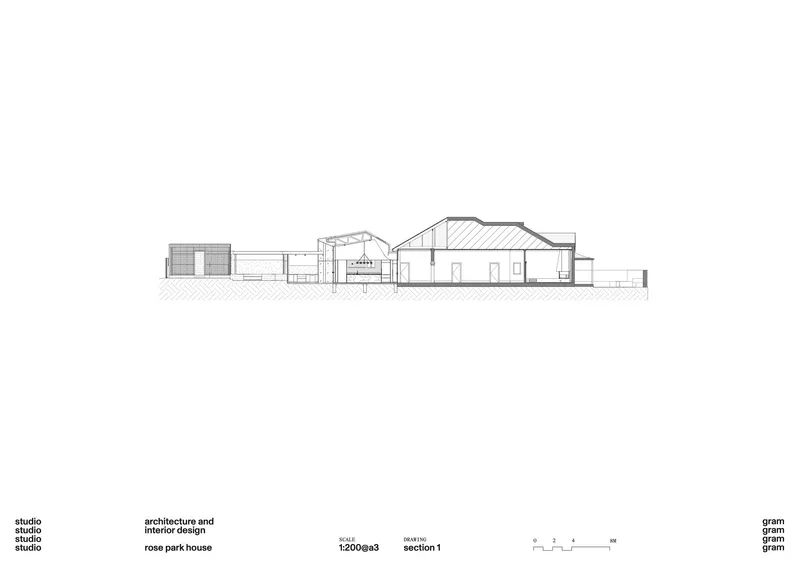
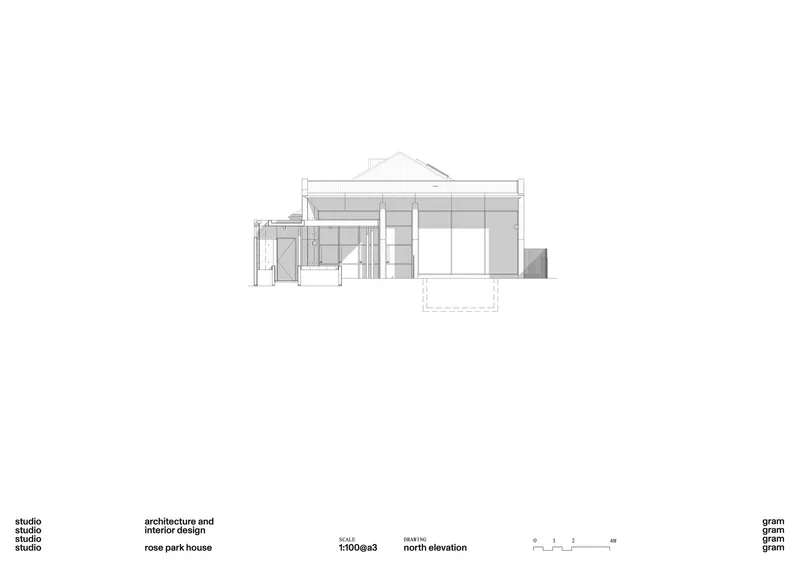

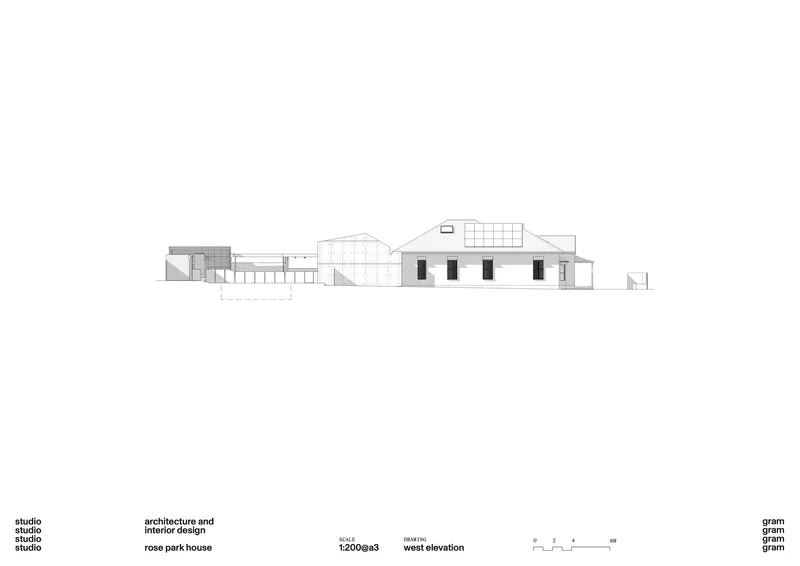
The floor plan confirms the linear arrangement: the existing villa's cellular rooms march in sequence along the central corridor before releasing into the full-width pavilion at the rear, with the pool and garden beyond. The axonometric drawing reveals how the curved ceiling operates as a continuous surface bridging the two building typologies, while the section makes the compression-and-release strategy legible. Roof heights step and shift, each volume calibrated to its program. The elevations tell two stories: the south facade reads as a symmetrical, gabled heritage dwelling, while the north elevation is a low-slung composition of glass, concrete, and hovering roof planes.
Why This Project Matters
Rose Park House is a disciplined exercise in reading what already exists and letting it drive the design. The pool's curve, the original concrete walls, the northern aspect: none of these were chosen by the architects, but all of them became the project's formal and strategic foundations. Studio gram resisted the temptation to impose a signature gesture and instead let the site's latent qualities dictate the architecture. The billowing concrete threshold is dramatic, yes, but it is also the logical resolution of two mismatched typologies meeting each other halfway.
The project also demonstrates that passive design in an Australian context does not require technological spectacle. Orientation, mass, overhangs, and a solar array on a hidden roofplane are enough. Paired with a material palette selected for longevity and low maintenance, the house is positioned to age well, both physically and architecturally. In a residential market saturated with white-box extensions that look pristine on day one and tired by year five, that is a genuinely valuable proposition.
Rose Park House by studio gram. Rose Park, Australia. Completed 2021. Photography by Timothy Kaye.
About the Studio
Share Your Own Work on uni.xyz
If projects like this are the kind of work you want to make, uni.xyz is a place to publish your own, find collaborators, and enter design competitions.


Popular Articles
Popular articles from the community


Tsunami Convergenics: Turning Catastrophic Ocean Forces into Underwater Housing Infrastructure
A speculative underwater settlement off the coast of Onagawa, Japan, treats tsunamis and typhoons as energy sources rather than threats.

Temporary Home for Dogs: A Reversed Zoo Rethinks Animal Shelter Architecture
In Bucharest, a sinuous corridor and freed landscape flip the logic of containment, designing a shelter that works to make itself unnecessary.

Opera on the Sea: Driftwood Logic Shapes a Timber Opera House on Estonia's Coast
Trevor Orgill's opera house translates the entangled drift of floating timber into a civic building where wood, water, and music converge.

Opera by the Sea Estonia: Three Shells Dissolving Architecture into Tallinn's Coastline
A winning opera house proposal replaces monumental form with interconnected shells that blur the boundary between building, park and Baltic Sea.

Similar Reads
You might also enjoy these articles

Bao Huynh Watercolor Atelier: A Serene Art Retreat in Hội An
Bao Huynh Watercolor Atelier in Hội An blends multifunctional art spaces, sustainable design, local materials, and family-friendly living in a serene environment.

Atelier Macri Concept Store Interior Design by CASE-REAL
Atelier Macri store features a "ko" counter, walnut wood details, cork displays, blending retail, gallery, and seamless customer experiences.

Manuel Vargas Izquierdo Stadium and High-Performance Sports Center: Architectural Excellence in Jalpa de Méndez
The Manuel Vargas Izquierdo Stadium blends sustainable design, inclusive sports facilities, and cultural-inspired architecture, revitalizing Jalpa de Méndez’s public spaces.

KAKR Buluh Awar Hall: Revitalizing Community and Ecology Through Bamboo Architecture
Community built bamboo hall revitalizes Buluh Awar village, empowering youth, restoring ecology, celebrating vernacular craftsmanship through sustainable architecture and culture.

Explore Curvilinear Architecture Competitions
Discover active competitions in this discipline

Challenge to design a portable theatre

Challenge to design a portable music platform

Challenge to design an open learning module for the elderly

Challenge to design mud housing for contemporary communities
Comments (0)
Please login or sign up to add comments
No comments yet. Be the first to comment!