

RDTH architekti Rips Out Nearly Every Wall in a Prague Apartment and Replaces Them with Furniture
A 101-square-meter post-war flat in Prague trades rigid partitions for a single rotated furniture block, curtains, and glass concrete.


Removing almost every wall from a 101-square-meter apartment sounds like provocation. In most European housing blocks, the post-war plan is sacred: a corridor feeds sealed rooms, each one doing one job. RDTH architekti took the opposite position in this Prague flat, stripping the layout back to its concrete skeleton and then replacing rigid partitions with a single compact furniture block, blackout curtains, shifts in floor level, and walls of glass concrete blocks. What remains is an apartment that performs like a four-room home yet flows like a single continuous space.
The result is not an open-plan loft pretending walls never mattered. It is a carefully calibrated gradient of privacy, where each zone earns its separateness through placement and material rather than drywall. A toilet door is the only conventional door in the entire flat. Everything else is negotiable, moveable, or translucent. That restraint, applied with real spatial intelligence, is what makes the project worth studying.
The Concrete Skeleton as Interior Architecture

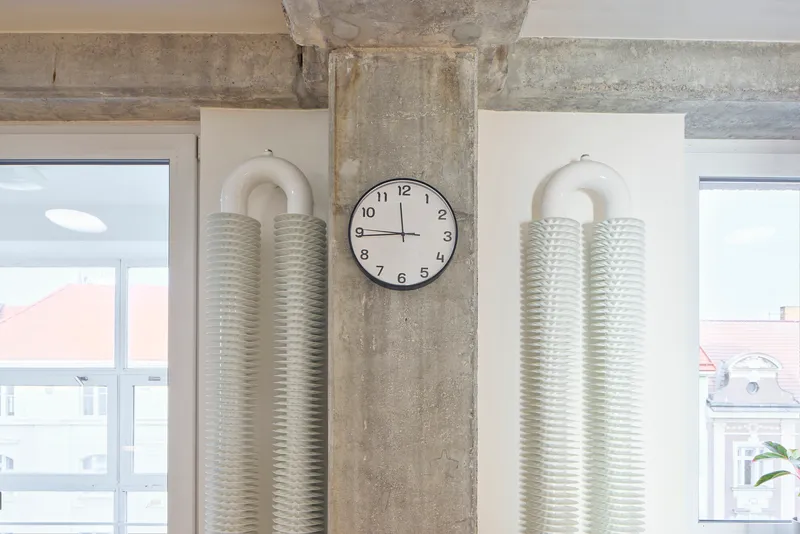
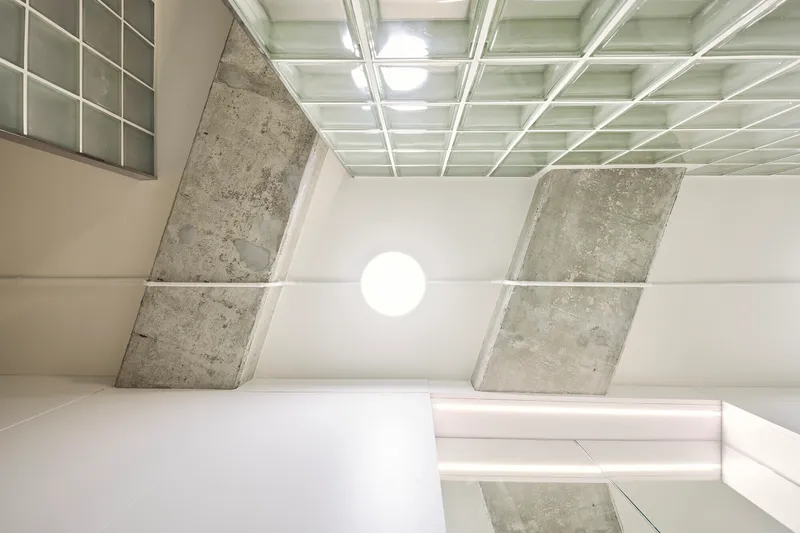
RDTH did not conceal the building's bones. The coffered concrete ceiling, with its deep beams converging at odd angles, reads like an infrastructure diagram left on display. Scars from removed load-bearing walls have been preserved and painted over rather than plastered smooth, leaving a legible record of the demolition that produced the new plan. A single globe light hangs from the central intersection of beams, turning structure into ornament without adding anything decorative.
Exposed columns and ribbed air ducts are treated with the same matter-of-fact clarity. Prague's younger studios have been quietly making this move for several years: treating raw, industrial legacies of Czech architecture with intellectual curiosity and delicate refinement instead of burying them behind finishes. Here, the contrast between rough concrete overhead and precise white joinery below gives the apartment its visual tension.
One Block, Four Zones
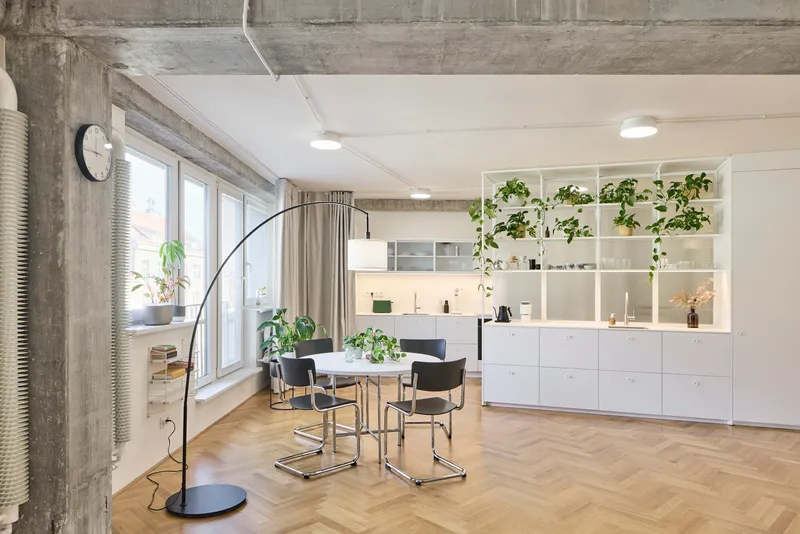

The central furniture block is the project's engine. Placed off-center and slightly rotated, it divides the apartment into functional zones without touching the perimeter walls. On one side, the living and dining area opens toward the window; on the other, sleeping and service spaces tuck behind it. The rotation is subtle but consequential: it prevents any single corridor from forming and instead creates a loop of movement through the flat.
A white shelving wall doubles as storage and display, lined with potted plants that trail down the face. Two kitchens serve distinct roles: the one in the living area functions as a home café for drinks and light prep, while a fully equipped second kitchen hides at the back, paired with open shelving and a freestanding washer and dryer. Splitting the kitchen program in two is an unusual call, but it keeps the social end of the apartment clean and informal.
Glass Concrete and the Privacy Gradient
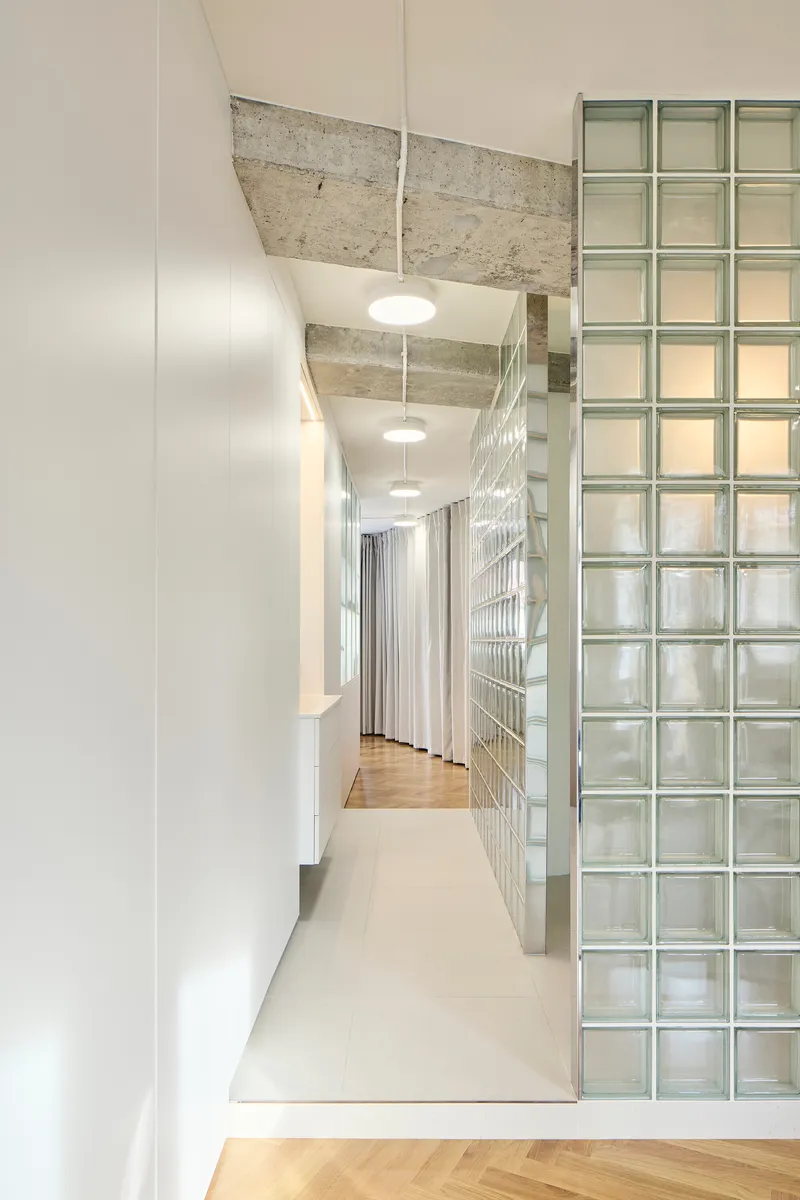
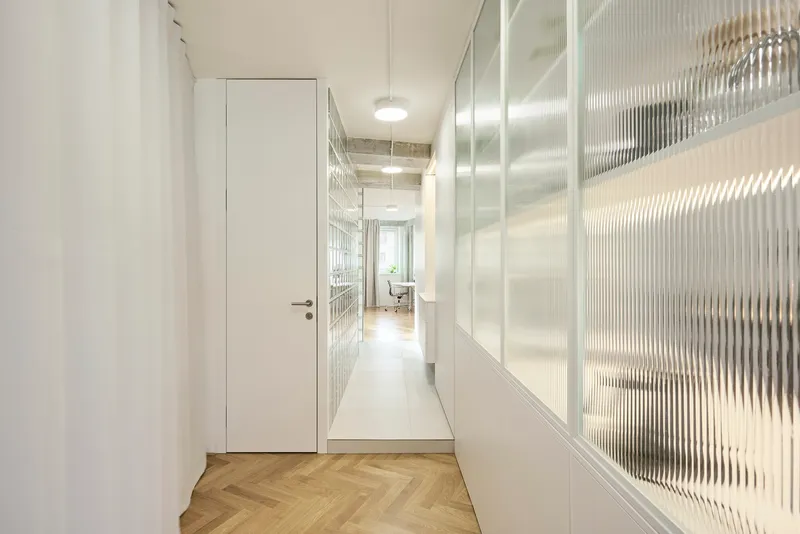
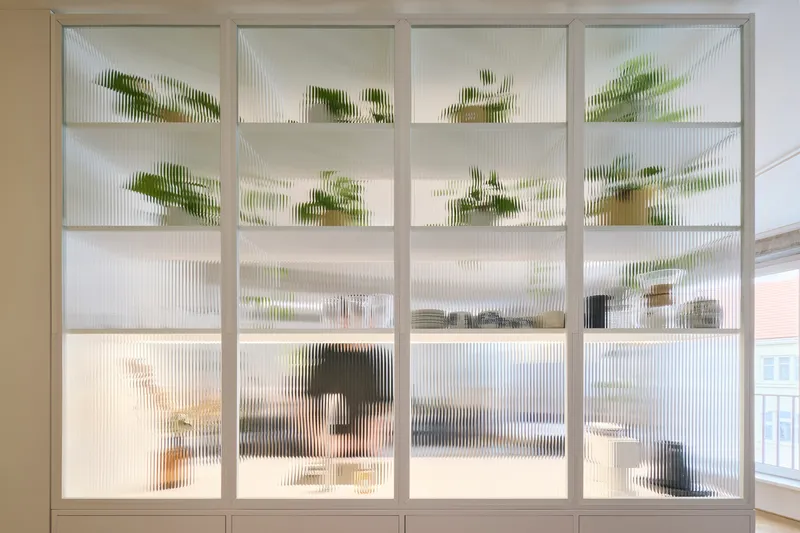
Glass concrete blocks do the heaviest conceptual lifting in the apartment. They transmit light while blocking sightlines, which means the bathroom and toilet feel enclosed without ever feeling dark. The blocks also throw soft, diffused silhouettes of objects and plants on the other side, so you always sense life in adjacent zones without seeing it clearly. It is privacy without isolation.
The fluted and ribbed glass panels that appear elsewhere in the corridors follow the same logic. They filter views into soft textures rather than hard edges, reinforcing the project's core idea: spatial hierarchy comes from degrees of openness, not from sealed rooms. Walking through the apartment, you experience a continuous modulation of visibility and enclosure that no conventional plan could produce.
Curtains as Architecture
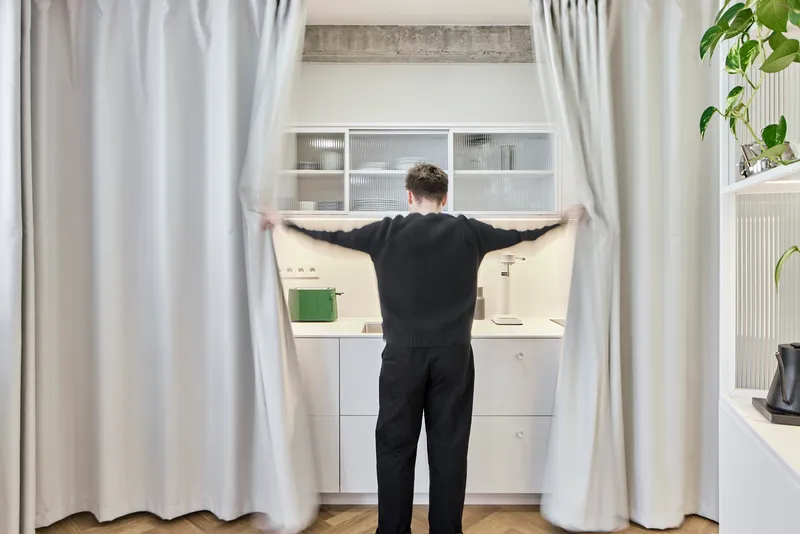
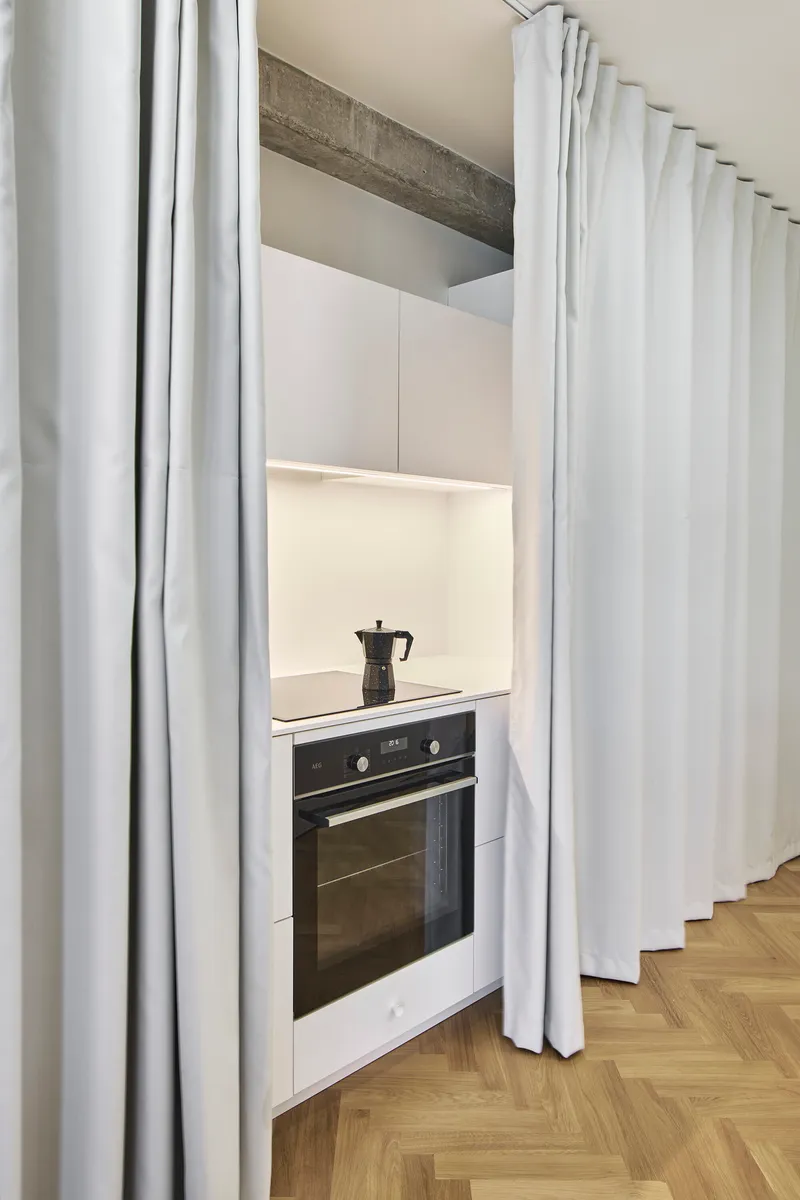
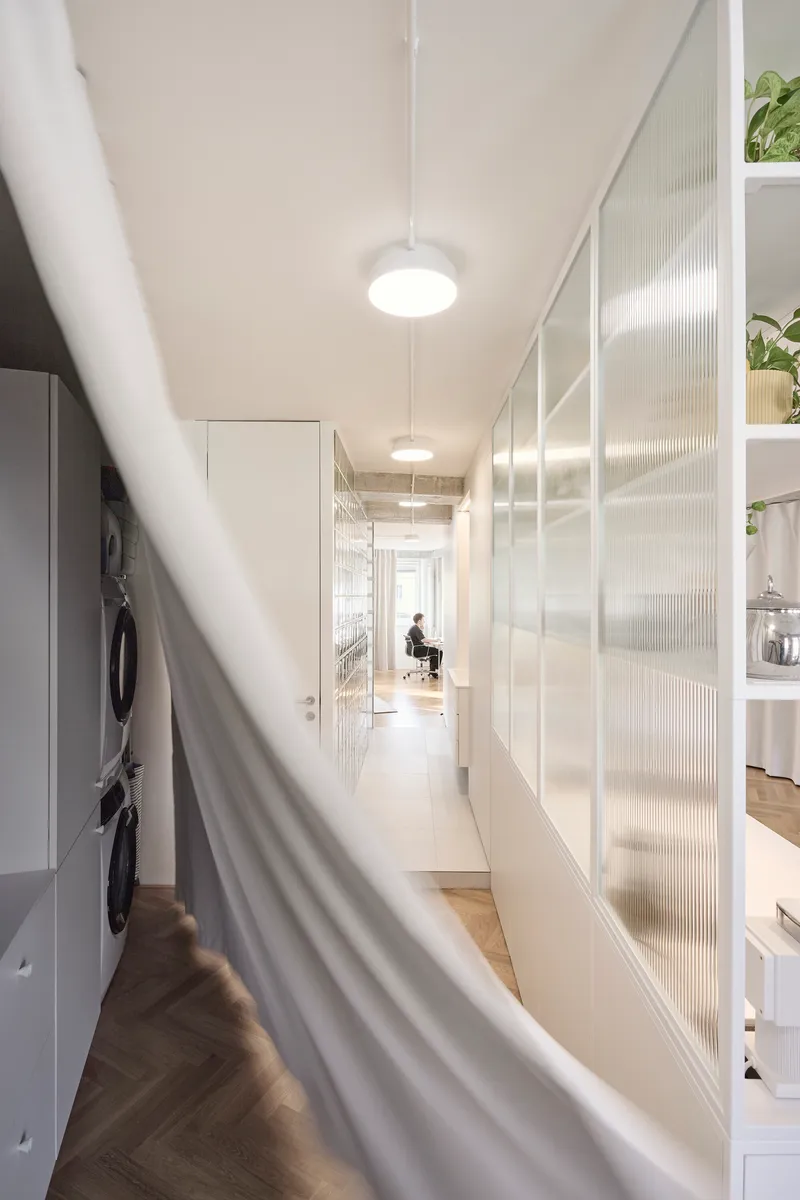
Floor-to-ceiling blackout curtains separate the bedroom alcove, conceal the back kitchen, and hide the built-in oven. They can be drawn back in a single motion, collapsing the apartment into one large room, or closed to create acoustic and visual privacy. The curtain separating the rear kitchen can be moved aside instantly when guests arrive, or left shut to hide the mess of real cooking. It is a domestic convenience that also happens to be an architectural statement.
Using textile as partition is not new, but RDTH commits to it with unusual consistency. The curtains are not accent elements; they are the primary means of enclosure after the glass block walls. Combined with a single digital lighting circuit controlled via phone or tablet, the apartment's atmosphere can be reconfigured in seconds. Openness here is a decision you make each time, not a permanent condition you live with.
Raised Floors and the Wet Zone
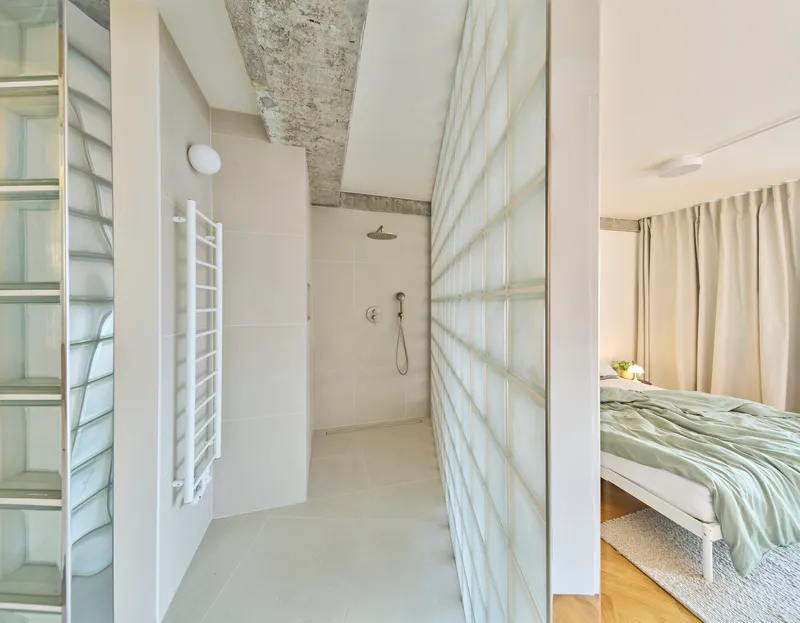
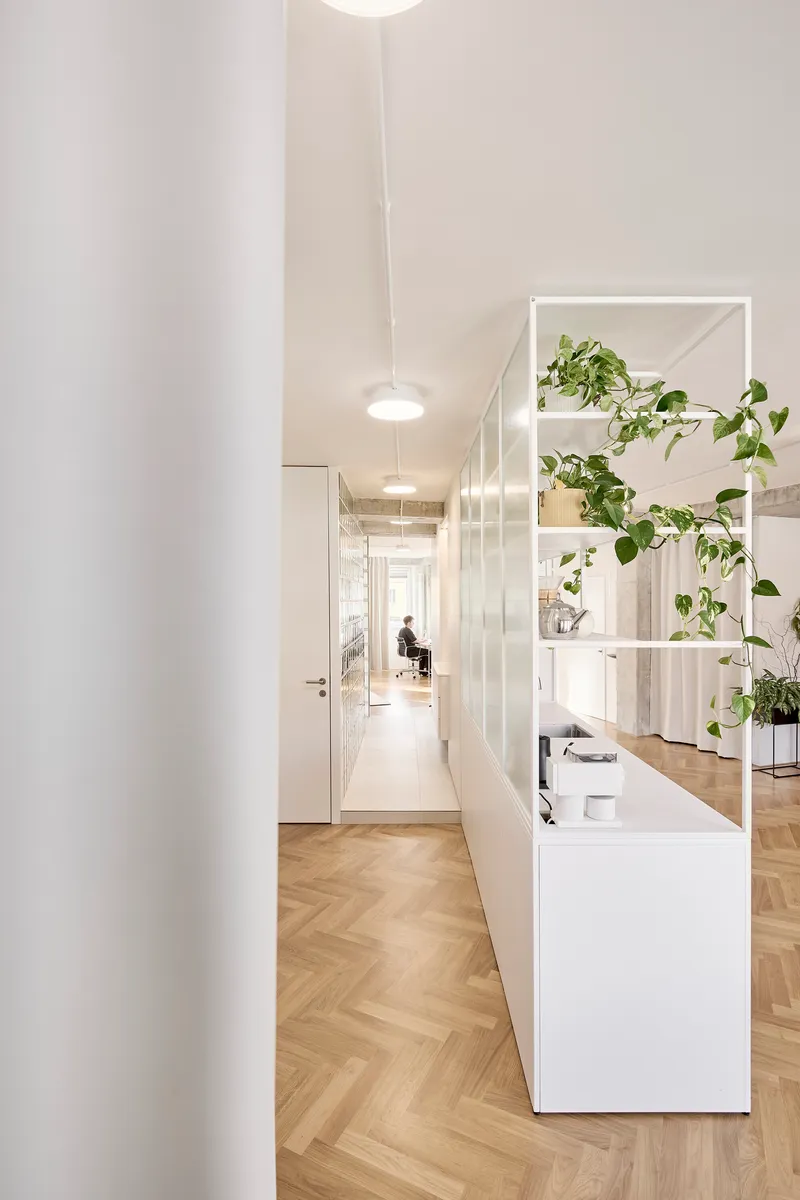
Sanitary functions sit on a raised floor behind the central block. The change in level is practical: it conceals the water and sewage distribution for the washbasin and sink without requiring a dropped ceiling or chased-out slab. But the step up also signals a shift in program. You feel the transition from living space to service space underfoot before you see it.
The washbasin is pulled outside the enclosed shower area, and the bathroom shares a glass block wall with the bedroom corridor. Herringbone oak parquet gives way to ceramic tile at the threshold. These small material transitions do what doors normally do: they tell you where you are and what kind of space you are entering. The toilet, the only room with a conventional door, earns its exception precisely because every other boundary in the apartment is negotiable.
Living in the Loop
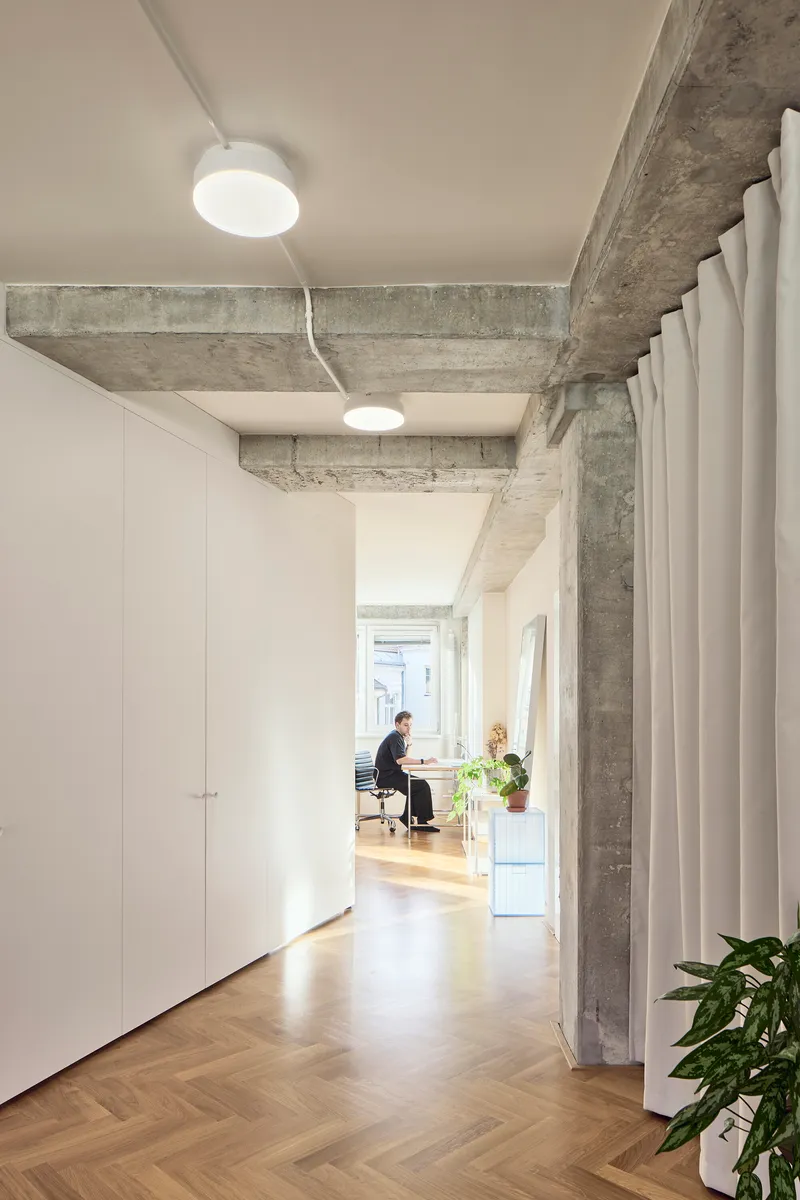
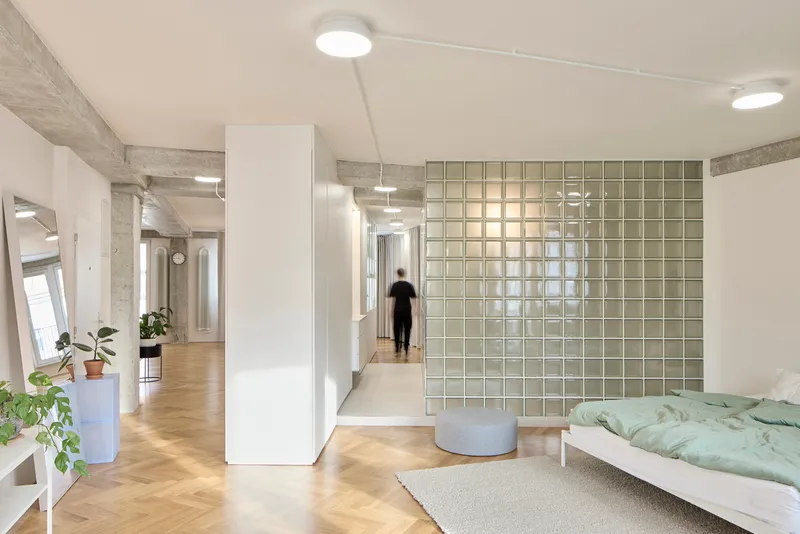
The apartment reads differently depending on where you stand. From the dining area, it feels expansive, with sightlines running through to the far window. From the corridor behind the glass blocks, it feels compressed and intimate, almost monastic. A figure at a desk near the window occupies a zone that is simultaneously workspace, hallway, and living room. The plan does not assign fixed identities to spaces; it lets use define them.
That ambiguity is the project's greatest strength and its biggest risk. It demands an occupant willing to live without a bedroom door, without a kitchen wall, without a clear boundary between public and private. The surrounding Prague neighborhood, walkable to shops, parks, a large library, and a metro station, suggests a lifestyle already oriented toward openness. The apartment simply brings that attitude indoors.
Plans and Drawings
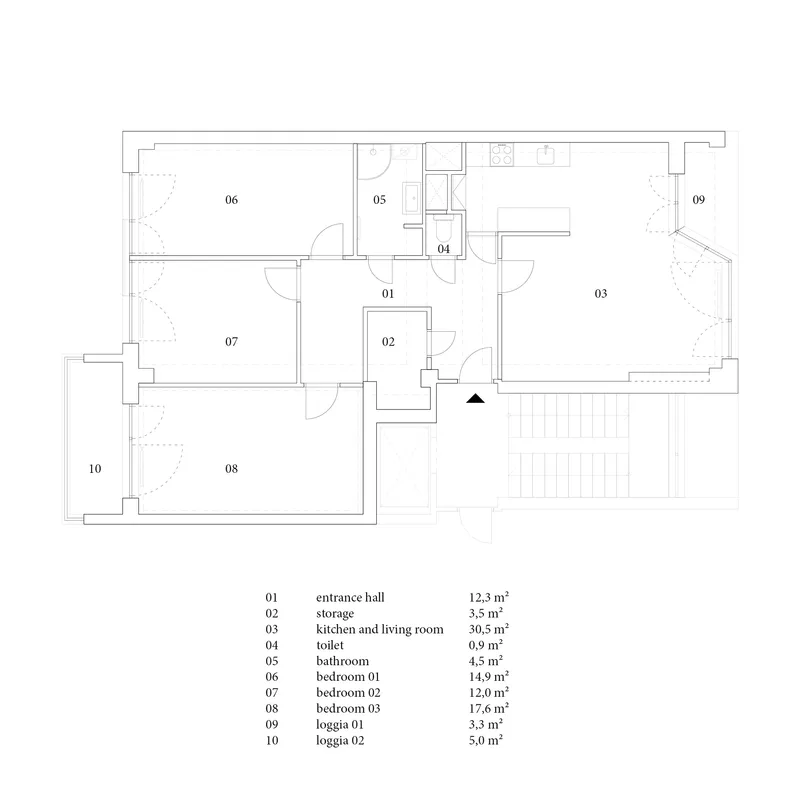
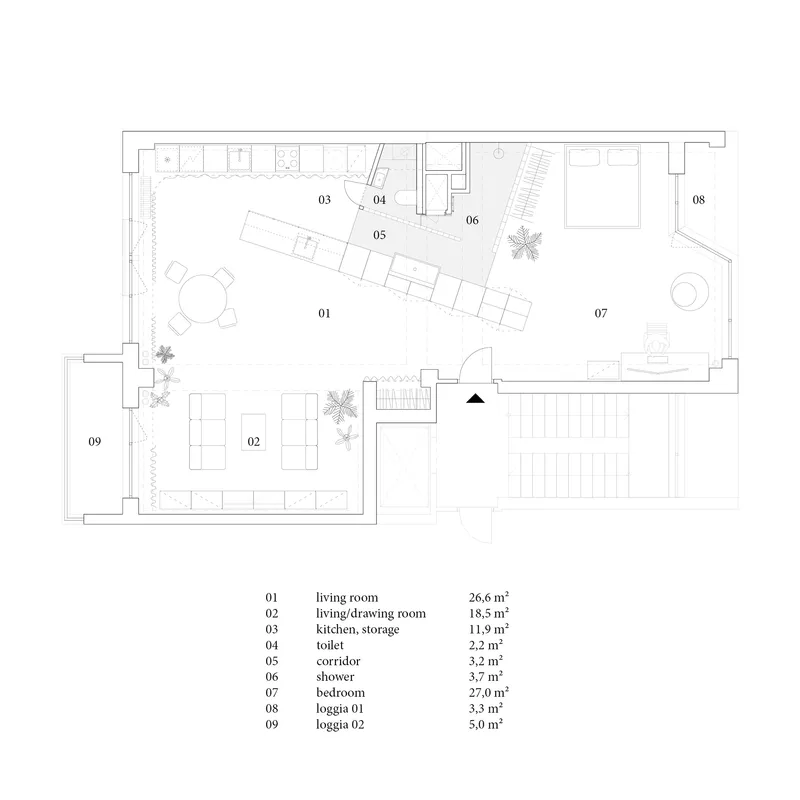
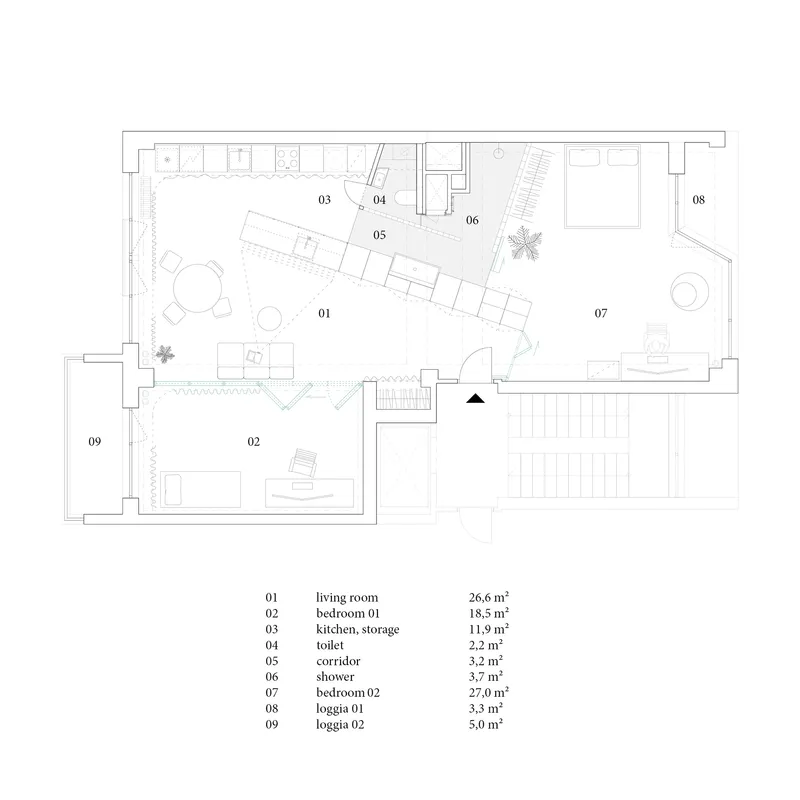
The three plans tell the story of transformation in sequence. The original layout shows a conventional three-bedroom arrangement organized around a central bathroom and kitchen, with corridors feeding each cell. The demolished plan reveals the structural grid and the installation shaft that survived. The final plan shows the rotated furniture block, the open loop of circulation, and the angled kitchen counter that refuses to align with the perimeter walls. Reading them together, you can see exactly how much wall was removed and how little was added back.
Why This Project Matters
The No-Wall Apartment is a controlled experiment in how little partition a home actually needs. RDTH architekti did not simply knock down walls for dramatic effect; they replaced a system of rigid enclosure with a system of adjustable permeability. Furniture, curtains, glass blocks, and floor-level changes do the work that plasterboard used to do, and they do it with more nuance. The result is an apartment that can be one room or four, depending on the hour and the mood.
More broadly, the project belongs to a quiet wave of Prague interior renovations where younger studios use surgical demolition and bespoke joinery to unlock light and movement in post-war housing stock. These are not luxury gut-renovations; they are arguments about what domestic space can become when you stop treating the existing plan as sacred. At 101 square meters, the No-Wall Apartment proves that spatial generosity is a question of strategy, not square footage.
No-Wall Apartment by RDTH architekti. Located in Prague, Czechia. 101 m². Completed in 2026. Photography by Filip Beránek.
About the Studio
Share Your Own Work on uni.xyz
If projects like this are the kind of work you want to make, uni.xyz is a place to publish your own, find collaborators, and enter design competitions.


Popular Articles
Popular articles from the community


Juan García Correa, John González and Claudia Rueda Sink a Circular Amphitheater into a Manizales Engineering Building
On the La Nubia campus in Manizales, Colombia, the S1 Building folds labs and offices into a hillside of ramped lawns that double as a campus route.

Jaramillo Van Sluys Arquitectura and Urbanismo Turn a Demolished Registry Lot in Quito into an Orchard Plaza
In Quito's Centro Histórico, a 2,800 m² plaza exposes the San Agustín convent wall and redraws its lost Augustinian orchard in volcanic stone.

longwave studio Reorganizes a 112 m² Tainan Apartment Around the Daily Routines of a Family and Two Cats
In Tainan, Taiwan, birch plywood, rust-red furniture and a freestanding plaster wall link arrival, storage, work and family life in one apartment.

U.GA Architects Wraps an Oval Rooftop Pool in Curved Board-Formed Concrete on Busan's Jeollidan-gil
In Busan's Jeonpo-dong, a 454 m² mixed-use block stacks a neighborhood facility, guest rooms and an oval rooftop pool inside spiraling concrete walls.

Similar Reads
You might also enjoy these articles


LAVA Architecten Gives Vocational Education a Sawtooth-Roofed Face on a Mechelen School Campus
In Mechelen, Belgium, a 2,053 m² STEM school on a 6×6 m grid turns workshops and classrooms into rooms that can be rearranged as teaching changes.

KEMA Studio Turns a Derelict Marvila Attic into a 60 m² Lighthouse Apartment Above Lisbon
In Lisbon's Marvila district, a rebuilt roof, four skylights and two plywood volumes turn an unlivable attic into a bright home facing the Tagus.

Pixel Gardens: One Repeated Module Stacked Into a Terraced Social Housing Tower for Famagusta
Salem Bader's shortlisted housing tower builds a vertical neighbourhood from one repeated module, offsetting units to carve terraces, light and air.

Bao Huynh Watercolor Atelier: A Serene Art Retreat in Hội An
Bao Huynh Watercolor Atelier in Hội An blends multifunctional art spaces, sustainable design, local materials, and family-friendly living in a serene environment.

Explore Apartment Competitions
Discover active competitions in this discipline

Challenge to reimagine the Iron Throne

Photograph architecture without architects

Illustrate the lost glory of Angkor Wat - Render Challenge

Design challenge to reuse E-waste
Comments (0)
Please login or sign up to add comments
No comments yet. Be the first to comment!