
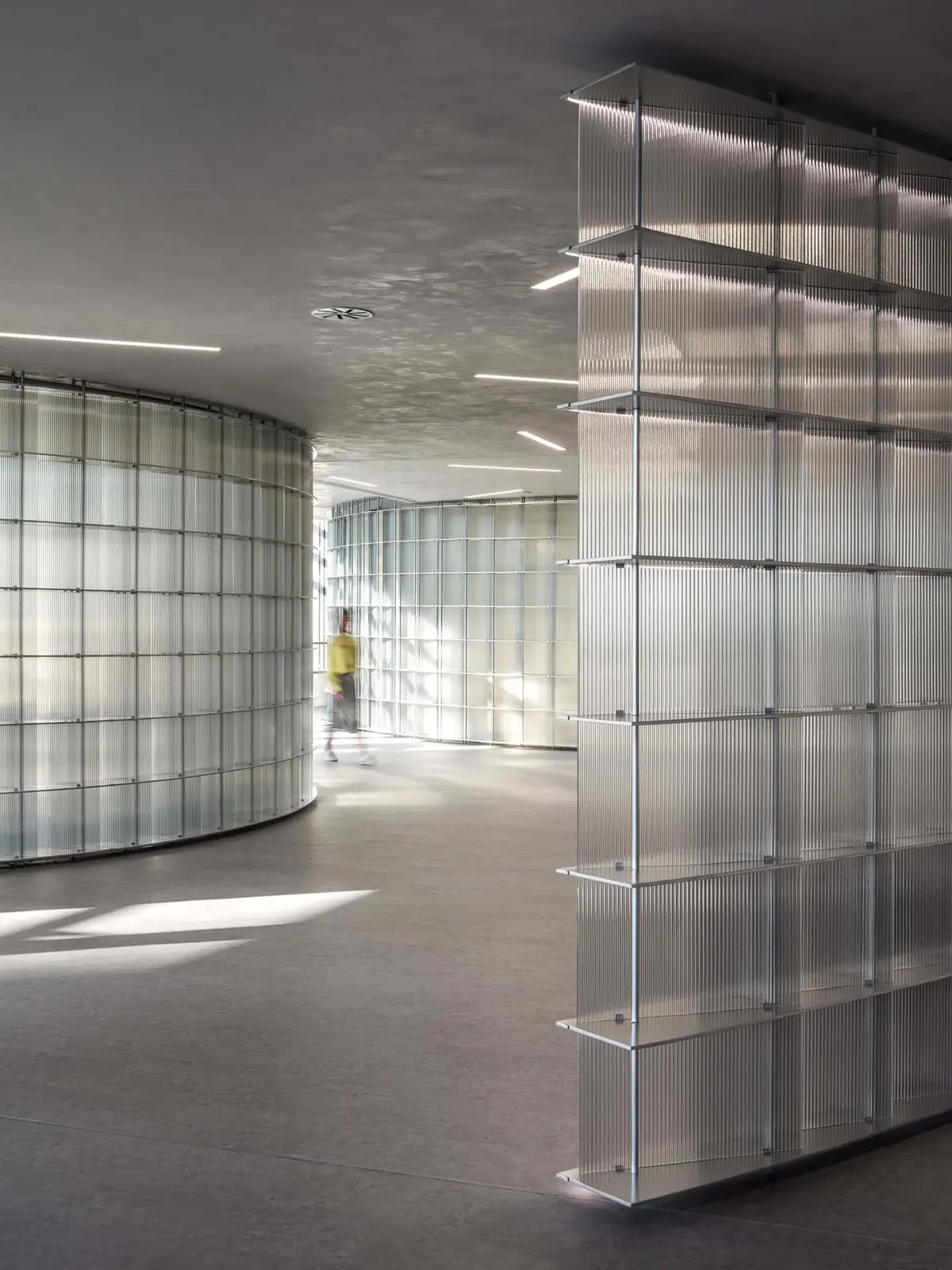
HCCH Studio Wraps a Shanghai High-Rise Office in Curved Walls of Translucent Glass
A 1,000 square meter fit-out in Lujiazui replaces the typical tech-office palette with layered glass, micro-cement, and quiet rigor.


Most offices designed for quantitative finance firms lean hard into one of two clichés: the austere trading floor or the startup playground. HCCH Studio, founded by Hao Chen and Chenchen Hu in Shanghai, chose neither for this asset management company occupying an entire floor of a super high-rise in Lujiazui. Instead they built an interior defined almost entirely by three curving walls of laminated glass and stainless steel, carving the 1,000 square meter floorplate into zones that feel more like a research library than a financial operation.
What makes the project genuinely interesting is its refusal to perform. The client's team is composed of mathematicians and engineers, people whose work demands focus and clarity, not branded color schemes. HCCH responded with a material strategy built on ambiguous transparency: channel glass partitions that transmit southern light while dissolving hard boundaries, micro-cement surfaces that absorb rather than reflect, and an expanded metal mesh ceiling that hides mechanical systems without pretending they don't exist. The result is a calm, luminous workplace whose spatial quality comes from precision rather than spectacle.
Three Curves That Organize Everything


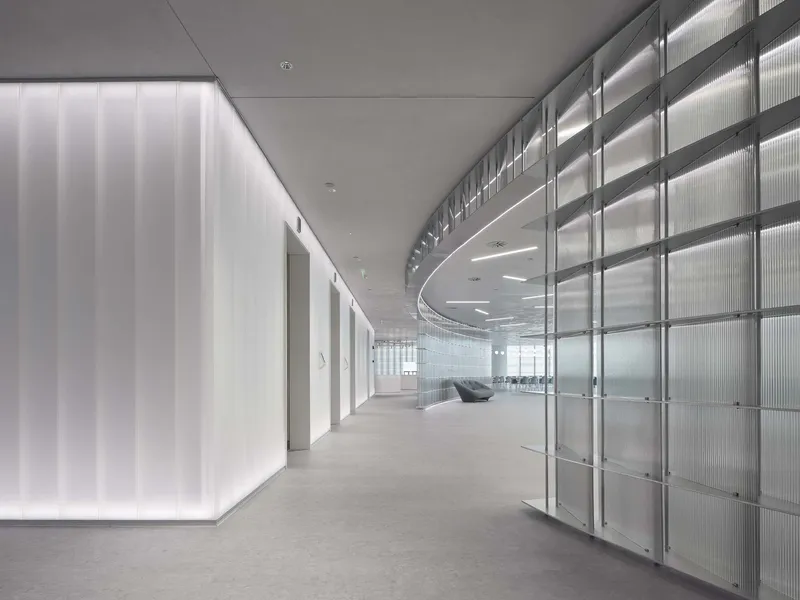
The plan's logic is deceptively simple. An entrance gate splits the floor into two halves: the public zone and the inner workspace. Three curved walls do the rest. Two of them enclose an external reception room at the entrance, and the third defines the dining area. These are not decorative gestures. They are the primary organizational device, replacing what would normally be a grid of drywall partitions with freestanding bookshelves made from laminated glass and stainless steel frames.
Walking along these walls is the key spatial experience. Natural light from the curtain wall passes through the glass array and refracts softly, producing a glow that changes throughout the day. The curves also generate generous circulation routes that feel more like gallery corridors than office hallways, turning the commute from desk to meeting room into something worth noticing.
Reception and the Threshold Condition

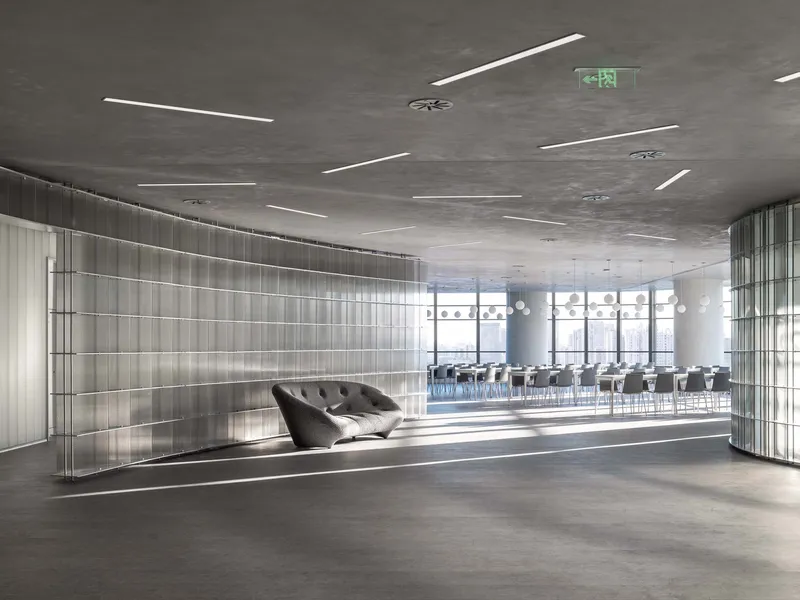

The reception area demonstrates HCCH's commitment to restraint. A curved desk wrapped in backlit glass block panels sits beneath a pair of pendant globe lights. The foyer behind it uses translucent vertical panels to filter views without blocking them entirely. A dark tufted sofa, one of the few pieces of furniture with any visual weight, anchors a lounge that reads as both intimate and transparent.
The threshold between public and private is deliberately soft. Rather than a locked door or a security desk, the transition relies on the curved glass walls themselves to signal a change in territory. You sense that you have moved from one zone to another because the light quality shifts, not because you swiped a badge.
The Dining Hall as Social Infrastructure
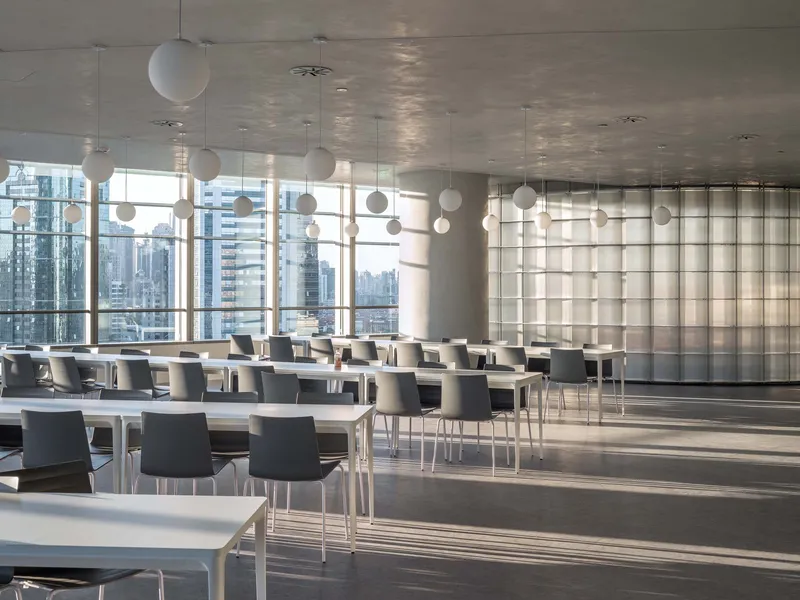
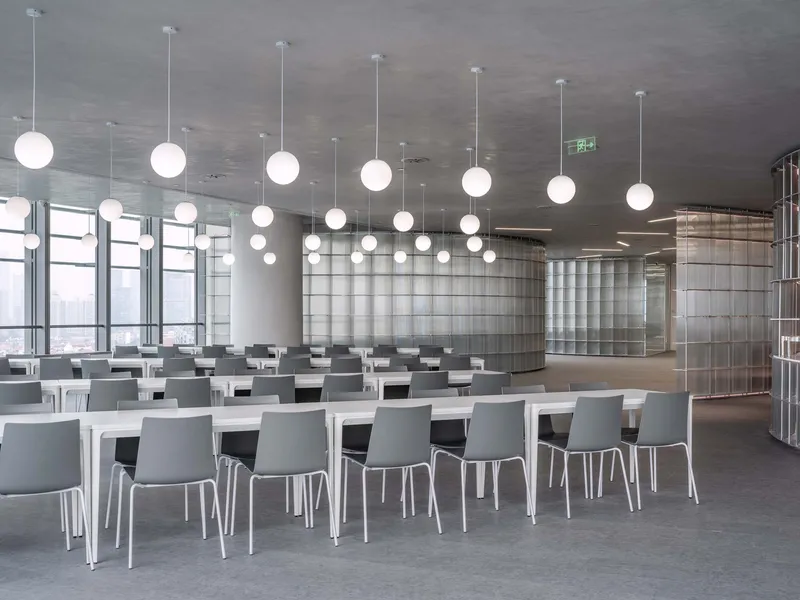
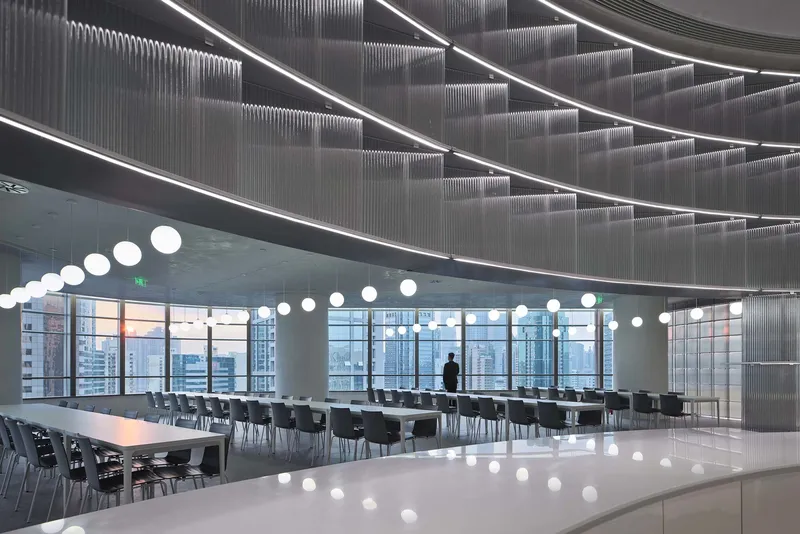
Half of the floor area is designated as public space for meetings and activities, a remarkably generous allocation for a finance firm. The dining area, enclosed by the third curved wall, doubles as the largest communal room. Rows of white tables and gray chairs sit beneath spherical pendant lights that echo the globe fixtures at reception, creating visual continuity across the public zone.
The ribbed metal ceiling panels in this area differ from the expanded mesh used elsewhere, marking the cafeteria as a distinct room without resorting to a different color or material family. Floor-to-ceiling glazing frames Pudong's skyline but, critically, the seating is arranged to face inward. The view is a backdrop, not the main event. HCCH clearly understands that the most productive social spaces orient people toward each other.
Workspace: Daylight at the Edge, Services at the Core
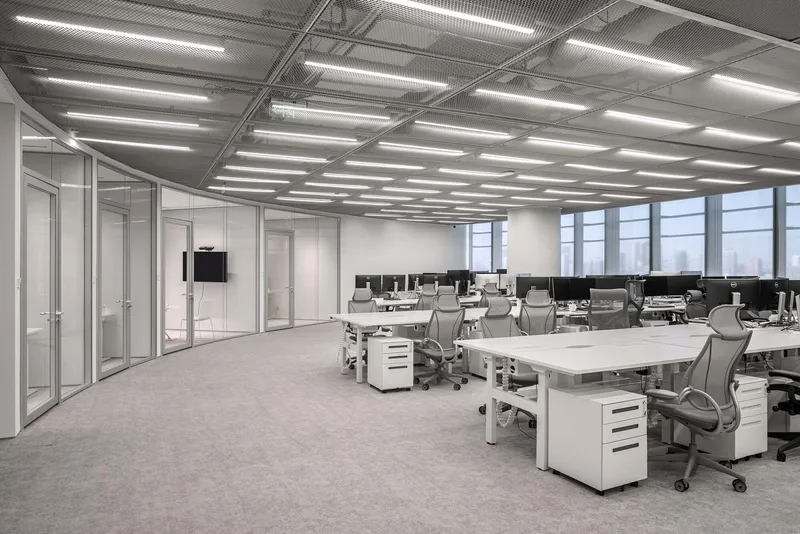

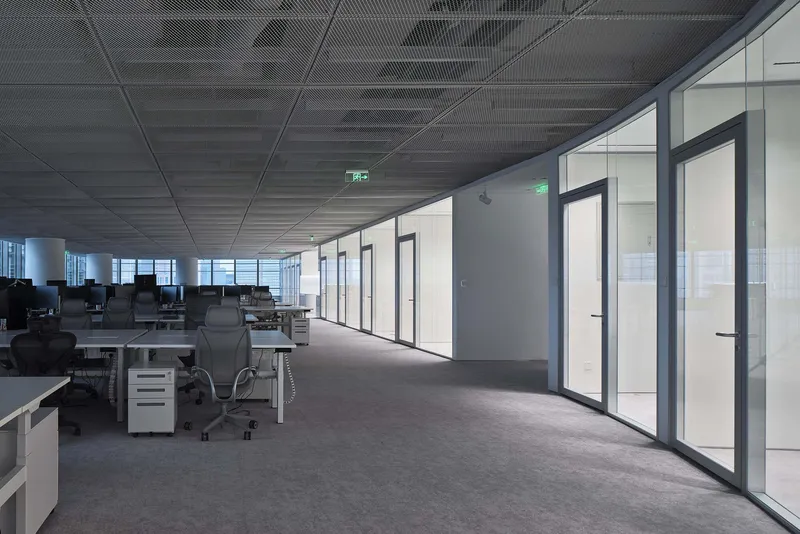
The inner work area follows a straightforward but well-executed principle: workstations along the windows, enclosed rooms around the central core. Two large analyst zones and a trader zone occupy the perimeter, where gray textured carpets absorb sound and southern daylight washes across desks. Focus rooms, small meeting rooms, and IT infrastructure are pushed to the windowless center, organized around the building's service core.
The ceiling here is the most revealing detail. Expanded metal mesh covers the entire surface, with strip lights and circular air outlets set flush. Lighting, sprinkler heads, and air conditioning outlets are all integrated into the gaps or mounted above the mesh. The effect is a continuous overhead plane that acknowledges the mechanical reality of a high-rise fit-out without trying to romanticize exposed ductwork. It is honest without being performative.
Glass Pods and Acoustic Privacy
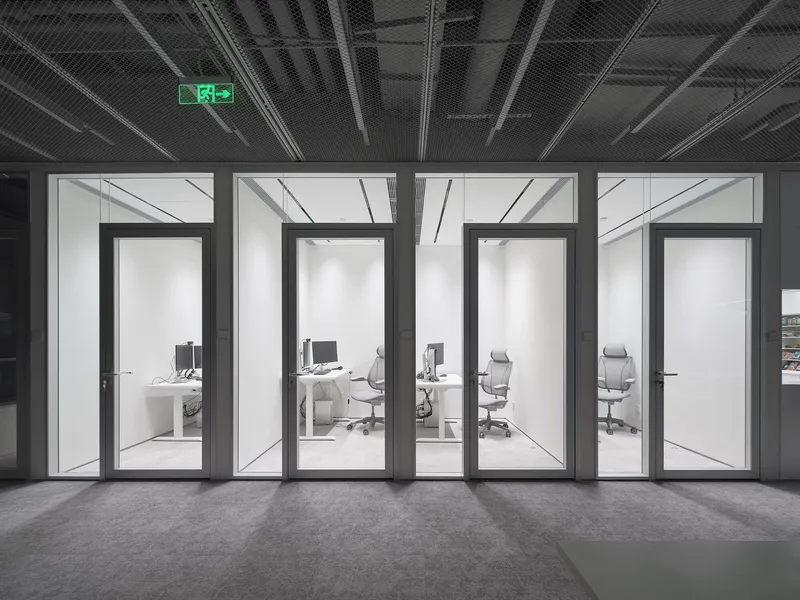

Enclosed meeting rooms and office pods are lined up along corridors with glass walls and soundproof doors. One meeting room features a circular ring light fixture that doubles as the room's only decorative element, casting a halo on the translucent glass walls and filtering exterior shadows into abstract patterns. These rooms prove that you can build acoustic enclosure within an open plan without creating visual dead zones.
The glass partitions maintain the layered transparency that defines the project. Standing in the corridor outside these pods, you can see through two or three layers of glass simultaneously, each one slightly different in opacity and texture. The resulting depth is subtle but unmistakable, and it gives the workspace a spatial richness that most glass-box offices lack.
Plans and Drawings

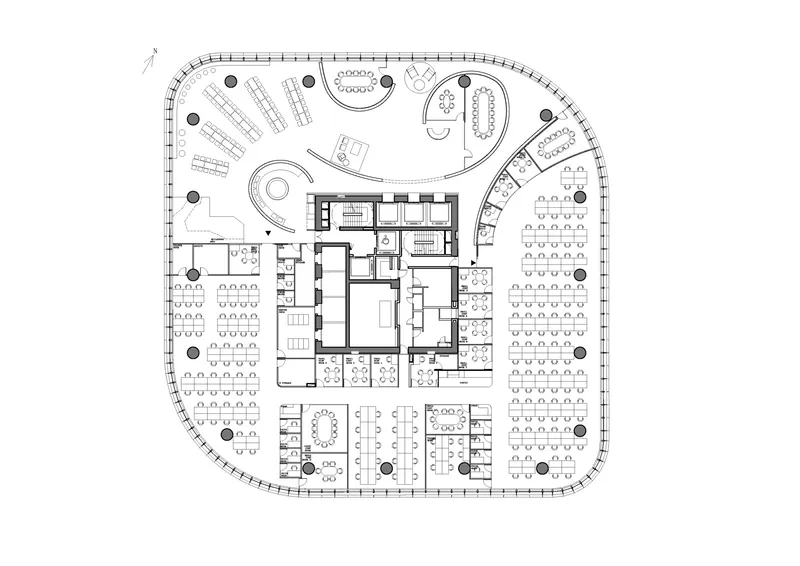
The floor plans reveal the project's organizational clarity. The rounded-square perimeter of the tower defines an outer ring of workstations and a central service core that absorbs all vertical circulation, restrooms, and mechanical risers. Between these two fixed geometries, the three curved partition walls negotiate the program with surprising economy. The drawings also show how much of the floor is devoted to open or semi-public use: the reception, meeting rooms, and dining area together occupy nearly as much area as the workspace itself.
Why This Project Matters
The Winding Frames of Light Offices makes a quiet argument against the dominant trends in workplace design. There are no ping-pong tables, no branded accent walls, no biophilic planters arranged for Instagram. Instead, HCCH Studio built an environment whose quality derives from material selection, daylighting strategy, and a clear spatial diagram. The curved glass walls are the single architectural move, and everything else serves them.
For a client whose daily work involves mathematical models and data analysis, this approach is appropriate in a way that goes beyond aesthetics. The space respects concentration. It provides generous social areas without forcing interaction. It brings daylight to every desk without sacrificing acoustic control. These are basic goals that most office fit-outs claim to meet and few actually achieve. HCCH managed it at 1,000 square meters in a Shanghai supertall, which makes the accomplishment all the more notable.
Winding Frames of Light Offices by HCCH Studio, located in Shanghai, China. 1,000 m². Completed in 2022. Photography by Qingyan Zhu and STUDIO FANG.
About the Studio
Share Your Own Work on uni.xyz
If projects like this are the kind of work you want to make, uni.xyz is a place to publish your own, find collaborators, and enter design competitions.


Popular Articles
Popular articles from the community

Extended Shell: Retrofitting Kolkata's Balconies as Living Urban Thresholds
A modular retrofit system recovers the social and environmental intelligence of Kolkata's historic verandas for contemporary Park Street residents.

Opera by the Sea Estonia: Three Shells Dissolving Architecture into Tallinn's Coastline
A winning opera house proposal replaces monumental form with interconnected shells that blur the boundary between building, park and Baltic Sea.

Temporary Home for Dogs: A Reversed Zoo Rethinks Animal Shelter Architecture
In Bucharest, a sinuous corridor and freed landscape flip the logic of containment, designing a shelter that works to make itself unnecessary.

The Amber Palace Opera: A Geological Fiction Surfaces on Tallinn's Baltic Waterfront
Pierre Brillard reimagines a Baltic legend as a public landscape, opera house, and waterfront promenade rooted in Tallinn's coastal identity.

Similar Reads
You might also enjoy these articles

Pixel Gardens: One Repeated Module Stacked Into a Terraced Social Housing Tower for Famagusta
Salem Bader's shortlisted housing tower builds a vertical neighbourhood from one repeated module, offsetting units to carve terraces, light and air.

Bao Huynh Watercolor Atelier: A Serene Art Retreat in Hội An
Bao Huynh Watercolor Atelier in Hội An blends multifunctional art spaces, sustainable design, local materials, and family-friendly living in a serene environment.

Atelier Macri Concept Store Interior Design by CASE-REAL
Atelier Macri store features a "ko" counter, walnut wood details, cork displays, blending retail, gallery, and seamless customer experiences.

Manuel Vargas Izquierdo Stadium and High-Performance Sports Center: Architectural Excellence in Jalpa de Méndez
The Manuel Vargas Izquierdo Stadium blends sustainable design, inclusive sports facilities, and cultural-inspired architecture, revitalizing Jalpa de Méndez’s public spaces.

Explore Wooden Frames Competitions
Discover active competitions in this discipline

Challenge to reimagine the Iron Throne

Photograph architecture without architects

Illustrate the lost glory of Angkor Wat - Render Challenge

Design challenge to reuse E-waste
Comments (0)
Please login or sign up to add comments
No comments yet. Be the first to comment!