
Roman Izquierdo Bouldstridge Turns an Old Barcelona Shop into a Loft Organized by Emptiness
In El Born, three timber torii frames and the Taoist concept of the void reshape 85 square meters of former commercial space into a dwelling.


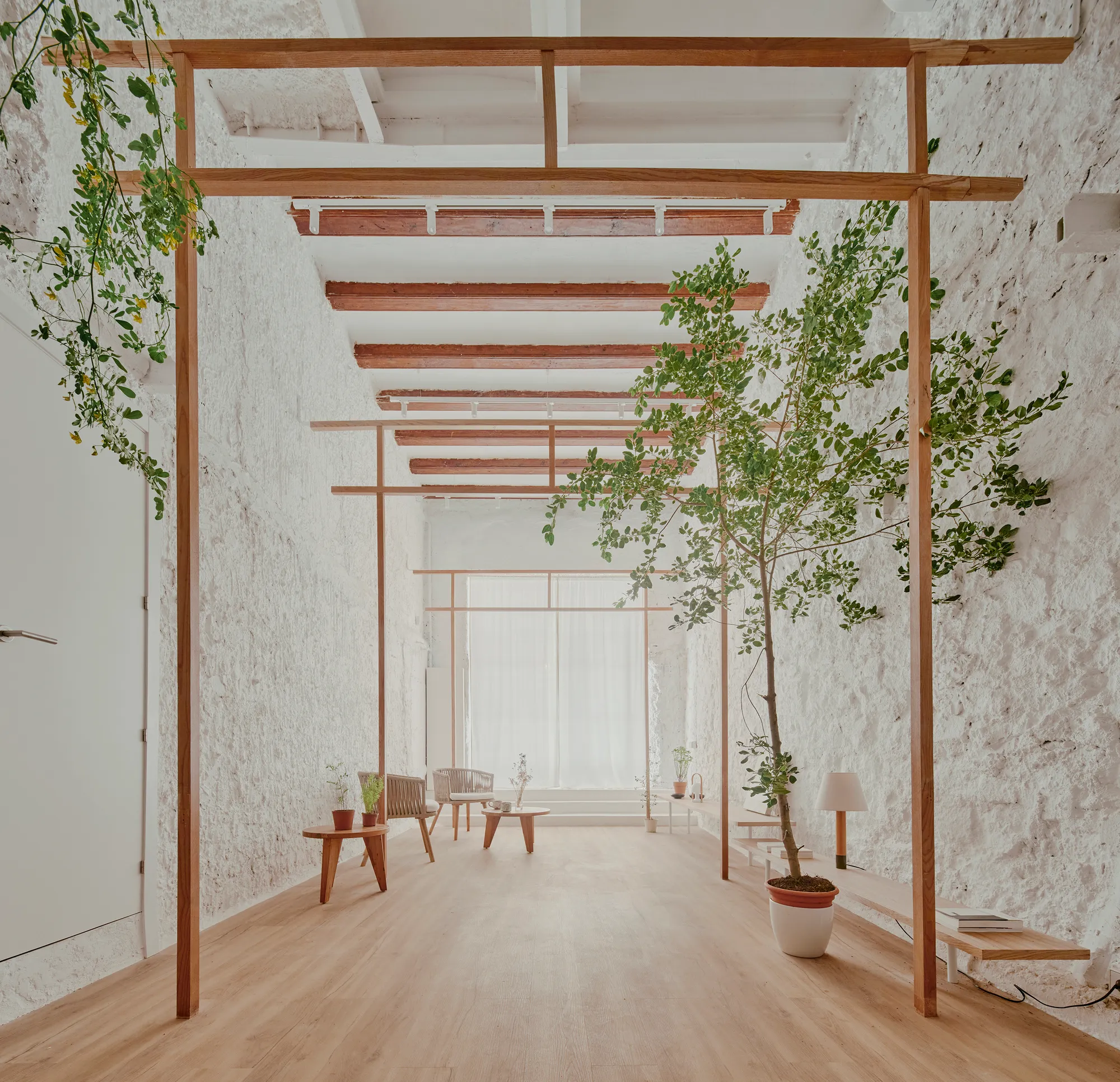
Most loft conversions treat open plan as a default, something you get when you knock walls down and leave exposed brick behind. The El Born Loft in Barcelona does something rarer: it treats openness as an argument. Designed by Roman Izquierdo Bouldstridge, the 85 square meter conversion of a former commercial space in one of Barcelona's densest historic quarters takes the Taoist idea that utility resides not in walls but in the emptiness they contain and builds an entire domestic program around it. The result is a home where the void is the protagonist, and the few physical interventions read more like punctuation than structure.
The key move is a set of three timber torii, portal frames borrowed from the Japanese gateway tradition and planted at intervals through the long, narrow plan. They don't enclose rooms. They create what the Japanese call ma, a concept of intermediate space, pauses in a spatial sequence that allow living functions to drift and recombine without the finality of partition walls. Paired with a white spiral staircase, nearly five meters of height, and a mezzanine sleeping level, these frames turn a stripped back commercial shell into something that feels genuinely spacious without pretending it's bigger than it is.
The Torii as Domestic Framework


Walk through the loft and the three timber torii mark thresholds between zones that are felt rather than defined. They are honest structures, post-and-beam assemblies with horizontal members that echo the exposed ceiling joists above. Potted trees line the corridor between them, their canopies softening the geometry and introducing a living layer that shifts with the seasons. The frames are tall enough to register as architecture but light enough to preserve sightlines from one end of the plan to the other.
What makes the torii work is their refusal to become walls. They occupy just enough volume to slow your eye and change the quality of a room without ever interrupting it. The concept of ma is often sentimentalized in Western design discourse, but here it functions practically: the frames give the inhabitant permission to assign different activities to different zones, or to collapse the whole space into one continuous event, without moving a single piece of furniture.
Stripping Back to the Skeleton


The studio's first act was demolition, peeling away layers of previous commercial interventions to reveal the building's original bones. What emerged was a narrow rectangular volume with rough white plaster walls, exposed timber ceiling beams, and enough height to accommodate a mezzanine without crushing the ground floor. The material palette, stone, wood, and ceramics, was already present in the shell. Rather than importing a new aesthetic, the architects amplified what was already there.
The construction sequence confirms the extent of this stripping back: the space was gutted to bare masonry before the timber framing and planting were introduced. It is a minimal intervention strategy that aligns with the project's broader philosophy of resource reduction. New materials are limited to the torii frames, the spiral staircase, and a set of elemental furniture panels on four legs that can be reconfigured as needs change.
Living with Light and Height

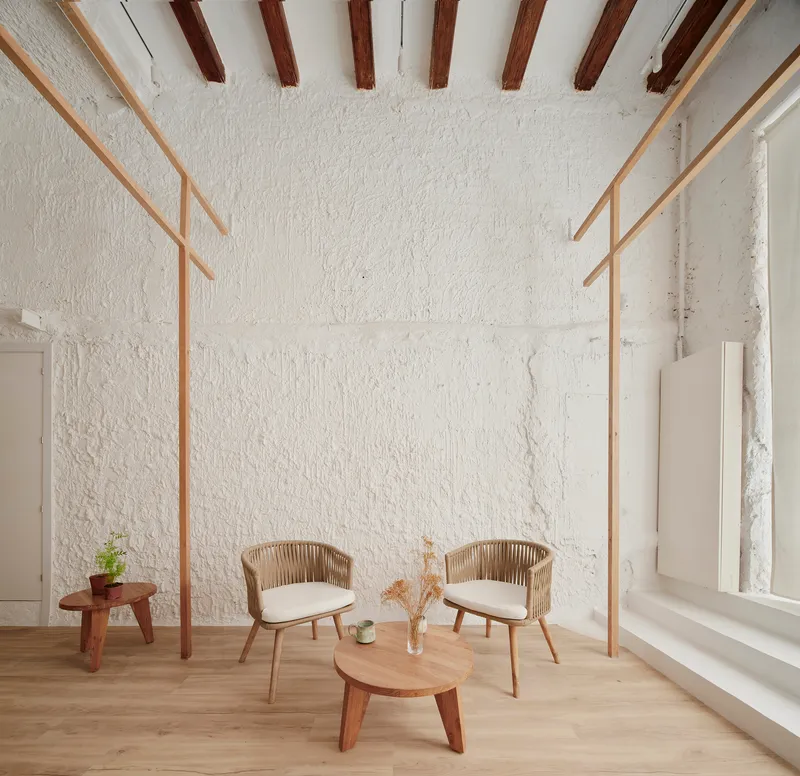

Nearly five meters of ceiling height in a space this compact is a genuine luxury, and the architects exploit it fully. The mezzanine, accessed by the white spiral staircase, houses the sleeping area and a small workspace. Below, the double height void lets daylight travel deep into the plan, picking up the grain of the timber beams and warming the whitewashed surfaces. Natural light is doing real work here: it differentiates zones, highlights the torii frames, and keeps the palette of white plaster and pale wood from feeling monotonous.
The tall window visible in several views acts as the primary light source, and its proportions feel calibrated to the section. Light enters high and washes the rough plaster walls, creating subtle shadow gradients that change through the day. In a neighborhood as dense as El Born, where facade openings are often limited, this careful handling of what light is available separates the project from the exposed-brick loft conversions that fill the surrounding streets.
The Mezzanine and the Spiral Stair


The white spiral staircase is the most sculptural element in the loft. Its tight geometry contrasts sharply with the rectilinear timber frames and the rough masonry walls, and its whiteness lets it recede into the plaster background when seen from certain angles. At the mezzanine level, horizontal timber railings provide enclosure without blocking the view down into the living space, maintaining the visual continuity that the entire scheme depends on.
From the mezzanine desk, the inhabitant looks out over the full depth of the lower level: the planted corridor, the dining area, the torii frames receding toward the far wall. It is a vantage point that reinforces the loft's central idea. You are not looking at a series of rooms. You are looking at a single, calibrated void in which domestic life can arrange itself freely.
Kitchen, Bathroom, and the Only Enclosed Room


The bathroom is the only fully enclosed space in the loft, a concession to basic privacy that the architects treat as an exception rather than a rule. Everything else, including the kitchen, is open to the central sequence. The kitchen sits under a whitewashed vaulted ceiling with exposed beams, its white base cabinets and timber countertop continuing the restrained material vocabulary. A dining table extends directly from the kitchen zone into the main volume, reinforcing the absence of hierarchy.
This radical openness is not unique, but the philosophical rigor behind it is. Many open-plan lofts end up open simply because they removed walls and called it a day. Here, the single enclosed room is a deliberate decision rooted in the idea that walls should exist only when absolutely necessary. The rest of the plan demonstrates that most domestic boundaries can be handled by light, materiality, and spatial pauses.
Plants as Architecture


A large tree and trailing climbing plants are not decorative afterthoughts in the El Born Loft. They occupy the void as what the studio calls "living inhabitants," their canopies and tendrils softening the timber frames and contributing a biological rhythm to a space defined by geometric restraint. The tree beside the low bench anchors the central corridor, and its height plays off the double-height volume in a way that a floor lamp or a bookcase never could.
Using plants at this scale inside a dwelling requires a commitment to care that most residential projects avoid. The fact that they are integral to the spatial concept, not a staging detail for the photo shoot, gives the loft an evolving quality. These spaces will look different in five years as the climbing plants thicken and the tree matures. The architecture accounts for that change rather than resisting it.
Plans and Drawings


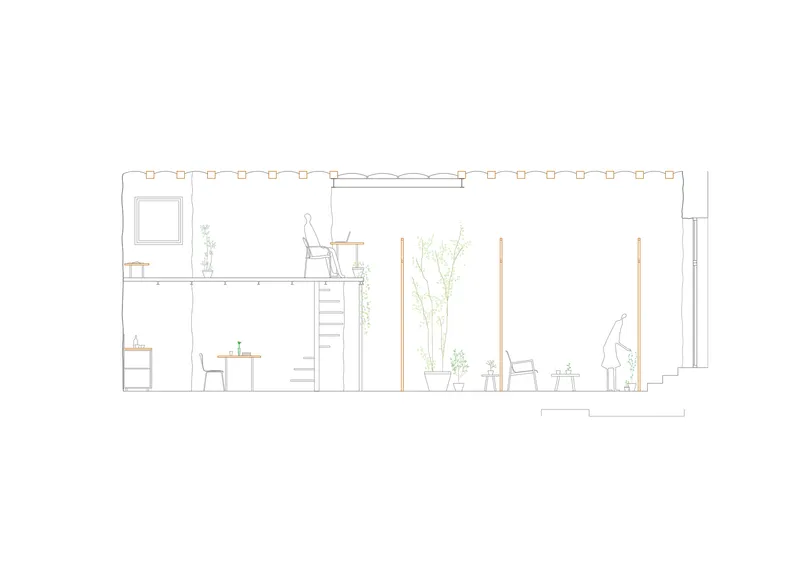

The floor plans confirm the narrow, linear organization: kitchen and bathroom occupy one end, the spiral stair sits roughly at the midpoint, and the living zone stretches toward the far wall. The section drawing reveals how critical the mezzanine is to the scheme, carving out a sleeping level without consuming the double-height void below. And the axonometric cutaway offers the clearest reading of the torii sequence, showing how the timber frames interact with the corrugated roof, the planted partitions, and the sparse furniture to create distinct spatial conditions within a single continuous volume.

The construction photograph sequence is equally telling. It documents the full arc from demolition to finished space and makes clear how little new material was introduced. The timber frames and spiral stair are essentially the only structural additions to a shell that the architects trusted enough to leave exposed.
Why This Project Matters
The El Born Loft matters because it proposes an alternative to the two dominant modes of loft conversion: the industrial-chic fetish for exposed services and raw concrete, and the white-box erasure that treats history as a liability. Roman Izquierdo Bouldstridge's approach does neither. It strips the commercial shell back to its original structure, then inserts a set of minimal, philosophically grounded elements, timber torii, a spiral stair, movable furniture panels, that organize space through pause and continuity rather than enclosure. The result is a dwelling that feels specific to its place and its ideas in equal measure.
It also makes a case for smallness done well. At 85 square meters, the loft is compact by any standard, yet the combination of five-meter ceilings, a mezzanine, and the deliberate absence of partition walls makes it feel generous. The lesson is not that every small space needs a torii frame. It is that spatial quality can be produced by what you remove as much as by what you add, and that a clear conceptual framework, in this case the Taoist emphasis on the utility of the void, can discipline a renovation into something more than the sum of its finishes.
El Born Loft by Roman Izquierdo Bouldstridge, located in the El Born district of Barcelona, Spain. 85 m². Completed in 2026. Photography by José Hevia.
About the Studio
Share Your Own Work on uni.xyz
If projects like this are the kind of work you want to make, uni.xyz is a place to publish your own, find collaborators, and enter design competitions.



Popular Articles
Popular articles from the community


AL-JANNAH: Sustainable Architecture and Permaculture for Afghan Widows
AL-JANNAH uses sustainable architecture and permaculture to create resilient oasis of housing, learning, work and renewal for Afghan widows.
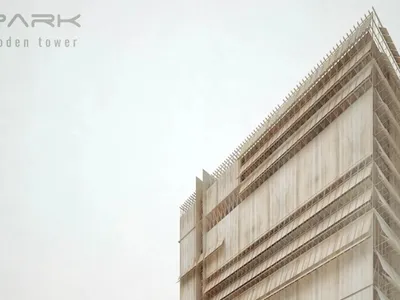
EW PARK: Sustainable Architecture Reimagines the Future of Urban Parking
EW PARK reimagines city parking as a modular wooden tower combining automation, solar energy, electric mobility, and adaptable urban design.

Conexión: Biophilic Design Reimagines High-Rise Living in Hong Kong
Conexión reimagines high-rise living in Hong Kong through biophilic design, green facades, shared spaces, daylight, water and nature within.

The Musturak Paradise: Senior Living Architecture for a Connected Future in Temara, Morocco
The Musturak Paradise reimagines senior living architecture in Temara via private homes, social spaces, culture, community, and shared care.

Similar Reads
You might also enjoy these articles

Bao Huynh Watercolor Atelier: A Serene Art Retreat in Hội An
Bao Huynh Watercolor Atelier in Hội An blends multifunctional art spaces, sustainable design, local materials, and family-friendly living in a serene environment.

Atelier Macri Concept Store Interior Design by CASE-REAL
Atelier Macri store features a "ko" counter, walnut wood details, cork displays, blending retail, gallery, and seamless customer experiences.

Manuel Vargas Izquierdo Stadium and High-Performance Sports Center: Architectural Excellence in Jalpa de Méndez
The Manuel Vargas Izquierdo Stadium blends sustainable design, inclusive sports facilities, and cultural-inspired architecture, revitalizing Jalpa de Méndez’s public spaces.

KAKR Buluh Awar Hall: Revitalizing Community and Ecology Through Bamboo Architecture
Community built bamboo hall revitalizes Buluh Awar village, empowering youth, restoring ecology, celebrating vernacular craftsmanship through sustainable architecture and culture.



Comments (0)
Please login or sign up to add comments
No comments yet. Be the first to comment!