

20 Most Popular Commercial Architecture Projects of 2025
From sustainable market concepts to heritage factories, the commercial buildings and proposals that drew the most attention on uni.xyz this year.


Commercial architecture had a remarkable year in 2025. Across markets, restaurants, retail flagships, and mixed-use developments, architects pushed beyond the transactional nature of commercial space to ask a harder question: what does it mean to build a place people actually want to be in?
The projects collected here are not just buildings that house commerce. They are spaces that rewrite the relationship between buying and belonging, between retail and ritual. From a sustainable market concept that rethinks urban food systems to a heritage textile factory in Bahrain that weaves tradition into its walls, these 20 projects represent the most popular commercial architecture published on uni.xyz in 2025.
We have ranked them by reader engagement: visits, saves, and conversation from our community of 260,000+ architects and designers. The list spans both built projects by established studios and conceptual proposals from emerging designers. Both mattered this year.
Markets and Public Commerce
The most visited commercial projects of 2025 were not luxury flagships or corporate towers. They were markets: places where food, community, and architecture converge. That says something about where the discipline is heading.
1. La Ruche: A Sustainable Urban Market Revolution

The most-read commercial project on uni.xyz in 2025, and for good reason. La Ruche, French for "The Beehive," treats the urban market not as a shed with stalls but as a civic institution. The design weaves adaptive architecture into a framework for sustainability, collaboration, and local food sovereignty. It is a building that argues markets are infrastructure, not afterthoughts.
What makes it exceptional is the refusal to separate the act of buying food from the act of participating in a city. Every design decision, from the modular stall system to the passive ventilation strategy, serves both commerce and community. The project captured readers because it proposed something rare: a commercial typology that feels civic.
Designers: Roxanne, Huyensa, Giulia
2. Chicxulub Market Plaza by Estudio MMX
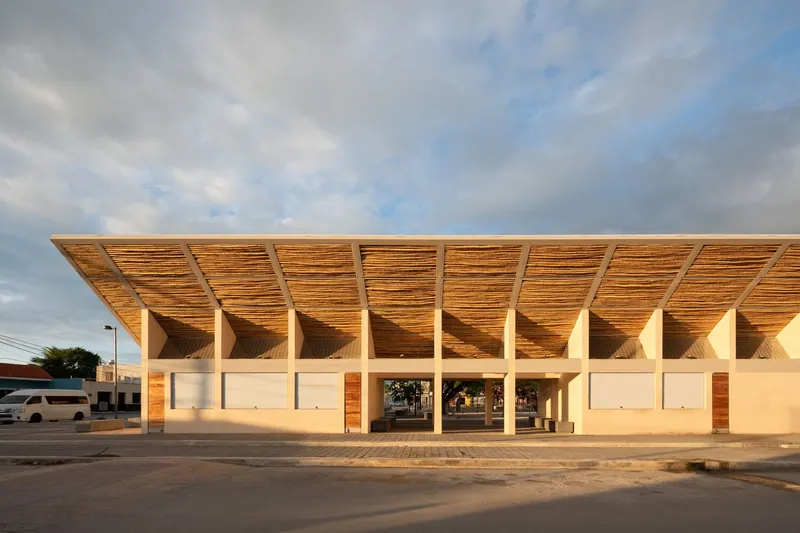
In the Yucatan Peninsula, Estudio MMX designed a market plaza that does not fight the climate but works with it. Deep overhangs create shaded public spaces. Natural ventilation replaces mechanical cooling. The market stalls open directly to the plaza, blurring the line between buying and gathering.
The project is a quiet masterclass in regional commercial architecture. It does not import a global retail vocabulary into a local context. It grows from the ground it sits on, using materials that age with the same patience as the community around them.
Studio: Estudio MMX
3. Reimagining Urban Spaces: Sustainable Shopping Mall Design

The shopping mall is not dead. It is being reborn. This conceptual proposal reimagines the mall typology by dissolving the boundary between indoor retail and outdoor public space, replacing anchor stores with community programs, and integrating sustainable systems that turn the building from an energy consumer into an energy contributor.
What makes the project compelling is its refusal to write off a typology most architects have given up on. Instead of designing for a new site, it offers a roadmap for how existing malls might evolve, making it instantly relevant to thousands of underperforming retail properties around the world.
Designer: Akib
4. Marche Thonglor by Contour Architect, Bangkok
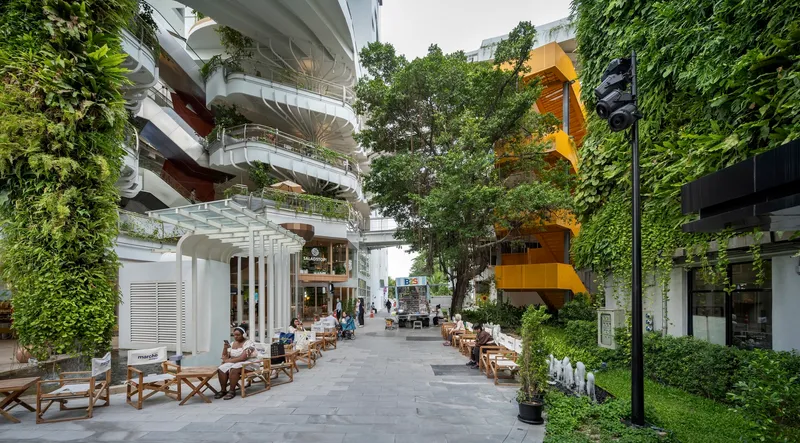
Bangkok's Thonglor neighborhood gained a building that breathes. Marche Thonglor is a mixed-use green oasis that layers retail, office, and dining within a biophilic framework so dense with planting that the building sometimes disappears behind its own canopy.
The architecture argues that in tropical cities, the most commercial thing you can offer is shade and green. Contour Architect understands this instinctively. Every terrace, every overhang, every carefully placed tree is a calculation about how heat and humidity shape human behavior.
Studio: Contour Architect
Retail Flagships
The retail flagship in 2025 became less about selling product and more about selling a world. The best ones created environments so immersive that the transaction almost felt secondary.
5. Goldwin Harajuku Building by Studio Hashimura, Tokyo

A compact vertical retail building in Harajuku that does more with less. Studio Hashimura designed The North Face flagship as a sculptural urban object: steel precision on the outside, warm natural interiors on the inside. The building turns the constraint of a narrow Tokyo lot into an architectural advantage.
Most retail flagships in prime urban locations sprawl horizontally and settle for ground-floor drama. Goldwin Harajuku stacks the experience vertically, treating each floor as a curated room rather than a retail area. The result is a store that feels discovered rather than entered.
Studio: Studio Hashimura
6. BONELESS Concept Store by Supercloud Studio, Guangzhou

Street culture meets spatial design in Guangzhou. Supercloud Studio created a store for the streetwear brand BONELESS that feels less like a shop and more like walking into a music video. Suspended interiors, bold branding scaled to architectural proportions, and an atmosphere that treats the customer as participant rather than consumer.
The project is a reminder that commercial architecture does not need to be polite. Sometimes the most honest retail space is the one that matches the energy of what it sells. BONELESS earns its name: the building refuses to stay within the rigid structural vocabulary most retail spaces default to.
Studio: Supercloud Studio
7. Nikon Shanghai Flagship 2.0 by LUKSTUDIO
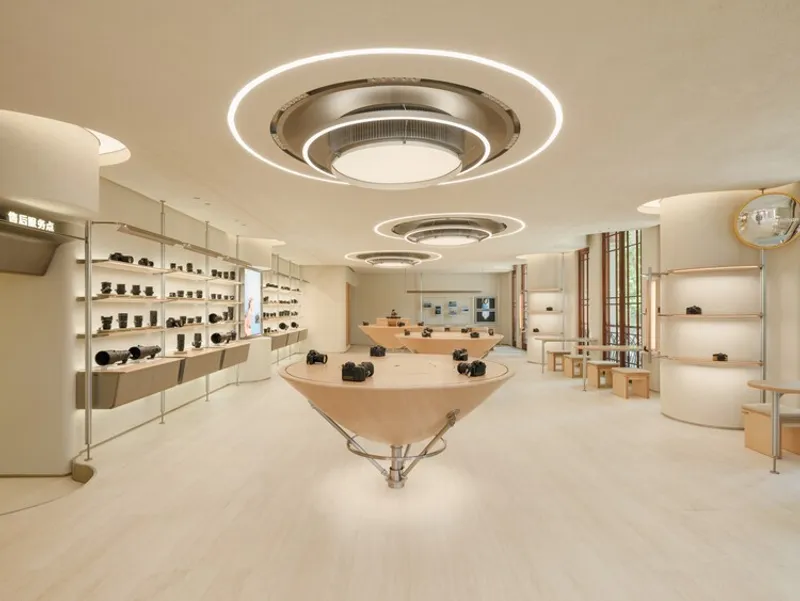
LUKSTUDIO transformed Nikon's Shanghai flagship into something unexpected: a photography hub that celebrates light itself. The store is organized around the experience of seeing, not just the products that enable it. Minimalist display systems step back so the interiors can perform like a camera: framing, filtering, and directing light through the space.
It is a retail concept that understands its audience deeply. Photographers do not come to a Nikon store for shelves of boxes. They come for the feeling of possibility. LUKSTUDIO turned that feeling into architecture.
Studio: LUKSTUDIO
8. Pillar of Zen: DANNONG Store by LUO studio, Taiyuan
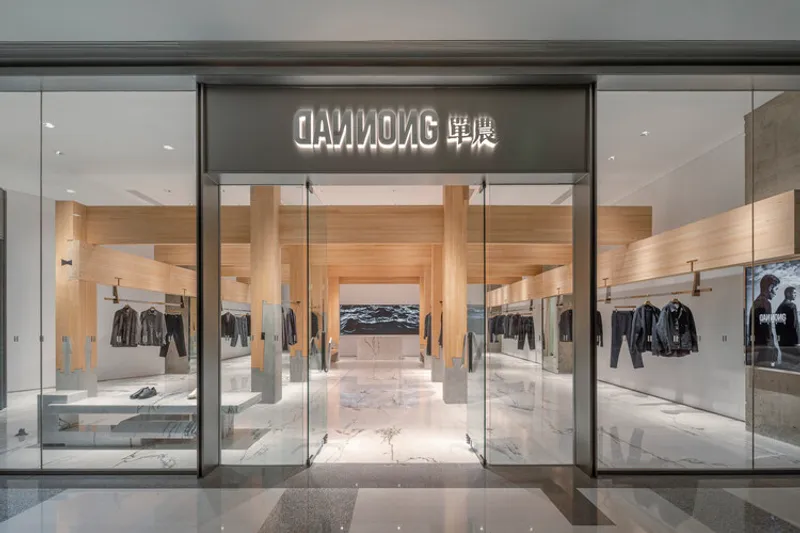
LUO studio reinterprets traditional Chinese timber architecture for a contemporary retail environment in Taiyuan. The DANNONG store is organized around columns that do more than hold up the roof; they define the spatial rhythm, frame the merchandise, and slow visitors down.
The project proves that clothing retail can be a calm ritual rather than a transactional experience. Every wooden element is both structural and symbolic, and the shopping act becomes almost meditative. It is retail design that understands ancient principles without pastiche.
Studio: LUO studio
Adaptive Reuse and Heritage
Some of the strongest commercial projects of the year did not start from a blank site. They started from buildings that already had a story, and the architects chose to continue that story rather than erase it.
9. Bumi Pakubuwono by WOFF, Jakarta

WOFF took a three-story office building in Jakarta and turned it into a green lifestyle hub. The transformation is masterful. Rather than gutting the structure, the architects worked with its existing bones, threading nature through the floors and wrapping the facade in living walls. The result is a building that feels like it has always been this way.
Adaptive reuse at its best is not renovation. It is translation. Bumi Pakubuwono translates the language of corporate office into the language of community gathering, proving that the most sustainable commercial architecture is often the building that already exists.
Studio: WOFF
10. Al Naseej Textile Factory by Leopold Banchini Architects, Bahrain
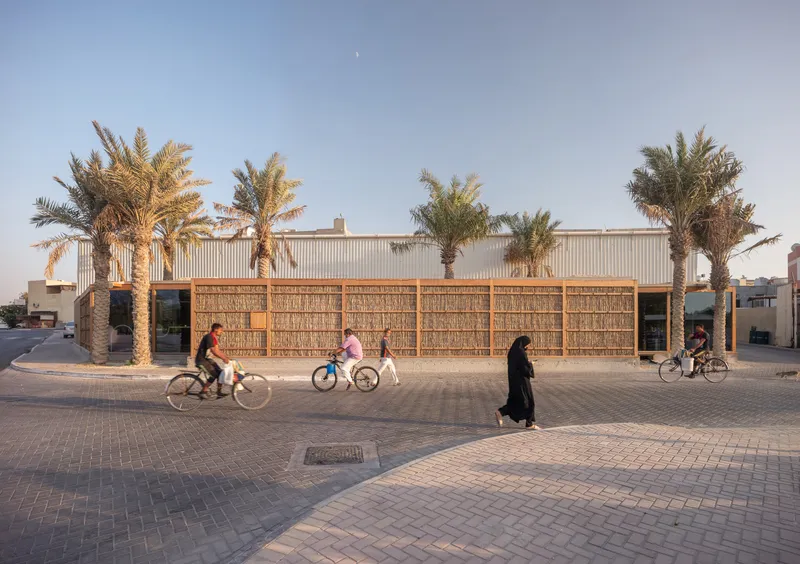
One of the most culturally resonant commercial projects of the year. Leopold Banchini Architects designed a textile factory in Bahrain that does not just house production; it honors the tradition of Bahraini weaving. The architecture speaks the same language as the craft it shelters: woven screens, layered thresholds, materials that age with dignity.
The factory is also a community space and a cultural anchor, making it commercial in the deepest sense. It sustains a local economy and a local identity simultaneously. Very few factory buildings aspire to this, and even fewer pull it off.
Studio: Leopold Banchini Architects
11. CHUK Heritage Cafe by 6717 Studio, Vietnam
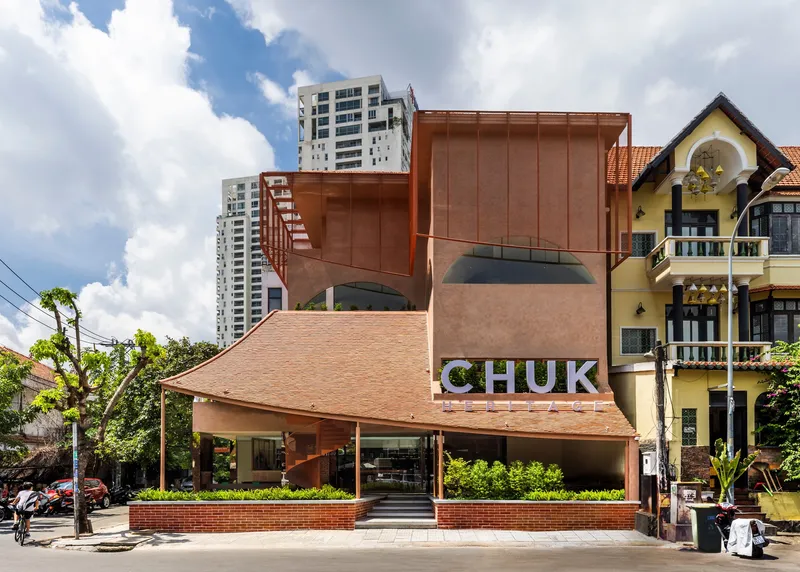
A cafe that remembers. 6717 Studio designed CHUK as a space where Vietnamese tradition is not a decorative overlay but a structural principle. Curved roofs reference regional vernacular, natural materials age gracefully, and the spatial sequence follows the rhythm of a traditional Vietnamese house.
You order coffee here, but you experience architecture. And perhaps more importantly, you experience a building that refuses to treat heritage as an aesthetic to be sampled. CHUK takes it seriously as a way of organizing space.
Studio: 6717 Studio
Restaurants and Dining
Restaurant design evolved this year toward full architectural experiences rather than polished interiors. The most popular dining projects on uni.xyz treated the restaurant as a building, not as a set.
12. Restaurant Niko by URBANODE Arquitetura

Restaurant Niko plays a beautiful tension: minimalist Japanese spatial sensibility meets what the architects call "over" design. It is a restaurant that is simultaneously restrained and exuberant, where every surface is considered but nothing feels precious.
The result is a dining space that vibrates with energy without ever becoming noisy. URBANODE Arquitetura understood that the best restaurants are architectural compositions, not decorative tableaus. Niko feels designed, not decorated.
Studio: URBANODE Arquitetura
13. Loka Meru Ballroom by andramatin, Indonesia
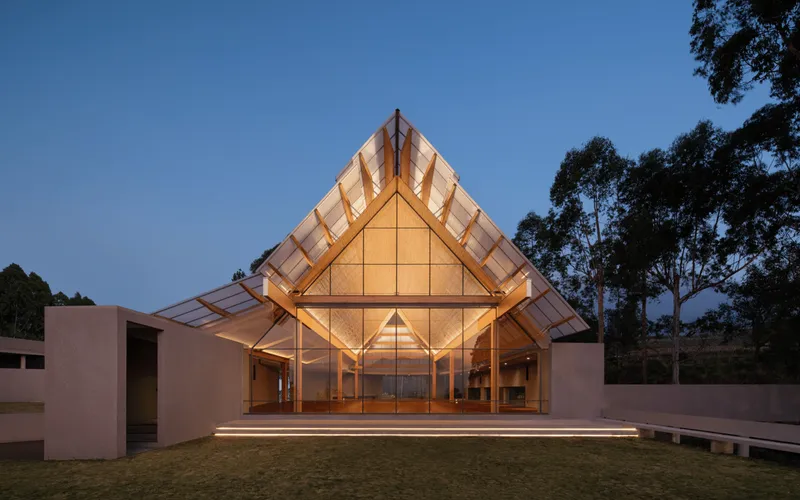
In the mountains of Central Java, andramatin built a timber ballroom that exists in quiet dialogue with its landscape. The building is commercial in function (events, weddings, gatherings) but architectural in ambition. The timber structure is both the space and the experience.
You do not decorate Loka Meru for an event. The building is the decoration. Andramatin's work has always understood how landscape shapes ceremony, and this project extends that intuition to commercial hospitality in a way few other Indonesian studios attempt.
Studio: andramatin
14. HEYDAY Community Hub by ASWA, Bangkok

Part co-working space, part food hall, part student hangout. ASWA designed HEYDAY as a curved-roof landmark near Bangkok University that refuses to be just one thing. The building's commercial model is built on overlap. The same space serves as a study spot in the morning, a lunch destination at noon, and a social hub in the evening.
Architecture as a platform, not a container. That is the idea behind HEYDAY, and it is quietly radical in a category that usually optimizes for a single program and a single time of day.
Studio: ASWA
Commercial Towers and Large-Scale
Commercial towers had to work harder in 2025 to justify their scale. The best ones integrated programs far beyond office space, becoming transit hubs, public plazas, and civic landmarks.
15. Parkline Place by Foster + Partners, Sydney

Foster + Partners brought their precision to Sydney with Parkline Place, a 39-story tower that integrates transit-oriented development with commercial workspace. The building sits directly above a transport hub, making the daily commute an architectural experience rather than a logistical burden.
Sustainability credentials are embedded, not bolted on. This is Foster at their most disciplined: a project where every engineering choice serves a design intent, and where the commercial program is elevated by the care taken with it.
Studio: Foster + Partners
16. LYM SPACE by PAK Architects, Hanoi

Shaped like a blooming flower in concrete, LYM SPACE is an office-commercial building that merges structural boldness with spiritual softness. Terraces of greenery cascade down the facade, and the interior spaces open and close like petals.
It is a building that takes the mundane program of office plus retail and transforms it into something genuinely poetic. In Hanoi, where commercial architecture usually defaults to maximum efficiency, LYM SPACE insists on maximum generosity.
Studio: PAK Architects
Bioclimatic Architecture
Tropical cities demand different commercial architecture than temperate ones. These projects from Jakarta to Boston treat climate as a design driver rather than an engineering problem.
17. Lattice Creative Garden by RAD+ar, Jakarta
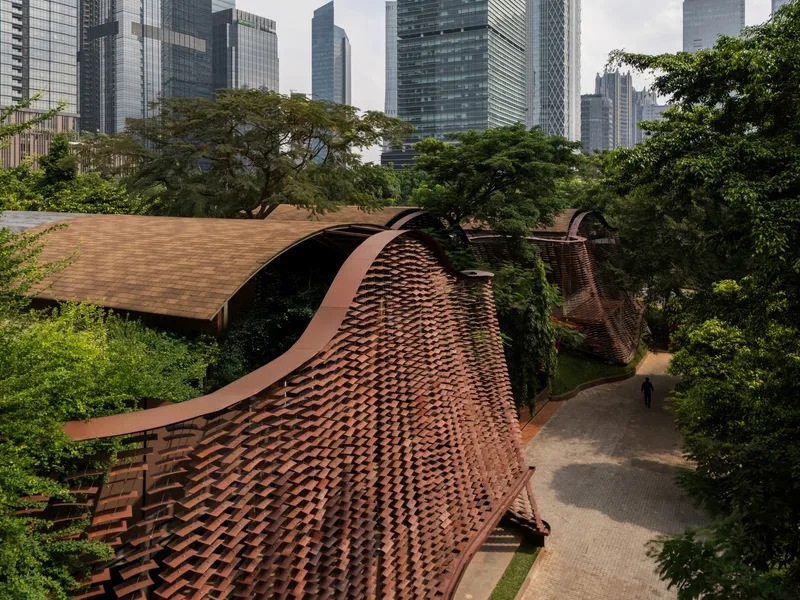
RAD+ar designed a commercial building in Jakarta that breathes. The Lattice Creative Garden uses recycled materials, passive cooling, and a parametric lattice screen that filters tropical sunlight while maintaining airflow.
It is sustainable architecture that does not look like a compromise; it looks like an invention. The lattice system is both the climate strategy and the visual identity, proving that performance-driven design can also be aesthetically confident.
Studio: RAD+ar
18. STEAM Design Center by Flansburgh Architects
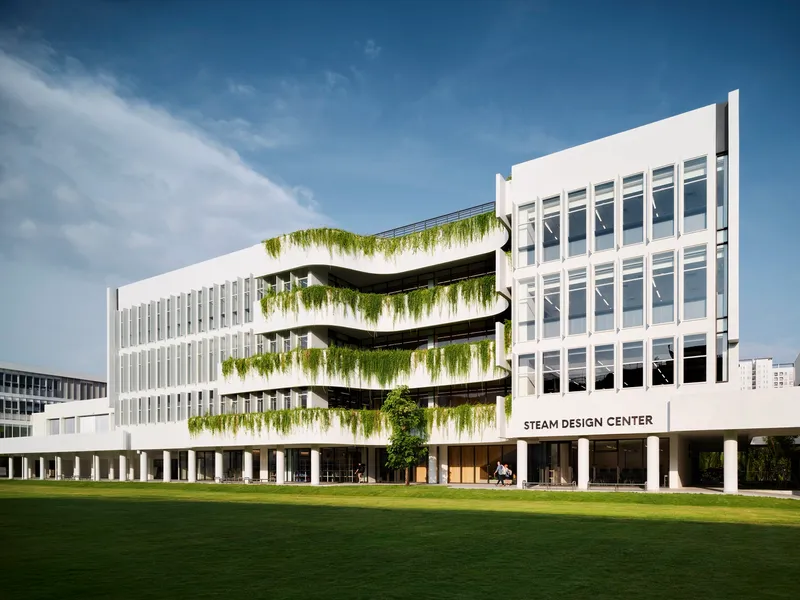
A building where education and commercial innovation share the same roof. Flansburgh Architects designed the STEAM Center as a space where learning happens through making: fabrication labs, exhibition spaces, and collaborative workshops arranged around a central atrium that makes all activity visible.
The architecture insists that creativity is not a private act but a public performance. Every sight line, every open studio, every circulation path reinforces the idea that making things is something to be seen and shared, not hidden behind a closed door.
Studio: Flansburgh Architects
New Commercial Typologies
The most forward-looking projects of the year refused to fit into established categories. They invented their own, asking what commerce could mean in contexts the discipline has historically ignored.
19. SOCIAL_PATCH: Vertical Architecture for Makoko, Lagos
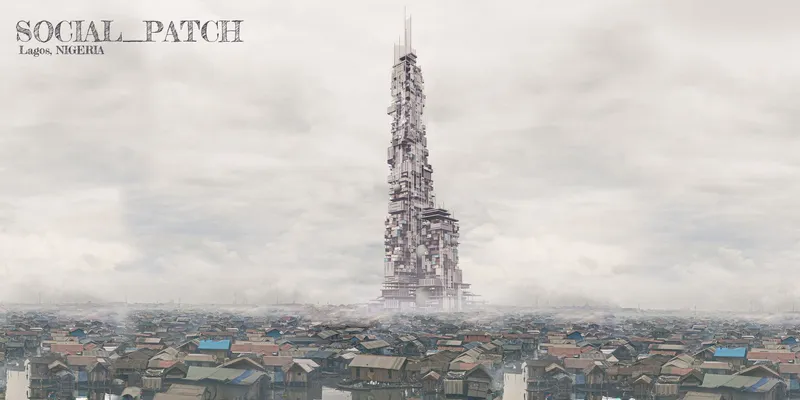
This is commercial architecture at its most urgent. SOCIAL_PATCH proposes a vertical mixed-use prototype for Makoko, Lagos, where density, water resilience, and cultural continuity must coexist. The project does not romanticize informal settlements; it takes them seriously as sites of architectural invention.
Commerce here is survival, and the architecture responds with precision. The proposal stacks markets, workshops, homes, and gathering spaces in a way that honors how people in Makoko already live, instead of imposing a foreign urban logic on them.
Designers: Kutlubal, Umut, Emre
20. eXchange: Reimagining Retail as a Space of Encounter
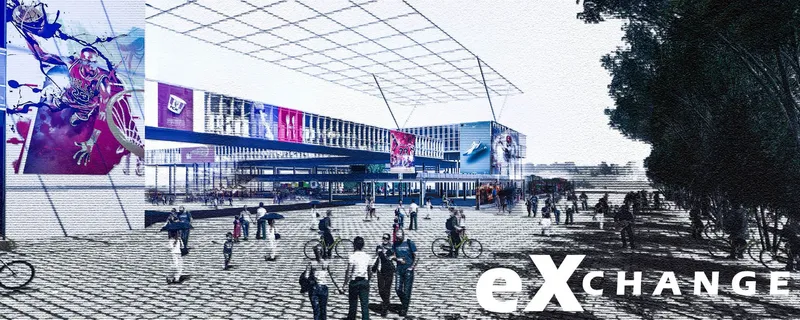
A conceptual proposal that reimagines the retail store as a space of exchange rather than consumption. eXchange asks what happens when the architecture of buying is redesigned around social interaction, community programs, and flexible public use.
The designers treat the storefront as a civic threshold. What makes it compelling is its pragmatism: eXchange does not imagine a post-retail future. It imagines a retail future that is smarter, more social, and more responsive to the cities it occupies.
Designers: Sunita, Dipan, Debashish
What Commercial Architecture Told Us in 2025
Looking across these 20 projects, a few patterns emerge. The most popular commercial buildings of 2025 were the ones that refused to be purely commercial. They were markets that became civic spaces. Retail flagships that became cultural experiences. Factories that became community anchors.
The discipline is moving away from the idea that commercial architecture is architecture's less interesting sibling. When architects bring the same rigor and ambition to a market stall as they do to a museum, the results can be extraordinary.
All 20 projects are featured in full on uni.xyz, with detailed photographs, plans, and architectural descriptions. Explore them, save the ones that inspire you, and consider how your own work might contribute to this evolving conversation about what commercial space can be.
This article features projects published on uni.xyz in 2025, ranked by reader engagement. Last updated: April 2026.


Popular Articles
Popular articles from the community


ETEH Reworks the Shared Spaces of São Domingos School in Brazil Around Timber, Color and Hanging Plants
At São Domingos School in Brazil, 436 m² of hall, refectory and library are recast with timber joinery, a yellow and blue code and trailing greenery.

FCC Arquitectura Expands a Portuguese Granite House with a Board-Marked Concrete Wing
In Portugal, JV House pairs a cleaned-up whitewashed and granite dwelling with a timber-shuttered concrete extension, courtyards and a garden pool.


The Amber Palace Opera: A Geological Fiction Surfaces on Tallinn's Baltic Waterfront
Pierre Brillard reimagines a Baltic legend as a public landscape, opera house, and waterfront promenade rooted in Tallinn's coastal identity.

Cube Design Draws an Ecological Corridor Between Two Shenzhen Hills with the Nankai Building
Beside Shenzhen's container docks, the Nankai Building pairs stacked balconies with a climbing green screen to connect two hillsides across its height.

Similar Reads
You might also enjoy these articles
Cube Design Draws an Ecological Corridor Between Two Shenzhen Hills with the Nankai Building
Beside Shenzhen's container docks, the Nankai Building pairs stacked balconies with a climbing green screen to connect two hillsides across its height.

Praksis A and Studio Sted Bend a Red Timber Cabin Across the Granite of Norway's Southern Coast
On the southern Norwegian coast, a 105 m² cabin follows the rock on slender posts, pairing red cladding outside with pine, brick and plywood within.

David Ortega Stacks a Two-Story Mexico City Penthouse Around a Steel Stair and a Pergola-Shaded Roof Terrace
In Colonia Roma, a 300 m² penthouse uses oak joinery, a planted steel stair and a slatted roof pergola to make a new-build apartment feel like a house.

PARALELA and LB2 Thread a Public Walkway Through the Base of a Las Condes Residential Tower
In Las Condes, Santiago, the Hamlet Building gives its fenceless ground floor to a 70-metre wooded passage linking two streets and the metro.

Explore Commercial Buildings Competitions
Discover active competitions in this discipline

Challenge to reimagine the Iron Throne

Photograph architecture without architects

Illustrate the lost glory of Angkor Wat - Render Challenge

Design challenge to reuse E-waste
Comments (0)
Please login or sign up to add comments
No comments yet. Be the first to comment!