

SWA Group Spirals a Landscape Memorial into the Woods of Sandy Hook
A 1.8-acre clearing in Newtown, Connecticut, honors 26 lives lost with water, stone, and a single sycamore tree.


Memorials have a difficult job. They must be permanent enough to hold collective grief and open enough to let that grief change shape over time. The Clearing, completed in 2022 in Newtown, Connecticut, by SWA Group, does something rare among contemporary memorial projects: it refuses to be a monument. Selected from 189 international submissions, the design centers on landscape rather than sculpture, using a spiraling woodland path, a circular granite water basin, and a single young sycamore to memorialize the 20 children and six educators killed at Sandy Hook Elementary School on December 14, 2012.
The site is only a quarter mile from the rebuilt Sandy Hook Elementary, close enough that visitors can hear children at recess. That acoustic proximity is not incidental. It is the emotional spine of the entire project. Where many memorials seal themselves off in contemplative silence, The Clearing keeps one ear open to the present, to the sound of the life that persists. The $3.75 million project was publicly funded and entirely community-led, built on a five-acre parcel donated by a local athletic club, a greenfield with no prior infrastructure, water, or electricity. What SWA delivered is not an object placed on the land but a careful edit of the land itself.
The Spiral Path
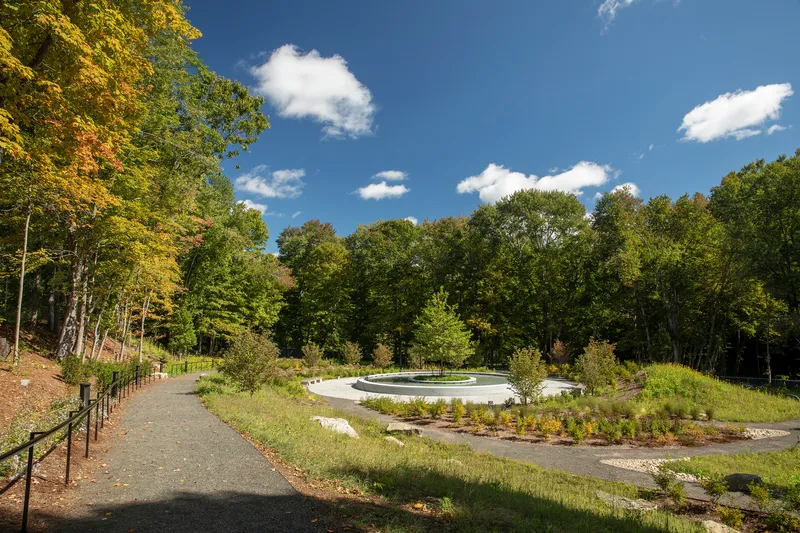

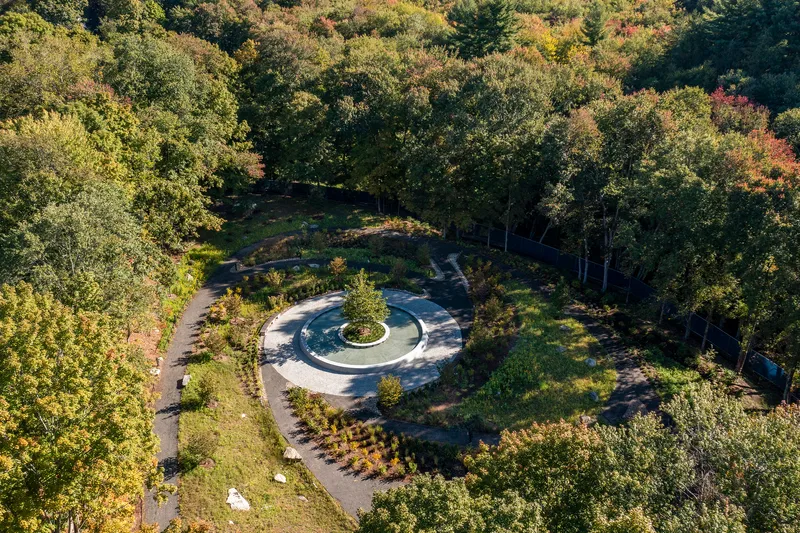
Visitors enter from Riverside Drive and are drawn into a circling network of gravel paths that pass through mature maples, across ponds, and through meadow. The trail spirals clockwise toward the center, deliberately slowing the pace and shifting attention from the outer world to an interior one. The pathways are constructed with permeable materials to support natural drainage, a functional choice that doubles as a philosophical one: nothing here is sealed off.
The approach is experiential in the truest sense. Rather than presenting the memorial as a single vista, the path unfurls it in stages. Trees screen and reveal. The clearing appears gradually, framed by woodland, and by the time you arrive at the granite basin you have already been walking long enough to quiet your mind. SWA understood that the journey is the memorial's first act of care.
Circle, Water, Tree
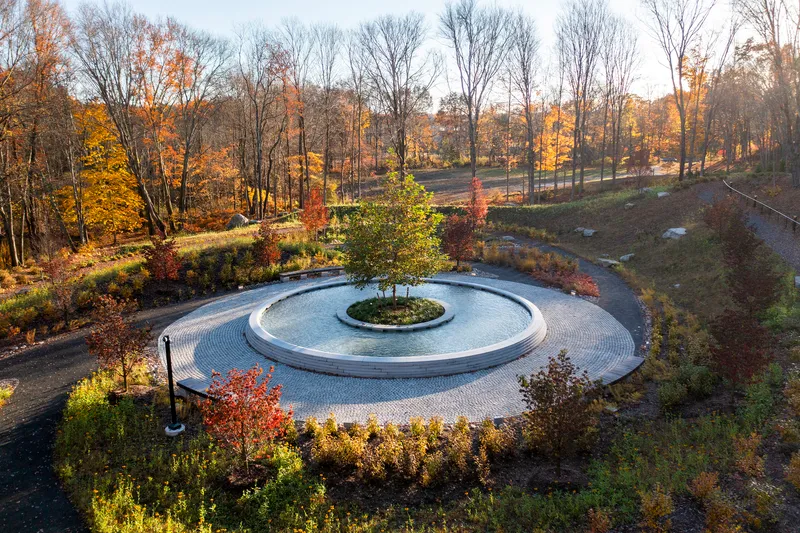


The design rests on three primary elements: the circle, the path, and the tree. At the center of the 47-foot-diameter granite reflecting pool stands a young sycamore, an explicitly future-facing gesture. As the tree grows and seasons change, the memorial will transform with it. The water flows counterclockwise toward the center, running opposite to the clockwise spiral of the path. That directional juxtaposition is the design's most potent formal idea, two forces meeting at the center, neither one resolving.
The concentric rings of pale, cleanly cut granite radiate outward from the tree island, creating a geometry that is legible from above but felt at ground level as a series of gentle thresholds. There is no single focal point demanding a fixed emotional response. You can face the water, the tree, or the forest canopy beyond. The memorial gives grief room to move.
Inscription and Material
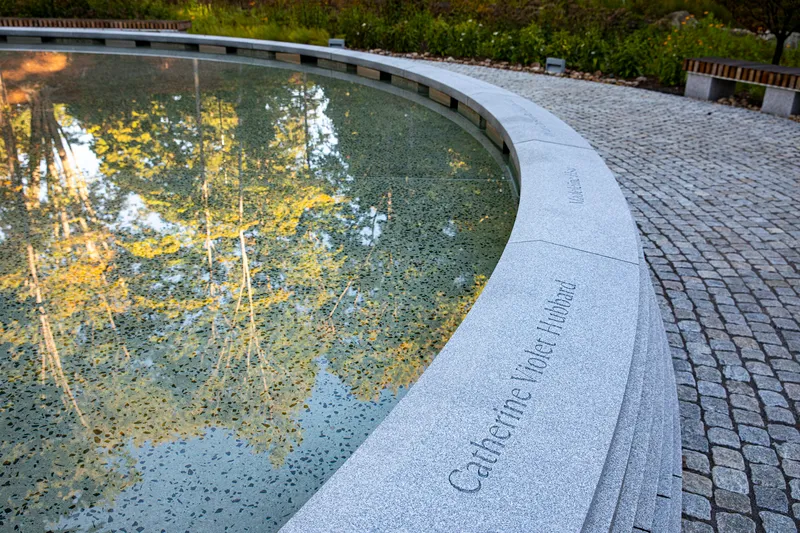

The granite is locally sourced from Connecticut, and the low basin edge carries the engraved names of the 26 who were killed. The inscription is positioned at the water line, where the beveled coping meets flowing water. It is a tactile detail: visitors can run their hands across the carved letters. Cobblestone paving surrounds the basin, and two low stone seatwalls with wood tops frame the clearing, offering places to rest without formalizing the space into an amphitheater.
Field stones excavated during construction were repurposed on site, a decision that keeps the material cycle local and honest. The entry pavilion uses stone and timber. Nothing here is imported for spectacle. Every surface belongs to the geology and ecology of this particular Connecticut hillside.
Planting as Memory


The memorial was woven into an existing clearing without damaging the intact surrounding forest. Plantings are almost entirely native perennials sourced from rural Connecticut: butterfly bushes, joe-pye weed, winterberries, rudbeckias. They were selected for pollinator value and for year-round texture and color, meaning the memorial is never static. In autumn, the rudbeckias and maples ignite; in winter, the bare sycamore and berry-laden branches offer a different kind of beauty, stripped and quiet.
Landscape memorials carry a risk of feeling vague, of substituting prettiness for precision. SWA avoids this by making the planting strategy itself a form of specificity. These are the plants that grow here. The pollinators they support are the pollinators that live here. The memorial's ecology is not symbolic; it is actual, rooted, and ongoing.
After Dark
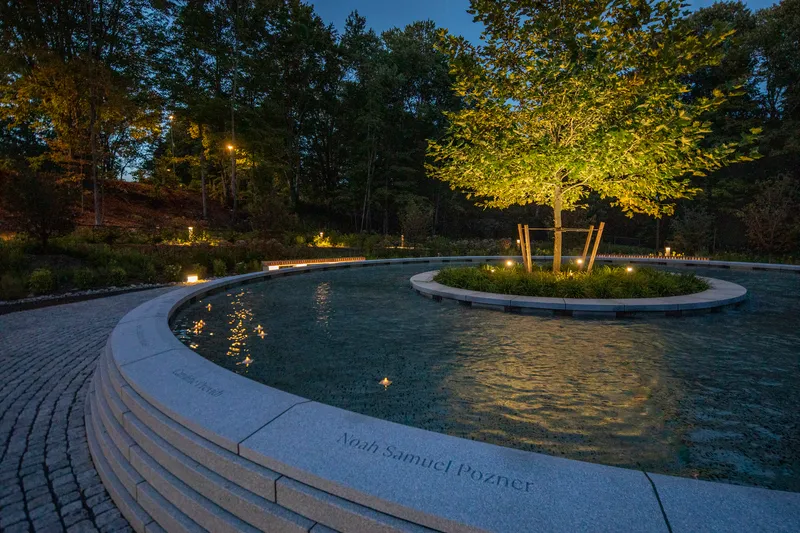
Atelier Ten designed the lighting, and the nighttime condition deserves attention. The illuminated fountain pools glow from within, and the inscribed coping is softly lit so that the names remain legible. The perimeter planting is washed with restrained light that avoids theatrical uplighting. The effect is intimate rather than dramatic, more candle than spotlight. For a memorial that will inevitably be visited at dusk, on anniversaries, or in the early morning, this calibration is essential.
Plans and Drawings


The site plan reveals the full extent of the five-acre parcel: wetland, pond, and contoured paths wrapping the 1.8-acre memorial clearing. The circular diagram overlaying seasonal vegetation changes and monthly climate data underscores SWA's commitment to designing a memorial that performs differently across the calendar year. These are not decorative drawings. They are evidence of a design process that treated time as a material.
Why This Project Matters
The Clearing matters because it proposes an alternative to the monumental tradition that still dominates American memorial design. There is no obelisk, no wall of names rising above eye level, no eternal flame. Instead, there is a clearing in the woods, a basin of flowing water, and a tree that will outlive everyone who planted it. The design's genius lies in its restraint: by giving grief a landscape rather than an object, SWA created a space that can absorb the full, contradictory range of human response, from sorrow to gratitude to the ordinary pleasure of hearing children play.
It also matters as a model for community-led public projects. The selection process was open and international; the funding was public; the materials are local; the planting is native. Every decision pointed back to the community and the site. In a country where mass shootings have become grotesquely routine, Newtown's memorial refuses spectacle and insists on the particular. Twenty children, six educators, this hillside, this water, this tree. That specificity is its moral authority.
The Clearing Memorial, designed by SWA Group with Sherwood Engineers, Stantec, Atelier Ten, and Fluidity. Newtown, Connecticut, United States. 1.8-acre memorial on a five-acre site. Completed in 2022. Photography by Neil Landino and David Lloyd.
About the Studio
Share Your Own Work on uni.xyz
If projects like this are the kind of work you want to make, uni.xyz is a place to publish your own, find collaborators, and enter design competitions.


Popular Articles
Popular articles from the community


ETEH Reworks the Shared Spaces of São Domingos School in Brazil Around Timber, Color and Hanging Plants
At São Domingos School in Brazil, 436 m² of hall, refectory and library are recast with timber joinery, a yellow and blue code and trailing greenery.

graciastudio Turns a Viewless Tijuana Lot Inward Around a Courtyard of Concrete, Timber and Trees
In Tijuana, Jorge Gracia's GA2 House stacks a timber-clad private floor over exposed concrete and replaces a missing view with a planted interior patio.

David Ortega Stacks a Two-Story Mexico City Penthouse Around a Steel Stair and a Pergola-Shaded Roof Terrace
In Colonia Roma, a 300 m² penthouse uses oak joinery, a planted steel stair and a slatted roof pergola to make a new-build apartment feel like a house.


Opera on the Sea: Driftwood Logic Shapes a Timber Opera House on Estonia's Coast
Trevor Orgill's opera house translates the entangled drift of floating timber into a civic building where wood, water, and music converge.

Similar Reads
You might also enjoy these articles

LAVA Architecten Gives Vocational Education a Sawtooth-Roofed Face on a Mechelen School Campus
In Mechelen, Belgium, a 2,053 m² STEM school on a 6×6 m grid turns workshops and classrooms into rooms that can be rearranged as teaching changes.

KEMA Studio Turns a Derelict Marvila Attic into a 60 m² Lighthouse Apartment Above Lisbon
In Lisbon's Marvila district, a rebuilt roof, four skylights and two plywood volumes turn an unlivable attic into a bright home facing the Tagus.

Pixel Gardens: One Repeated Module Stacked Into a Terraced Social Housing Tower for Famagusta
Salem Bader's shortlisted housing tower builds a vertical neighbourhood from one repeated module, offsetting units to carve terraces, light and air.

Bao Huynh Watercolor Atelier: A Serene Art Retreat in Hội An
Bao Huynh Watercolor Atelier in Hội An blends multifunctional art spaces, sustainable design, local materials, and family-friendly living in a serene environment.

Explore Memorial Design Competitions
Discover active competitions in this discipline

Challenge to reimagine the Iron Throne

Photograph architecture without architects

Illustrate the lost glory of Angkor Wat - Render Challenge

Design challenge to reuse E-waste
Comments (0)
Please login or sign up to add comments
No comments yet. Be the first to comment!