

The Unbound Brain: A School Shaped by Cognitive Architecture
Cylindrical learning pods radiate like neurons from a central cortex, turning the floor plan into a spatial model of human thought.


What if a school didn't just teach you how the brain works but actually felt like being inside one? The Unbound Brain takes that provocation literally, organizing its programme around clustered cylindrical volumes that radiate outward from a central gathering space like neurons firing across synaptic gaps. The result is an educational campus where circulation paths double as cognitive metaphors, where the plan itself encodes the distinction between analytical reasoning and creative intuition, and where every threshold crossing reminds students that thought has no fixed boundary.
Designed by Tasmin Zaman, the project received Editor's Choice recognition in the School of Thought competition. The brief called for rethinking educational architecture in an era that demands adaptability, emotional intelligence, and participatory learning. Zaman's response roots itself in cognitive science and experiential pedagogy, producing a campus that is less a building and more a spatial ecosystem tuned to the rhythms of human cognition.
Cylindrical Volumes on a Landscaped Cortex

The three-dimensional rendering reveals the project's most striking move: a dense cluster of glass-wrapped cylindrical pods rising from paved plazas and bordered by generous green landscape. The volumes vary in diameter and height, creating a roofline that reads as organic topography rather than institutional uniformity. Transparency is the default condition. Glass envelopes dissolve the visual barrier between interior and exterior, so that a student working in one pod can see activity happening in the next. The spaces between pods become just as important as the pods themselves, forming shaded courtyards and informal gathering zones where unplanned encounters can spark new ideas.
The curvilinear geometry is not arbitrary ornament. By eliminating right angles and corridors, Zaman removes the hierarchical spatial logic of conventional schools, where classrooms are cells and hallways are control mechanisms. Here, every room bulges outward, inviting movement and suggesting continuity. The paved plazas serve as thresholds, smooth transitions from the surrounding landscape into the learning environment without the psychological barrier of a grand entrance or security checkpoint.
An Organic Masterplan that Mirrors Neural Networks
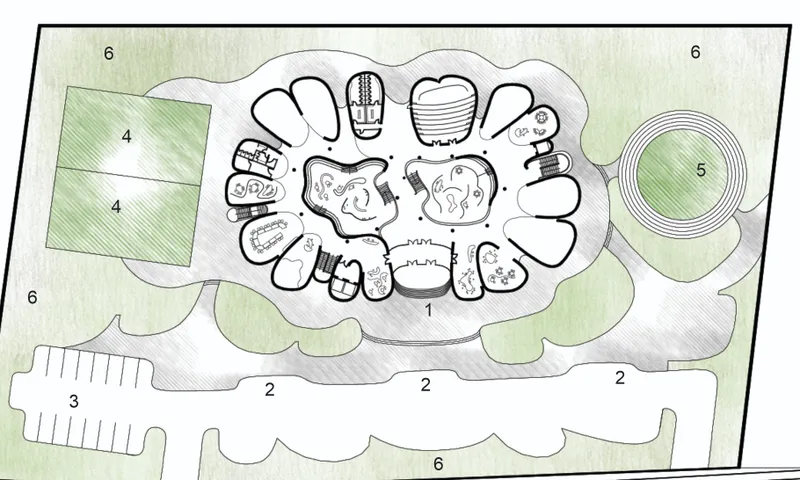
The site plan makes the neural metaphor explicit. Circular and curved spaces cluster together in an organic formation, connected by pathways that branch and reconverge like dendrites. Parking zones and structured drop-off points line the perimeter, keeping vehicular traffic at the campus edge so pedestrians can move freely through the interior landscape. A centrally located green court anchors the composition, functioning as a multifunctional gathering space: part amphitheater, part commons, part breathing room for an otherwise densely packed plan.
Multiple public access points ensure that the campus is porous, welcoming educators, students, and the broader community without funneling everyone through a single gate. The open-air amphitheater is positioned to serve both academic events and community programming, reinforcing Zaman's vision of a school that belongs to its neighborhood, not just its enrollment roster.
Ground Floor: Pods Orbiting a Central Pool and Terraced Stage
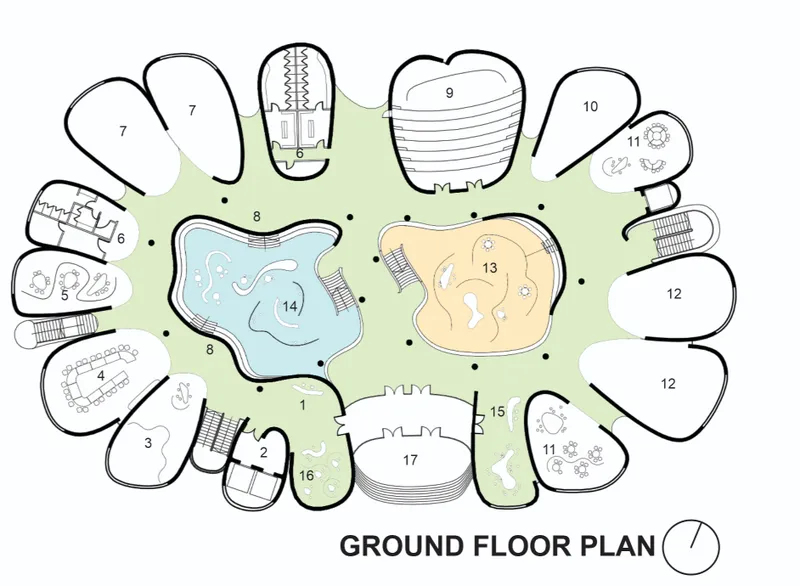
At the ground level, the plan reveals radiating pod-like rooms arranged around a central pool and terraced performance space. This is where the neuro-inspired zoning becomes programmatically tangible. Administrative offices, seminar halls, reception areas, and meeting rooms occupy specific pods, while a library, workshop zones, and lounge areas fill others. The distinction between logical, analytical spaces and creative, artistic zones is embedded in the layout, echoing the hemispheric duality of the brain itself.
The central pool and terraced stage serve as the campus's social cortex. They provide a gravitational center that all circulation orbits, ensuring that students moving between seminars and workshops inevitably pass through a shared communal zone. A basement level below dedicates itself to physical development, housing indoor sports zones, a basketball court, and sports administration facilities, keeping high-energy activities acoustically separated from the quieter learning environments above.
First Floor: Color-Coded Chambers and a Central Void
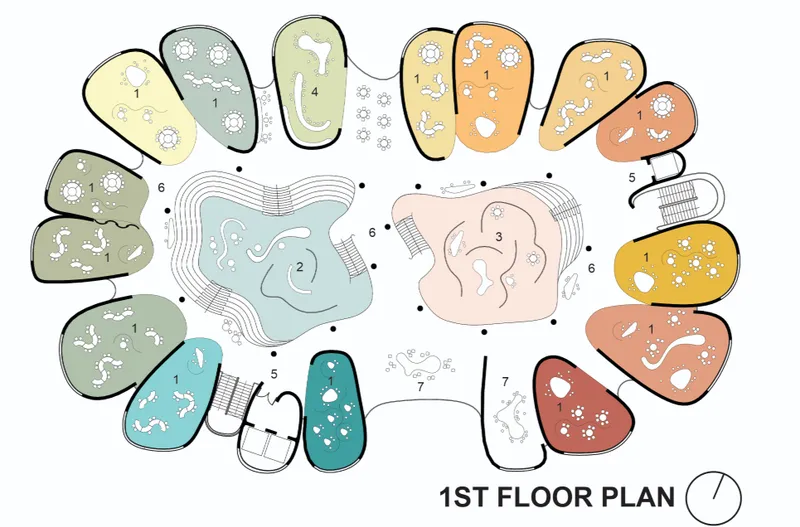
The first floor plan introduces color-coding to distinguish programmatic zones: organic chambers in varying hues radiate around a central void that connects visually to the ground floor below. Interconnected pathways weave between discourse rooms, sharing zones, workshops, additional library space, and dining areas. The palette draws inspiration from the seasonal color spectrum of maple leaves, shifting from warm oranges to deep reds and greens to create a sensory-rich interior atmosphere that is calming without being static.
The blend of open and semi-private zones on this level is deliberate. Structured learning spaces sit alongside informal breakout areas, so students can transition between focused study and collaborative work without leaving the floor. The central void acts as both a light well and a spatial anchor, pulling daylight deep into the plan and giving occupants a persistent visual connection to the communal life happening below.
Why This Project Matters
The Unbound Brain belongs to a growing body of work that refuses to accept the corridor-and-classroom model as the default for educational architecture. By grounding its formal language in cognitive science, Zaman's design avoids the trap of metaphor for metaphor's sake. The brain analogy is not decorative; it actively structures program distribution, circulation logic, and the balance between communal and individual space. The result is a campus where the architecture itself becomes a teaching tool, making visible the idea that learning is networked, nonlinear, and resistant to rigid compartmentalization.
As an Editor's Choice entry, the project demonstrates the kind of conceptual ambition that competition briefs exist to provoke. Schools are among the most typologically conservative building types, and proposals like this one push the conversation forward by asking what a learning environment could be if designers started from cognition rather than administration. Whether or not every cylindrical pod translates directly to a buildable reality, the spatial argument is clear: unbind the floor plan and you begin to unbind the minds inside it.
View the Full Project
About the Designers
Designer: Tasmin Zaman
Enter a Design Competition on uni.xyz
uni.xyz runs architecture and design competitions year-round that reward proposals with spatial conviction and real site intelligence.
Project credits: The Unbound Brain by Tasmin Zaman School Of Thought (uni.xyz).


Popular Articles
Popular articles from the community


Opera on the Sea: Driftwood Logic Shapes a Timber Opera House on Estonia's Coast
Trevor Orgill's opera house translates the entangled drift of floating timber into a civic building where wood, water, and music converge.

Singing Woman: An Opera House That Performs Before the Curtain Rises
Ovidiu Cristian Pavel's conceptual opera house translates Estonia's choral identity into a sculpted waterfront landmark facing the Baltic Sea.

Manzana Morphosis: Stretching Barcelona's Grid into a Living Landscape for 2050
A radical reworking of the Eixample manzana turns density into a tool for generous public space, vertical ecology, and environmental performance.


David Ortega Stacks a Two-Story Mexico City Penthouse Around a Steel Stair and a Pergola-Shaded Roof Terrace
In Colonia Roma, a 300 m² penthouse uses oak joinery, a planted steel stair and a slatted roof pergola to make a new-build apartment feel like a house.

Similar Reads
You might also enjoy these articles

Cube Design Draws an Ecological Corridor Between Two Shenzhen Hills with the Nankai Building
Beside Shenzhen's container docks, the Nankai Building pairs stacked balconies with a climbing green screen to connect two hillsides across its height.

Praksis A and Studio Sted Bend a Red Timber Cabin Across the Granite of Norway's Southern Coast
On the southern Norwegian coast, a 105 m² cabin follows the rock on slender posts, pairing red cladding outside with pine, brick and plywood within.
David Ortega Stacks a Two-Story Mexico City Penthouse Around a Steel Stair and a Pergola-Shaded Roof Terrace
In Colonia Roma, a 300 m² penthouse uses oak joinery, a planted steel stair and a slatted roof pergola to make a new-build apartment feel like a house.

PARALELA and LB2 Thread a Public Walkway Through the Base of a Las Condes Residential Tower
In Las Condes, Santiago, the Hamlet Building gives its fenceless ground floor to a 70-metre wooded passage linking two streets and the metro.

Explore Conceptual Architecture Competitions
Discover active competitions in this discipline

Challenge to reimagine the Iron Throne

Photograph architecture without architects

Illustrate the lost glory of Angkor Wat - Render Challenge

Design challenge to reuse E-waste
Comments (0)
Please login or sign up to add comments
No comments yet. Be the first to comment!