
Bernardes Arquitetura Stretches a Timber Roof Along a Reservoir's Edge in Minas Gerais
Dam House in Itaúna lets a sweeping wooden canopy dissolve the boundary between hillside terrain and open water.

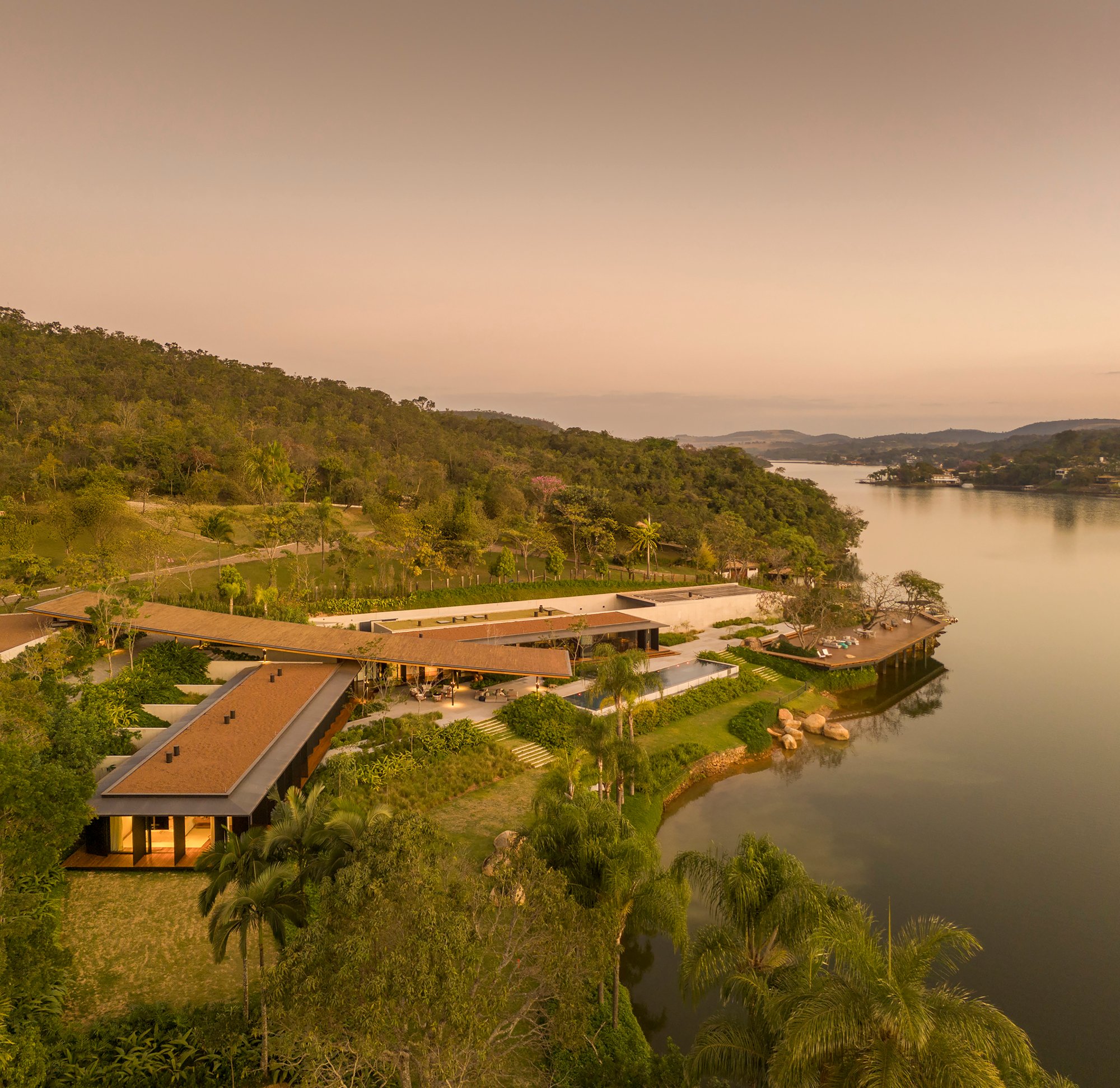
A house on a reservoir can go one of two ways: it can plant itself on the hillside and declare its presence, or it can fold into the slope and let the water do the talking. Bernardes Arquitetura, led by Thiago Bernardes with Marcia Santoro and Camila Tariki, chose the second route at Dam House, a 1,030 m² residence on the shore of a reservoir in Itaúna, Minas Gerais. The result is a building that reads less as architecture and more as topography: low rooflines tracing the grade, volumes stepping down the slope, and timber planes that seem to hover just above the ground.
What makes this project worth studying is the discipline of its single organizing gesture. One continuous wooden roof does nearly all the work. It defines the entry sequence, orders the interior circulation, frames the horizon, and ultimately delivers the occupant to the water's edge. There is no competing formal ambition, no sculptural flourish fighting for attention. The roof is the architecture, and everything else, the concrete walls, the planted beds, the sliding timber screens, exists in service of that idea.
A Roof That Reads the Land
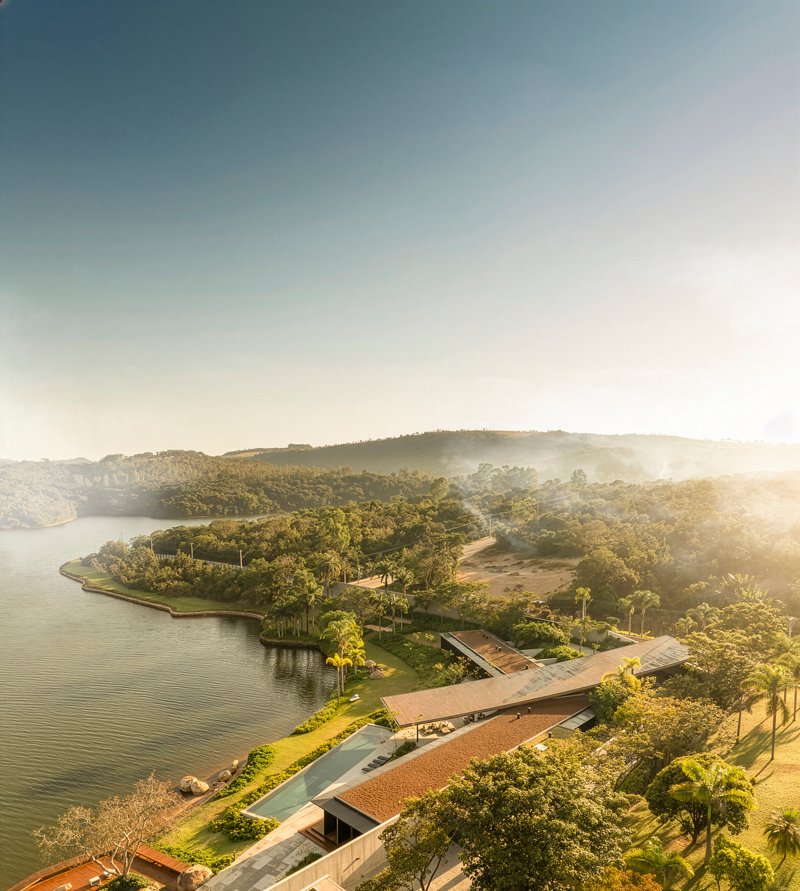
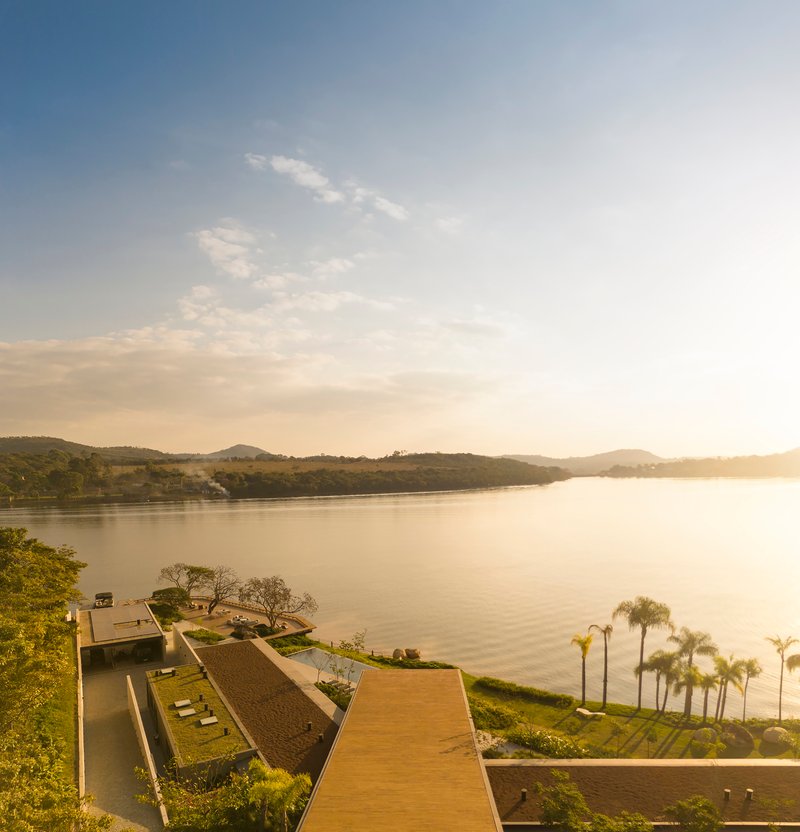
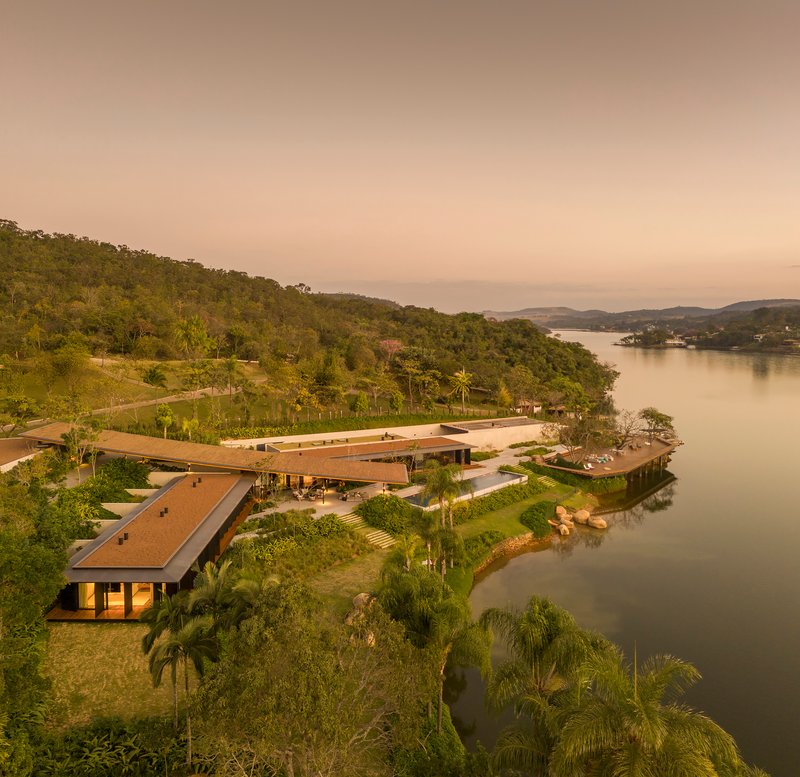
Seen from the air, Dam House barely registers against the forested peninsula it inhabits. The roofline runs long and low, its angular planes shifting direction to follow the contour of the hill as it drops toward the water. Rather than carving a flat platform into the slope, the building steps down with it, keeping the profile close to the treeline. At golden hour, the timber surfaces pick up the same warm tone as the surrounding eucalyptus and palms, reinforcing the camouflage.
The sweeping geometry is not arbitrary. Each shift in the roof's angle corresponds to a change in program or grade below, creating distinct volumes that are unified above. It is an old Bernardes move, familiar from the studio's work in Rio and the Atlantic Forest, but it finds a particularly convincing application here, where the terrain's gentle curve gives the roof a natural logic to follow.
Approaching Through a Planted Corridor
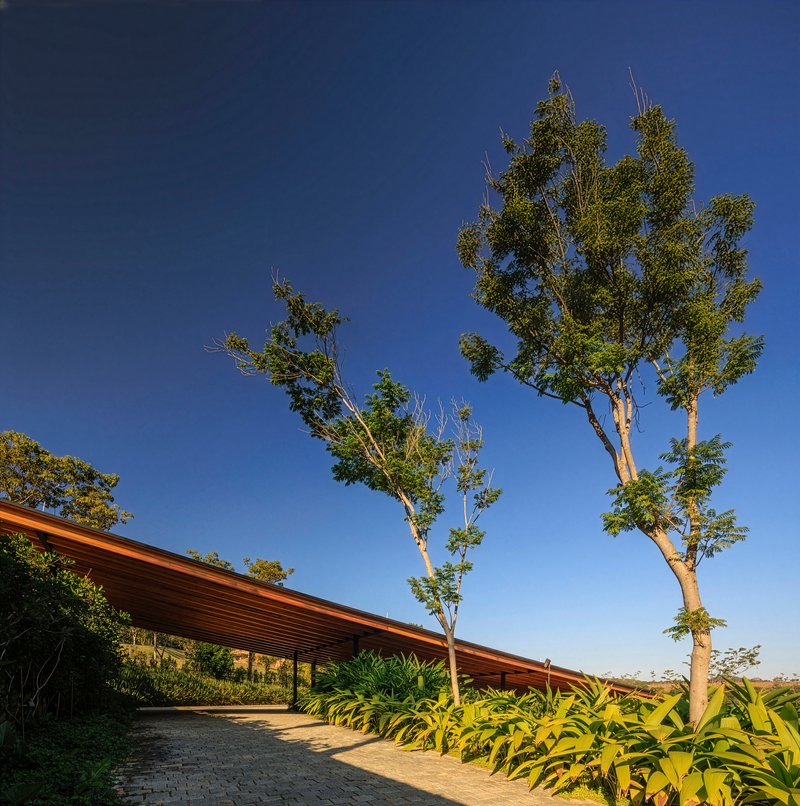
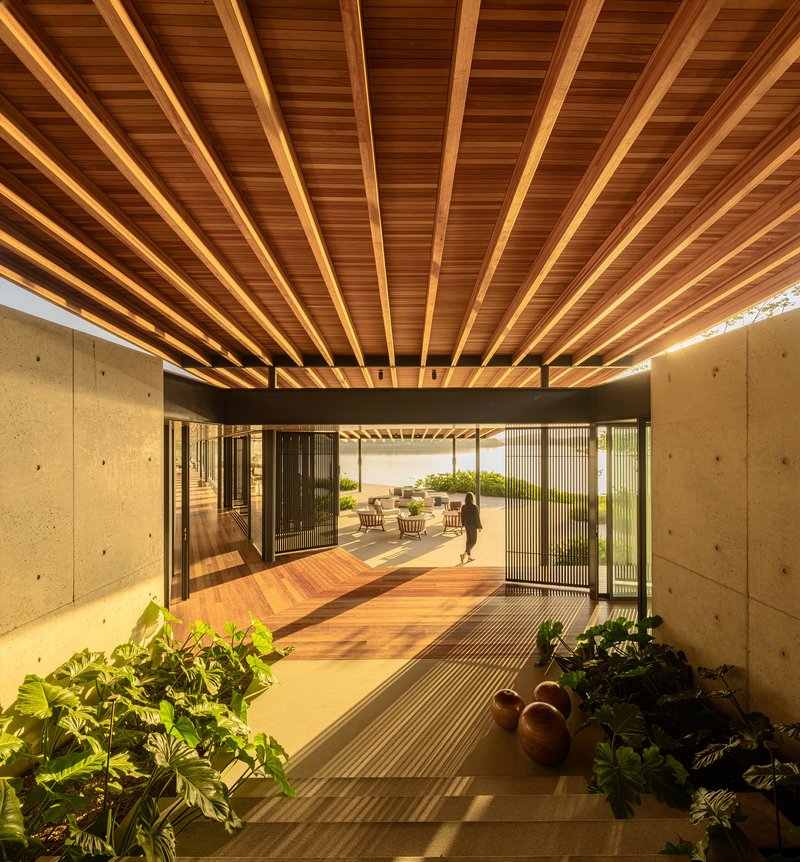
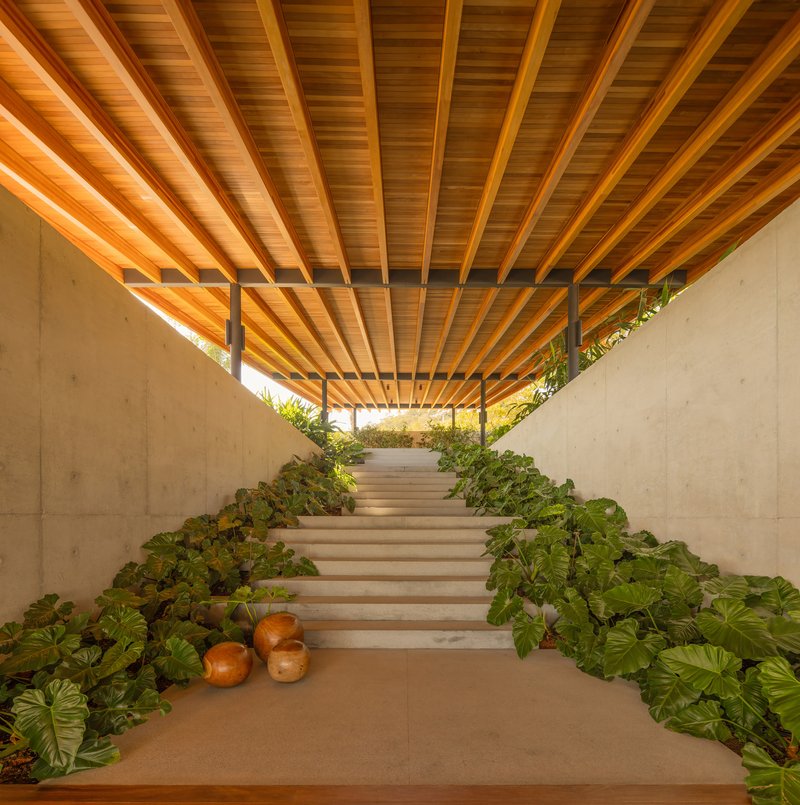
Arrival is choreographed with care. A driveway passes beneath tall eucalyptus trees before sliding under a timber slat canopy that compresses the visitor's view. Planted beds line both sides of the entry corridor, their greenery pressing close against concrete walls. The effect is deliberate constriction: overhead, the timber plank ceiling is intimate; at eye level, vegetation crowds the periphery. You are being squeezed before being released.
A concrete staircase ascends under the slatted canopy, flanked by more planting, reinforcing the sense of moving through landscape rather than into a building. Light filters through the timber overhead in thin stripes, marking the passage with a rhythmic pattern that shifts as you climb. By the time the view opens, the reservoir hits with full force precisely because it was withheld.
Living Under Timber and Light
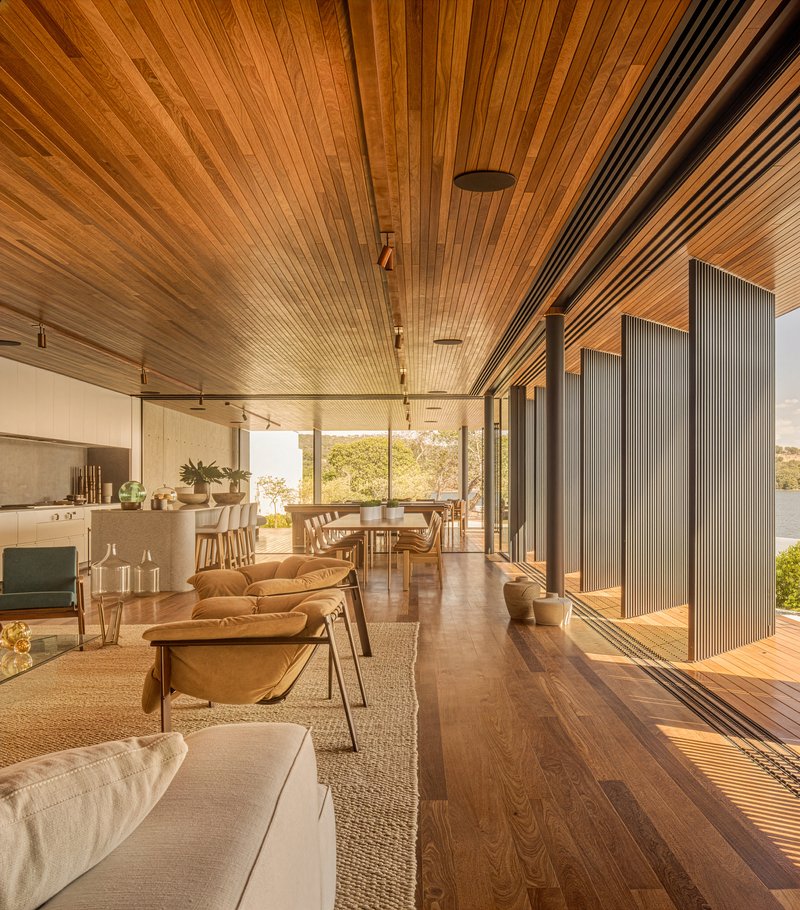
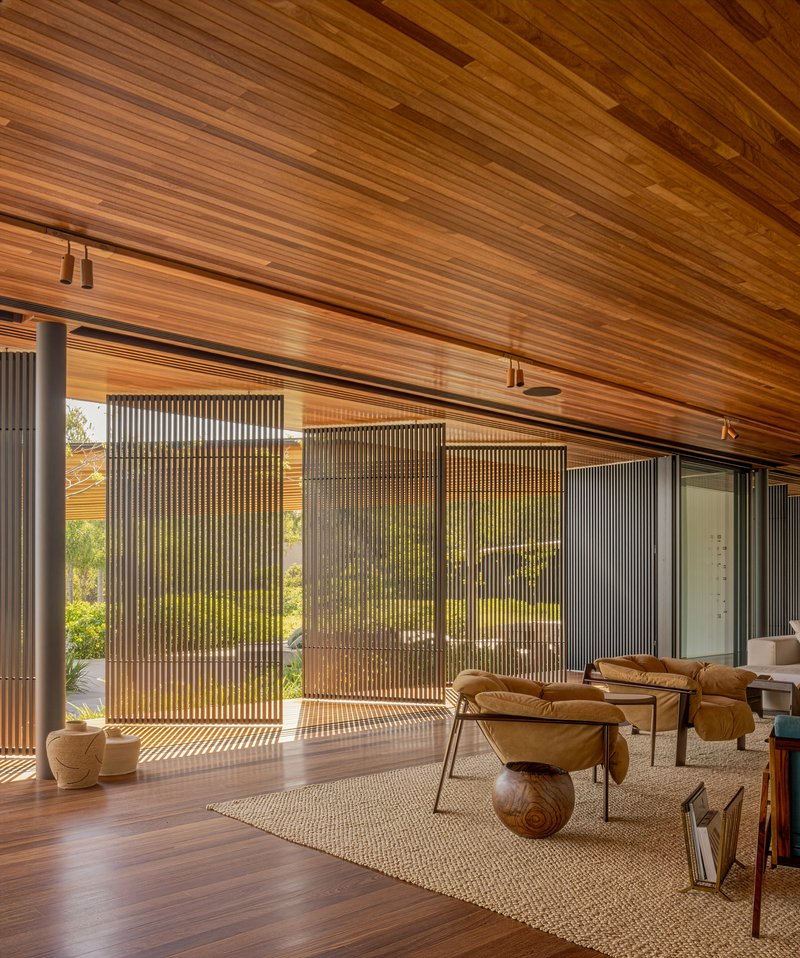
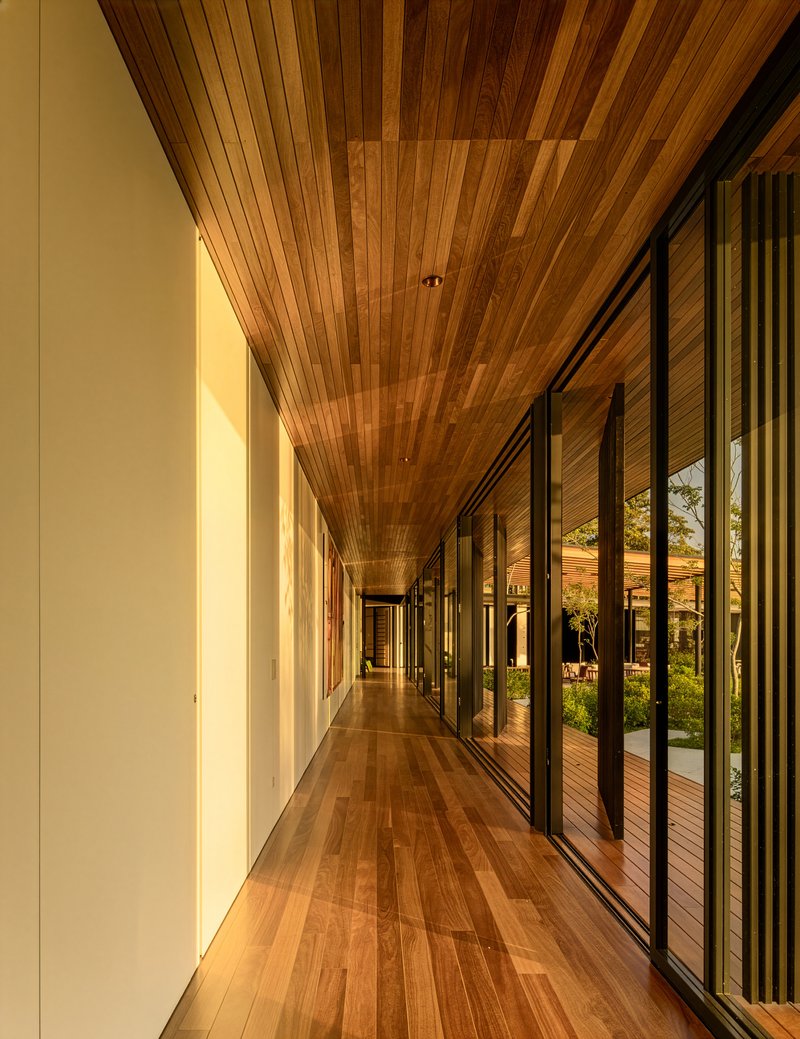
Inside, the wooden roof continues its role as protagonist. The living areas sit beneath a timber slat ceiling that filters and patterns sunlight across the floor throughout the day. Vertical timber screens along the facade act as a secondary filter, creating layered shadows that shift with the sun's angle. The double screening, overhead and vertical, means the interior never receives direct glare but is always animated by light.
The open-plan living space uses sliding screens rather than fixed partitions, allowing the occupants to modulate privacy and ventilation without breaking the spatial continuity. Furniture sits low and simple, letting the ceiling and floor planes do the compositional work. A corridor lined with floor-to-ceiling glazing connects the social wing to more private areas, its timber-planked ceiling pulling you along like a covered walkway in a Japanese garden.
Concrete, Stone, and the Ground Plane
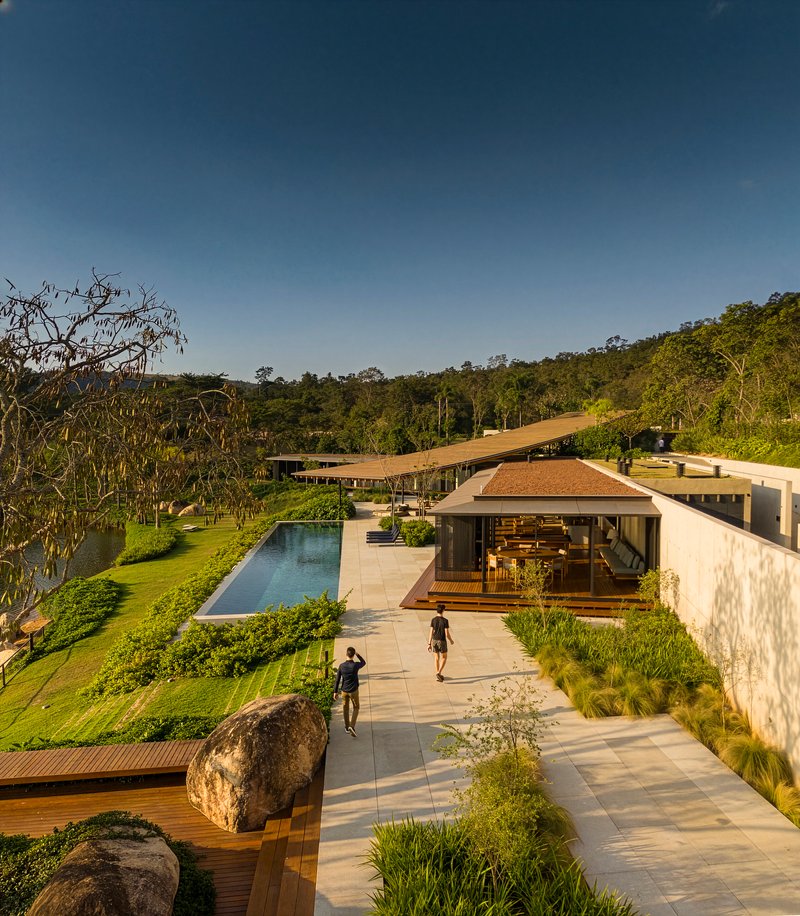
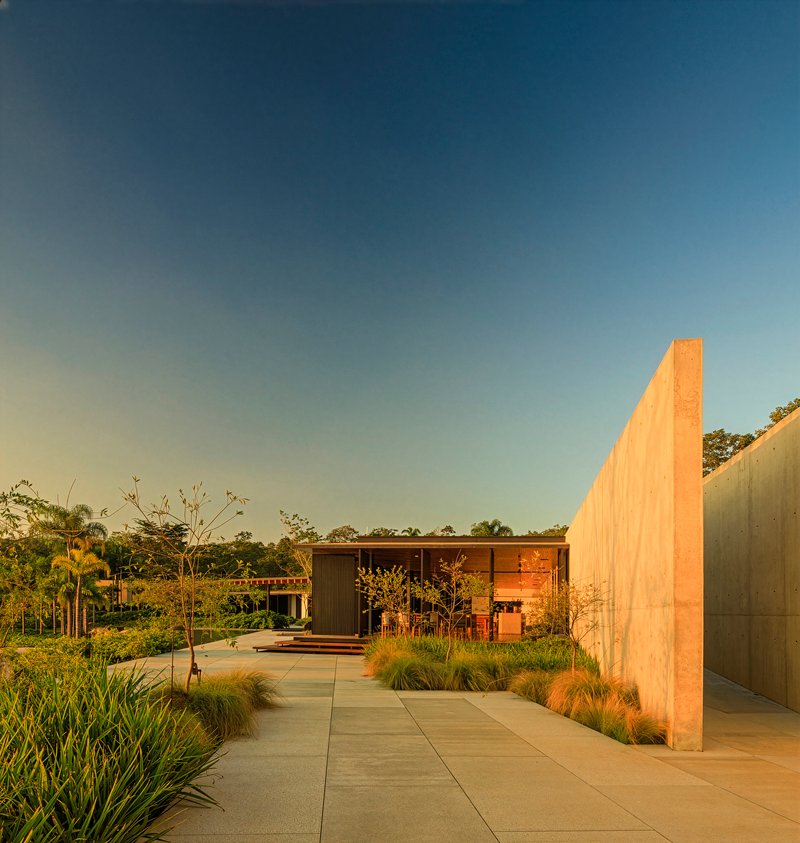
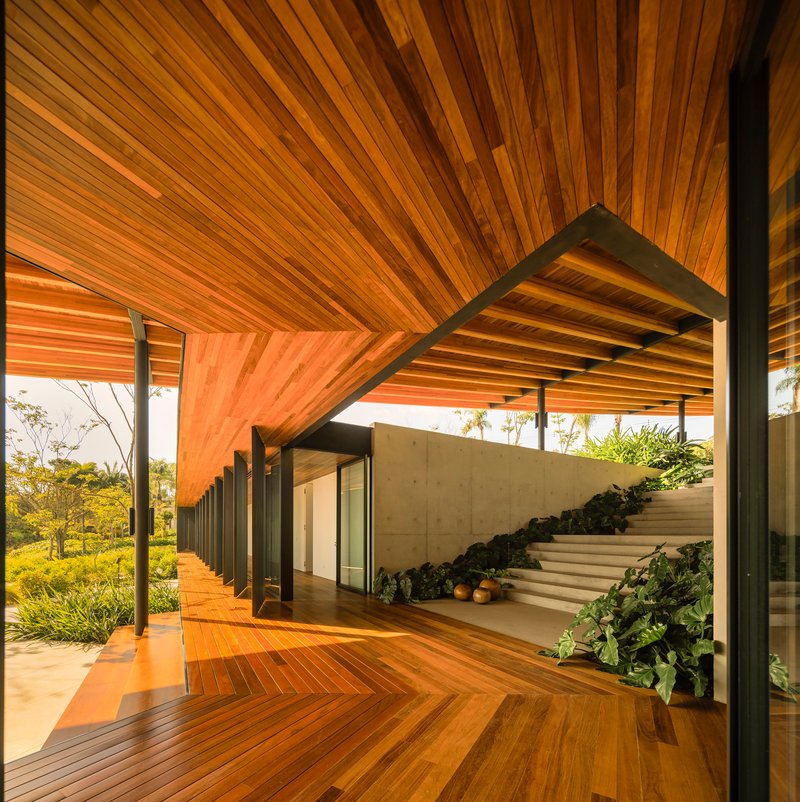
If the roof is all warmth and lightness, the ground plane belongs to weight. Concrete retaining walls anchor the building to the hillside, their raw surfaces left exposed to weather alongside the planted beds. A stone courtyard with a rectangular pool sits between pavilions, creating a mineral pause in the otherwise vegetated landscape. Figures walking through this courtyard feel scaled against the horizontal volumes in a way that underscores how low and extended the architecture really is.
The material split is clear: everything that touches the earth is concrete and stone; everything that touches the sky is timber. It is a binary that gives the house legibility. The angled timber planes converge above decks and planted stairs, hovering over concrete walls that do the heavy structural lifting below. There is a satisfying honesty to the division, each material doing what it does best.
Private Quarters at the Water's Edge
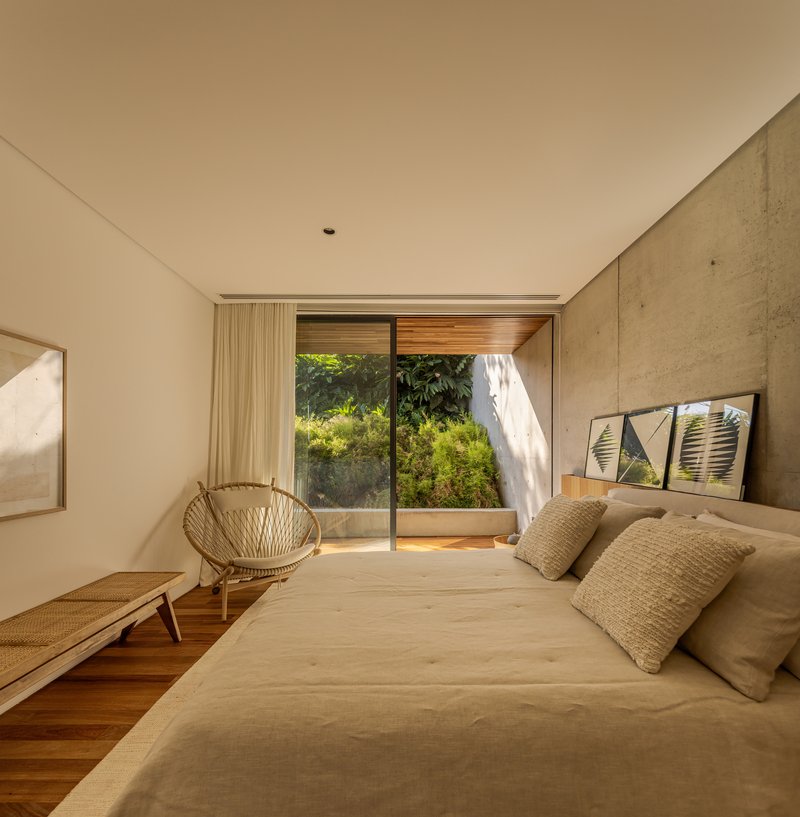
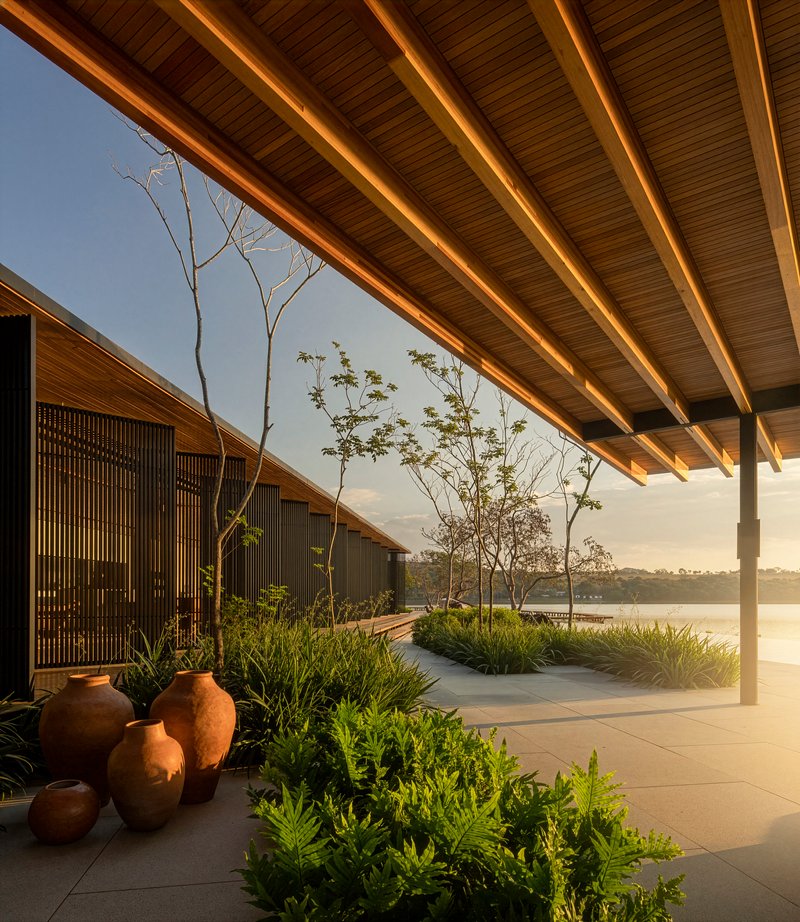
The bedrooms occupy a linear bar that extends along the slope, each room opening through full-height glass doors to a planted terrace. A concrete accent wall grounds the otherwise transparent enclosure, providing a sense of enclosure at the headboard while the foot of the bed faces open sky and water. It is a simple sectional trick, but it works: you wake up looking at the reservoir through vegetation, with solid wall at your back.
The covered terrace, with its exposed timber beams and planted beds stepping down toward the lake, serves as the house's emotional destination. At sunset, this space collapses the distance between interior and landscape entirely. The structural beams frame horizontal slices of sky and water, functioning as a constructed belvedere that rewards the long, compressed approach from the entrance.
The Pavilion in Its Setting
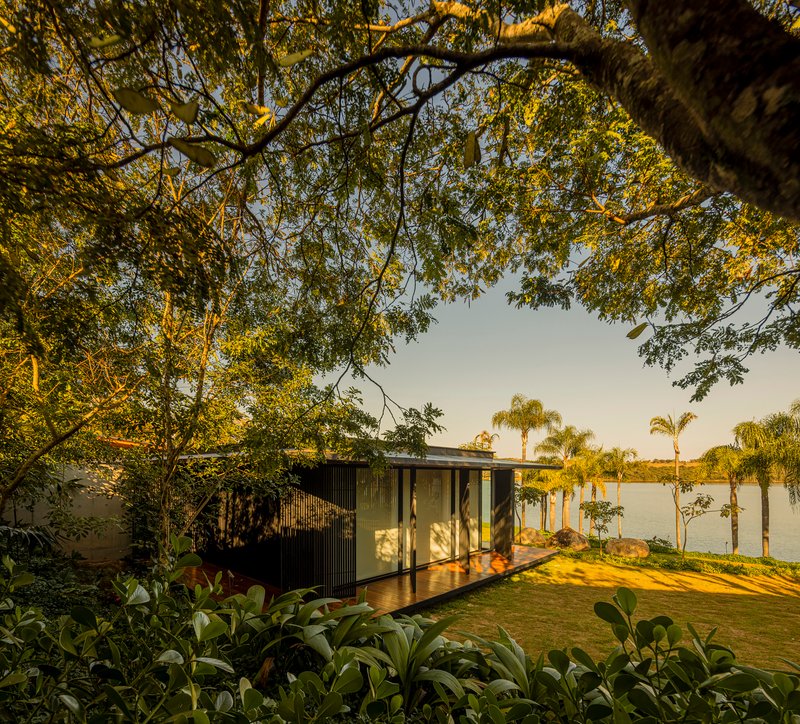
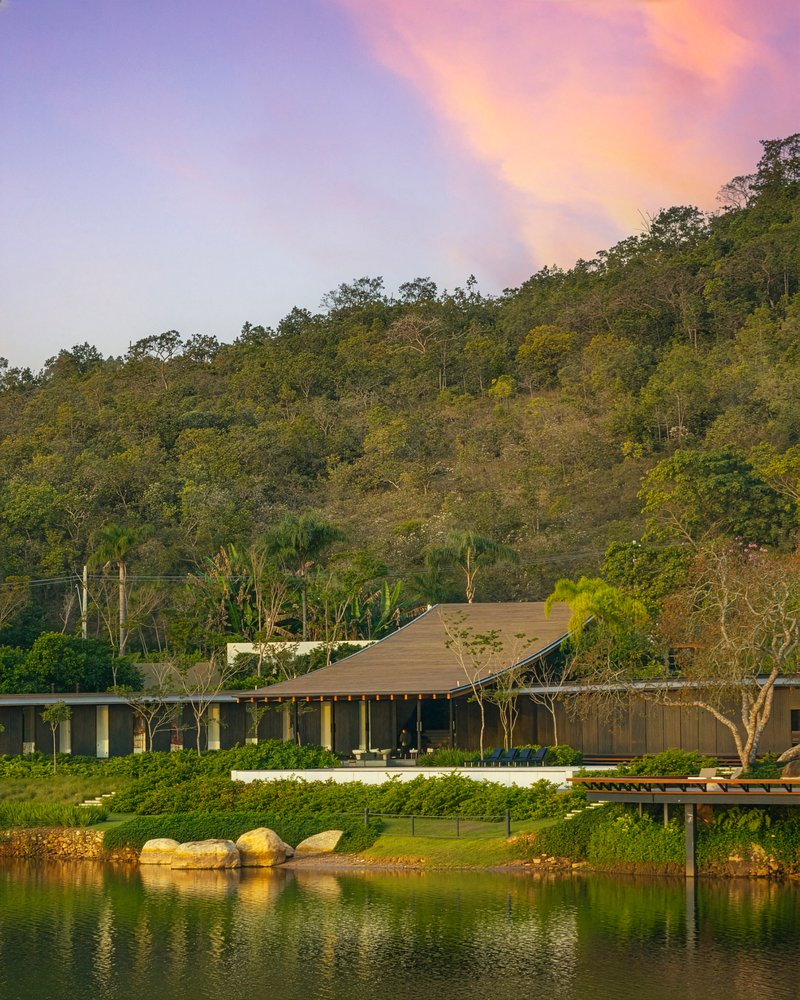
From the garden and the lake, the house reads as a series of glass and timber pavilions set beneath overhanging branches. The vertical slat facades dissolve the mass further, breaking reflected light into fragments that blend with the surrounding foliage. At dusk, seen from the water, the residence glows softly beneath the forested hillside, its roofline tracing a parallel course to the slope above it.
Landscape consultant Cenário deserves credit for integrating planting so thoroughly into the architecture that it becomes difficult to locate where building ends and garden begins. The planted beds are not decorative afterthoughts; they are structural to the experience, guiding movement, framing views, and softening every transition between inside and outside.
Plans and Drawings
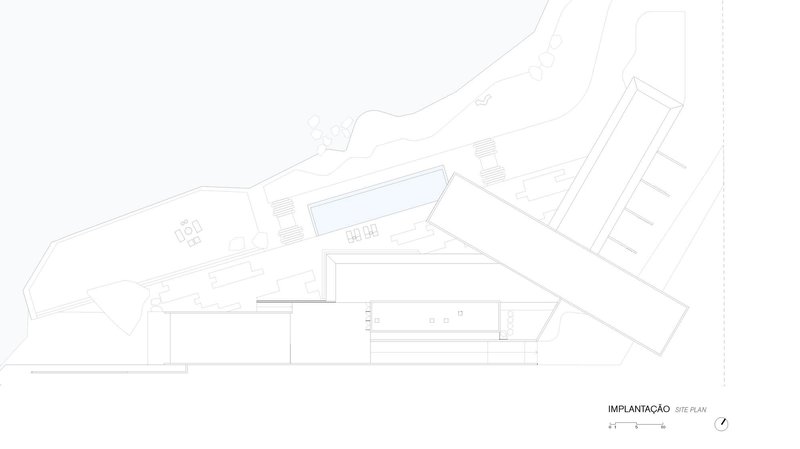
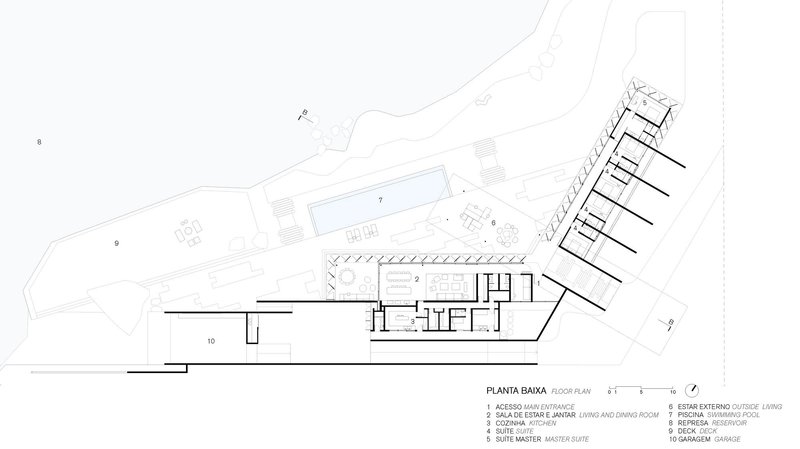
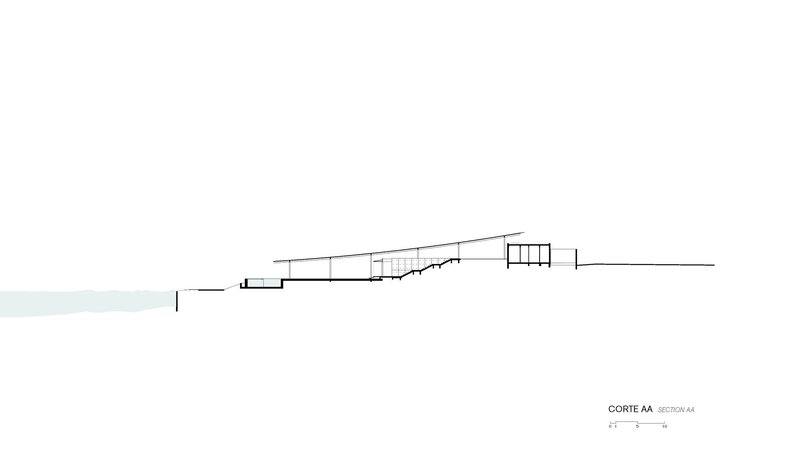
The site plan reveals the angular geometry that is less legible from the ground: building volumes pivot along the slope, their axes shifting to track the shoreline and the contours of the hillside. The floor plan shows a main living wing organized around a central service core, with an extended bedroom bar stretching to the east. The separation between social and private zones is clear but never abrupt, connected by the continuous roof overhead.
The section is the most telling drawing. It shows the building stepping down the terrain in a series of distinct levels, each volume landing at a different elevation. The roof planes float above these shifts, maintaining a consistent relationship with the sky while the floor drops away beneath. You can read the entire approach sequence in this single cut: compression at arrival, descent through planted corridors, and release at the terrace overlooking the water.
Why This Project Matters
Dam House is a reminder that restraint and ambition are not opposites. Bernardes Arquitetura committed to a single architectural idea, a timber roof that reads the terrain, and pursued it with enough consistency that the house achieves a kind of inevitability. Nothing feels added; nothing feels missing. In an era when residential architecture often chases novelty for its own sake, the discipline here is refreshing. The house does not try to astonish. It tries to belong.
The project also offers a compelling model for building on sensitive waterfront sites. By stepping down the slope rather than flattening it, and by keeping the roofline at or below the treeline, the house minimizes its visual impact from the reservoir while maximizing every occupant's connection to it. The reservoir was here first, and the architecture knows it. That deference, executed with real craft by the structural team at ITA Engenharia and the builders at Hauz, is what elevates Dam House from a well-made vacation property to a genuinely considered piece of landscape architecture.
Dam House by Bernardes Arquitetura (Thiago Bernardes, Marcia Santoro, Camila Tariki), Itaúna, Minas Gerais, Brazil. 1,030 m², completed 2024. Photography by Fernando Guerra | FG+SG.
About the Studio
Share Your Own Work on uni.xyz
If projects like this are the kind of work you want to make, uni.xyz is a place to publish your own, find collaborators, and enter design competitions.




Popular Articles
Popular articles from the community

gru.a Builds a 70 m² Timber Shelter That Opens Like a Farm Door in Brazil's Valley of the Vines
In the mountainous region near Rio de Janeiro, a compact retreat uses plywood panels and deep eaves to blur the line between inside and out.
OMCM arquitectos Builds a Summer House in Paraguay from Quarry Waste Blocks and Three Sacred Trees
In the young hillside neighborhood of Altos, a 696-square-meter concrete volume hovers on six pillars around three preserved native Yvyraju trees.
IDIN Architects Wraps a Hua Hin Hotel Around a Private Courtyard to Escape the City
Dusit D2 Hua Hin turns an urban infill site in Thailand's family vacation heartland into a self-contained resort through courtyard planning.

VEIVE Architects Builds a Mountain Hostel That Disappears into a Hangzhou Hillside
On the Huihang Ancient Trail in Xiangjian Village, a shelter of wood, steel, and rammed earth roots itself in the rural landscape.

Similar Reads
You might also enjoy these articles

127af Flips a Tiny Bagnolet Rowhouse Upside Down with a Handcrafted Roof Extension
A 55-square-meter terraced house on the edge of Paris gains a luminous upper living floor through lightweight timber and steel.
1.61 Design Workshop Wraps a 600-Square-Meter Café in Vietnam in Sculptural Burgundy Drama
Reden Café & Bistro pairs a helical staircase, mosaic floors, and deep red interiors to rethink Vietnamese hospitality space.

The Unbound Brain: A School Shaped by Cognitive Architecture
Cylindrical learning pods radiate like neurons from a central cortex, turning the floor plan into a spatial model of human thought.
Revival Vernacular Architecture: Rammed Earth Settlements for the Sahara
A modular desert community in Mauritania that fuses passive cooling techniques with earthen construction and local craftsmanship.


Explore Residential Building Competitions
Discover active competitions in this discipline




The Global Benchmark for Architecture Dissertation Awards


Challenge to design mud housing for contemporary communities
Comments (0)
Please login or sign up to add comments
No comments yet. Be the first to comment!