
WUWU Atelier and ADINJU Rebuild an Ancestral Home in Guangdong with Quiet Brick Precision
In rural Heyuan, a 440-square-meter renovation trades spectacle for craft, turning local brick into an architecture of restrained belonging.


Rural China builds fast and without architects. The villages around Heyuan, in northern Guangdong, are a testament to that: dense, ad hoc, sometimes chaotic, but alive with a spatial intelligence born of sheer accumulation. When a family decides to renovate an ancestral home inside this fabric, the temptation for any designer is to announce itself, to carve out a pristine object against the grain. WUWU Atelier and ADINJU, led by architect Pan Youjian, chose the opposite path. Their Guangdong Brick House, completed in 2025 in Puqian Town, is a 440-square-meter renovation that inhabits its context with something close to modesty.
What makes the project worth studying is not any single gesture but the accumulation of disciplined decisions. The house is brick, like its neighbors. Its windows are rectangular, its volumes stacked. Yet in the specifics of its bonding patterns, the calibration of its openings, and the way light enters through carefully placed skylights and voids, the building achieves a material density that the surrounding self-built houses hint at but never fully control. The architects did not invent a new language here. They listened to an existing one and spoke it more carefully.
Fitting In, Standing Apart
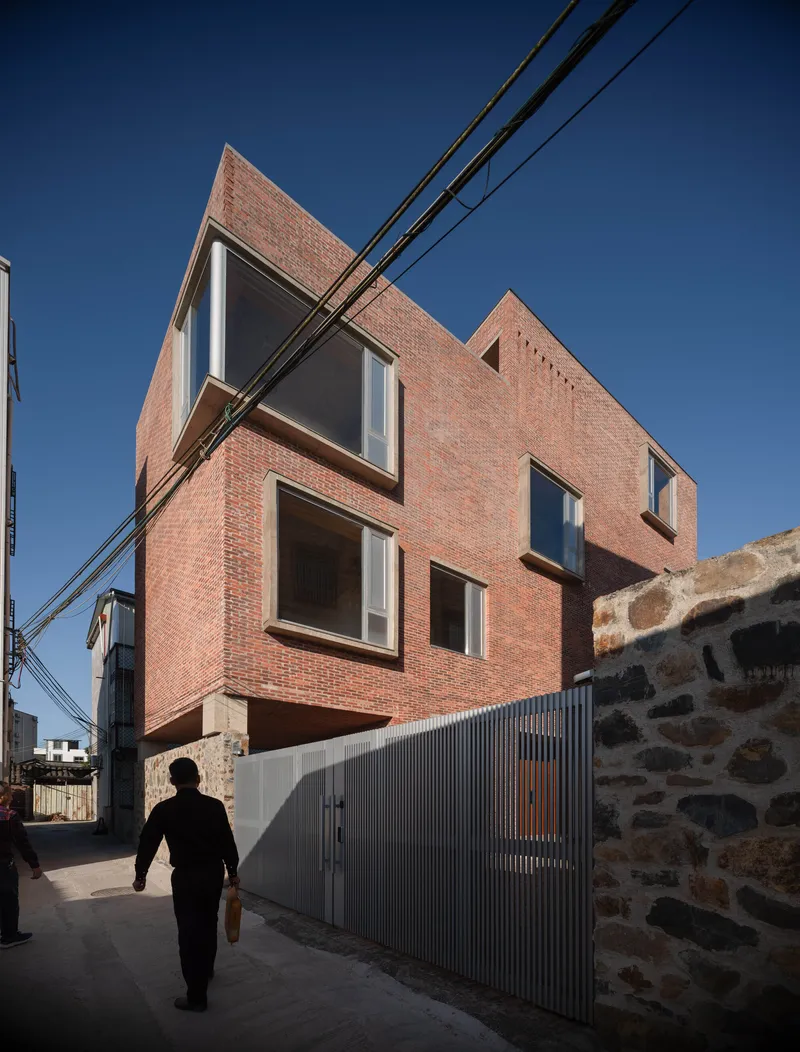
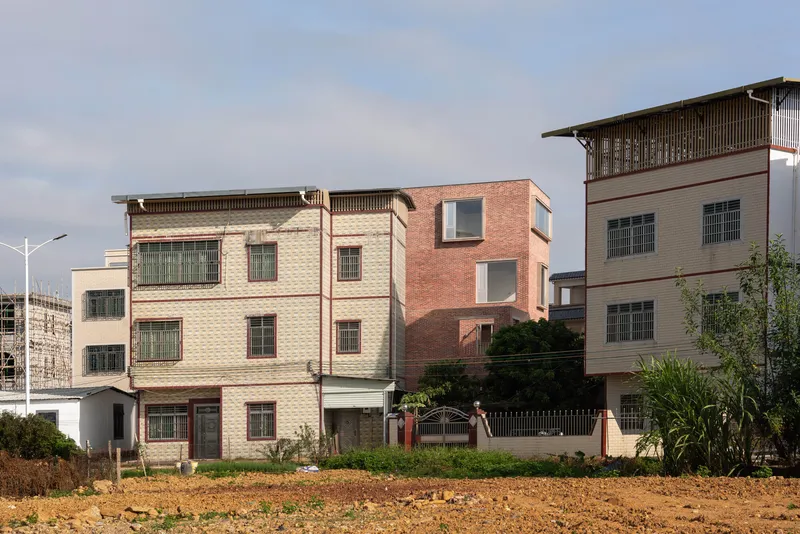
From the street, the Brick House reads as a slightly taller, slightly more composed version of its neighbors. The facade uses asymmetric window openings scattered across three stories, a move that mirrors the informal rhythms of surrounding buildings without copying them. Corrugated metal fences and tiled structures press up against the new brick volumes, and the house does not flinch. Its massing steps and staggers, absorbing the irregularities of the site rather than bulldozing them into a clean footprint.
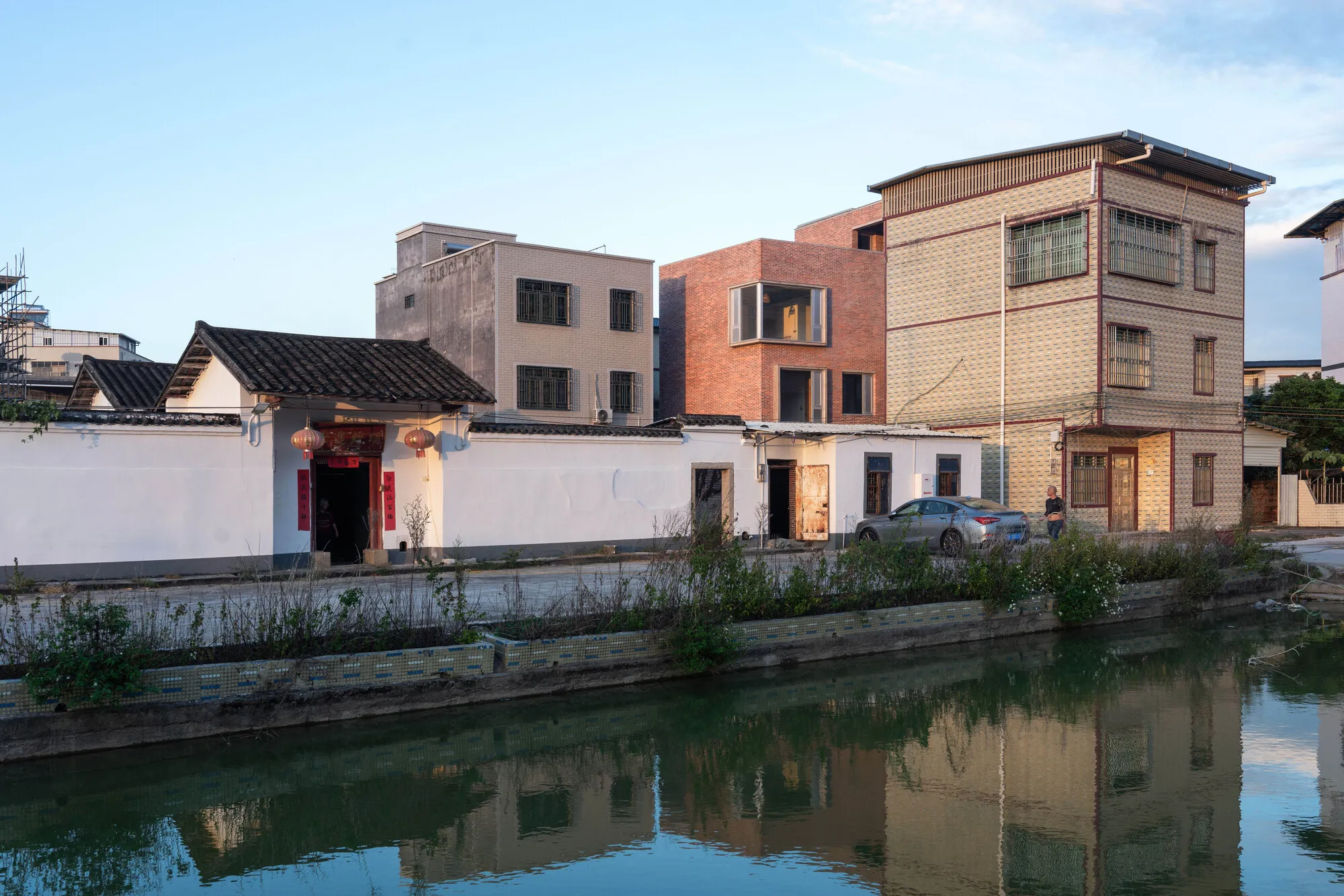
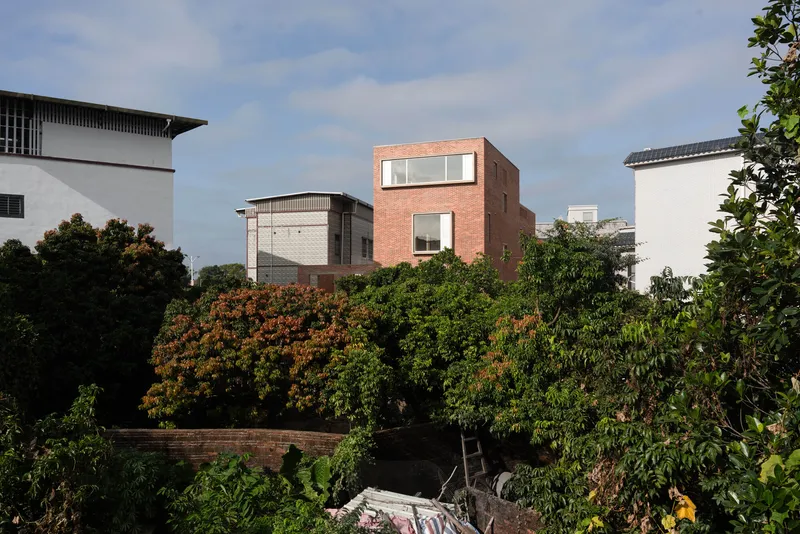
Seen from across the canal at dusk, the brick mass rises among older rooftops with a quiet authority. It is taller than most of its neighbors but never towers. The staggered openings, lit from within, give the facade a lantern quality, animated without being performative. The rear elevation is even more telling: chickens scratch in the foreground yard below a brick volume that rises above an old retaining wall, proof that the architects treated the boundary conditions as real constraints rather than inconveniences to erase.
Brick as Method
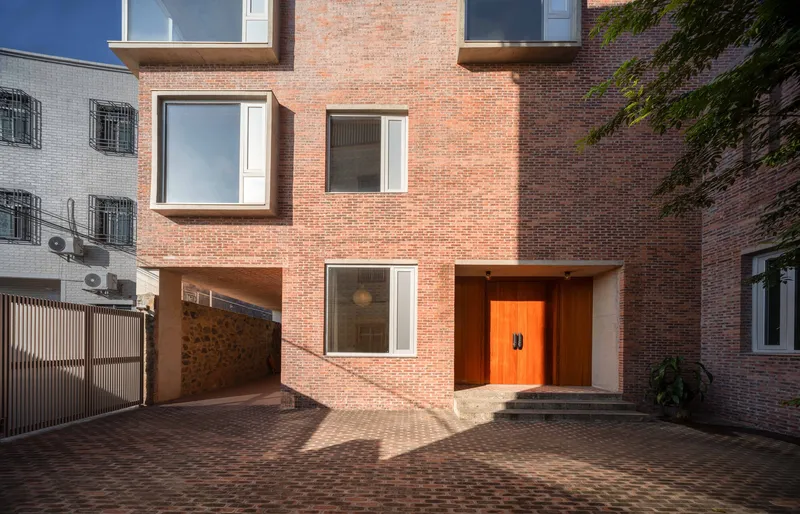
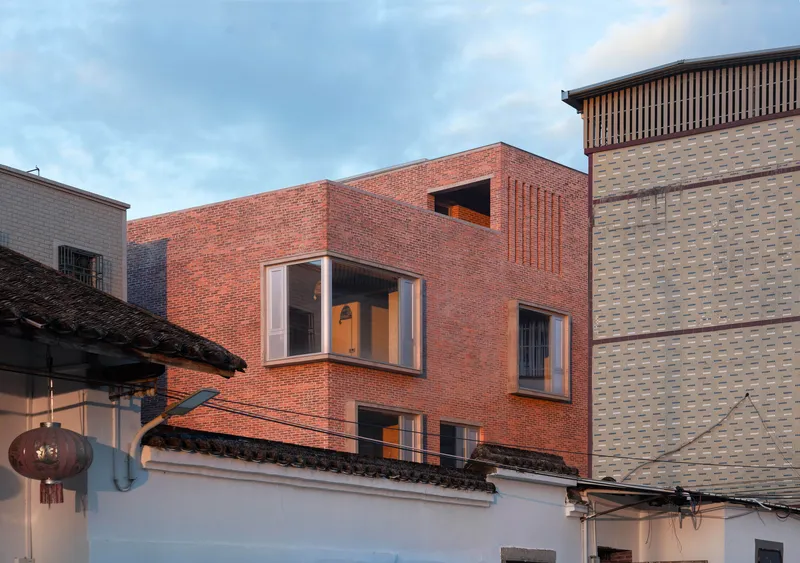
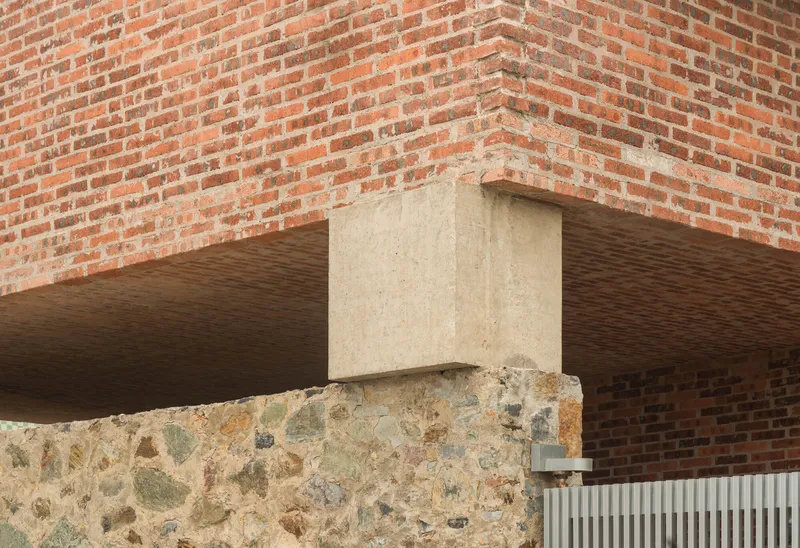
The facades are not just brick. They are brick worked by named craftsmen: Jiang Daping, Master Huang, Lai Renhui, Liu Rongchun. That distinction matters. The angled brickwork details around the protruding bay window, the chequered paving in the courtyard, the careful meeting of red brick wall and stone foundation beneath a timber soffit: these are not details drawn in Revit and handed to a contractor. They are negotiations between a design intention and hands that know the material.
The recessed orange entry door on the primary facade reads as both an invitation and a threshold. It is set deep enough into the masonry to create a shadow line that registers from across the courtyard, giving the entrance weight without ornamentation. Bay windows project outward with confident geometry, their brick sills and jambs articulated with enough variation to catch raking light. This is a house built by masons who were given room to exercise judgment, and it shows.
The Courtyard as Negotiator
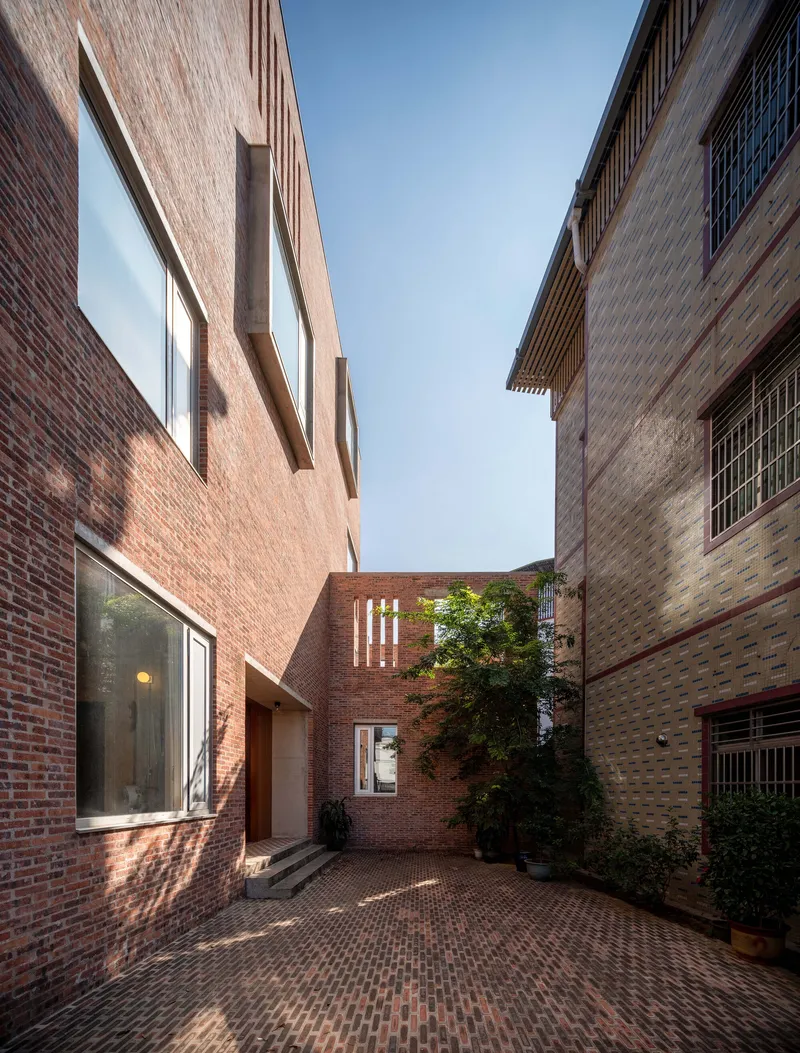
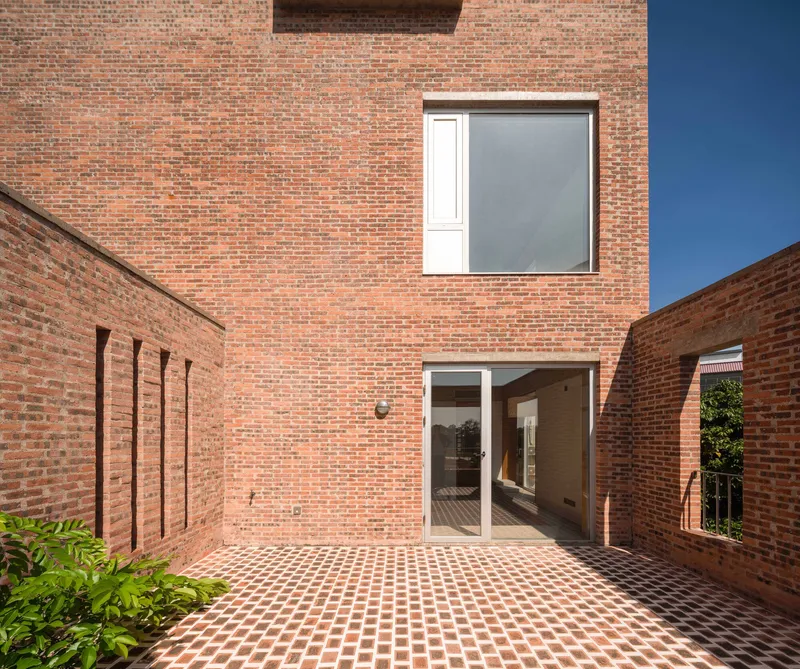
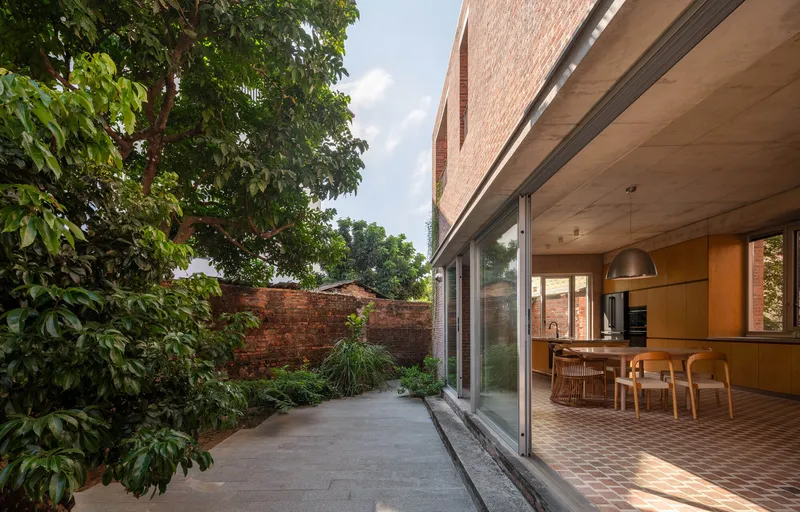
Between the principal volumes, a brick courtyard serves as the organizational hinge of the house. A planted tree anchors the space, its canopy filtering late afternoon light onto the chequered paving below. The courtyard is not large, perhaps four meters across at its widest, but it does extraordinary work. It separates private and communal zones, provides cross-ventilation through the section, and delivers daylight deep into rooms that would otherwise be landlocked by the dense surrounding fabric.
Full-height glazing opens the dining area directly onto the courtyard terrace, collapsing the boundary between inside and outside in a way that Guangdong's subtropical climate permits for much of the year. The glass doors, when slid open, transform the ground floor into a single continuous surface of terracotta tile running from kitchen to tree. It is a move borrowed from the courtyard typology of southern Chinese vernacular housing, executed here with a precision that the original builders would recognize.
Light from Above
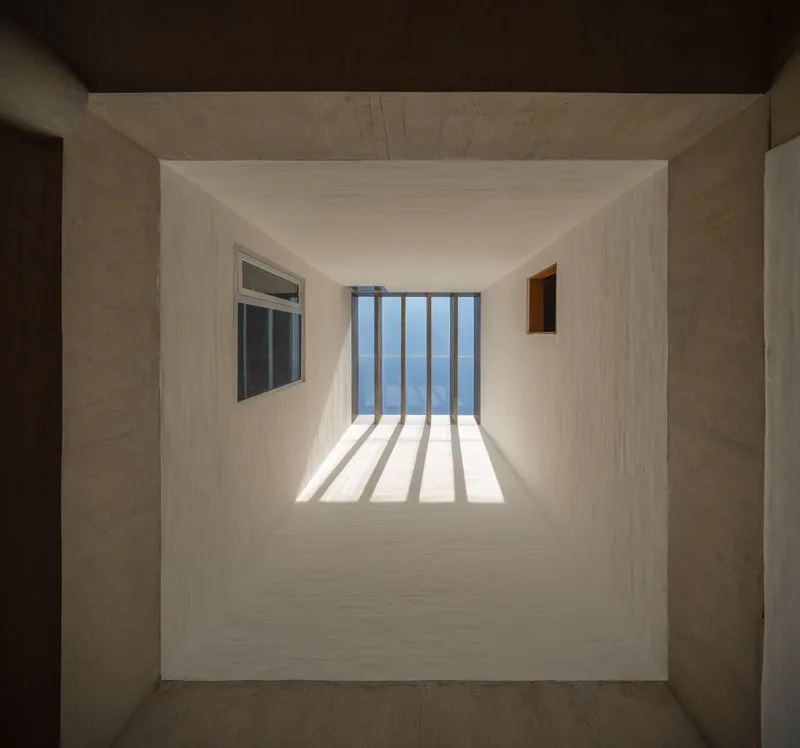
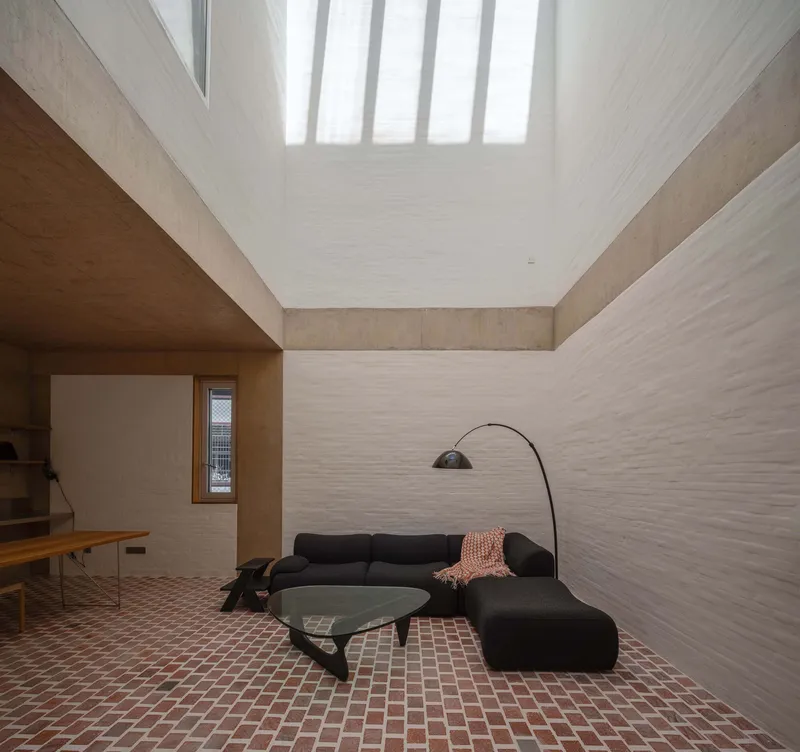
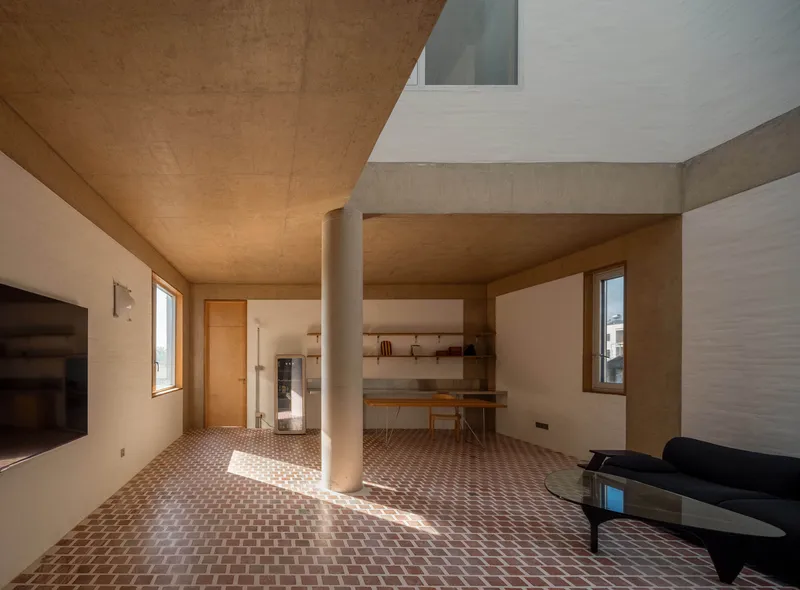
The most inventive spatial moves in the Brick House happen vertically. A skylight shaft with vertical louvers casts striped shadows down white plaster walls, turning a circulation zone into something close to a light installation. In the interior courtyard space, vertical skylight slats diffuse natural light across terracotta tiles, creating a soft, even glow that avoids the harshness of direct tropical sun. These are not decorative skylights. They are calibrated environmental instruments.
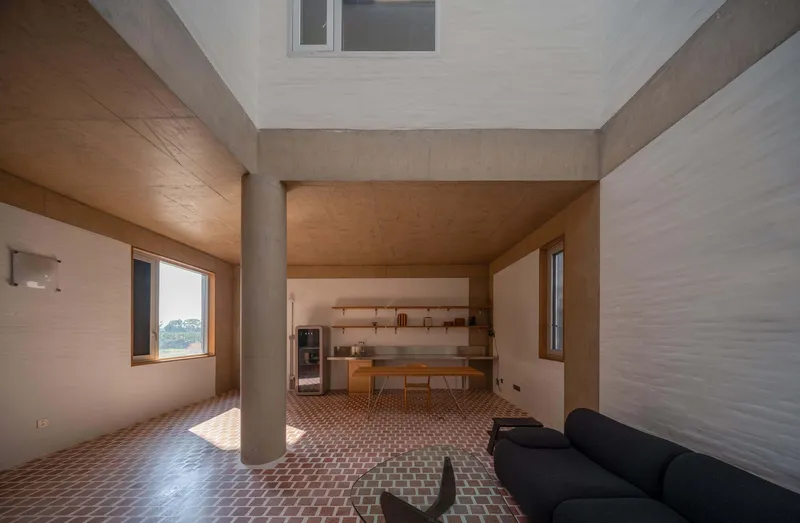
The living room benefits from a clerestory above, light washing down a cylindrical column and pooling on the patterned terracotta floor. The architects use the double-height void revealed in the section drawings as a chimney for both light and air, pulling warm air upward and drawing cooler air in from the courtyard level. In a climate as hot and humid as northern Guangdong, this kind of passive strategy is not a luxury; it is a necessity.
Interior Craft and Material Continuity
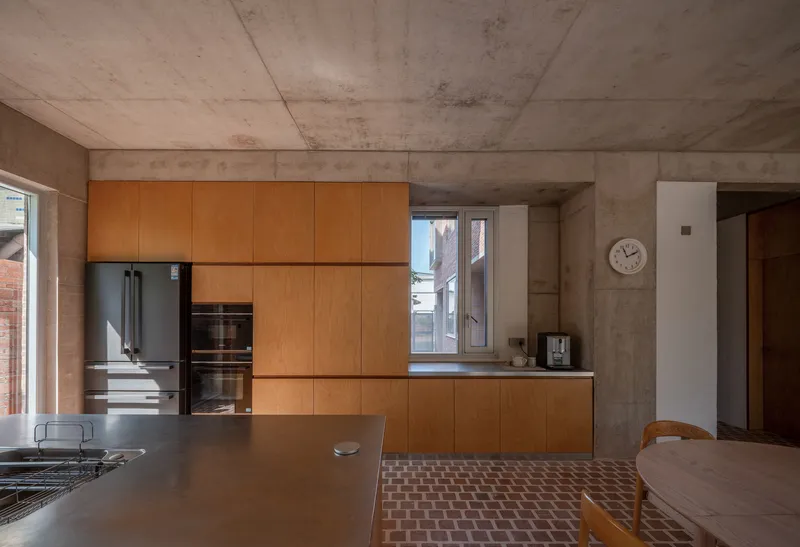
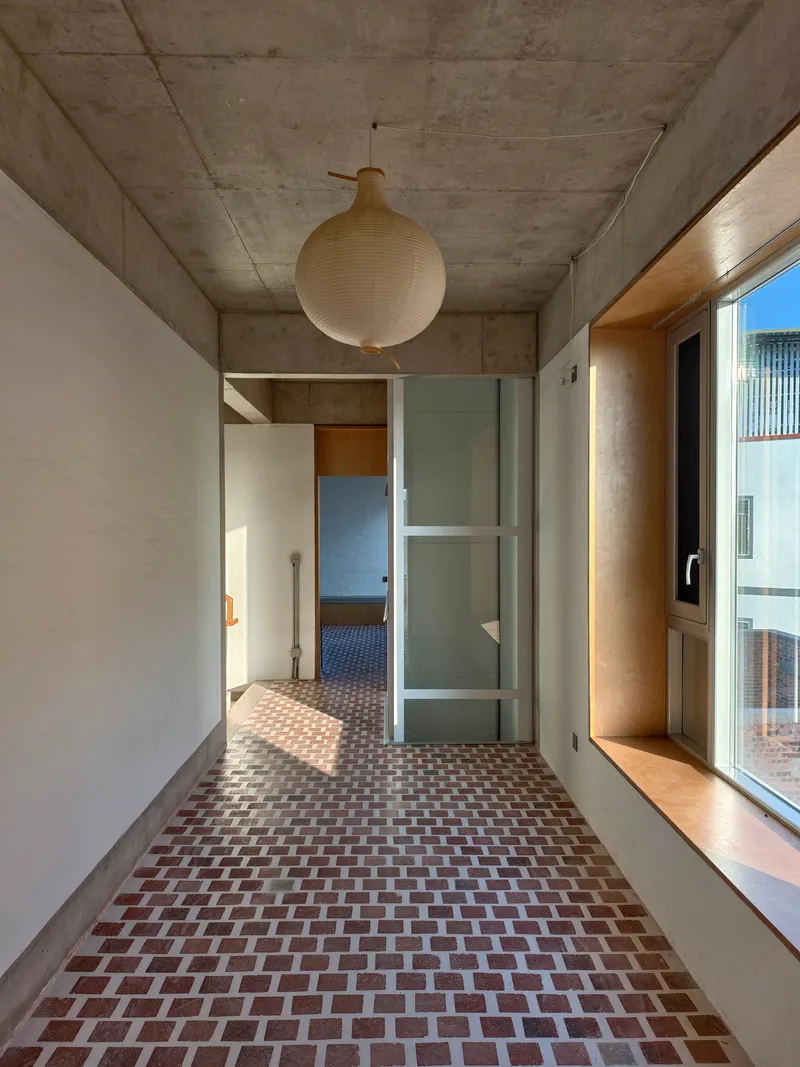
Inside, the material palette is deliberately limited: exposed concrete ceilings, light timber cabinetry and ceiling panels, terracotta and brick floors laid in herringbone and chequered patterns. The kitchen places warm wood against raw concrete with a directness that avoids the fetishization of either material. Zhong Xinhua's interior woodwork, including built-in window seats and the dining table, carries a grain and proportion that feels continuous with the masonry outside rather than imported from a different aesthetic universe.
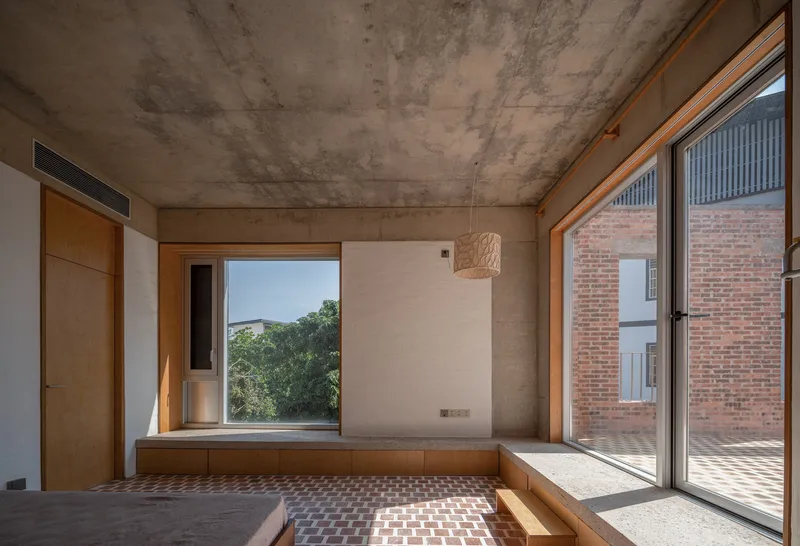
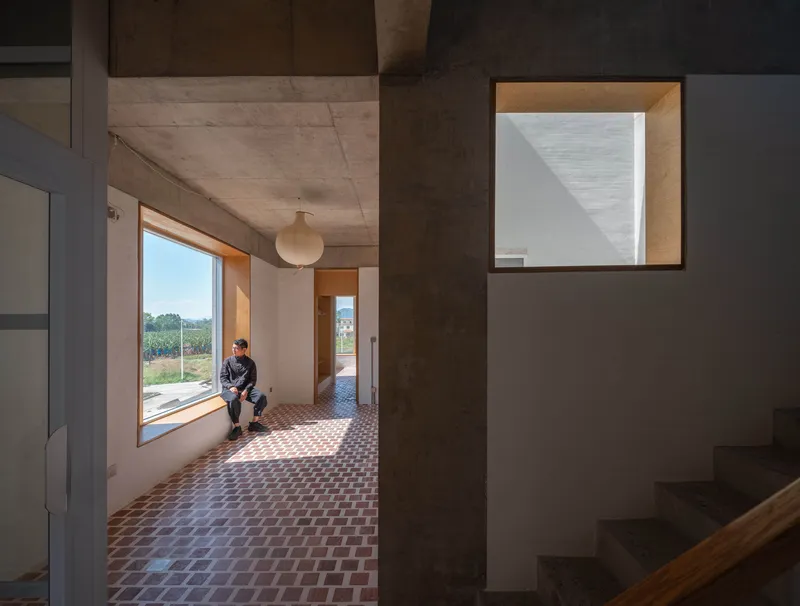
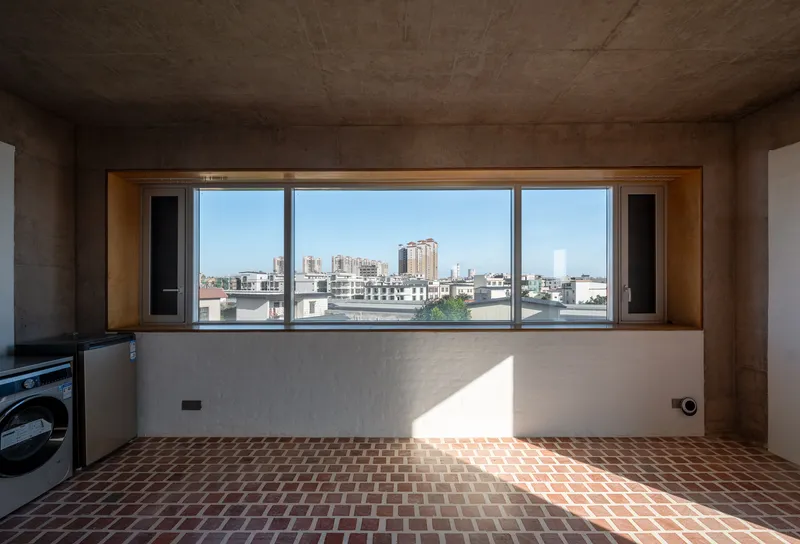
The window seats are among the house's best moments. A timber-framed niche on one facade offers a view to the courtyard, the concrete soffit overhead casting geometric shadows that shift through the day. On an upper floor, a similar seat frames a view of the city through a timber-edged opening, with a red brick herringbone floor underfoot. These are inhabitable thresholds: part furniture, part architecture, thick enough to sit in and contemplative enough to pause.
Gathered Spaces
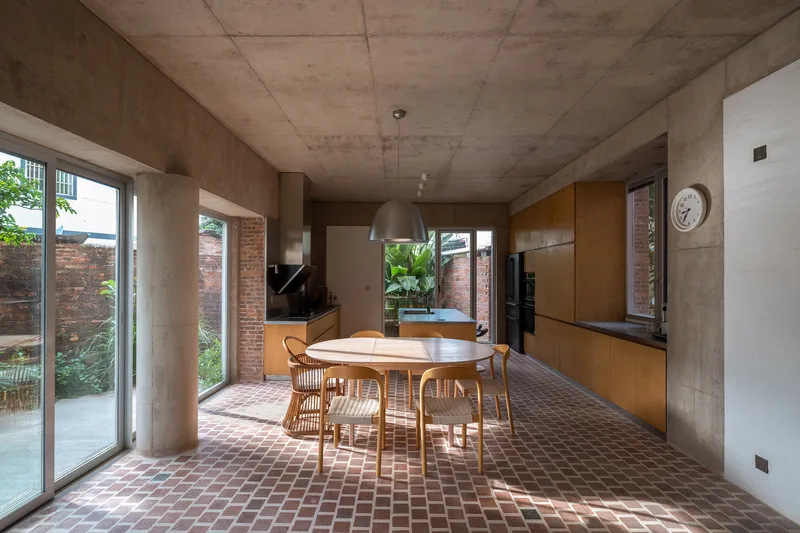
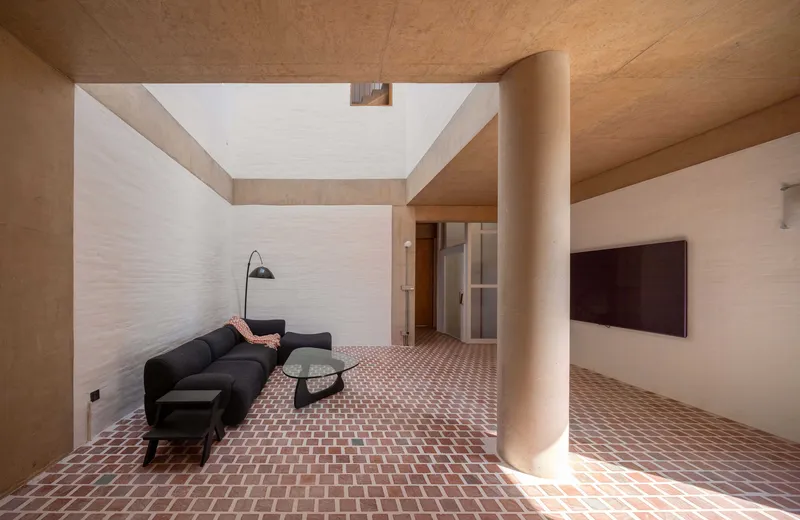
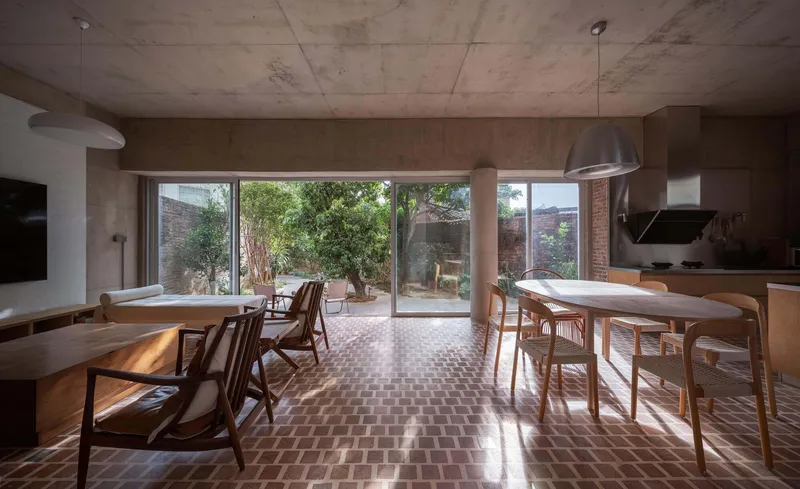
The open-plan ground floor, organized around a cylindrical concrete column, brings kitchen, dining, and living into a single flowing space. The column is structural, but it also acts as a spatial marker, a point around which movement pivots. Patterned terracotta floor tiles unify the zones, while changes in ceiling treatment (timber panels in the living area, exposed concrete in the kitchen) gently distinguish one activity from another without the tyranny of walls.
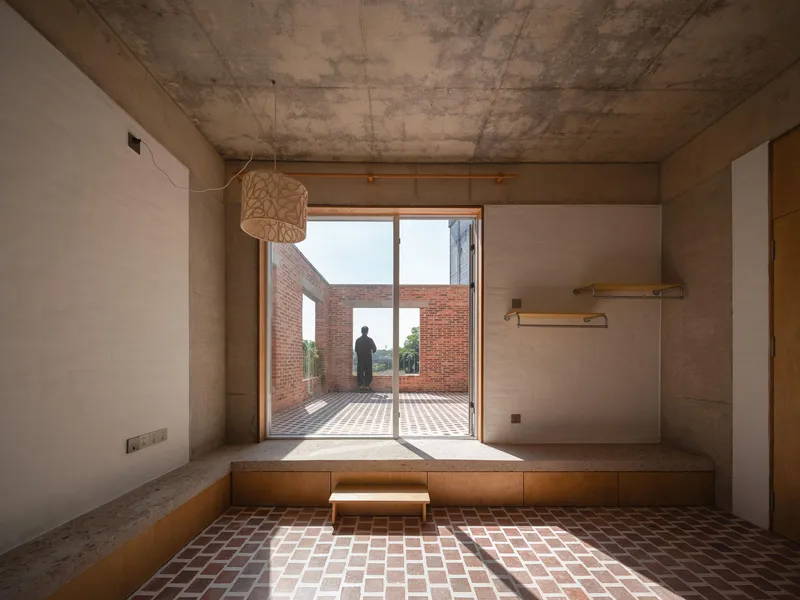
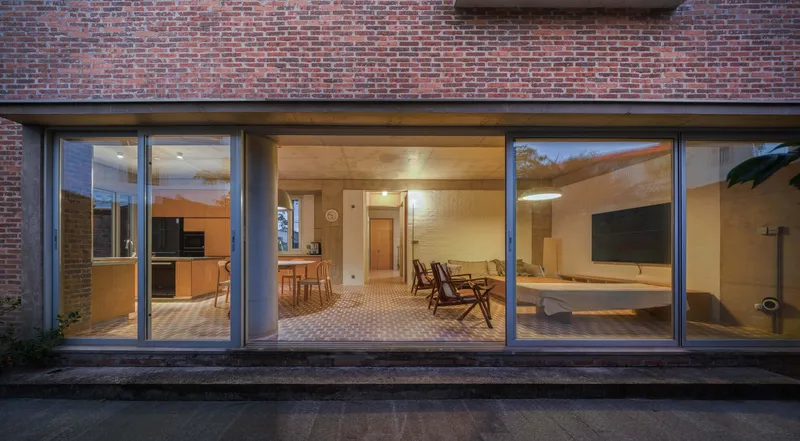
A doorway on one side frames a figure on the terrace beyond, a shot that reveals the architects' understanding of sequence. Movement through this house is always directed toward something: a tree, a person, a strip of sky. At dusk, the glazed rear facade turns the interior into a warm, glowing display visible from the garden, inverting the daytime relationship between inside and outside.
The Canal and the Neighborhood
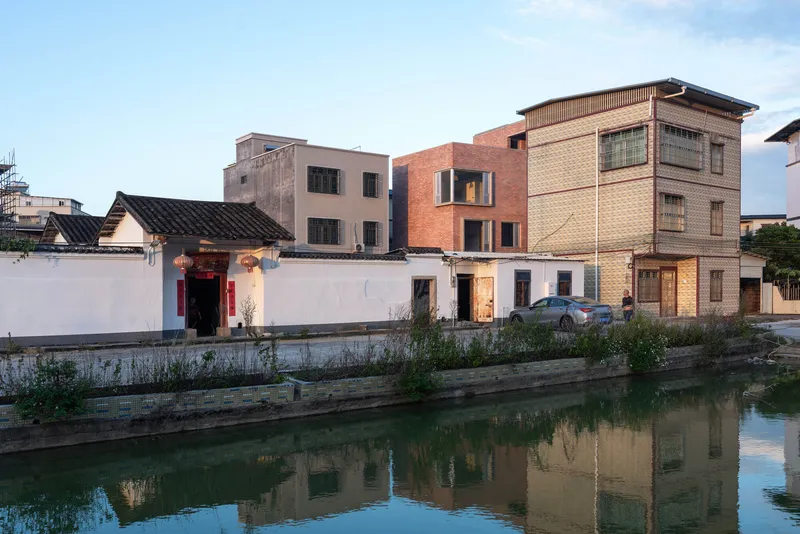
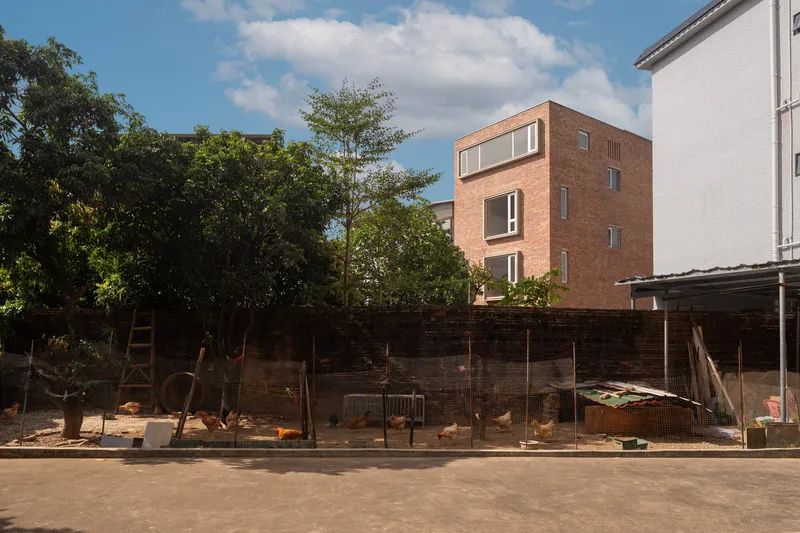
The house's relationship to its neighborhood is visible in two telling images. From the canal, the brick volume rises among older structures, its reflection doubling its presence without aggression. From the rear yard, chickens and a low wall provide the kind of unscripted context that no rendering can fake. The architects clearly understood that the success of this project would be measured not by photography but by how naturally it would age into its surroundings, gaining the patina that its neighbors already wear.
Plans and Drawings
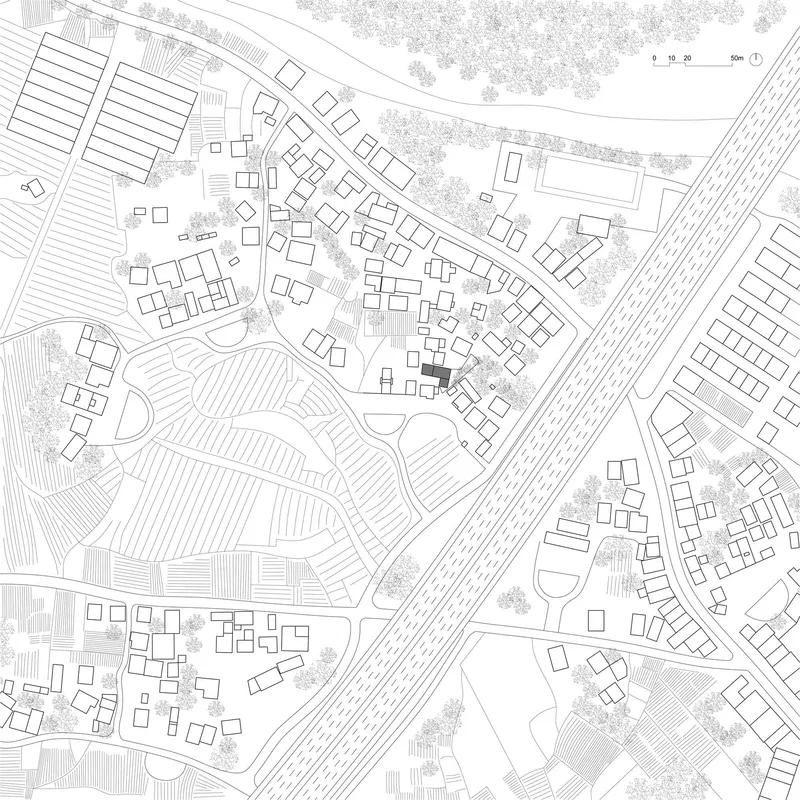
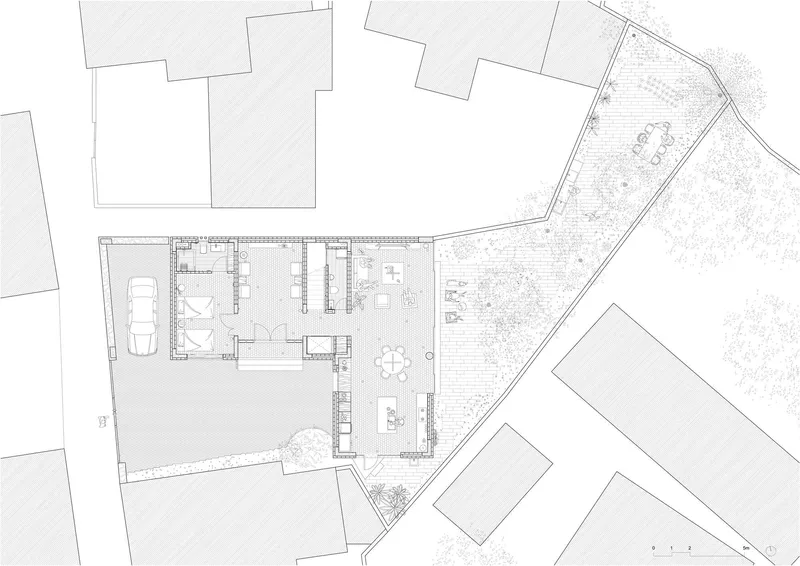
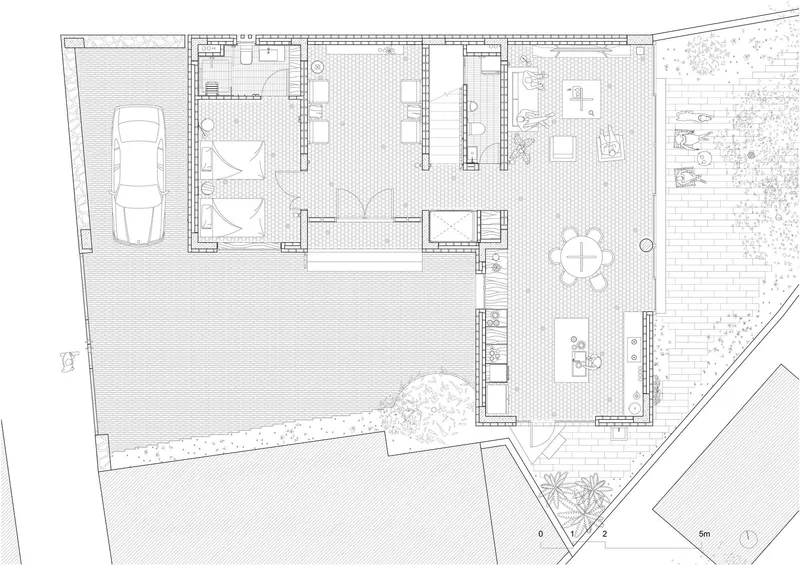
The site plan situates the house within the tight residential grain of Puqian Town, revealing how narrow the plot is and how densely the surrounding fabric presses in. The ground floor plan shows a garage at one end, living areas opening to the courtyard garden, and a central circulation spine that threads the entire section. The L-shaped upper floor plan places two bedrooms around a courtyard terrace, preserving outdoor space even at the upper levels.
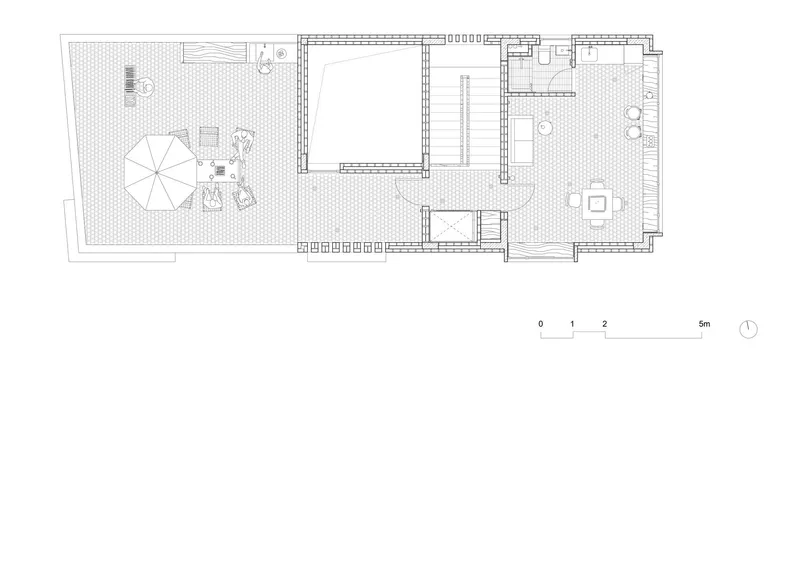
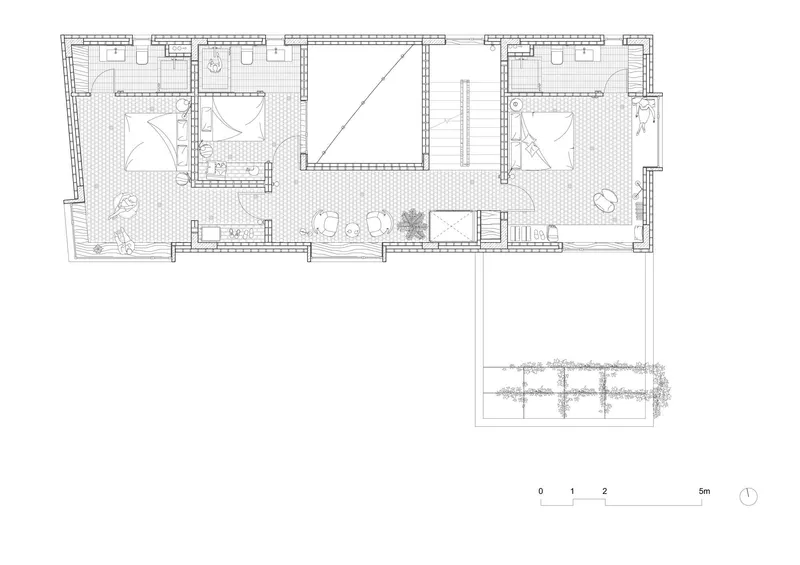
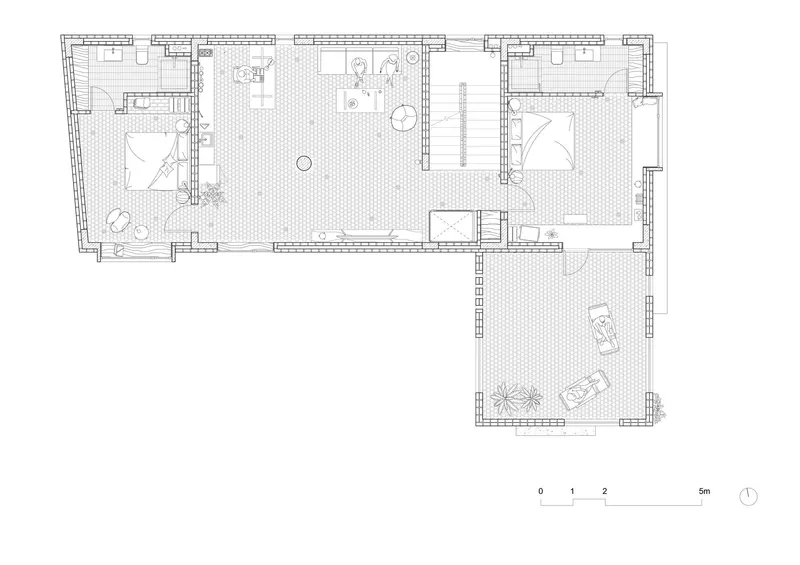
Floor plans at successive levels confirm the narrow residential layout with courtyard and central spine as the organizational constant. Two bedrooms flank a central void at the upper floors, a configuration that allows cross-ventilation and borrowed light from the double-height space. The terrace below the void provides the kind of outdoor room that subtropical climates demand.
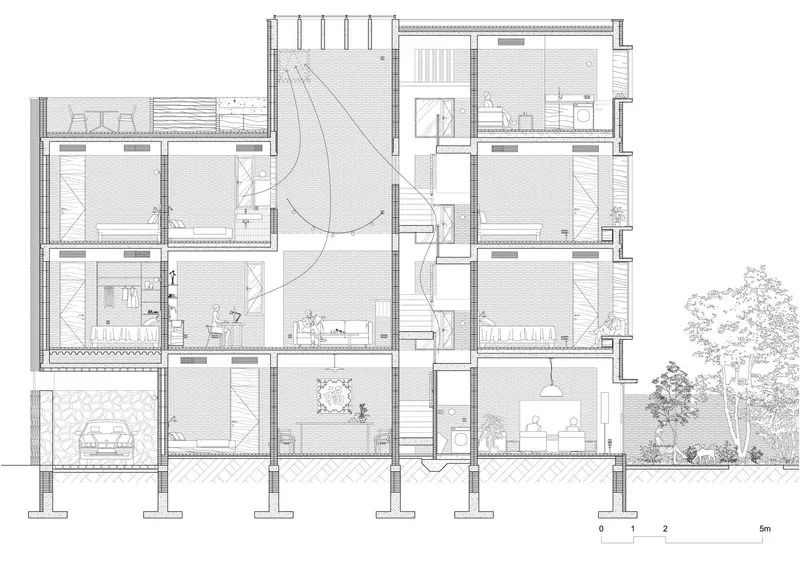
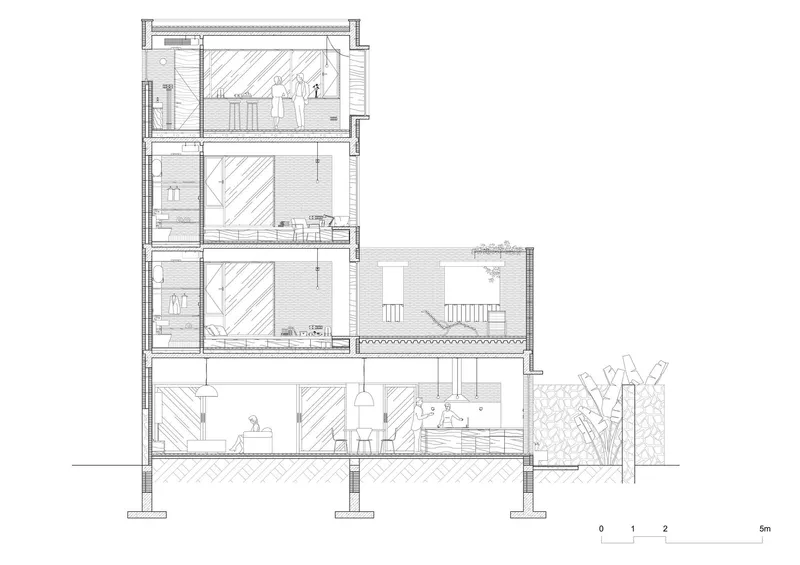
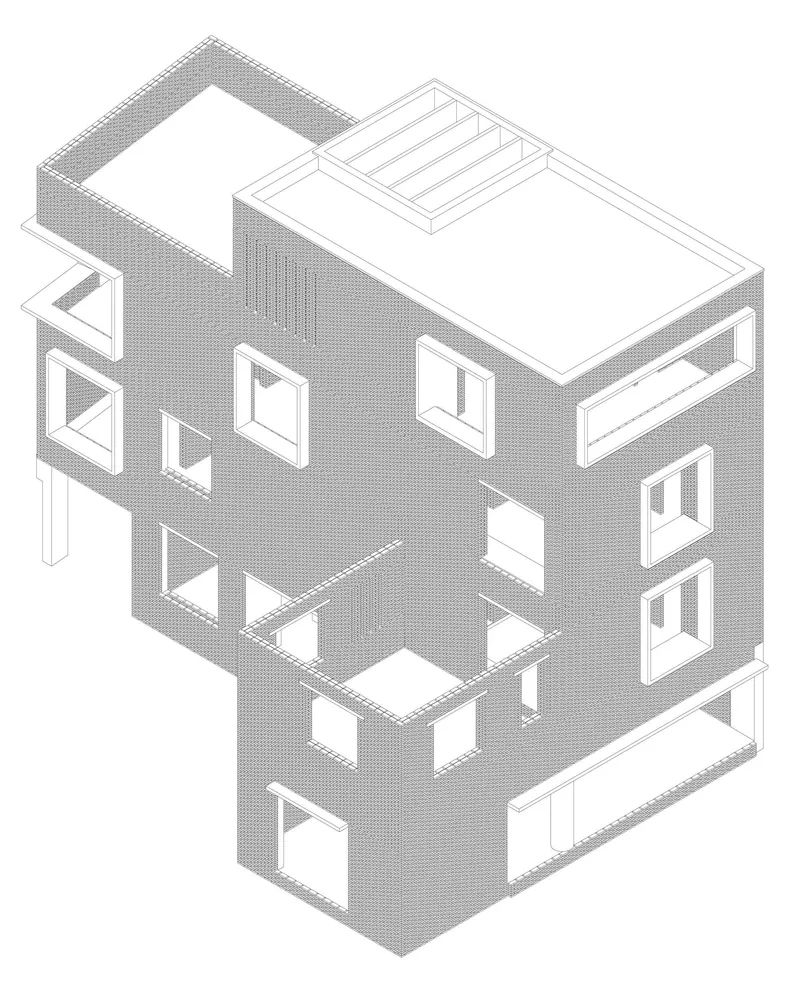
The section drawings are the most revealing documents. They show three and four levels of rooms organized around a central staircase and double-height void, with human figures providing scale that the photographs sometimes obscure. The axonometric drawing makes the scattered window openings legible as a system: each opening is sized and positioned for a specific interior condition, not composed for exterior effect.
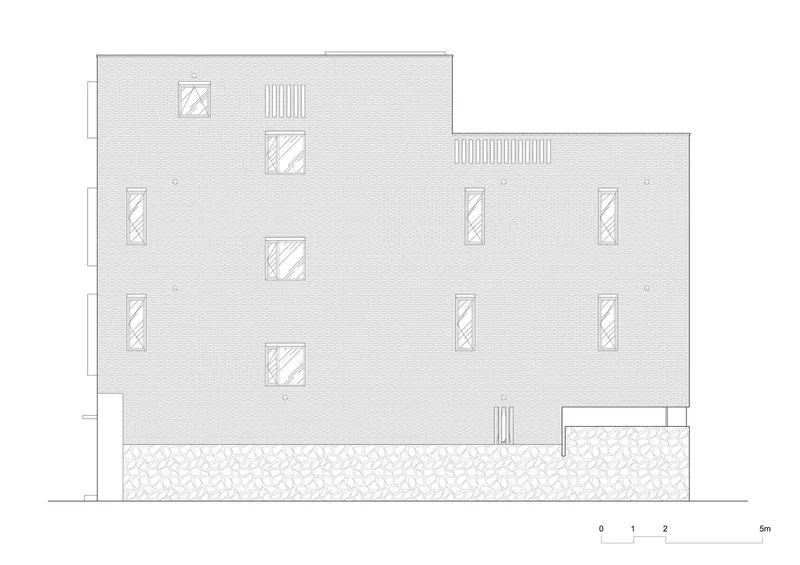
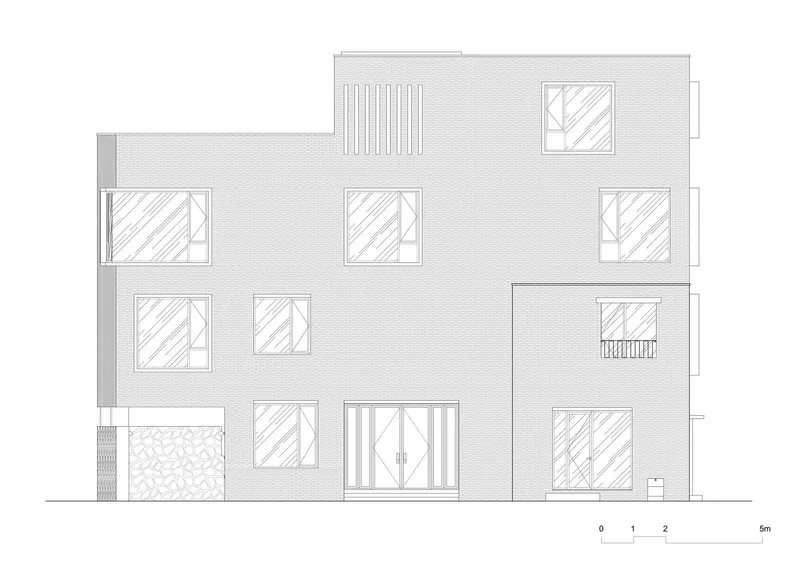
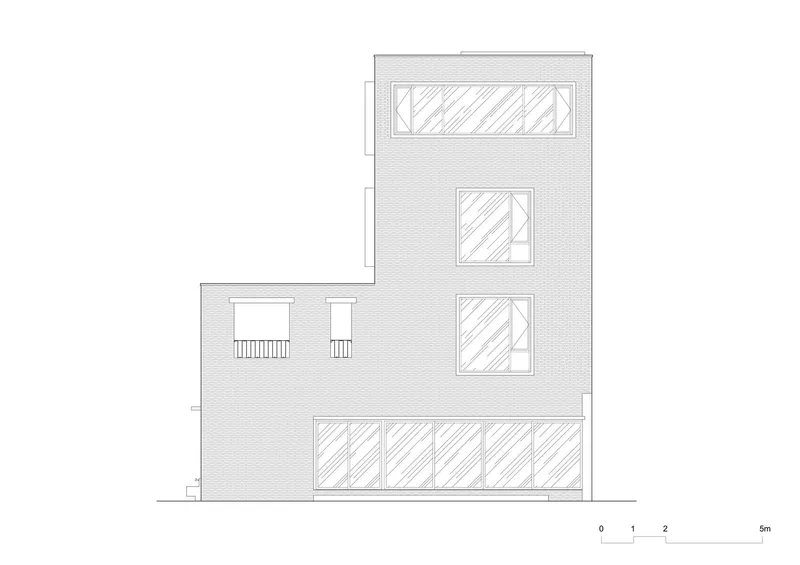
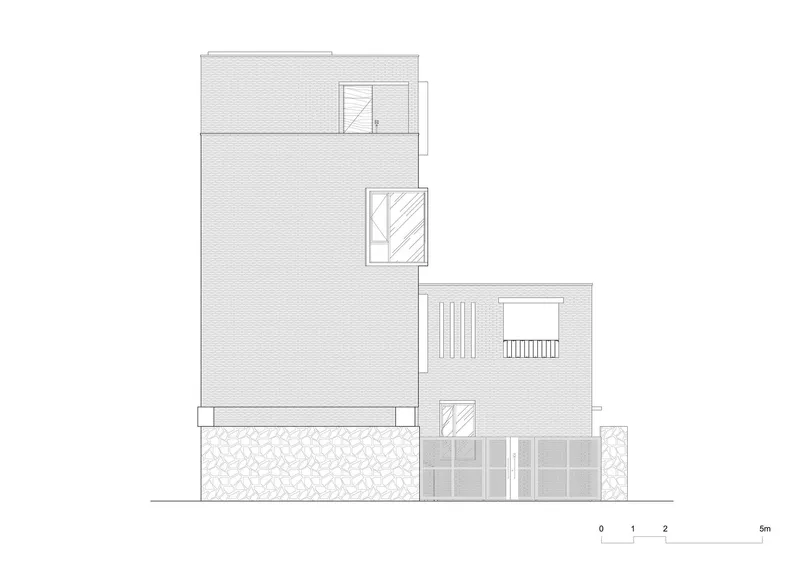
The elevation drawings confirm what the photographs suggest: that the facade compositions are controlled but not symmetrical. Each elevation has its own logic, responding to orientation, program, and the proximity of neighboring structures. The textured wall with scattered rectangular openings on one side contrasts with the more regular fenestration of the street-facing facade, evidence of a design process attentive to specific conditions rather than abstract composition.
Why This Project Matters
The Guangdong Brick House matters because it demonstrates that working within vernacular constraints is not a limitation but a design method. In a country where rural construction often oscillates between chaotic self-building and parachuted-in trophy houses, WUWU Atelier and ADINJU found a third way. They hired local craftsmen, used local materials, respected the existing site boundaries, and produced a house that is architecturally rigorous without being alienating. The building improves its neighborhood not by contrast but by competence.
There is a lesson here that extends beyond Guangdong. As the profession increasingly grapples with questions of context, sustainability, and cultural continuity, projects like this one argue that the answers are often already present in the places we build. The skill lies not in importing solutions but in recognizing what is already working and doing it better, with more intention, more craft, and more care. Pan Youjian and his collaborators have built a house that belongs where it stands. In an era of architectural tourism, that is a radical act.
Guangdong Brick House by WUWU Atelier and ADINJU, lead architect Pan Youjian. Puqian Town, Heyuan, Guangdong, China. 440 m², completed 2025. Photography by Yilong Zhao.
About the Studio
Share Your Own Work on uni.xyz
If projects like this are the kind of work you want to make, uni.xyz is a place to publish your own, find collaborators, and enter design competitions.




Popular Articles
Popular articles from the community


The Musturak Paradise: Senior Living Architecture for a Connected Future in Temara, Morocco
The Musturak Paradise reimagines senior living architecture in Temara via private homes, social spaces, culture, community, and shared care.

Co-Life: Senior Housing Design That Reconnects Older Adults With the City
Co-Life reimagines senior housing design through healing gardens, shared streets, workshops, and a sustainable community across generations.

Play: Fragments of Their World
Familiar architecture becomes modular playground design, creating safe spaces where displaced children can learn, connect, imagine and play.

The Earth Pod: 3D Printed Homes for Resilient Refugee Communities
The Earth Pod reimagines refugee housing through 3D printed homes made from clay, combining resilience, self-sufficiency, and rapid shelter.

Similar Reads
You might also enjoy these articles

Bao Huynh Watercolor Atelier: A Serene Art Retreat in Hội An
Bao Huynh Watercolor Atelier in Hội An blends multifunctional art spaces, sustainable design, local materials, and family-friendly living in a serene environment.

Atelier Macri Concept Store Interior Design by CASE-REAL
Atelier Macri store features a "ko" counter, walnut wood details, cork displays, blending retail, gallery, and seamless customer experiences.

Manuel Vargas Izquierdo Stadium and High-Performance Sports Center: Architectural Excellence in Jalpa de Méndez
The Manuel Vargas Izquierdo Stadium blends sustainable design, inclusive sports facilities, and cultural-inspired architecture, revitalizing Jalpa de Méndez’s public spaces.

KAKR Buluh Awar Hall: Revitalizing Community and Ecology Through Bamboo Architecture
Community built bamboo hall revitalizes Buluh Awar village, empowering youth, restoring ecology, celebrating vernacular craftsmanship through sustainable architecture and culture.


Explore Adobe Brick Making Competitions
Discover active competitions in this discipline


Challenge to design mud housing for contemporary communities


Challenge to design luxury tourism on rails


VR headsets Storefront design competition

Designing a staircase for a client
Comments (0)
Please login or sign up to add comments
No comments yet. Be the first to comment!