
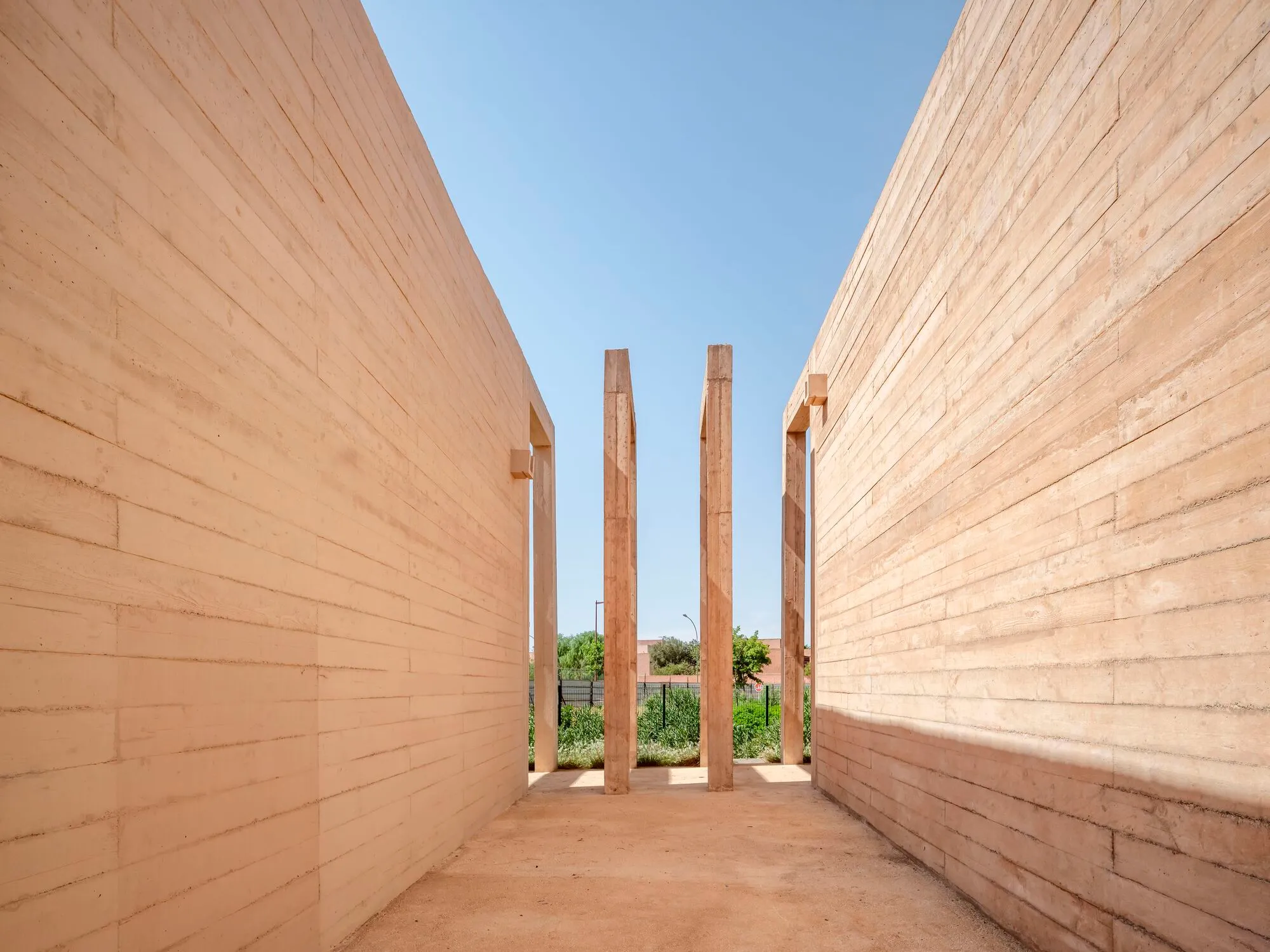
OUALALOU+CHOI Root a Regional Sports Campus in Moroccan Earth and Timber
A 10,230 square meter athletic complex in Ben Guerir uses rammed earth walls and timber screens to anchor sport in the arid landscape.


Ben Guerir sits in Morocco's arid interior, a city shaped by phosphate industry and loose urban edges. When the Office Chérifien des Phosphates (OCP) commissioned a regional sports campus here, the brief was ambitious: covered pool, multisport courts, gymnasiums, a clubhouse, athlete housing, and administration buildings, all on a 10,230 square meter site with a 12 million euro budget. The architects selected for the task, OUALALOU+CHOI, led by Tarik Oualalou and Linna Choi, responded not with a single monolithic facility but with a campus of distinct volumes that read as geological formations rising from a planted steppe.
What makes this project worth studying is the refusal to treat a sports facility as a sealed, climate-controlled box. Instead, the design disaggregates the program into four rectangular buildings organized along a curving site boundary, connected by outdoor passages and shaded corridors. The material palette is deliberately limited to rammed earth and timber, both of which perform thermally in extreme heat while establishing a visual kinship with the terrain. The result is a facility that feels less like infrastructure dropped onto the landscape and more like something that grew from it.
Rammed Earth as Structural Identity
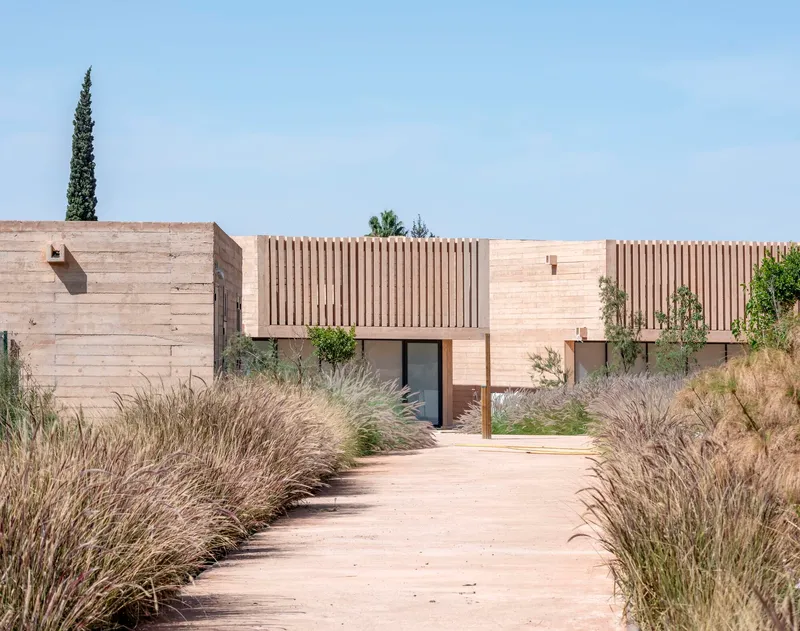
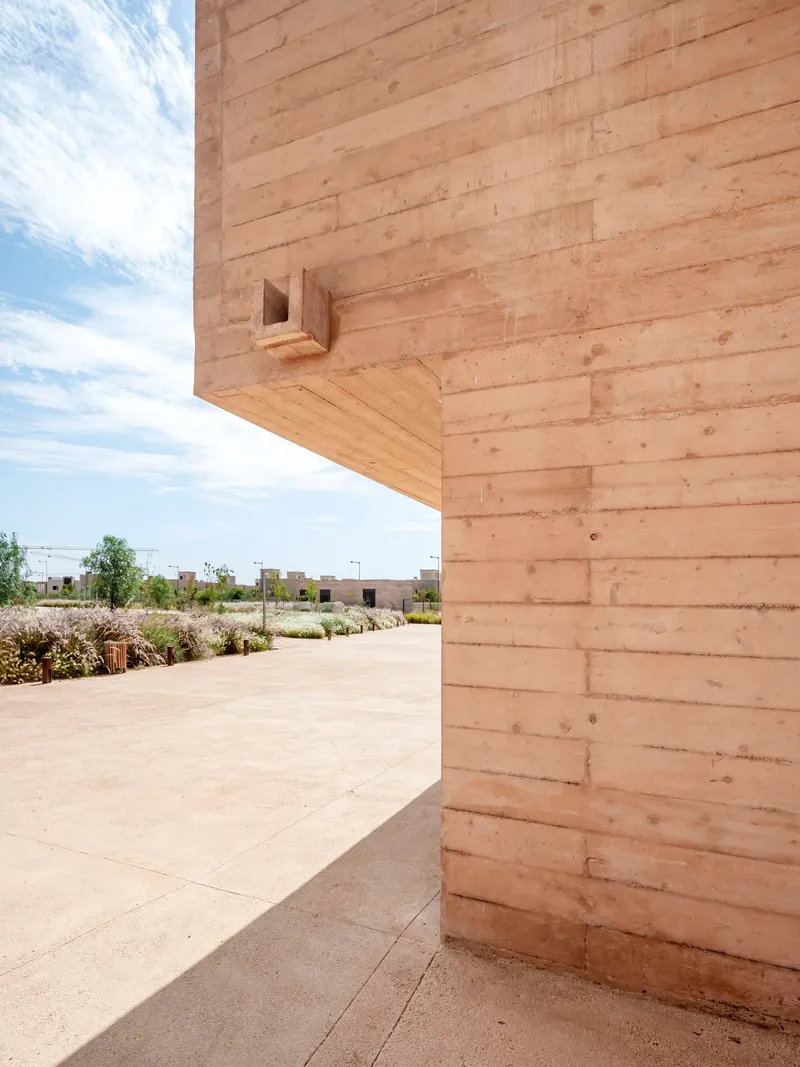
The rammed earth walls are the project's most assertive gesture. Thick, striated, and warm in color, they carry the horizontal weight of the buildings while absorbing and slowly releasing heat through the day/night cycle. This is not decorative cladding over a concrete frame. The walls are load-bearing protagonists, and their layered texture, visible in close detail at corners and cantilevers, records the construction process itself. Each horizontal band is a pour, a compaction, a geological stratum made in real time.
At the corner detail visible in image five, a cantilevered rammed earth volume juts out with quiet authority, punctuated by a small cubic opening that functions as a birdhouse. It is a minor detail with major implications: the architects understood this campus as habitat, not just for athletes but for the ecology around it. The entrance pathway similarly frames the approach between rammed earth walls, directing movement while blocking lateral wind and dust.
Timber Screens and Filtered Light
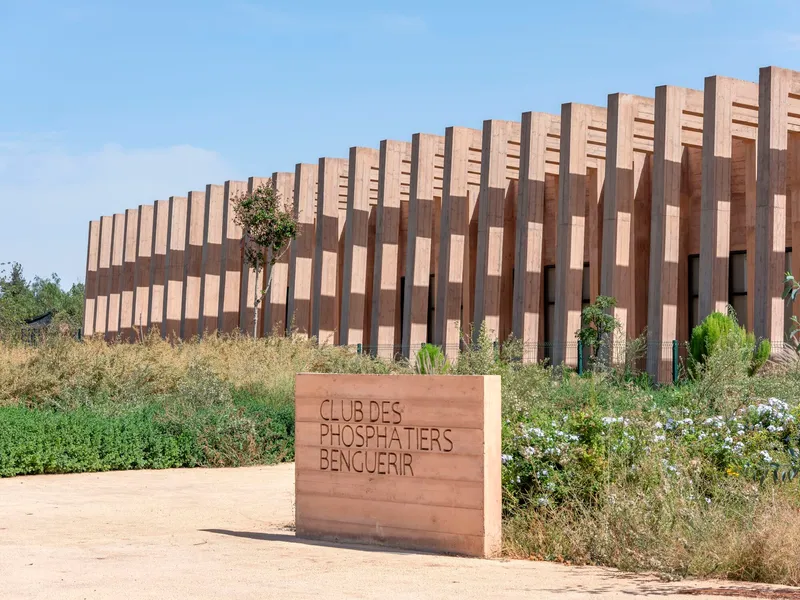
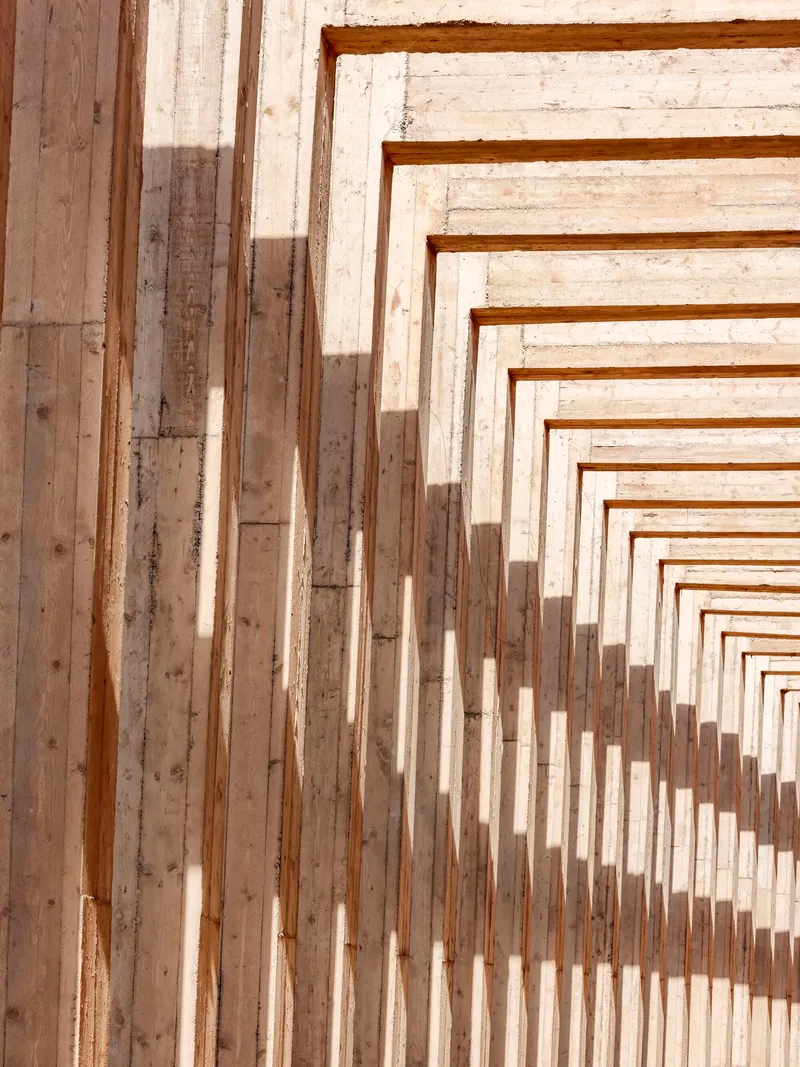
Where rammed earth provides mass and thermal inertia, timber takes on the lighter work of filtering sunlight and mediating between inside and outside. Vertical timber fin screens wrap entire facades, creating a secondary skin that reduces solar gain without eliminating views or ventilation. The fins are closely spaced but not uniform; their rhythm shifts depending on orientation and program, producing a moiré effect as you move past them.
The curved screen in image four is particularly effective: it rises above a sloping hillside planted with ornamental grasses, its gentle arc softening the otherwise rectilinear geometry. The pergola structure in image six, composed of stepped timber beams, casts a rhythmic pattern of shadow that changes with the sun's angle. These are not ornamental moves. In a climate where direct sunlight can be punishing, the quality of shade is a design parameter as critical as any structural calculation.
Landscape as Architecture

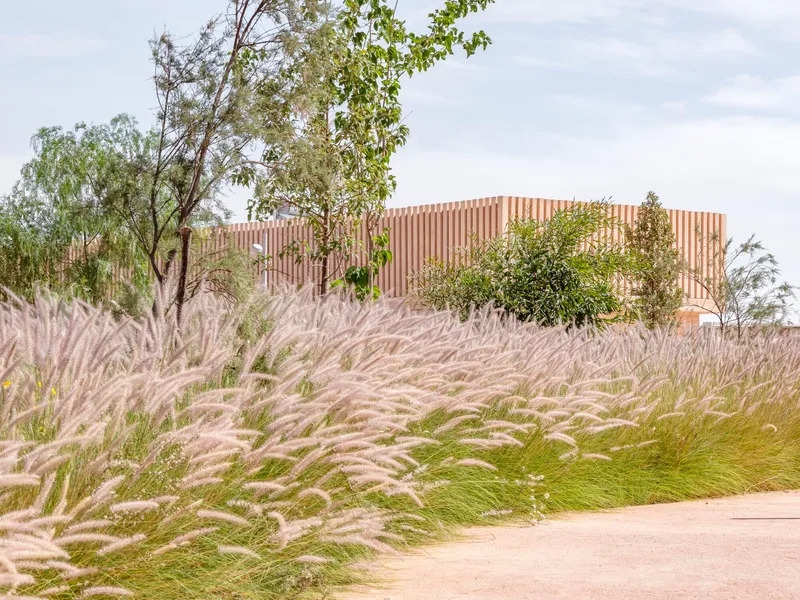
The planting strategy deserves its own discussion. Rather than importing irrigated lawns or ornamental hedges, the campus is set within meadows of native wildflowers and drought-tolerant grasses. In image one, the low horizontal volumes sit above a wildflower meadow in full summer bloom, the architecture almost receding behind a haze of color. This is a deliberate inversion of the typical sports facility, where landscape is an afterthought of parking lots and chain-link fence.
The planting serves practical purposes beyond aesthetics. Native grasses stabilize the soil, reduce dust, moderate ground-level temperatures, and require minimal irrigation. They also blur the boundary between campus and surrounding terrain, making the complex feel less like an enclave and more like a continuation of the regional landscape. For a project funded by a phosphate company in a region where industrial extraction has reshaped the ground itself, this ecological attention carries real symbolic weight.
Passages and Thresholds

The outdoor passage in image three is one of the most compelling spatial moments in the project. Narrow, framed by rammed earth walls on both sides, and punctuated by four free-standing timber columns, it creates a compressed threshold that opens to sky above. The effect is monastic: a moment of reduction before arrival. The columns do not support a roof here; they mark rhythm and scale, turning a simple corridor into a procession.
These interstitial spaces, the passages between buildings, the shaded walks, the planted gaps, are as carefully designed as the buildings themselves. They allow cross-ventilation across the campus, create microclimates of shade and breeze, and give athletes and visitors moments of transition between the intensity of training and the calm of rest. In a campus typology, the space between is often leftover. Here, it is the connective tissue that makes the whole thing work.
Plans and Drawings

The site plan reveals the organizational logic clearly: four rectangular building volumes are arranged along a curved plot boundary, their long axes roughly parallel but offset to create the outdoor passages and courtyards between them. The curve of the boundary generates the slight rotations and gaps that give the campus its informal, almost village-like character. It is a simple diagram, but the execution in material and landscape transforms it into something with real presence.
Why This Project Matters
Sports architecture tends to gravitate toward spectacle: soaring steel trusses, translucent membrane roofs, branded graphics. OUALALOU+CHOI went in the opposite direction, building a facility that prioritizes thermal performance, ecological integration, and material honesty over visual drama. The choice of rammed earth and timber in a region where concrete and steel are the default is not nostalgic. It is strategic, leveraging local materials and passive climate strategies to reduce operational costs and environmental impact over the building's lifetime.
More broadly, the project demonstrates that institutional buildings in arid climates do not have to be hermetically sealed environments battling the sun with mechanical systems. By disaggregating the program, designing shade as architecture, and embedding native planting throughout, the campus treats its harsh context as a design partner rather than an adversary. For a region undergoing rapid development, this is a model worth replicating.
Sports Campus in Ben Guerir, designed by OUALALOU+CHOI (Tarik Oualalou and Linna Choi), Ben Guerir, Morocco. 10,230 m². Completed 2023. Photography by Luc Boegly.
About the Studio
Share Your Own Work on uni.xyz
If projects like this are the kind of work you want to make, uni.xyz is a place to publish your own, find collaborators, and enter design competitions.



Popular Articles
Popular articles from the community


Hill & Cross Opera: Sculptural Opera House Architecture Shaped by Tallinn’s Landscape and Identity
Hill & Cross Opera reimagines opera house architecture in Tallinn through its sculptural hill, civic plaza, glass wave and a luminous cross.

Riyadh For All: Intergenerational Urban Design for Active Aging in Rabat
Riyadh For All reimagines urban design in Rabat with intergenerational co-living, adaptive courtyards, and Moroccan cultural exchange today.

The Earth Pod: 3D Printed Homes for Resilient Refugee Communities
The Earth Pod reimagines refugee housing through 3D printed homes made from clay, combining resilience, self-sufficiency, and rapid shelter.

Conexión: Biophilic Design Reimagines High-Rise Living in Hong Kong
Conexión reimagines high-rise living in Hong Kong through biophilic design, green facades, shared spaces, daylight, water and nature within.

Similar Reads
You might also enjoy these articles

Bao Huynh Watercolor Atelier: A Serene Art Retreat in Hội An
Bao Huynh Watercolor Atelier in Hội An blends multifunctional art spaces, sustainable design, local materials, and family-friendly living in a serene environment.

Atelier Macri Concept Store Interior Design by CASE-REAL
Atelier Macri store features a "ko" counter, walnut wood details, cork displays, blending retail, gallery, and seamless customer experiences.

Manuel Vargas Izquierdo Stadium and High-Performance Sports Center: Architectural Excellence in Jalpa de Méndez
The Manuel Vargas Izquierdo Stadium blends sustainable design, inclusive sports facilities, and cultural-inspired architecture, revitalizing Jalpa de Méndez’s public spaces.

KAKR Buluh Awar Hall: Revitalizing Community and Ecology Through Bamboo Architecture
Community built bamboo hall revitalizes Buluh Awar village, empowering youth, restoring ecology, celebrating vernacular craftsmanship through sustainable architecture and culture.


Explore Sports Center Competitions
Discover active competitions in this discipline


Challenge to design a barrier free sports center

Challenge to design an outdoor ice-rink and park


Challenge to design public laboratory
Comments (0)
Please login or sign up to add comments
No comments yet. Be the first to comment!