
Three Architects Stitch a Social Center into a Crumbling Galician Hamlet
In Muimenta, Spain, timber and plywood volumes graft onto granite ruins to anchor a rural revitalization effort.


Rural Galicia is full of hamlets slowly losing their grip on habitation. Stone walls stand open to the sky, roofs cave in, and the population drifts toward regional capitals. Muimenta, a small village in the municipality of Carballeda de Avia, follows that pattern. So when the local council launched a revitalization plan, the question was not what program to insert but how to insert it without pretending the decay never happened. The answer, designed by Eduardo Dipre Mazza, Daniel Gomez Magide, and Miguel Angel Diaz Gonzalez, is a 214 square meter social center that occupies, extends, and frankly borrows from the ruins already on site.
What makes the project worth studying is the directness of its material strategy. Weathered granite stays weathered. New volumes arrive in pale timber cladding and plywood, making no attempt to mimic the stone but accepting its discipline of scale, roof pitch, and courtyard enclosure. The result is a compound that reads as one place with two ages, neither dominating the other.
Grafting onto Granite


The architects treat the existing stone walls less as heritage relics and more as infrastructure. Granite walls that once enclosed barns and storerooms now serve as lateral supports, thermal buffers, and, most importantly, compositional anchors for the new timber volumes. The junction between old and new is legible at every corner: pale vertical siding meets rough coursed masonry with a thin shadow gap, letting each material breathe.
An arched doorway survives in one ruin, framing views through the new structure beyond it. The gesture is simple but effective. It turns a fragment into a threshold and reminds you that architecture here did not begin in 2025.
The Courtyard as Organizing Device

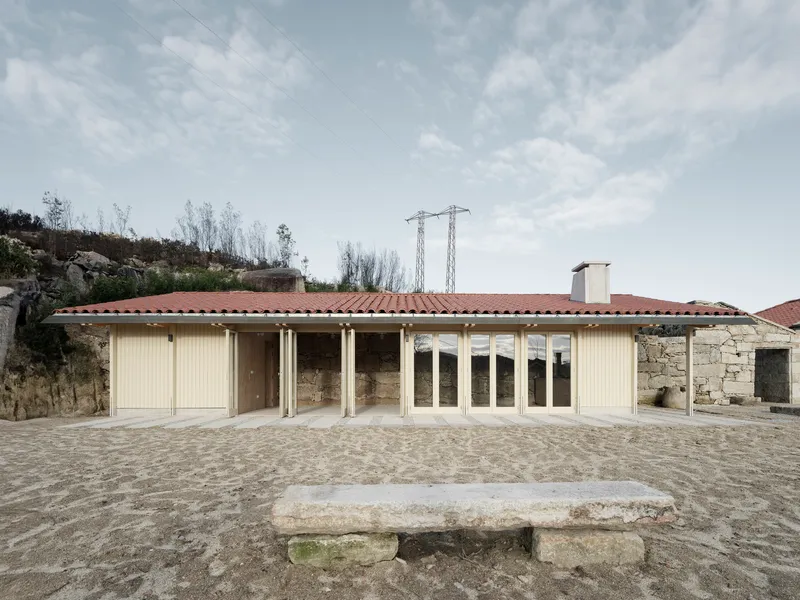

Galician vernacular architecture clusters around courtyards and shared walls. The social center follows that logic. A gravel courtyard sits between the surviving stone barn ruins and a new timber-framed pavilion, creating an outdoor room that can host gatherings, markets, or simply a place to stand out of the rain. Stone paving extends from the courtyard beneath the new volumes, blurring the line between inside and outside.
A concrete portal frame marks the transition from the public courtyard into the path between the old walls. It is one of the few gestures in a different material register, and it works precisely because it is restrained: a single structural element that signals passage without competing for attention.
Landscape Perch


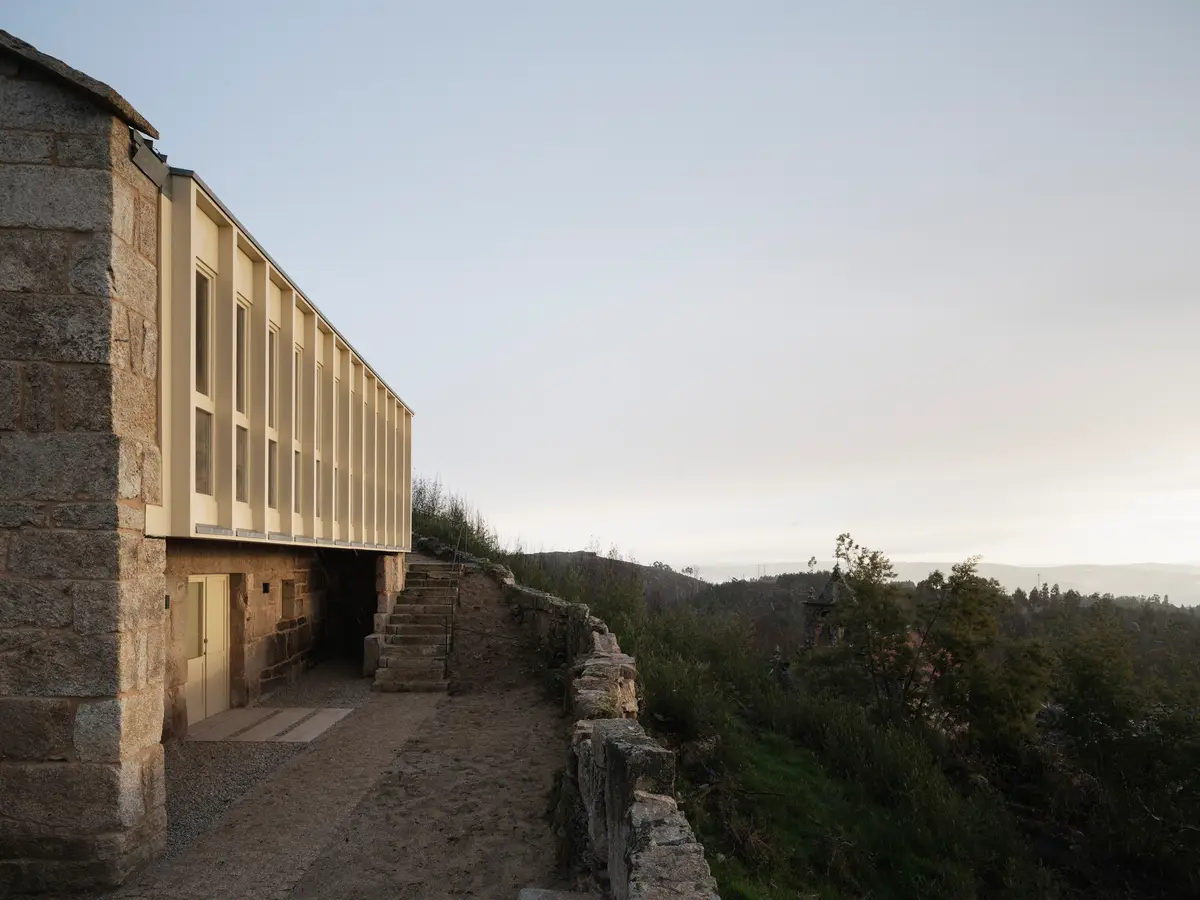
Muimenta sits on a hillside, and the architects exploit that topography. One volume cantilevers over the slope, its illuminated facade of vertical timber panels becoming a lantern for the village at dusk. A stone staircase with a minimal steel railing climbs the grade beneath this cantilever, connecting the lower landscape to the social center above. The move is pragmatic and scenic at once: it provides accessible circulation while giving the building a presence from the valley below.
The wider context, visible in the overcast panorama of terracotta roofs against forested hills, confirms that the building does not try to stand out. Its roofline matches the village pitch. Its footprint fits within the existing pattern of walls and paths. The cantilever is confident but not exhibitionist.
Timber and Plywood Interiors


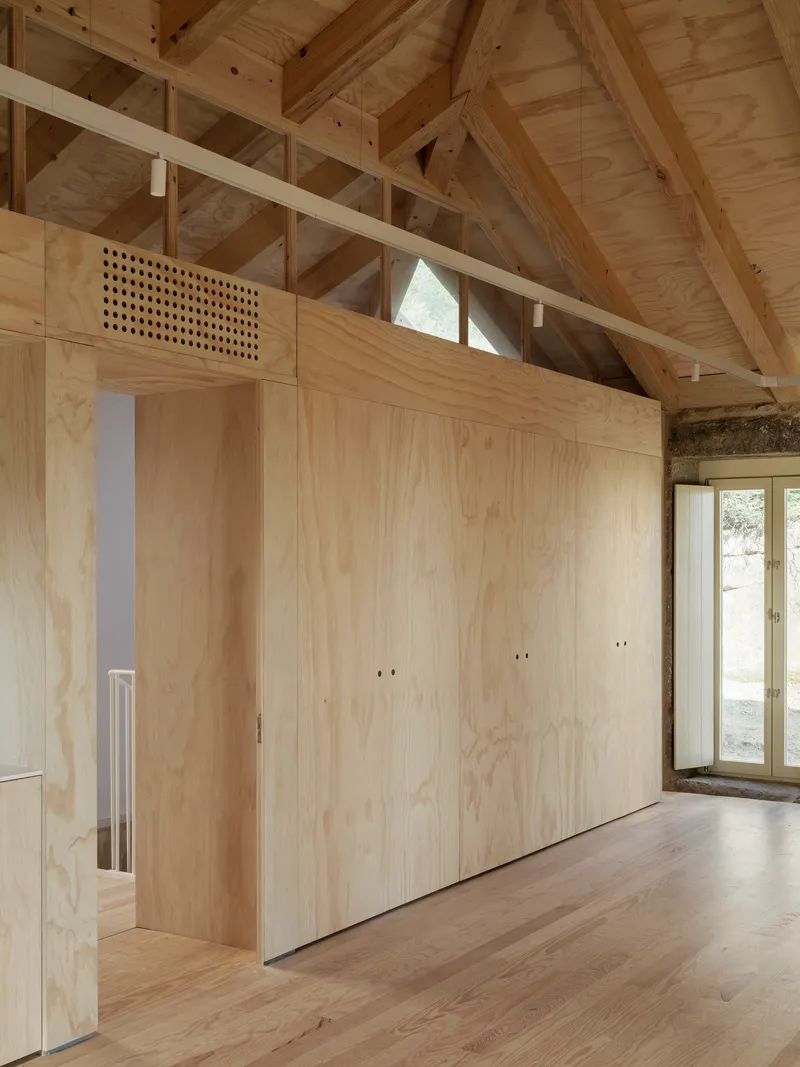
Inside, plywood does most of the heavy lifting. Cabinetry, partitions, and shelving are all built from the same pale boards, creating a warm, uniform envelope that contrasts with the exposed granite wall retained at the kitchen. Perforated ventilation grills integrated into the plywood partitions keep the air moving without adding mechanical clutter, a detail that reflects the project's modest budget and rural practicality.
Exposed timber beams and rafters are left unfinished overhead, keeping the structural logic visible throughout. The aesthetic is honest and dry: no suspended ceilings, no drywall returns, just material doing its job.
Light, Corridors, and Vertical Circulation
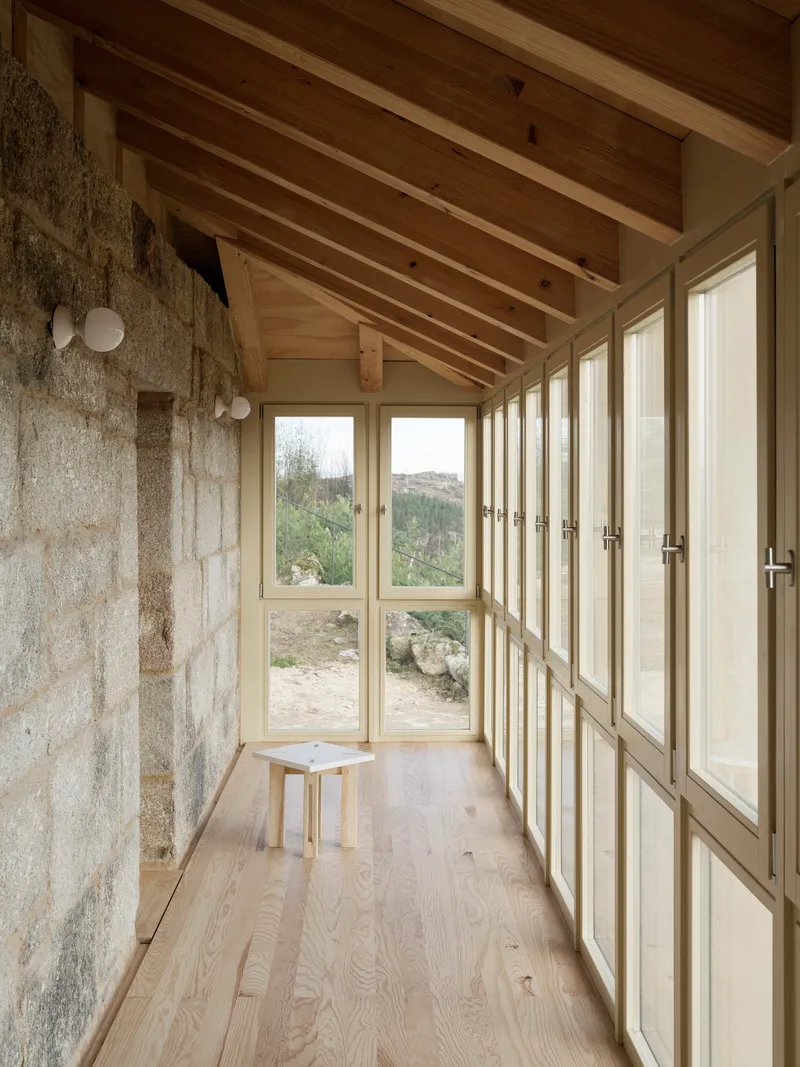
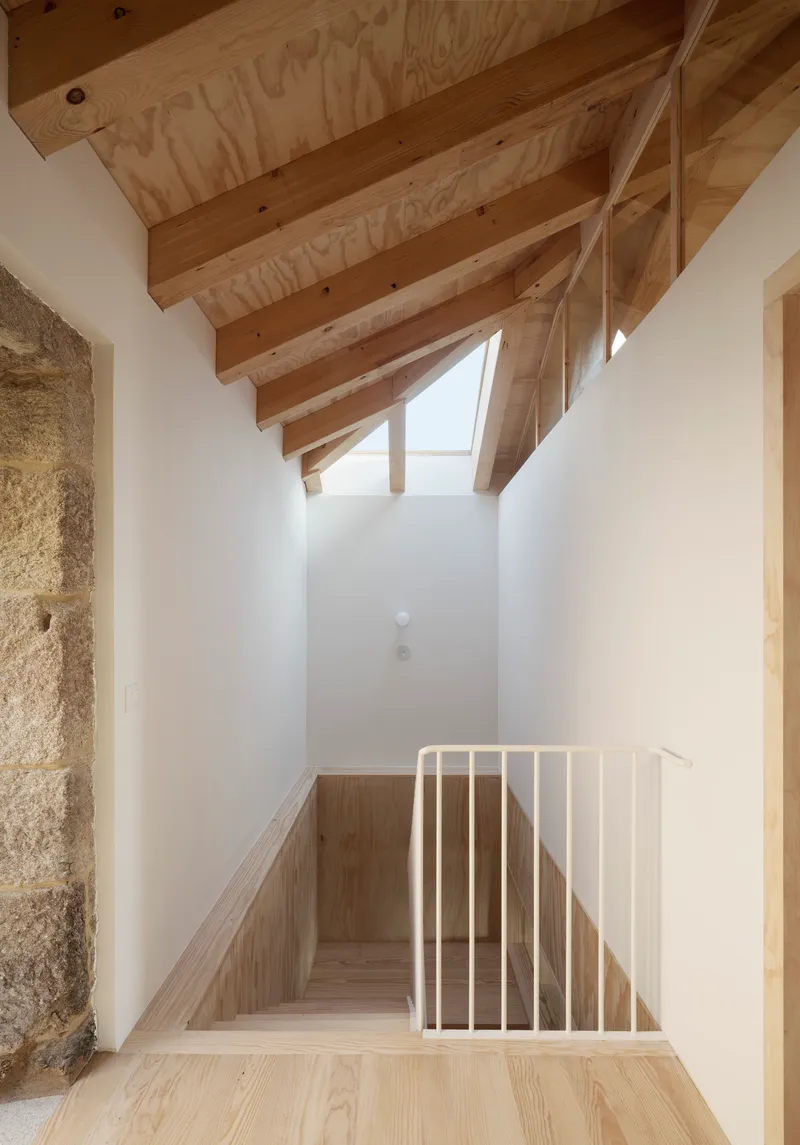
A narrow glazed corridor runs along the stone wall, offering views over the landscape through floor-to-ceiling glass while keeping you in physical contact with the granite. The corridor doubles as a gallery and a thermal buffer, capturing low winter sun against the stone mass.
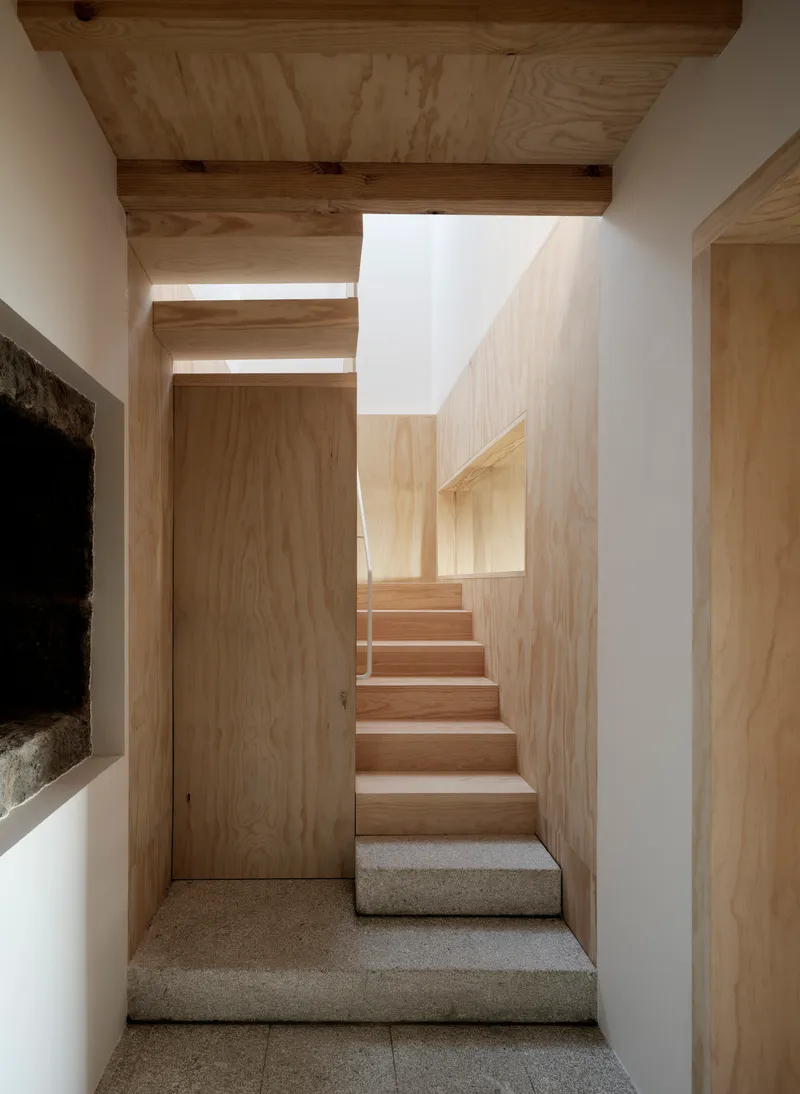
Vertical circulation is handled with equal care. A staircase climbs through white plaster walls beneath a skylight, pulling daylight deep into the section. The combination of the timber and concrete stair treads with the bright shaft above gives the ascent a quality that belies the building's compact footprint. A corner window framed by exposed stone and plywood cabinetry delivers the kind of composed interior moment that only comes from thinking hard about where light enters.
Roofscape and Detail

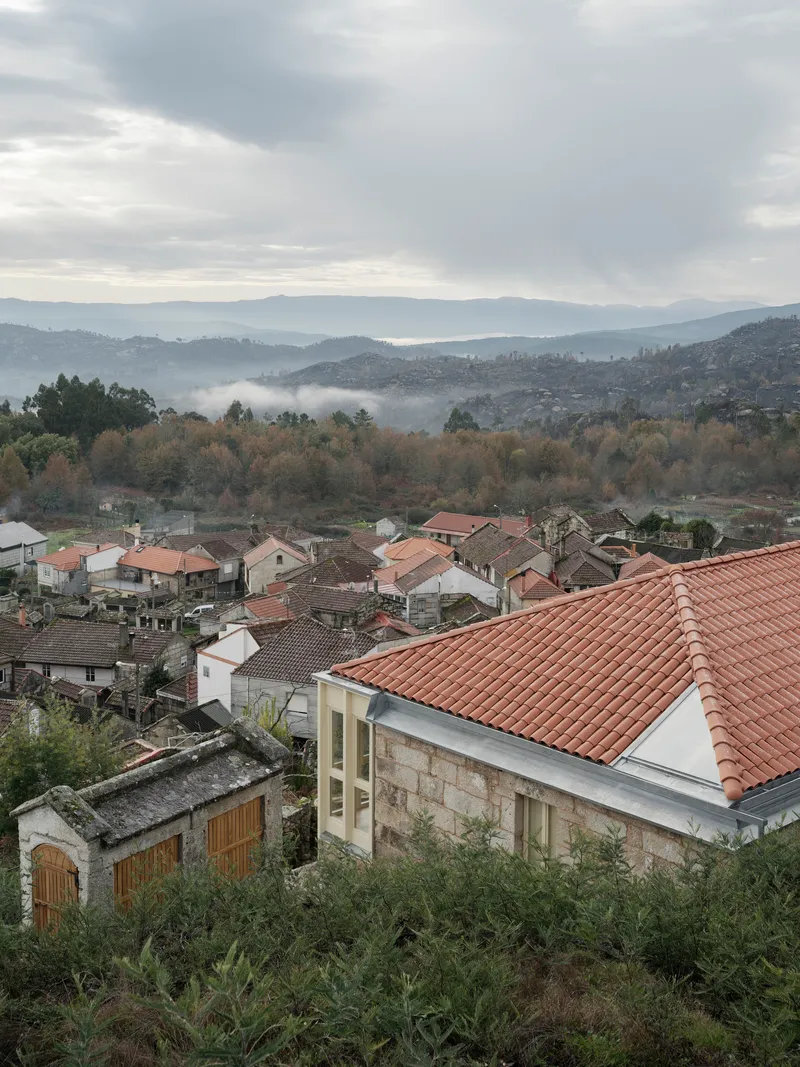

Terracotta tiles cap everything. The eave detail, where timber rafters meet vertical panel cladding beneath a row of clay tiles, demonstrates the architects' commitment to local roofing conventions without slavish imitation. The overhangs are generous enough to protect the timber cladding from Galicia's abundant rain, and the tile profile matches the surrounding village houses.
Seen from a distance, the social center's roofline dissolves into the existing village fabric. That is the point: a building that serves the community should look like it belongs to the community.
Plans and Drawings

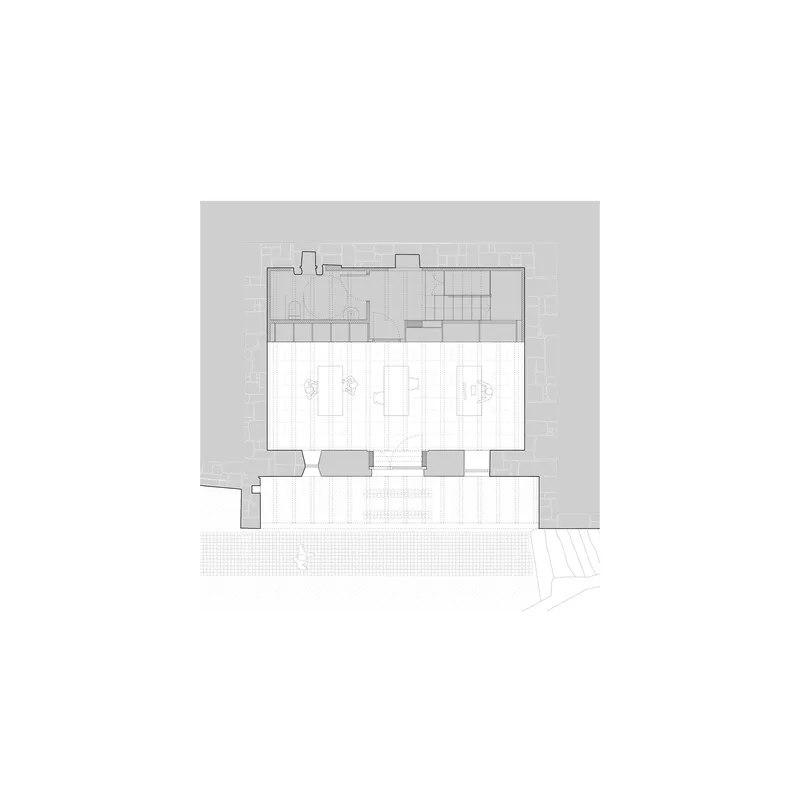

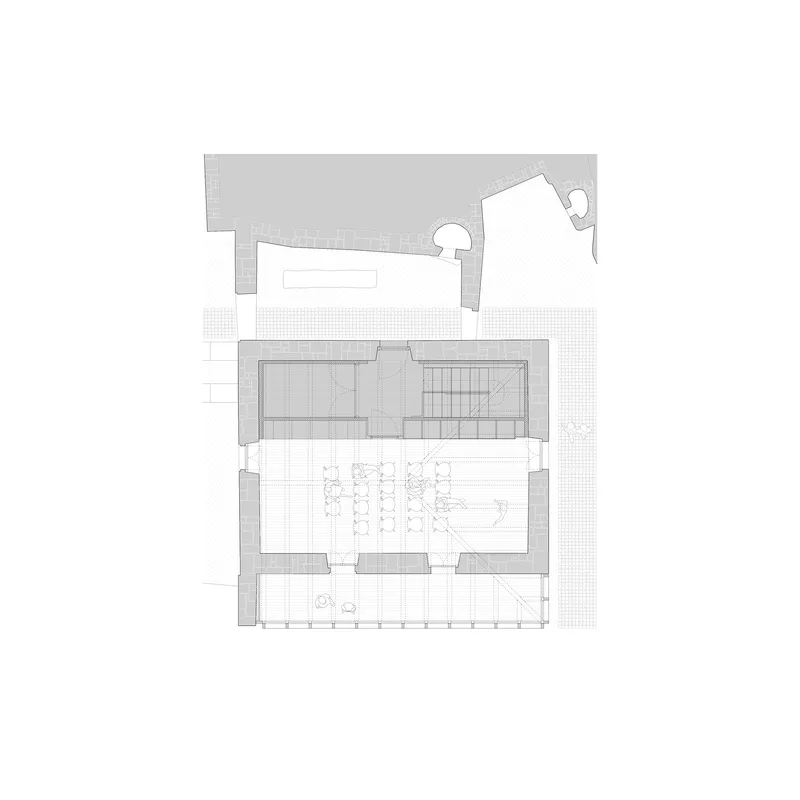
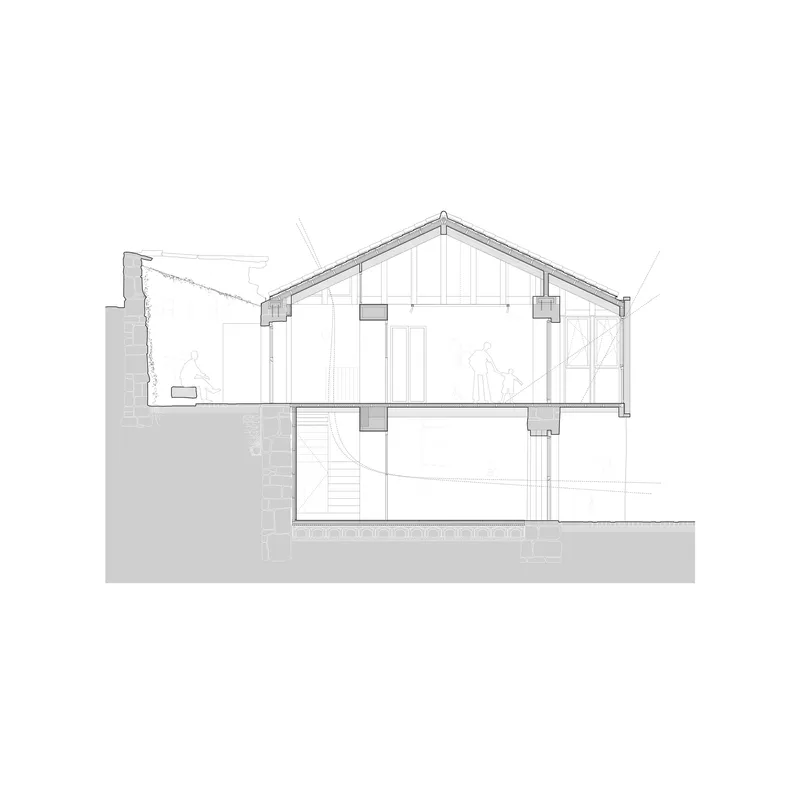
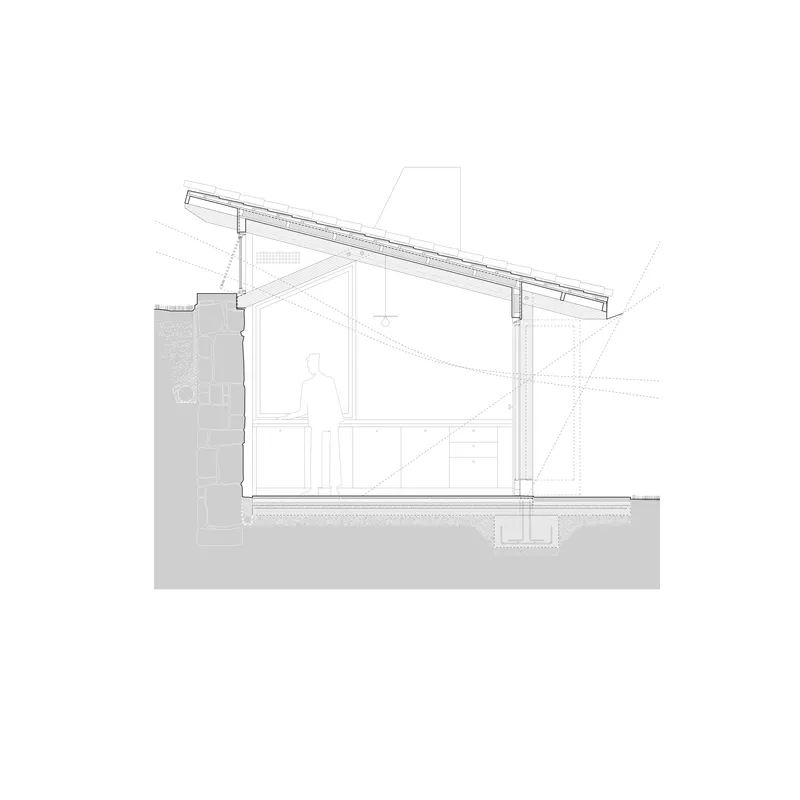
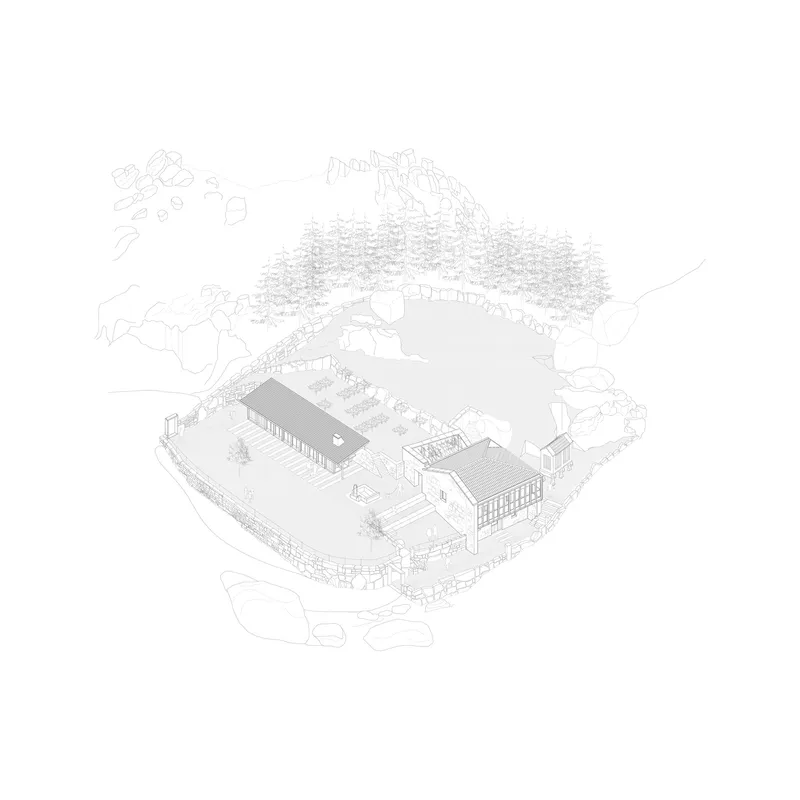
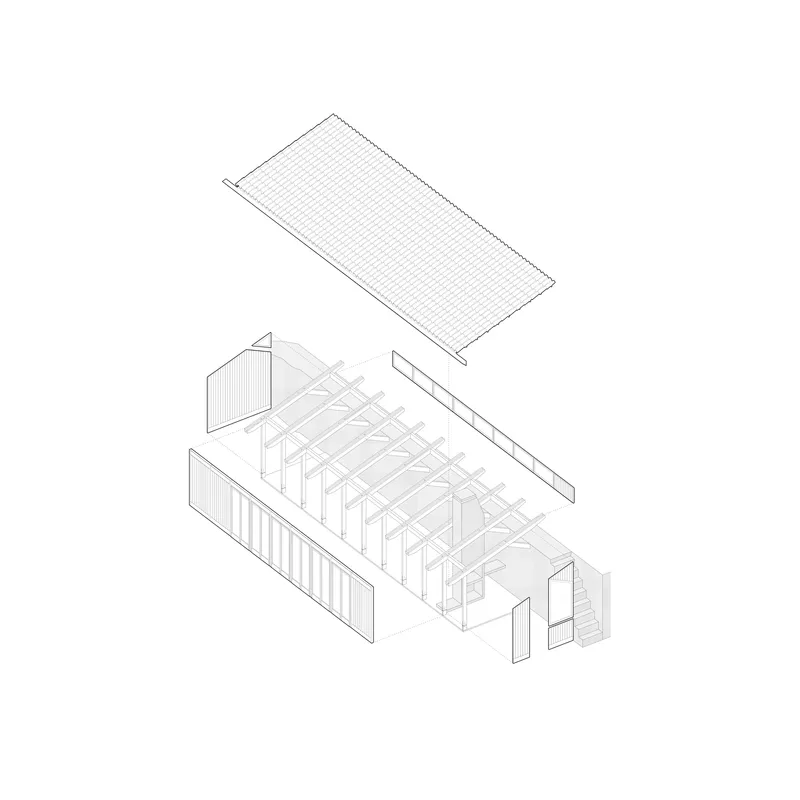

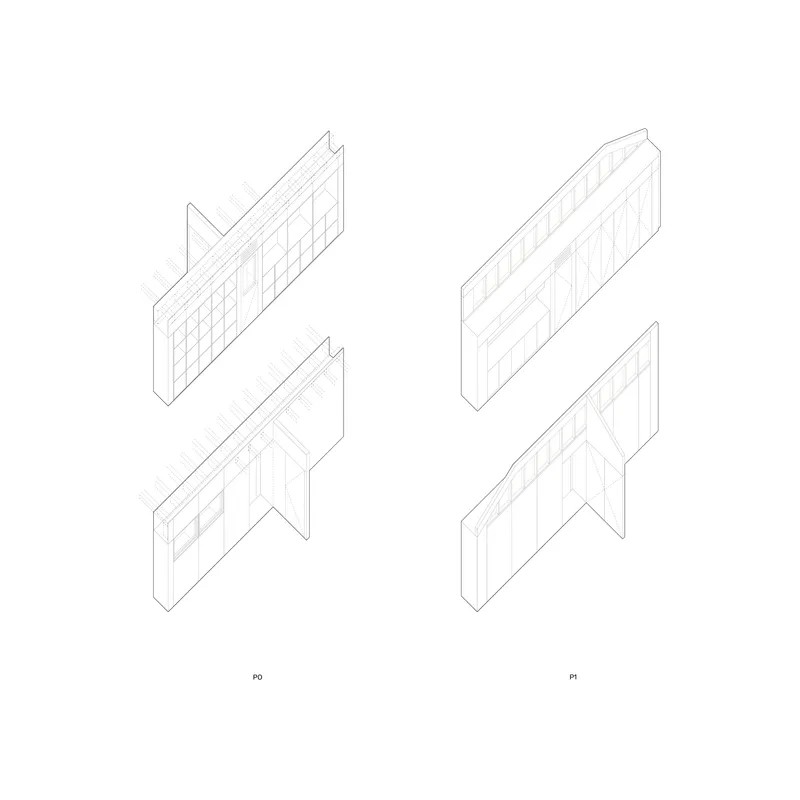

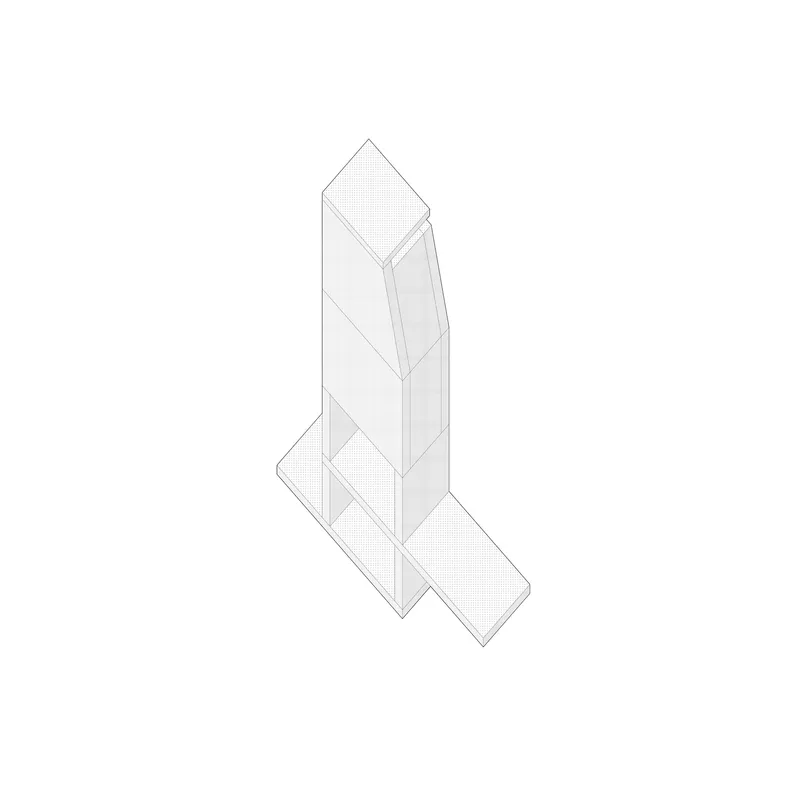
The site plan reveals just how embedded the project is within Muimenta's existing network of roads and property walls. The building is not a freestanding object; it completes a block. Floor plans show a compact rectangular volume organized around the courtyard, with stairs threading between levels to navigate the hillside grade change. The sections confirm a two-story structure with a basement level carved into the slope and a pitched roof that keeps headroom where it counts.
The exploded axonometric drawings are particularly instructive. They break the building into its constituent systems: roof plane, structural timber frame, and vertical cladding panels, each drawn separately so you can understand the assembly logic. A set of isometric wall panel studies shows four variations of opening and joint configuration, revealing the modular thinking behind what appears, from the outside, to be a simple timber skin. The red-highlighted roof framing axonometric makes clear how the new timber structure negotiates with the adjacent stone volumes, sharing walls where possible and spanning independently where necessary.
Why This Project Matters
Rural revitalization projects in Spain often fall into two traps: either they fetishize the ruin as a picturesque object, freezing it behind glass, or they bulldoze everything and build something that could be anywhere. The Muimenta Social Center avoids both. It treats the existing granite fabric as a collaborator rather than a monument, grafting new timber volumes onto old walls with a clarity that respects both the past and the present. The material palette is narrow, the budget evidently tight, and the ambitions appropriately scaled to a village that needs a gathering place, not a spectacle.
The collaboration between Eduardo Dipre Mazza, Daniel Gomez Magide, and Miguel Angel Diaz Gonzalez produces architecture that is quiet without being timid. Every decision, from the cantilevered facade to the perforated plywood vents, serves a practical purpose while contributing to a coherent whole. If rural communities across Galicia and beyond are going to survive, they will need more buildings like this one: modest in size, precise in execution, and genuinely committed to the places they inhabit.
Muimenta Social Center, designed by Eduardo Dipre Mazza, Daniel Gomez Magide, and Miguel Angel Diaz Gonzalez. Muimenta, Spain. 214 m². Completed 2025. Photography by Luis Diaz Diaz.
About the Studio
Share Your Own Work on uni.xyz
If projects like this are the kind of work you want to make, uni.xyz is a place to publish your own, find collaborators, and enter design competitions.


Popular Articles
Popular articles from the community


Manzana Morphosis: Stretching Barcelona's Grid into a Living Landscape for 2050
A radical reworking of the Eixample manzana turns density into a tool for generous public space, vertical ecology, and environmental performance.

Opera by the Sea Estonia: Three Shells Dissolving Architecture into Tallinn's Coastline
A winning opera house proposal replaces monumental form with interconnected shells that blur the boundary between building, park and Baltic Sea.

Temporary Home for Dogs: A Reversed Zoo Rethinks Animal Shelter Architecture
In Bucharest, a sinuous corridor and freed landscape flip the logic of containment, designing a shelter that works to make itself unnecessary.

Extended Shell: Retrofitting Kolkata's Balconies as Living Urban Thresholds
A modular retrofit system recovers the social and environmental intelligence of Kolkata's historic verandas for contemporary Park Street residents.

Similar Reads
You might also enjoy these articles

Pixel Gardens: One Repeated Module Stacked Into a Terraced Social Housing Tower for Famagusta
Salem Bader's shortlisted housing tower builds a vertical neighbourhood from one repeated module, offsetting units to carve terraces, light and air.

Bao Huynh Watercolor Atelier: A Serene Art Retreat in Hội An
Bao Huynh Watercolor Atelier in Hội An blends multifunctional art spaces, sustainable design, local materials, and family-friendly living in a serene environment.

Atelier Macri Concept Store Interior Design by CASE-REAL
Atelier Macri store features a "ko" counter, walnut wood details, cork displays, blending retail, gallery, and seamless customer experiences.

Manuel Vargas Izquierdo Stadium and High-Performance Sports Center: Architectural Excellence in Jalpa de Méndez
The Manuel Vargas Izquierdo Stadium blends sustainable design, inclusive sports facilities, and cultural-inspired architecture, revitalizing Jalpa de Méndez’s public spaces.

Comments (0)
Please login or sign up to add comments
No comments yet. Be the first to comment!