

Rojkind Arquitectos and Think Parametric Build a Glueless Pavilion from 67 Interlocking Panels
A serpentine fiber-cement installation in Chapultepec Park celebrates a decade of architectural media in Mexico City.


Sixty-seven panels of autoclaved fiber-cement, no glue, no fasteners, just interlocking geometry. That is the entire material bill for this temporary installation by Rojkind Arquitectos and Think Parametric, erected on the rooftop terrace of the LAGO/ALGO restaurant in Mexico City's Bosque de Chapultepec, an 810-hectare urban park that remains one of the largest in the Western Hemisphere. The pavilion was commissioned to mark a tenth-anniversary celebration, and rather than producing something disposable, the two studios delivered a modular serpentine wall that could, in principle, be disassembled and reassembled elsewhere without leaving so much as a screw hole behind.
What makes the project worth examining is not its occasion but its method. The curved form, which reads in plan as a horseshoe wrapping an intimate courtyard, references the serpent as a Mesoamerican symbol of cyclical time and unity. More practically, the staggered, pixelated surface of Cempanel boards updates a longstanding Mexican tradition of lattice screens, filtering light and air through a wall that never fully closes. Design team members Michel Rojkind, Arie-Willem Hendrik de Jongh, Rodrigo Medina, Diego Lezama, and León Villegas treated the pavilion as a proof of concept: parametric design driving analog assembly.
Serpentine Geometry After Dark
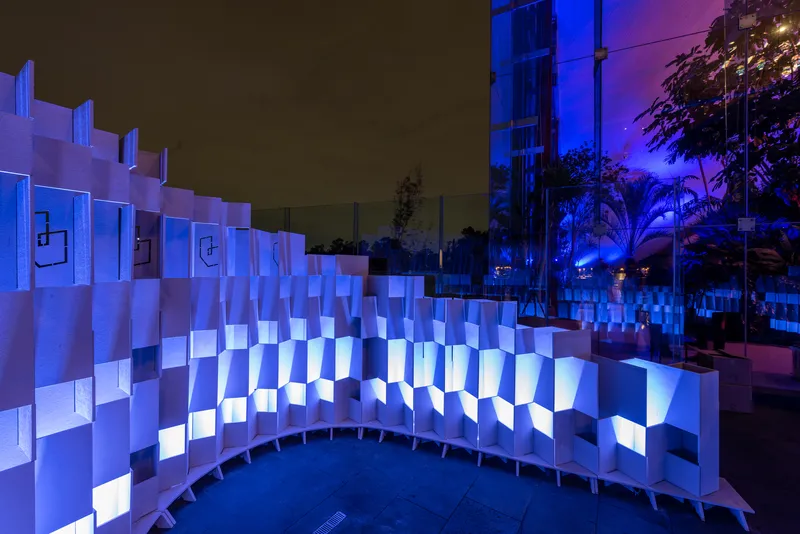
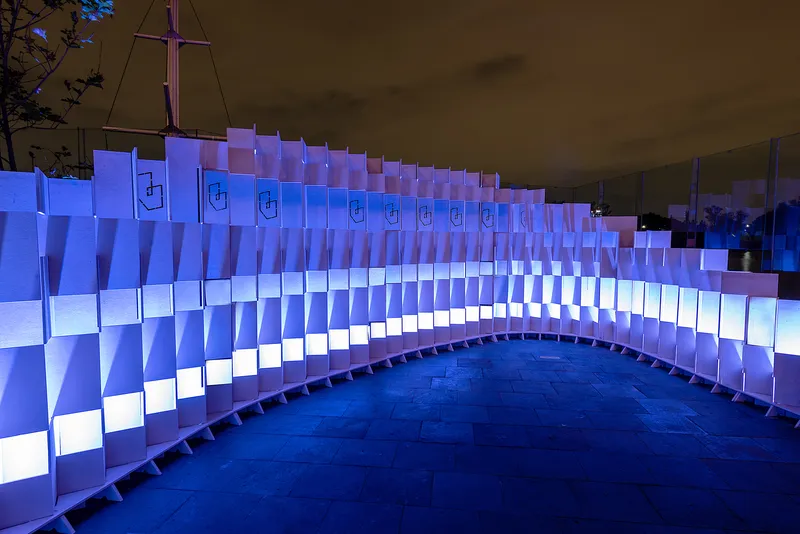
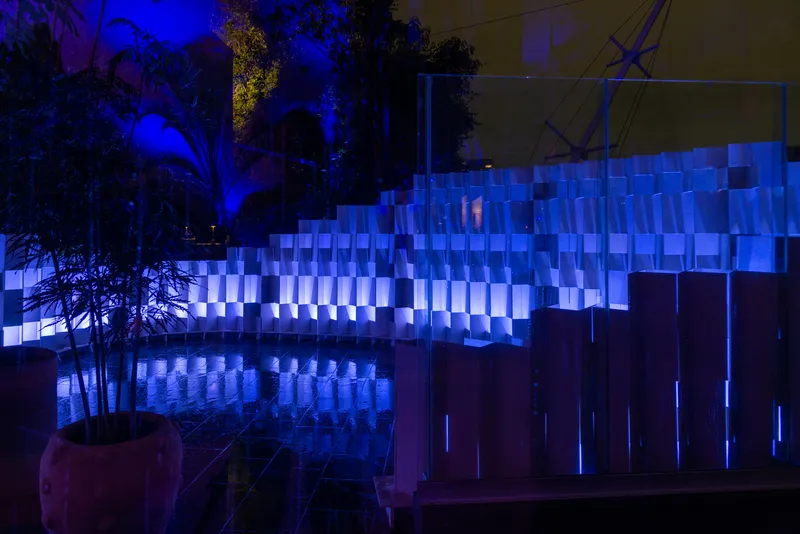
The pavilion's most arresting identity emerges at night. Blue and violet uplighting, designed by Luz en Arquitectura and Kai Diedrerichsen of Factor Eficiencia, transforms the matte gray cement panels into a luminous screen. The light bleeds through the gaps between staggered modules, turning the entire wall into a lantern that registers its own constructive logic. In the adjacent pond, the curved form doubles itself in reflection, extending the installation's footprint without adding a single extra panel.
The color temperature shifts throughout the evening, moving from cool blue to warmer violet, which keeps the installation from reading as static scenography. Light here does real architectural work: it reveals the depth of each module's offset and clarifies the serpentine plan for anyone approaching from across the water.
The Courtyard as Gathering Space


Step inside the horseshoe and the pavilion becomes something else entirely: a courtyard. Potted trees break up the floor plane, and the curved wall acts as a continuous bench and backdrop. From the overhead views, you can see how the geometry channels foot traffic inward, creating an almost amphitheatrical enclosure that encourages mingling rather than linear circulation. The backlit folded seating integrated into the wall's inner face gives visitors a reason to linger.
For an event pavilion, this spatial generosity matters. Most temporary installations privilege the exterior image at the expense of the interior experience. Here, the inside is arguably the stronger condition, a sheltered clearing framed by the rhythmic texture of cement panels and softened by planting. The violet evening light washes the courtyard without flooding it, keeping the atmosphere intimate even when crowds gather.
Sixty-Seven Parts, Zero Adhesives

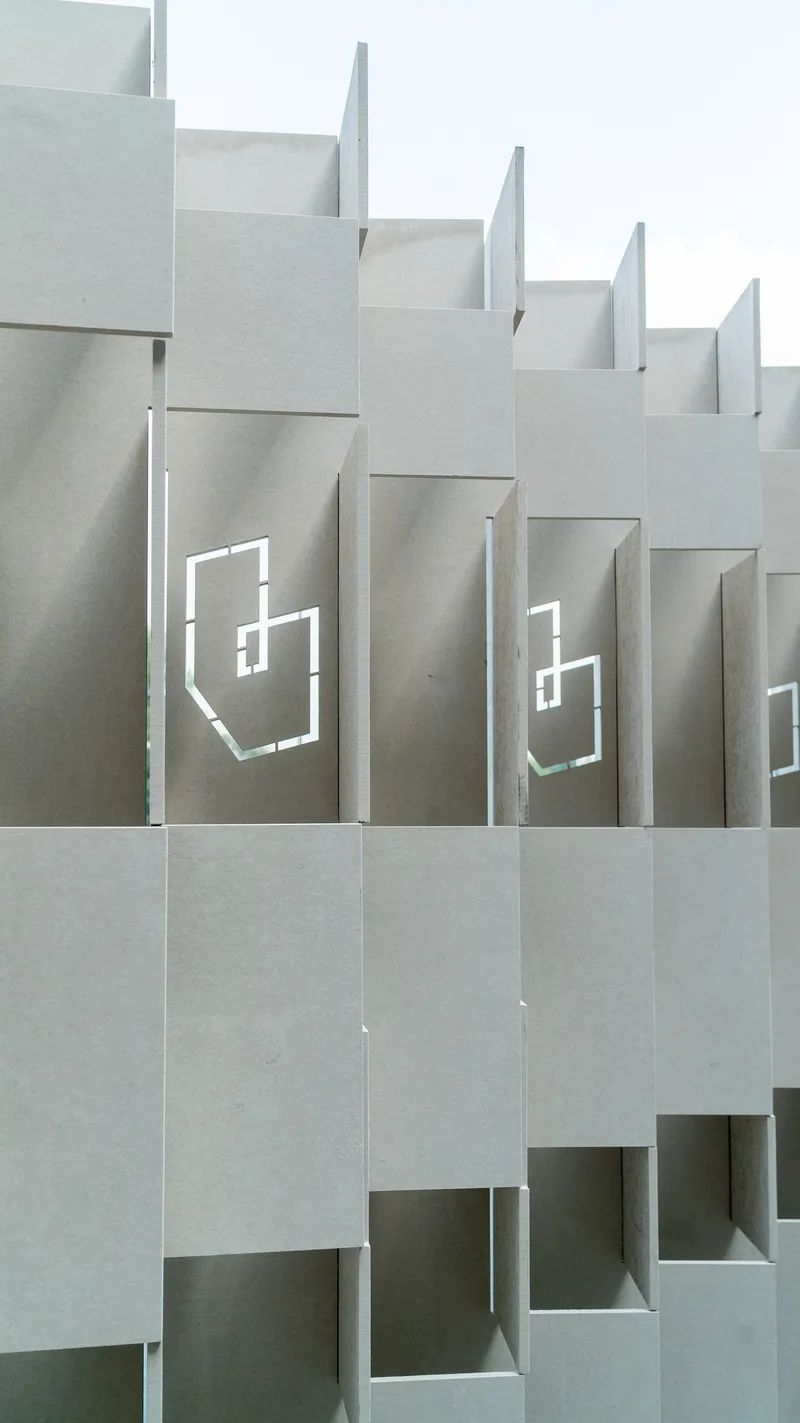
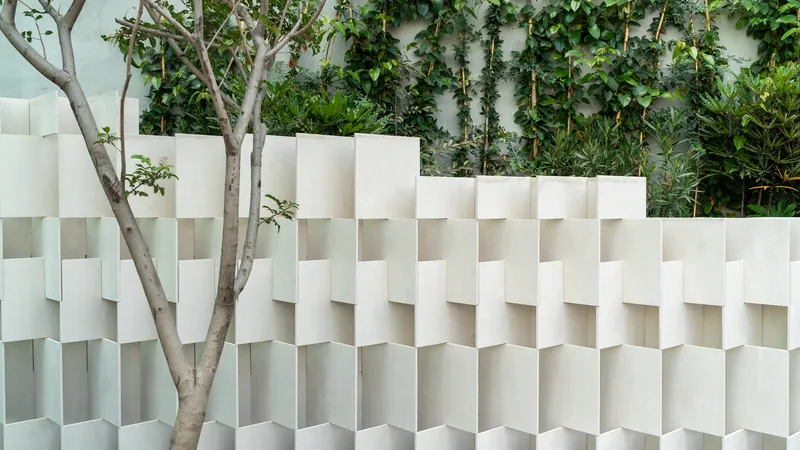
In daylight the installation reveals its construction frankly. Each module is a Cempanel unit, autoclaved fiber-cement that is lightweight, weather-resistant, and cheap enough for a temporary program. The modules interlock through their own geometry, stacking and stepping without glue, screws, or bolts. Geometric logo cutouts punched into select panels add legibility to the wall and act as apertures that frame views through the screen.
The decision to eliminate all fasteners is not just an aesthetic conceit. It turns the pavilion into a fully reversible assembly, closer in spirit to a dry-stacked stone wall than to conventional panelized construction. For a discipline increasingly concerned with material reuse and circular economies, this is a small but pointed demonstration: parametric computation can serve disassembly just as readily as it serves complex form.
Lattice Tradition, Parametric Means


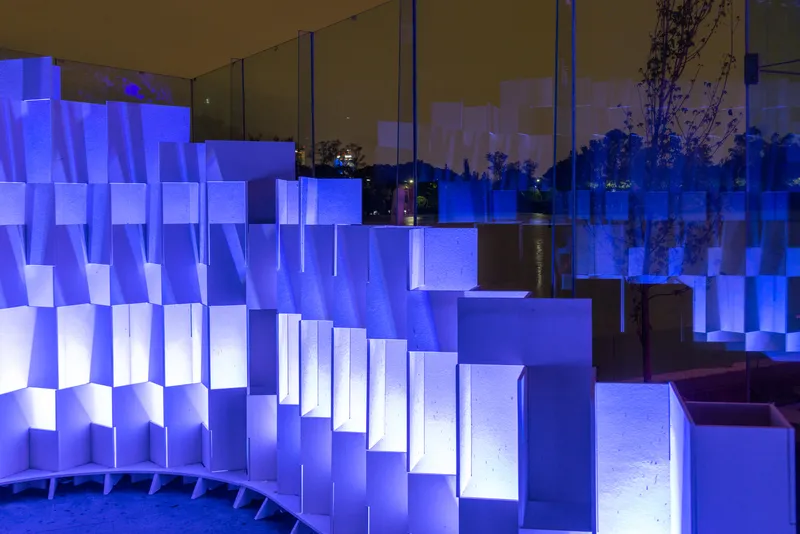
Mexico has a deep tradition of celosías, lattice walls that regulate light, ventilation, and privacy. The pavilion's alternating solid and void panels pay direct homage to that lineage, but the curve and the staggered heights introduce a variability that would be difficult to achieve with repetitive masonry units. Think Parametric's contribution is legible here: the wall's surface reads as a pixelated gradient, dense in some zones and porous in others, tuned to views and wind direction.
Climbing vines trained against the terrace wall behind the installation blur the boundary between landscape and object. This is a smart contextual move. Chapultepec is, above all, a park, and the pavilion earns its place on the LAGO/ALGO terrace by behaving more like a garden folly than a corporate event structure.
Night Canopy and Water


Seen from a distance, the pavilion sits beneath the glazed canopy of the restaurant terrace, and the two structures enter into a visual dialogue. The glass roof catches and refracts the colored lighting, creating a secondary glow that extends the installation's presence well beyond its physical footprint. The pond, the glass, and the cement panels form three registers of reflection, each at a different scale and fidelity.
The overhead shot is particularly revealing. The horseshoe plan describes a clear figure on the terrace, and the palm trees rising above the wall tie the composition to the surrounding parkland. It is a reminder that temporary installations succeed or fail based on how well they read at the scale of the site, not just the scale of the selfie.
Plans and Drawings


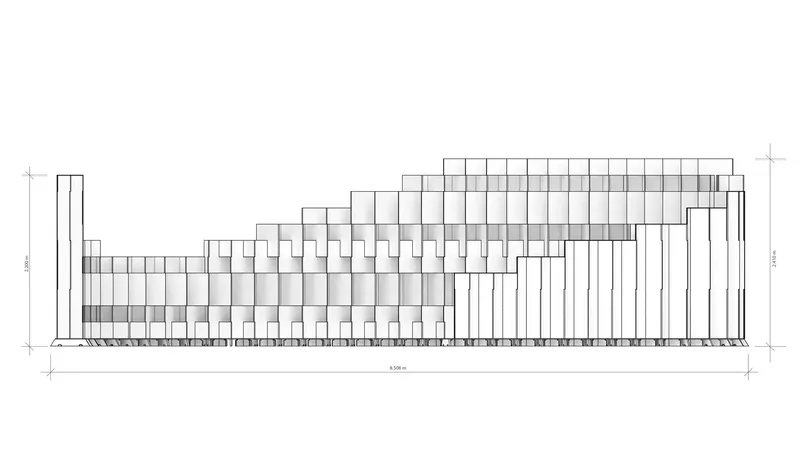

The exploded axonometric is the most instructive drawing in the set. It isolates a single wall segment, showing how each panel slots onto a base plate, how spotlights nest between modules, and how the stagger is calibrated to produce the pixelated surface. The elevations confirm that no two adjacent panels share the same height, a quiet complexity that would be invisible without the drawing.
The plan drawing with radii dimensions makes the horseshoe geometry explicit. The curve is not freeform; it is composed of arcs with precise radii, which explains why 67 unique-seeming parts can still be organized into a manageable fabrication logic. The surrounding site context, pond, terrace edge, planting zones, shows how tightly the installation was tailored to its specific location on the LAGO/ALGO rooftop.
Why This Project Matters
Temporary pavilions are often treated as disposable spectacles, impressive for an evening and landfill by the following month. Rojkind Arquitectos and Think Parametric resist that trajectory by designing an assembly that is materially honest, structurally reversible, and culturally grounded. The interlocking Cempanel system is not a gimmick; it is a constructive argument for how parametric tools can serve sustainability rather than merely complexity. The serpent metaphor, cyclical time, renewal, is neatly enacted by the pavilion's own capacity for disassembly and reuse.
More broadly, the project demonstrates that collaboration between a design-driven architecture office and a parametric consultancy can produce work that is legible and generous, not just computationally sophisticated. The courtyard works. The lighting works. The lattice tradition is honored without being sentimentalized. For a celebration that could easily have produced a forgettable stage set, this pavilion leaves behind a more useful legacy: a method.
ArchDaily X Pavilion, designed by Rojkind Arquitectos and Think Parametric. Ciudad de México, Mexico. Completed in 2022. Photography by Jaime Navarro.
About the Studio
Share Your Own Work on uni.xyz
If projects like this are the kind of work you want to make, uni.xyz is a place to publish your own, find collaborators, and enter design competitions.


Popular Articles
Popular articles from the community


LT2A and OPEN Architectes Thread a Brick and Glass High School Through a Wooded Belgian Campus
In Braine-l'Alleud, a 3,000 m² wing for Collège Cardinal Mercier pairs pale brick with a glazed colonnade, deferring to a small chapel and a dense wood.

David Ortega Stacks a Two-Story Mexico City Penthouse Around a Steel Stair and a Pergola-Shaded Roof Terrace
In Colonia Roma, a 300 m² penthouse uses oak joinery, a planted steel stair and a slatted roof pergola to make a new-build apartment feel like a house.

Jaramillo Van Sluys Arquitectura and Urbanismo Turn a Demolished Registry Lot in Quito into an Orchard Plaza
In Quito's Centro Histórico, a 2,800 m² plaza exposes the San Agustín convent wall and redraws its lost Augustinian orchard in volcanic stone.

David Macias Steps a Doorless Stone and Plaster House Down a Tropical Colombian Hillside
In the humid hills of Colombia, Threshold House replaces the front door with an open void and terraces its 850 m² down the slope instead of fighting it.

Similar Reads
You might also enjoy these articles


LAVA Architecten Gives Vocational Education a Sawtooth-Roofed Face on a Mechelen School Campus
In Mechelen, Belgium, a 2,053 m² STEM school on a 6×6 m grid turns workshops and classrooms into rooms that can be rearranged as teaching changes.

KEMA Studio Turns a Derelict Marvila Attic into a 60 m² Lighthouse Apartment Above Lisbon
In Lisbon's Marvila district, a rebuilt roof, four skylights and two plywood volumes turn an unlivable attic into a bright home facing the Tagus.

Pixel Gardens: One Repeated Module Stacked Into a Terraced Social Housing Tower for Famagusta
Salem Bader's shortlisted housing tower builds a vertical neighbourhood from one repeated module, offsetting units to carve terraces, light and air.

Bao Huynh Watercolor Atelier: A Serene Art Retreat in Hội An
Bao Huynh Watercolor Atelier in Hội An blends multifunctional art spaces, sustainable design, local materials, and family-friendly living in a serene environment.

Explore Pavilion Competitions
Discover active competitions in this discipline

Challenge to design a portable theatre

Challenge to design a portable music platform

Challenge to design an open learning module for the elderly
Comments (0)
Please login or sign up to add comments
No comments yet. Be the first to comment!